
Our picks in this guide
Compare the models in this guide
See today’s price, delivery options and customer reviews on Amazon.
As an Amazon Associate, I earn from qualifying purchases.In this article 9 sections
Your phone lights up: "Hurricane Watch". Later: "Hurricane Warning". They sound almost the same, but they tell you very different things about time. One says "get ready", the other says "your preparations should be done". Here is what every hurricane alert from the National Weather Service means, how much time each one gives you, and what to do when you get it.
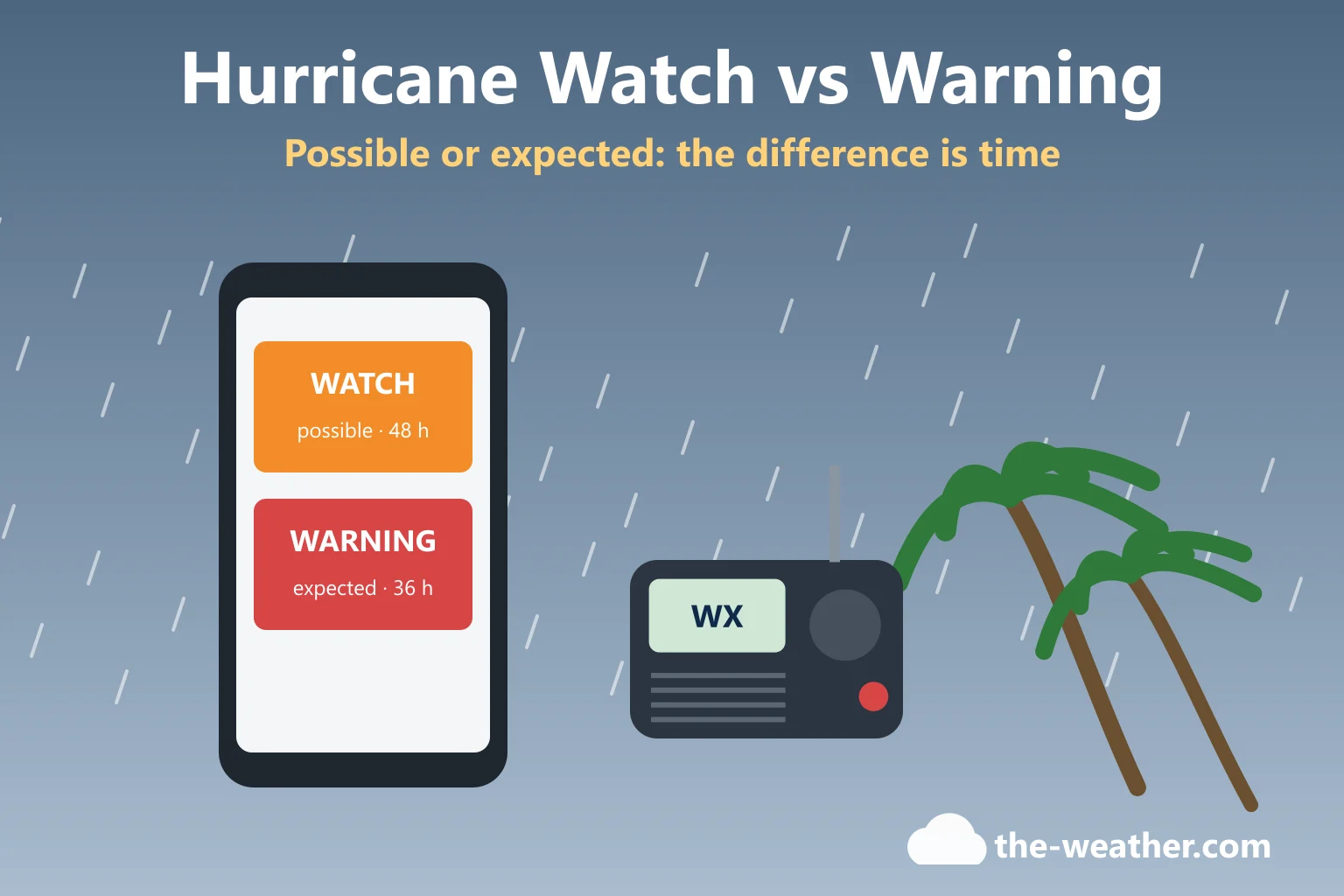
Short answer: a hurricane watch means hurricane conditions (sustained winds of 74 mph or more) are possible in your area; the National Hurricane Center issues it 48 hours before it expects tropical storm-force winds. A hurricane warning means hurricane conditions are expected; it is issued 36 hours before tropical storm-force winds, and by then "all preparations should be complete" (National Weather Service). Storm surge has its own watch and warning on the same 48 and 36 hour pattern.
Editorial Research
- Written by
- Lena Thornton, Weather Station Analyst & CWOP Contributor
- Based on
- The National Weather Service page on hurricane and tropical storm watches, warnings, advisories and outlooks, the National Hurricane Center glossary, Ready.gov, and Midland's product page and owner's manual for the ER40
- Hands-on testing
- Not performed by The-Weather.com for the radio on this page
- Research last verified
- October 20, 2026
Watch vs Warning: The Difference Is Time
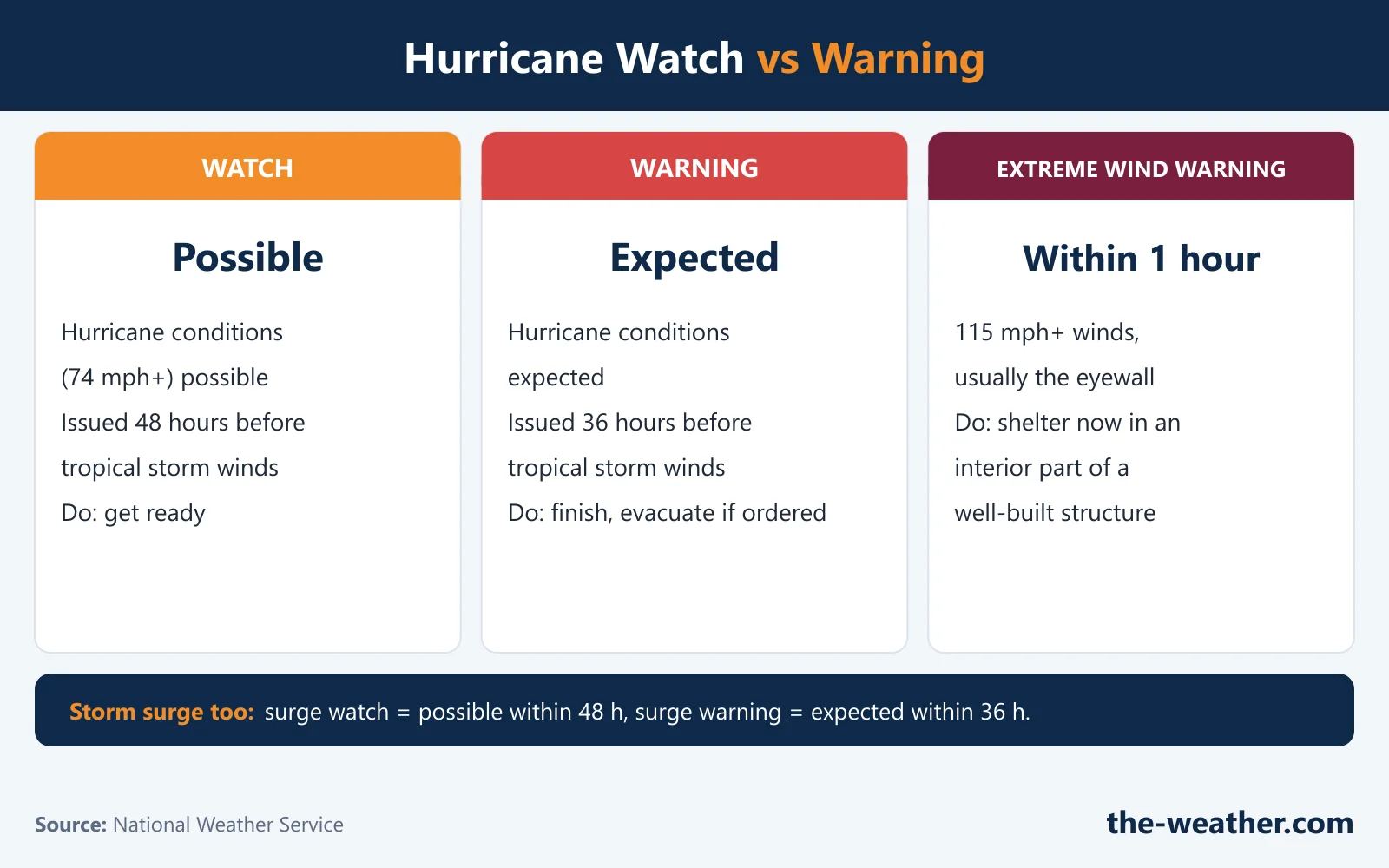
Why issue a watch 48 hours ahead? The NWS explains that it may not be safe to prepare for a hurricane once winds reach tropical storm force (39 mph and up). So the watch is timed to give you about two days before tropical storm-force winds arrive, and the warning about a day and a half.
| Hurricane Watch | Hurricane Warning | |
|---|---|---|
| Meaning | Hurricane conditions (74 mph+) are possible in your area | Hurricane conditions are expected somewhere in the area |
| Issued | 48 hours before tropical storm-force winds are expected | 36 hours before tropical storm-force winds are expected |
| Your job | Get ready: plan, supplies, check your evacuation zone | Finish preparations; evacuate immediately if ordered |
Definitions and timing: National Weather Service.
All the Hurricane Alerts, From Least to Most Urgent
Tropical Storm Watch / Hurricane Watch / Storm Surge Watch
Tropical storm winds (39-73 mph), hurricane winds (74 mph+) or life-threatening surge flooding are possible. Tropical storm and storm surge watches: generally within 48 hours. A hurricane watch comes 48 hours before tropical storm-force winds are expected.
Do: get ready.
Tropical Storm Warning / Hurricane Warning / Storm Surge Warning
Those conditions are expected, generally within 36 hours.
Do: finish preparations, check for evacuation orders.
Extreme Wind Warning
Extreme winds of a major hurricane (115 mph or more), usually from the eyewall, are expected to begin within an hour.
Do: take shelter now in an interior part of a well-built structure.
The NWS also notes two situations that surprise people. Watches and warnings can be issued for a potential tropical cyclone: a storm that is not officially a tropical cyclone yet, but is forecast to bring dangerous conditions to land. And they can stay up for a post-tropical cyclone: a storm that has lost its tropical characteristics but is still dangerous. So "it is not a hurricane anymore" does not mean the alert is over.
Storm surge alerts deserve special attention, because the National Hurricane Center calls surge the leading cause of hurricane deaths. If you are under a storm surge warning, the NWS says to check for evacuation orders from your local officials. Our page What Is Storm Surge? explains why.
What to Do During a Hurricane Watch
This is your preparation window. Based on Ready.gov's hurricane and evacuation advice:
- Know your zone. If you live in an evacuation zone, you may have to leave quickly. Look it up now with your official state or county tool; our evacuation zones page shows how.
- Plan where you would go, and how. Ready.gov suggests several destinations in different directions, and a place that accepts pets if needed (most public shelters allow only service animals).
- Fill the tank if an evacuation seems likely. Gas stations may be closed or without power later.
- Charge phones and backup batteries, and have a way to get alerts that does not need power.
- Bring in outdoor furniture, clear drains and gutters, and check your supplies, medication and pet supplies.
What to Do During a Hurricane Warning
- Finish your preparations. The NWS says all preparations should be complete.
- Evacuate immediately if ordered. Ready.gov: if you live in a mandatory evacuation zone and local officials tell you to evacuate, do so immediately.
- Staying? For high winds, take refuge in a designated storm shelter or an interior room. If you are trapped by flooding, go to the highest level of the building, but not into a closed attic.
- Never drive through flood water. Ready.gov: six inches of fast-moving water can knock you down, and one foot of moving water can sweep your vehicle away.
Checklists summarized from Ready.gov: Hurricanes and Ready.gov: Evacuation. Always follow your local officials first.
How You Will Hear the Alert
The NWS lists the channels: its hurricane products reach you on hurricanes.gov, on TV and radio, on cell phones, and on NOAA Weather Radio. Ready.gov adds Wireless Emergency Alerts and the Emergency Alert System, which need no sign-up, and the FEMA app for NWS alerts in up to five locations.
Every one of those works fine, until the power is out and your phone is at 4 percent. That is the gap a battery or crank NOAA Weather Radio fills. And because warnings and the latest advisories keep coming every few hours during a storm, it pays to have one that can run without an outlet. If you live along the Gulf, our list of Gulf Coast NOAA frequencies and SAME codes helps you set it up.
A Radio for the Watch-to-Warning Days: Midland ER40
For a go-bag or a kitchen counter during hurricane season, the Midland ER40 covers the basics without needing an outlet. Everything below comes from Midland's product page, spec sheet and owner's manual; we have not tested it ourselves.
- NOAA weather alerts on all 7 NOAA weather channels, with an audible siren and a flashing light when an alert comes in.
- Alerts while switched off: the manual says the ER40 receives alerts when powered off, as long as it is tuned to your local weather station and alerts are turned on.
- Three ways to charge its replaceable 2,600 mAh lithium-ion battery: USB, a hand crank and a solar panel.
- Flashlight with SOS strobe, AM/FM radio with clock, a backlit display and a wrist lanyard.
- USB output to charge a phone.
Know the limits before you buy: the manual says the ER40 will not receive weather alerts while it is charging another device, so do not leave your phone plugged into it overnight if you count on the alarm. It receives broadcasts up to about 50 miles from the transmitter, depending on terrain and conditions. And Midland's manual and spec sheet do not mention SAME county filtering; in our reading, that means it may also sound for alerts in nearby counties on the same transmitter. For a bedside radio that filters by county, look at our NOAA weather alert radios; for a larger Midland crank radio, see our Midland ER310 review. Setup steps, charging and a side-by-side with the ER310 are in our Midland ER40 review.
Hear the warning when the power is out
Midland ER40 crank and solar NOAA weather radioon Amazon · opens in a new tabAffiliate link: we may earn a commission if you buy through it, at no extra cost to you. More options: weather radios for hurricane season · emergency weather radios
Hurricane Watch and Warning FAQ
What does a hurricane warning mean?
That hurricane conditions, sustained winds of 74 mph or more, are expected somewhere in the warned area. The National Hurricane Center issues it 36 hours before it expects tropical storm-force winds, and by then all preparations should be complete. Evacuate immediately if ordered.
Which is worse, a hurricane watch or a hurricane warning?
A warning. A watch means hurricane conditions are possible (issued 48 hours before tropical storm-force winds); a warning means they are expected (36 hours before).
What is an extreme wind warning?
An NWS alert that extreme sustained winds of a major hurricane, 115 mph or more and usually from the eyewall, are expected to begin within an hour. Take shelter immediately in an interior part of a well-built structure.
What is the difference between a tropical storm warning and a hurricane warning?
The expected wind. A tropical storm warning is for sustained winds of 39 to 73 mph within 36 hours; a hurricane warning is for 74 mph or more.
Can there be a warning before a storm is even named?
Yes. The NWS can issue watches and warnings for a "potential tropical cyclone", a system forecast to bring tropical storm or hurricane conditions to land before it has fully become a tropical cyclone.
Update Log
- October 20, 2026: First version. Alert definitions from the NWS; ER40 details from Midland's product page, spec sheet and owner's manual.
Sources
- National Weather Service: Hurricane and Tropical Storm Watches, Warnings, Advisories and Outlooks
- National Hurricane Center: Glossary
- National Hurricane Center: Storm Surge Overview
- Ready.gov: Hurricanes and Ready.gov: Evacuation
- Midland ER40: product page, spec sheet and owner's manual
More in this series: What is a typhoon? · Hurricane categories · Storm surge · Track a hurricane live · Evacuation zones · Tornado warning
Ready to decide?
Find your pick on Amazon
Prices and stock change daily. Check the current price, delivery options and what owners say in their reviews.
Our top picksCompare our picks on AmazonToday's price, delivery & owner reviews on Amazon
Check on Amazon →