As an Amazon Associate, I earn from qualifying purchases.
In this article 18 sections
- How Many Weather Instruments Are There?
- Weather Instruments: Quick Reference
- Types of Weather Instruments
- Instrument Accuracy: What to Expect
- Thermometer: Measures Air Temperature
- Barometer: Measures Atmospheric Pressure
- Anemometer: Measures Wind Speed
- Wind Vane: Measures Wind Direction
- Hygrometer: Measures Relative Humidity
- Rain Gauge: Measures Precipitation
- Pyranometer: Measures Solar Radiation
- Advanced Weather Instruments
- Home Weather Station: All Instruments Combined
- Which Weather Instrument Should You Buy?
- Weather Instruments for Kids: Simple Explanations
- A Brief History of Weather Instruments
- What Instruments Do Meteorologists Use to Forecast Weather?
- Frequently Asked Questions
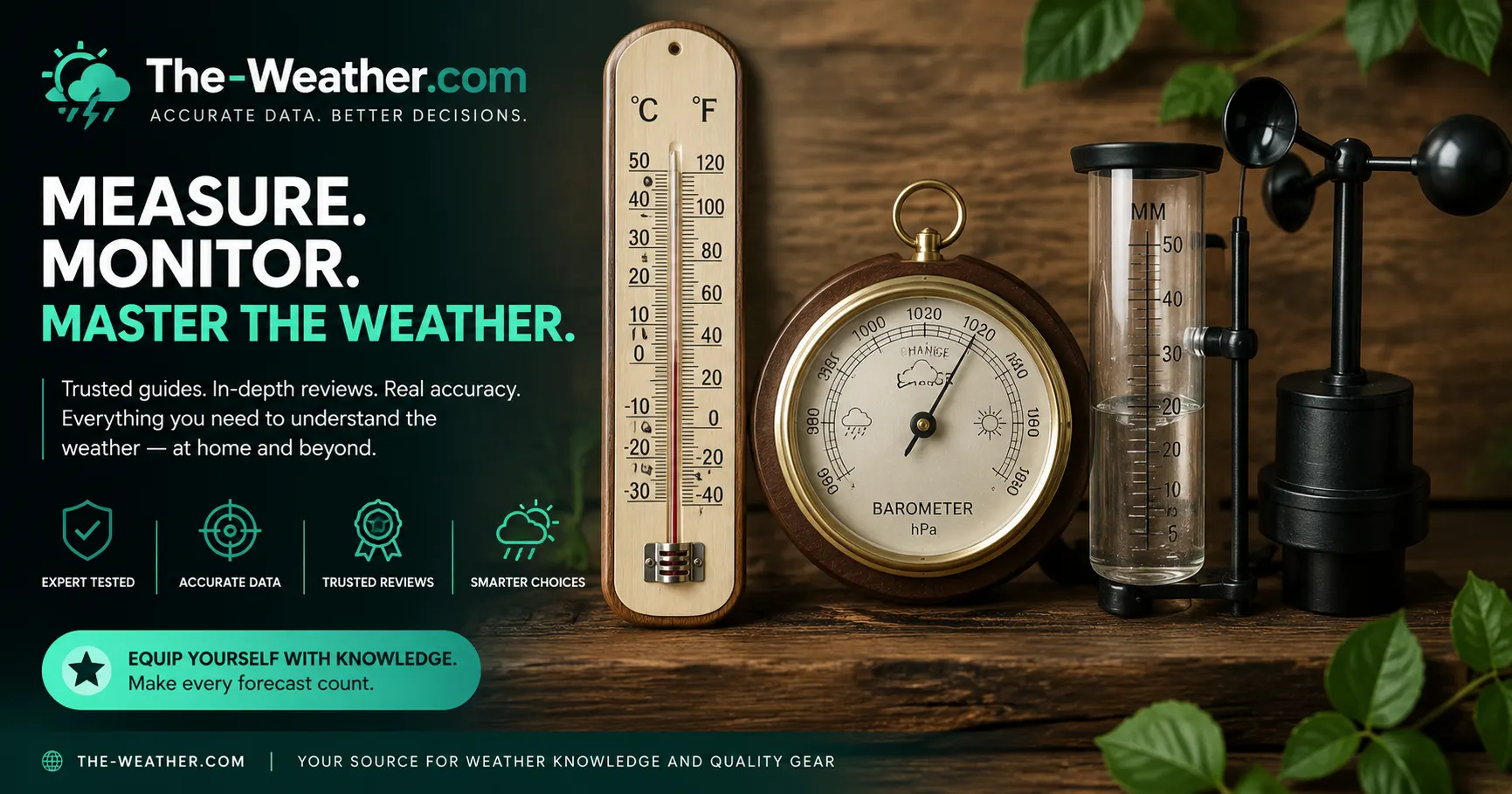
The core weather measuring instruments used by meteorologists and home weather observers.
Most people have a rough idea what a thermometer does. Fewer know what distinguishes a barometer from a hygrometer, why anemometer placement matters more than any other sensor, or what a pyranometer adds that no other instrument provides. This guide covers all of it.
How Many Weather Instruments Are There?
The answer depends on which instruments you include. Different sources count differently because some list only surface instruments, others include upper-air instruments like radiosondes, and others include remote sensing systems like radar and satellites. Here is how the most common counts break down:
- Thermometer
- Barometer
- Anemometer
- Hygrometer
- Rain gauge
- Thermometer
- Barometer
- Anemometer
- Wind vane
- Hygrometer
- Rain gauge
- All 6 above
- Pyranometer
- All 7 above
- Lightning detector
- UV index sensor
- Radiosonde
- Doppler radar
- Weather satellite
For home use, the relevant set is 5 to 7 instruments. Which ones you get depends on the model: many full stations from brands like Davis Instruments, Ambient Weather and Ecowitt cover the six core instruments, and some add solar radiation. The remaining instruments, radar, radiosondes, satellites, are operated by national meteorological agencies and are not available for consumer use.
Weather Instruments: Quick Reference
| Instrument | Measures | Unit | Home use? |
|---|---|---|---|
| Thermometer | Air temperature | °F / °C | Essential |
| Barometer | Atmospheric pressure | inHg / hPa | Very useful |
| Anemometer | Wind speed | mph / km/h / knots | Useful |
| Wind Vane | Wind direction | Compass degrees | Useful |
| Hygrometer | Relative humidity | % RH | Essential |
| Rain Gauge | Precipitation | inches / mm | Very useful |
| Pyranometer | Solar radiation | W/m² | Optional |
| Lightning Detector | Lightning strike distance | miles / km | Optional |
| UV Index Sensor | Ultraviolet radiation | UV Index | Optional |
| Radiosonde | Upper-air temp, humidity, pressure | Multiple | Agency only |
| Doppler Radar | Precipitation, movement | dBZ / mph | Agency only |
| Weather Satellite | Cloud cover, surface temp | Multiple | Agency only |
Types of Weather Instruments
Weather instruments fall into three broad categories based on how and where they collect data. Understanding the difference helps you know which type is relevant for home use and which belongs in a national meteorological network.
Measure atmospheric conditions at ground level. These are the instruments used in home weather stations.
- Thermometer
- Barometer
- Anemometer
- Wind vane
- Hygrometer
- Rain gauge
- Pyranometer
Measure atmospheric conditions at altitude, from a few hundred feet to 100,000 feet above the surface.
- Radiosonde (weather balloon)
- Dropsonde
- Aircraft sensors
- Pilot balloon (pibal)
Measure large areas of the atmosphere without being in direct contact with what they are measuring.
- Doppler radar
- Weather satellites
- Lidar
- Sodar
Within surface instruments, the distinction between digital and analog determines how readings are displayed and recorded.
- Digital: electronic sensor, LCD display, data logging
- Analog: mechanical, dial or liquid display, manual reading
- Both types are available for all core instruments
Instrument Accuracy: What to Expect
Consumer weather instruments are not laboratory devices. Every sensor has a specified accuracy tolerance: the range within which its readings are expected to be correct. Understanding these tolerances helps you interpret your readings realistically and choose sensors that match your needs.
| Instrument | Typical Consumer Accuracy | Best Available | Key Notes |
|---|---|---|---|
| Thermometer | ±2°F | ±0.5°F | Radiation shield required for outdoor accuracy |
| Hygrometer | ±3% RH | ±2% RH | Calibrate with salt test for precision use |
| Barometer | ±0.06 inHg | ±0.03 inHg | Must be set to local sea-level equivalent |
| Rain Gauge | ±4% | ±1% | Placement and debris management critical |
| Anemometer | ±3 mph | ±2 mph | Mounting height matters more than sensor accuracy |
| Wind Vane | ±10 degrees | ±3 degrees | May not register light winds below 2 mph |
Modern smartphones contain barometers but cannot measure rainfall, wind speed, or humidity without external sensors. The built-in barometer is primarily used for altitude estimation in navigation apps rather than weather forecasting.
Thermometer: Measures Air Temperature
A thermometer measures air temperature by detecting the thermal energy in the surrounding air. Modern digital thermometers use electronic sensors, typically thermistors or platinum resistance thermometers, that change electrical resistance with temperature. Mercury and alcohol thermometers use the thermal expansion of a liquid in a sealed glass tube.
For outdoor weather measurement, the thermometer must be shielded from direct sunlight and radiated heat from buildings and pavement. A radiation shield, a louvred white enclosure that allows air to circulate freely while blocking solar radiation, is standard in all home weather stations. Without one, a thermometer can read 5°F to 15°F (3°C to 8°C) higher than the true air temperature on sunny days.
For home use: See our best outdoor thermometers guide and our best indoor outdoor thermometer picks for wireless options with display consoles.
Barometer: Measures Atmospheric Pressure
A barometer measures the weight of the atmosphere above the measurement point. Atmospheric pressure changes as weather systems move in and out. Falling pressure indicates an approaching low pressure system bringing cloud, wind, and rain. Rising pressure indicates a high pressure system bringing clearer, calmer conditions.
The trend matters more than the absolute reading. A rapid pressure drop of 0.10 inHg or more over three hours is a reliable indicator of deteriorating weather. Most digital home barometers display a trend arrow alongside the current reading. Standard sea-level pressure is 29.92 inHg (1013.25 hPa). For more detail on how pressure drives weather, see our guide to what is barometric pressure.
For home use: See our best home barometers guide.
Anemometer: Measures Wind Speed
An anemometer measures wind speed by detecting the force or movement of air. The most common consumer type uses three hemispherical cups mounted on horizontal arms that spin on a vertical shaft. Wind causes the cups to rotate faster, and the rotation rate converts to a wind speed reading. Ultrasonic anemometers, used in the WeatherFlow Tempest and Ecowitt Wittboy Pro, measure wind speed by detecting the time difference between ultrasonic pulses sent in opposite directions. They have no moving parts and do not freeze in winter.
The NWS standard for wind measurement is 33 feet (10 metres) above open, flat terrain. Buildings and trees create turbulence that significantly reduces measured wind speeds at lower heights. Mounting height is the single biggest factor in anemometer accuracy.
Wind Vane: Measures Wind Direction
A wind vane rotates to point into the wind, indicating the direction the wind is blowing from. Wind direction is always reported as the direction the wind comes from, not toward. A north wind blows from the north toward the south.
In most home weather stations, the wind vane and anemometer are combined in a single unit. Digital stations convert the vane position to compass degrees (0 to 360) or cardinal directions. In the northern hemisphere, winds shifting from south to southwest often precede warm fronts, while a shift to northwest typically indicates clearing after a cold front passes.
Hygrometer: Measures Relative Humidity
A hygrometer measures relative humidity: the amount of water vapour in the air as a percentage of the maximum amount the air could hold at that temperature. Modern digital hygrometers use capacitive sensors that change electrical properties as they absorb or release moisture.
Humidity affects how temperature feels (the heat index), dew point calculations, and precipitation formation. For indoor use, the ideal range is 40% to 60% RH. Below 30% causes dry skin and respiratory irritation. Above 60% encourages dust mite activity and mould growth.
For home use: See our complete hygrometer guide, our best bedroom hygrometer picks, and our best greenhouse hygrometer recommendations.
For growers: see our best hygrometer for a grow tent picks.
Rain Gauge: Measures Precipitation
A rain gauge measures the amount of liquid precipitation that falls over a set period. The most common consumer type is the tipping bucket gauge: rain fills a small funnel and flows into a see-saw bucket that tips when it holds a set amount (typically 0.01 inches). Each tip registers one count, and the total converts to a rainfall measurement.
Placement is critical. The gauge needs clear sky above it with no obstructions within a 45-degree angle from the top. Trees, roof overhangs, and buildings all deflect rain and cause under-reporting. The history of the rain gauge reaches back to 1441 in Korea, where standardised gauges were used to assess agricultural tax levels based on rainfall.
For home use: See our best rain gauges guide and our dedicated rain measurement page for a full breakdown of methods and accuracy.
Pyranometer: Measures Solar Radiation
A pyranometer measures the intensity of solar radiation reaching the earth's surface from the entire sky hemisphere, in watts per square metre. It tells you how much solar energy is available at your location at any given moment.
For most home weather observers, a pyranometer is optional. It becomes useful for solar panel monitoring, greenhouse management, agricultural planning, and evapotranspiration calculations for irrigation. The Davis Vantage Pro2 Plus includes a solar radiation sensor as standard. It can be added to most Ecowitt stations as an optional sensor.
Advanced Weather Instruments
Beyond the standard seven surface instruments, three additional sensors are available for home weather stations as optional add-ons, and three professional instruments make up the upper-air and remote sensing layer used by national meteorological agencies.
Lightning Detector
A lightning detector measures the electromagnetic signature of lightning strikes and estimates their distance from the sensor. Most consumer lightning detectors use the Franklin AS3935 chip, which detects the radio frequency energy released by a strike and classifies it as overhead, near (under 25 miles), or distant. Ecowitt, Ambient Weather, and AcuRite all offer lightning detector sensors that connect to their home weather station ecosystems.
UV Index Sensor
A UV index sensor measures the intensity of ultraviolet radiation from the sun on a scale of 0 to 11+. The UV index is the primary metric used to determine sunscreen requirements and sun exposure risk. UV index 3 to 5 requires sun protection. UV index 6 to 7 requires protection and shade during midday. UV index 8 and above requires staying indoors during peak hours. Most Ambient Weather, Davis, and Ecowitt stations include UV index as standard or as an optional sensor.
Radiosonde (Weather Balloon)
A radiosonde is an instrument package attached to a weather balloon, launched twice daily worldwide at the same times (00:00 and 12:00 UTC) by national meteorological services including the NOAA and National Weather Service. As the balloon rises to around 100,000 feet, the radiosonde transmits temperature, humidity, pressure, and GPS-derived wind data back to ground stations. This upper-air data is essential for initialising weather forecast models. The US alone launches over 90,000 radiosondes annually.
Doppler Radar
Doppler radar transmits microwave pulses and measures the energy reflected back by precipitation. The shift in frequency between transmitted and returned pulses reveals both the intensity of precipitation and its movement toward or away from the radar. The US WSR-88D NEXRAD network of 160 radar stations covers the entire contiguous United States. Dual-polarization radar, now standard across the network, can distinguish rain from snow, hail, and biological targets like birds and insects.

The 8 core weather instruments and what each one measures.
Every weather forecast starts with ground-level observations from instruments like these. Your local TV forecast relies on data collected by a network of weather stations across the country: each running the same core set of instruments listed here.
A home weather station gives you that same data for your exact location, which is why readings from your backyard often differ significantly from the nearest official weather station. See our home weather stations guide for a full comparison of integrated units.
Home Weather Station: All Instruments Combined
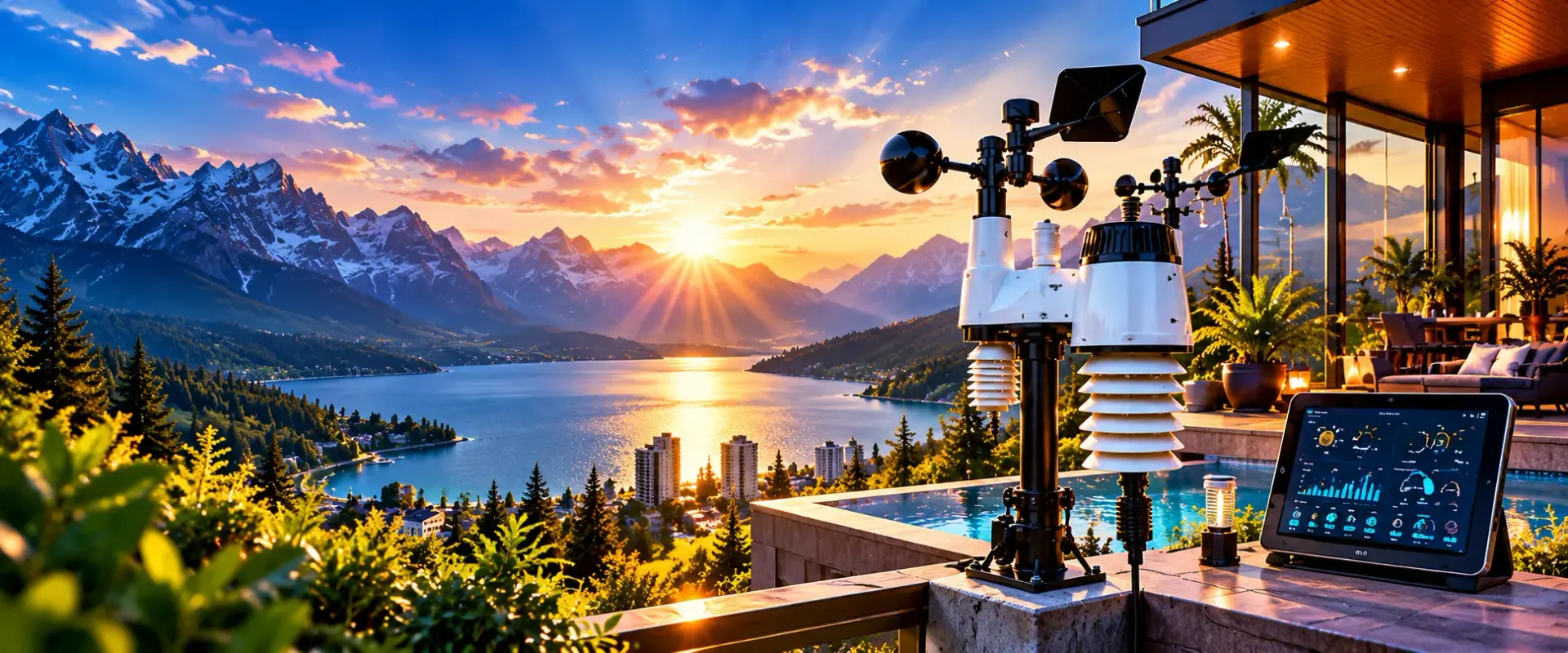
A home weather station integrates most of the instruments above into a single outdoor sensor suite that transmits wirelessly to an indoor console or phone app. A typical consumer weather station measures temperature, humidity, atmospheric pressure, wind speed, wind direction, and rainfall simultaneously, with optional sensors for UV, solar radiation, and lightning.
| Station | Temp | Pressure | Wind | Rain | Solar/UV | Best for |
|---|---|---|---|---|---|---|
| Ambient WS-2902C | ✓ | ✓ | ✓ | ✓ | Optional | Best overall value |
| WeatherFlow Tempest | ✓ | ✓ | ✓ Ultrasonic | ✓ Haptic | ✓ | No moving parts |
| Davis Vantage Pro2 | ✓ NIST | ✓ NIST | ✓ Separate mount | ✓ Aerocone | Pro2 Plus | Best accuracy |
| Ecowitt Wittboy Pro | ✓ | ✓ | ✓ Ultrasonic | ✓ Haptic | Optional | No subscription |
See our full home weather stations comparison and our best Wi-Fi weather stations guide for a complete breakdown of all options by budget.
Which Weather Instrument Should You Buy?
The right instrument depends on what you want to track. Not everyone needs a full home weather station. Start with the instrument that addresses your most immediate need and expand from there.
A practical overview of the main weather instruments and what each one does.
| If you want to... | Start with |
|---|---|
| Monitor indoor comfort | Hygrometer |
| Forecast incoming storms | Barometer |
| Track rainfall for gardening | Rain gauge |
| Know real outdoor temperature | Outdoor thermometer |
| Monitor wind for sailing/farming | Anemometer + wind vane |
| Full backyard weather data | Home weather station |
| Professional grade accuracy | Davis Vantage Pro2 |
| Understand dew point and humidity | Dew point guide |
Weather Instruments for Kids: Simple Explanations
Each weather instrument does exactly one job: measuring one specific thing about the air around us. Here is a simple way to understand what each one does:
Kids can make a simple rain gauge at home using a straight-sided jar, a ruler, and a permanent marker. Place it in an open area away from trees, and read the water level after each rainstorm. This is exactly how professional rain gauges work: the only difference is the tipping bucket mechanism that counts each 0.01 inch automatically.
A Brief History of Weather Instruments
The world's first standardised rain gauges were developed in Korea in 1441 during the reign of King Sejong, used to assess agricultural tax levels based on rainfall. In Europe, Christopher Wren and Robert Hooke developed a tipping bucket rain gauge in the 1660s. The modern tipping bucket design remains the standard for consumer and professional precipitation measurement today. For more detail, see our history of the rain gauge.
Galileo Galilei developed an early thermoscope that used air expansion to indicate temperature change. The sealed liquid thermometer followed in 1654, developed by the court of Ferdinand II de Medici in Florence. Gabriel Fahrenheit introduced the mercury thermometer and the Fahrenheit scale in 1714. Anders Celsius proposed the centigrade scale in 1742.
Evangelista Torricelli, a student of Galileo, invented the mercury barometer in 1643 and demonstrated that atmospheric pressure supports a column of mercury roughly 30 inches tall. The aneroid barometer, which uses a sealed metal cell instead of liquid mercury, was invented by Lucien Vidie in 1844 and remains the basis of most modern consumer barometers.
John Thomas Romney Robinson invented the four-cup anemometer in 1846. The three-cup design that became the modern standard was developed later in the 19th century. The first ultrasonic anemometer was developed in the 1950s for research use. Consumer ultrasonic anemometers appeared in home weather stations in the 2010s with the WeatherFlow Tempest.
Modern home weather stations integrate all core instruments into a single wireless unit that uploads data to cloud platforms continuously. The Citizen Weather Observer Program (CWOP) network aggregates readings from thousands of personal weather stations worldwide, feeding real-time ground truth data into National Weather Service forecast models.
What Instruments Do Meteorologists Use to Forecast Weather?
Professional meteorologists use the same core instruments as home weather observers, scaled up to a national network. The NOAA operates thousands of Automated Surface Observing Systems (ASOS) stations at airports across the US, each running thermometers, barometers, anemometers, hygrometers, and rain gauges continuously. Standards for all these instruments are set by the World Meteorological Organisation (WMO).
Beyond surface instruments, meteorologists also use:
- Radiosondes: Instrument packages on weather balloons, launched twice daily worldwide, measuring temperature, humidity, and pressure up to 100,000 feet.
- Doppler radar: Detects precipitation type, intensity, and movement. The US WSR-88D NEXRAD network covers the entire contiguous US.
- Weather satellites: GOES satellites provide continuous imagery of cloud cover, surface temperatures, and atmospheric moisture from geostationary orbit.
- Lightning detection networks: Track lightning strike location and frequency in real time.
- Citizen weather observers: Home weather stations uploading to Weather Underground and the CWOP network contribute real-time ground-truth data between official station locations.
Frequently Asked Questions
What are the 7 weather instruments?
The 7 core weather instruments are: thermometer (temperature), barometer (atmospheric pressure), anemometer (wind speed), wind vane (wind direction), hygrometer (humidity), rain gauge (precipitation), and pyranometer (solar radiation). Home weather stations combine most of these in a single integrated unit.
What are the 5 weather instruments?
The 5 most essential weather instruments are: thermometer (air temperature), barometer (atmospheric pressure), anemometer (wind speed), hygrometer (humidity), and rain gauge (precipitation). These five cover the core atmospheric measurements needed to monitor and forecast local weather conditions.
What are the 6 weather instruments?
The 6 standard surface weather instruments are: thermometer, barometer, anemometer, wind vane, hygrometer, and rain gauge. This is the set used by most automated surface observing stations worldwide, including those operated by the National Weather Service at airports across the US.
What are the 12 weather instruments?
The 12 weather instruments covering surface and upper-air measurement are: thermometer, barometer, anemometer, wind vane, hygrometer, rain gauge, pyranometer, lightning detector, UV index sensor, radiosonde, Doppler radar, and weather satellite. Home weather stations cover some or all of the first nine, depending on the model. The remaining instruments are used by meteorological agencies.
What are the types of weather instruments?
Weather instruments fall into three main types: surface instruments (thermometer, barometer, anemometer, hygrometer, rain gauge) that measure conditions at ground level; upper-air instruments (radiosondes, weather balloons) that measure the atmosphere at altitude; and remote sensing instruments (Doppler radar, weather satellites) that measure large areas without direct contact.
What weather instrument measures humidity?
A hygrometer measures relative humidity, expressed as a percentage of the maximum moisture air can hold at a given temperature. Modern digital hygrometers use capacitive sensors. Most home weather stations include a combined temperature and humidity sensor in the outdoor unit.
What weather instrument measures wind direction?
A wind vane measures wind direction. It rotates to point into the wind and reports the direction the wind is blowing from. In most home weather stations, the wind vane and anemometer are combined in a single unit and report direction in compass degrees or cardinal points.
What instrument measures air pressure?
A barometer measures atmospheric pressure in inches of mercury (inHg) or hectopascals (hPa). Falling pressure indicates approaching wet weather. Rising pressure indicates clearing conditions. Most home weather stations include a built-in digital barometer that tracks pressure trends over 24 hours.
What instruments do meteorologists use to forecast weather?
Meteorologists use thermometers, barometers, anemometers, hygrometers, rain gauges, radiosonde weather balloons, Doppler radar, and weather satellites. For home forecasting, a barometer tracking pressure trends and a thermometer are the two most useful instruments. A home weather station combines all ground-level measurements.
What are the analog weather instruments?
Analog weather instruments display readings mechanically rather than digitally. A mercury or alcohol thermometer, an aneroid barometer with a needle dial, a hair hygrometer, and a mechanical rain gauge with a graduated cylinder are all analog instruments. They require no batteries but need manual reading and periodic calibration.
What are weather instruments and their uses?
Weather instruments measure specific atmospheric conditions: thermometer measures temperature, barometer measures pressure, anemometer measures wind speed, wind vane measures wind direction, hygrometer measures humidity, rain gauge measures precipitation, and pyranometer measures solar radiation. Together they give a complete picture of local weather conditions at ground level.
What instruments can you use to gather information about weather?
To gather complete weather information at home, you need a thermometer for temperature, a barometer for pressure trends, a hygrometer for humidity, a rain gauge for precipitation, and an anemometer with wind vane for wind. A home weather station combines all five in a single unit that connects to a phone app and uploads readings automatically.
Sources
Instrument definitions and meteorological standards from the World Meteorological Organisation (WMO) Guide to Meteorological Instruments and Methods of Observation. NWS siting guidelines from weather.gov. NOAA radiosonde programme details from noaa.gov. Manufacturer specifications from Davis Instruments, WeatherFlow, and Ecowitt official documentation. No manufacturer compensation was received.

Lena Thornton
Weather Station Analyst & CWOP Contributor. Lena has researched, reviewed and analysed weather stations and instruments for over a decade. She contributes observation data to the Citizen Weather Observer Program (CWOP) and writes exclusively for the-weather.com.