We may earn a commission when you buy through links on this page, at no extra cost to you. Learn more
In this article 8 sections
- Why Hurricane Season Requires a Different Approach to Emergency Alerts
- The 3 Best Weather Radios for Hurricane Season 2026
- WR400 vs WR120B vs ER310: Hurricane Season Comparison
- 2026 Hurricane Season: What the Forecast Means for Your Preparedness
- 2026 Atlantic Hurricane Season Forecast: What It Means for Florida & the Gulf Coast
- Hurricane Radio Preparedness Checklist: Do This Before June 1
- Frequently Asked Questions
- Our Recommendation for 2026
Best Weather Radio for Hurricane Season 2026 (Florida & Gulf Coast Emergency Guide)

Our picks in this guide
Compare the models in this guide
See today’s price, delivery options and customer reviews on Amazon.
As an Amazon Associate we earn from qualifying purchases, at no extra cost to you. Learn moreWhat is the best weather radio for hurricane season? For home use: the Midland WR400: S.A.M.E. county alerts, battery backup, AM/FM, and USB charging during outages. For your evacuation kit: the Midland ER310: hand crank, solar, 6 AA backup, and a 130-lumen flashlight. Both work without cell towers. Buy and program before June 1.
Information verified against NOAA, FEMA, and manufacturer documentation. I'm Lena Thornton, a weather station analyst and CWOP contributor. This guide covers the best weather radios specifically for hurricane preparedness: what to look for, which models I recommend, and why the choice between a desktop and portable radio matters differently during hurricane season than any other time of year. If you need to compare all NOAA radios, see our full NOAA weather radio comparison.
Top weather radios for hurricane season in Florida and the Gulf Coast, designed for reliable NOAA emergency alerts and power outage situations.
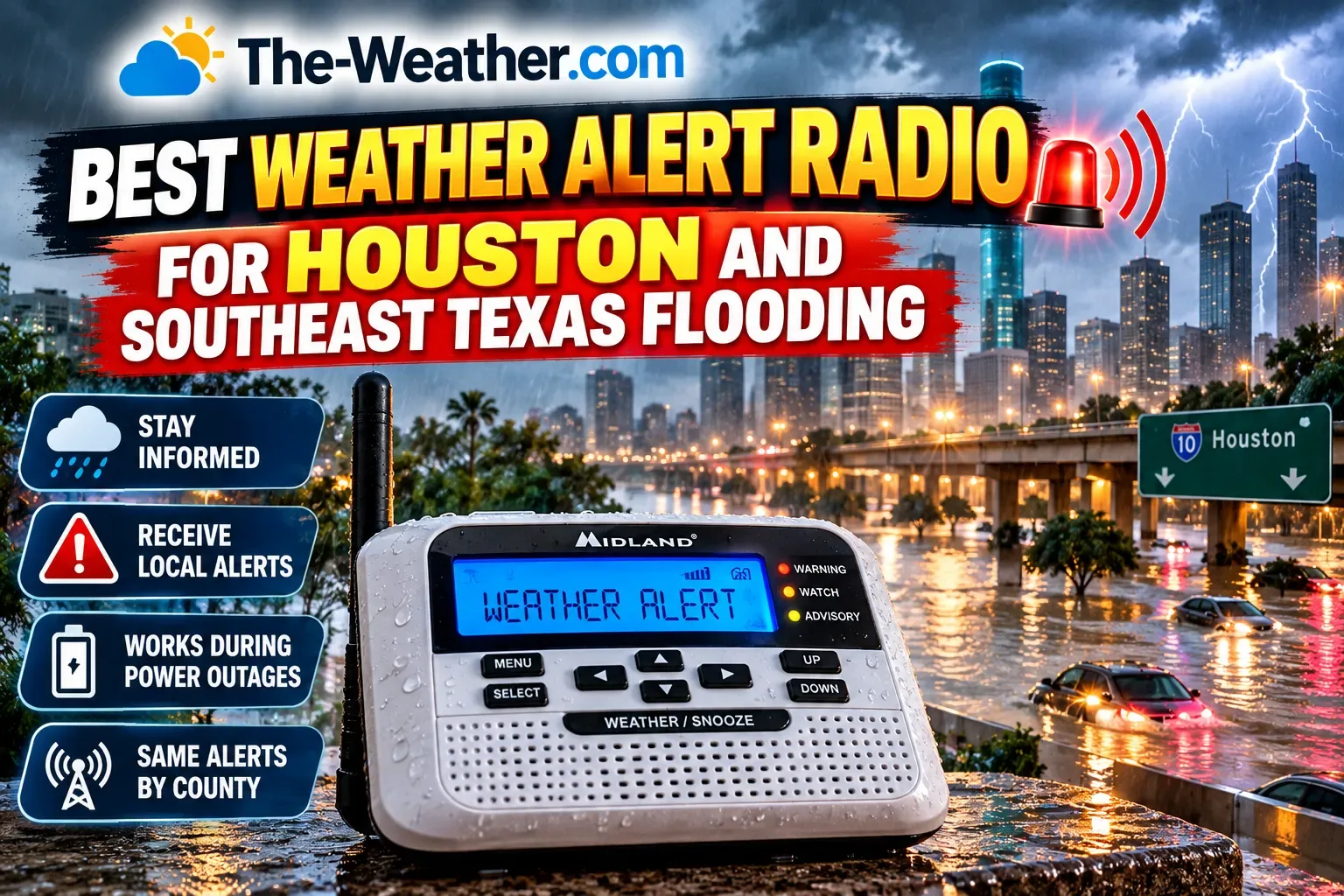
Live in Houston or Southeast Texas? County codes, local NOAA transmitters and a 5-step setup: weather alert radio for Houston and Southeast Texas flooding.
Why Hurricane Season Requires a Different Approach to Emergency Alerts
Most emergency preparedness advice treats all severe weather the same. Hurricane season is different, and it changes which radio features matter most. For some households, phone alerts alone may be sufficient, especially those well outside high-risk coastal areas. For Florida and Gulf Coast residents, the stakes are different.
The Cell Tower Problem
During Hurricane Sandy, approximately one in four cell towers in affected areas became inoperable, according to industry reports at the time. During Hurricane Maria in 2017, communications collapsed entirely across Puerto Rico: radio was one of the most reliable communication methods that continued to function. As one Florida news director put it at the time: "There are no cell phones. No electricity. No internet. No television. No water. No anything." NOAA weather radio continued broadcasting.
NOAA Weather Radio All Hazards broadcasts on dedicated VHF government frequencies from more than 1,000 transmitters nationwide: a separate system that operates independently from cellular networks. It does not require internet, does not require cell signal, and operates from battery backup when the power grid fails. This is the core reason FEMA and Ready.gov specifically recommend battery-powered or hand-crank NOAA radios for hurricane preparedness.
What Hurricane-Specific Features You Need
For hurricane preparedness specifically, prioritise these features above everything else:
- Battery backup or hand crank: power outages during hurricanes can last days to weeks. Your radio must work without AC power.
- S.A.M.E. county programming: filters alerts to your county, reducing irrelevant warnings from inland areas during a coastal storm.
- Automatic alert from standby: hurricane watches and warnings can upgrade rapidly. You need a radio that alerts you without manual monitoring.
- Loud siren: 85–90dB for home use; audible through storm noise and closed doors.
- USB device charging: keeping your phone charged during extended outages can be life-saving for coordination and emergency calls when cell service is intermittent.
- Portable option for evacuation kit, if you evacuate, you need alerts on the road and at the shelter, not just at home.
October 2026 update: NOAA's August update lowered the outlook to 2 to 6 hurricanes, and by late September the Atlantic still had no hurricane, a first since 1914. Read why the 2026 Atlantic hurricane season has had no hurricanes. The season runs until November 30.
The 3 Best Weather Radios for Hurricane Season 2026
These three radios cover every hurricane preparedness scenario: home monitoring, budget home use, and evacuation kit. All verified against Midland's official documentation.
Midland WR400
The most capable home NOAA weather radio for hurricane season. Automatic county-filtered alerts, AM/FM, USB charging during outages, and 4 AA battery backup that keeps monitoring even when the grid goes down.
- S.A.M.E. for up to 25 counties: filtered alerts only
- 85dB siren: wakes sleepers through storm noise
- AM/FM radio: local emergency broadcasts during hurricane
- USB-A device charging: phone charged during outages
- 4 AA battery backup: more capacity for extended outages
- Stores last 10 alerts: review what was issued while you sheltered
- Dual alarm clock: wake to weather or FM during storm prep
- ~$45–$55
Full review: read the full WR400 breakdown
Midland ER310
The best portable radio for hurricane evacuation kits. Hand crank, solar panel, and 6 AA backup means it works for days without power: exactly what you need when evacuating or sheltering without electricity.
- Hand crank: 1 min cranking = ~9 min radio
- Solar panel: maintains charge in sunlight
- 6 AA alkaline backup: deep power reserve
- 130-lumen CREE flashlight: High/Low/Strobe/SOS
- NOAA auto-alert from standby
- USB-A device charging output
- Ultrasonic dog whistle: search-and-rescue signal
- ~$55–$65 · 0.3 lbs · pocket/bag sized
Full review: Midland ER310 Review
Midland WR120B
The most accessible home NOAA radio under $40. Same S.A.M.E. county programming as the WR400, the loudest siren in the desktop lineup at 90dB, and color-coded LED severity indicators, at half the price.
- S.A.M.E. for up to 25 counties
- 90dB siren: louder than the WR400
- Color-coded LED: Red/Orange/Green severity
- 3 AAA battery backup
- Alarm clock with snooze
- Trilingual: English/Spanish/French
- ~$30–$40
Full review: see how it compares
WR400 vs WR120B vs ER310: Hurricane Season Comparison
The right radio depends on whether you need home monitoring, a portable evacuation kit option, or both. Here is exactly how they compare on the features that matter most during a hurricane.
| Feature | WR400 ~$49 |
WR120B ~$35 |
ER310 ~$60 |
|---|---|---|---|
| Best Use Case | Home monitoring Most features |
Budget home | Evacuation kit Portable |
| S.A.M.E. County | Up to 25 counties | Up to 25 counties | None, all-channel |
| Battery Backup | 4 AA alkaline Most capacity |
3 AAA alkaline | Li-ion + solar + crank + 6 AA Most versatile |
| Works Without Power | Yes, 4 AA backup | Yes, 3 AAA backup | Yes, multiple sources |
| USB Device Charging | Yes, USB-A 5V/1A Phone charging |
No | Yes, USB-A output |
| Hand Crank | No | No | Yes, 1 min = ~9 min Evacuation ready |
| Flashlight | No | No | 130-lumen CREE SOS + Morse code |
| Alert Siren | 85dB · 3 levels | 90dB · 3 levels Loudest |
Audible siren |
| AM/FM Radio | Yes, 4 presets/band | No | Yes |
| Portable | No, desktop | No, desktop | Yes, 0.3 lbs Go-bag ready |
2026 Hurricane Season: What the Forecast Means for Your Preparedness
Top weather radios for hurricane season in Florida and the Gulf Coast: reliable NOAA emergency alerts for power outage situations.
AccuWeather's 2026 Atlantic hurricane season forecast, released March 25, 2026, calls for 11–16 named storms including 4–7 hurricanes and 2–4 major hurricanes of Category 3 or higher: broadly aligned with seasonal outlooks from NOAA and other forecasting agencies. The northern and eastern Gulf Coast and Carolinas are identified as the highest-risk areas for direct impacts.
A developing El Niño is expected to suppress some activity, but as AccuWeather's lead hurricane expert Alex DaSilva stated, forecasters are particularly concerned about rapid intensification near the coast this year. The warm Atlantic and Gulf waters could allow storms to intensify dramatically in a short period: giving coastal households very little warning time.
This is precisely the scenario where a dedicated NOAA weather radio provides the most value. When a storm intensifies rapidly from a tropical storm to a Category 2 hurricane in 12 hours, the difference between receiving an automatic alert at 2 a.m. from a bedside radio versus checking a weather app the next morning is the difference between a safe evacuation and being caught in the storm.
The 2026 season officially begins June 1. Buy and program your radio before then, not when a storm is already on the five-day forecast and stock is running low.
2026 Atlantic Hurricane Season Forecast: What It Means for Florida & the Gulf Coast
This forecast overview covers the 2026 Atlantic hurricane season outlook: El Niño's influence on storm suppression, the rapid intensification concern, and which regions face the highest landfall risk this year.
Pay particular attention to the rapid intensification discussion. AccuWeather forecasters highlighted this as a key concern for 2026: warm Gulf and Atlantic waters could allow storms to strengthen dramatically close to shore, compressing the warning window significantly for coastal communities.
The Gulf Coast sections are especially relevant for Louisiana, Mississippi, Alabama, and Florida Panhandle residents. Even in a below-average season, a single major hurricane making landfall in a densely populated coastal area causes catastrophic damage, as Hurricane Andrew demonstrated in 1992 during a season with just seven named storms.
Hurricane Radio Preparedness Checklist: Do This Before June 1
Most people don't think about this until the first storm hits. If you already own a Midland weather radio, this checklist ensures it is actually ready when a storm approaches. If you are buying one, complete these steps as soon as it arrives.
- Program your county's S.A.M.E. code, Menu → SET LOCATION → SINGLE → select your state and county. See our full Midland programming guide for step-by-step instructions.
- Set the correct NOAA channel: Menu → SET CHANNEL → tune to the clearest channel for your area. Use the NOAA county frequency lookup to confirm the right transmitter.
- Install fresh backup batteries: 4 AA (WR400) or 3 AAA (WR120B). Replace pre-season every year, not when a storm is already forecast.
- Test the alert function: Menu → ALERT TEST → confirm the siren fires at your programmed volume. Do this before storm season, not during.
- Add the ER310 to your go-bag: desktop radios stay home. Your evacuation kit needs a portable crank radio with a flashlight and backup power options.
- Extend the antenna fully: the telescoping antenna should be fully extended for best VHF reception, especially in hurricane conditions when signal can be degraded.
- Place radio where you sleep: a radio on a shelf in the living room will not wake you at 3 a.m. during a nighttime hurricane warning. Bedroom placement is critical.
Frequently Asked Questions
What is the best weather radio for hurricane season?
For home use, the Midland WR400 is the best overall option: S.A.M.E. county programming, 4 AA battery backup, AM/FM radio, and USB device charging during outages. For evacuation kits, the Midland ER310 is the better choice with its hand crank, solar panel, 6 AA backup, and 130-lumen flashlight. For the best budget home option, the WR120B covers the core alert function at under $40.
Do I need a weather radio if I live in Florida or the Gulf Coast?
Yes, more than almost anywhere else in the US. Florida and the Gulf Coast are among the highest-risk regions for hurricane impacts, and AccuWeather's 2026 forecast specifically identifies the northern and eastern Gulf Coast as an area of elevated landfall risk. During a major hurricane, cell towers are among the first infrastructure to fail. A NOAA weather radio operates on dedicated VHF transmitters that continue broadcasting when cellular networks are down.
Will my phone alerts work during a hurricane?
Phone WEA alerts depend on functioning cell towers. If you've ever lost signal during a storm, you already know how unreliable phones can be. During Hurricane Sandy, approximately one in four cell towers in affected areas became inoperable, according to industry reports. During major hurricane landfalls, cell networks can become overloaded or fail entirely. A NOAA weather radio broadcasts on dedicated government VHF frequencies: a separate system that continues working even when cell networks fail. Use both: keep WEA alerts on your phone and have a dedicated NOAA radio as backup.
How many hurricanes are forecast for 2026?
AccuWeather's 2026 Atlantic hurricane season forecast predicts 11–16 named storms including 4–7 hurricanes and 2–4 major hurricanes of Category 3 or higher, in line with seasonal outlooks from NOAA and other forecasting agencies. Forecasters also expect 3–5 direct US impacts, with the northern and eastern Gulf Coast and Carolinas at elevated risk. A developing El Niño may suppress overall activity, but rapid intensification near the warm Gulf and Atlantic waters remains a key concern. The season officially begins June 1, 2026.
What is the difference between a desktop and portable weather radio for hurricane season?
A desktop radio like the WR400 or WR120B is best for home monitoring: it plugs into AC power with battery backup and monitors from standby 24/7. A portable radio like the ER310 is better for evacuation kits: hand crank, solar, and 6 AA backup for extended off-grid use. For complete hurricane preparedness, the ideal setup is a desktop radio at home and a portable radio in your evacuation kit. Our full NOAA weather radio comparison covers all options.
When should I buy a hurricane weather radio?
Before June 1: the official start of the Atlantic hurricane season. Demand for weather radios increases sharply as major storms approach and stock can run low quickly. Buying before the season also gives you time to properly program your county's S.A.M.E. code, test the alert function, and install fresh backup batteries: steps that take 15–20 minutes but should be done before a storm is already on the forecast. See our complete programming guide to set up your radio correctly.
Our Recommendation for 2026
If you live in Florida, the Gulf Coast, or anywhere along the Atlantic seaboard, a dedicated NOAA weather radio is not optional equipment: it is the alert system that continues working when cell towers fail and power goes out. The 2026 forecast identifies rapid intensification as a key risk, meaning coastal residents may have less warning time than usual.
Buy the WR400 for home use. Add the ER310 to your evacuation kit. Program both before June 1. That combination covers every hurricane scenario, home monitoring, overnight alerts, extended outages, and evacuation, with redundant backup power at every level.
Sources
Hurricane season forecast data: AccuWeather 2026 Atlantic Hurricane Season Forecast (March 25, 2026). Cell tower failure data: based on industry reports and manufacturer analysis, including Midland's published documentation. NOAA radio network specifications: NWS NOAA Weather Radio All Hazards. Hurricane radio preparedness: Ready.gov Emergency Alerts. 2017 hurricane radio documentation: C.Crane Media and local3news.com. Midland product specifications: Midland official product pages and user manuals. No manufacturer compensation was received.
Which NOAA Weather Radio Is Right for Your Home?
We compared five NOAA weather alert radios on S.A.M.E. programming, battery backup, alert reliability, and hurricane season performance.

Lena Thornton
Weather Tech Specialist & CWOP Contributor. Lena covers NOAA weather radio reviews, hurricane preparedness technology, and emergency alert systems at The-Weather.com. Every guide is grounded in verified official documentation from NOAA, FEMA, and Midland. Last updated April 2026.
Ready to decide?
Find your pick on Amazon
Prices and stock change daily. Check the current price, delivery options and what owners say in their reviews.
Our top picksCompare our picks on AmazonToday's price, delivery & owner reviews on Amazon
Check on Amazon →