We may earn a commission when you buy through links on this page, at no extra cost to you. Learn more
In this article 12 sections
- Tornado Warning vs Tornado Watch: The Key Difference
- How the NWS Issues Tornado Warnings
- What to Do Immediately When a Tornado Warning Is Issued
- Warning Polygons: Why Your Exact Location Matters
- Common Tornado Myths That Cost Lives
- Where to Shelter During a Tornado Warning
- Tornado Warning: Decision Flowchart
- Who Is Most at Risk During a Tornado Warning
- How NOAA Weather Radio Alerts You During a Tornado Warning
- After the Tornado Warning Passes
- Recommended Emergency Equipment
- Frequently Asked Questions
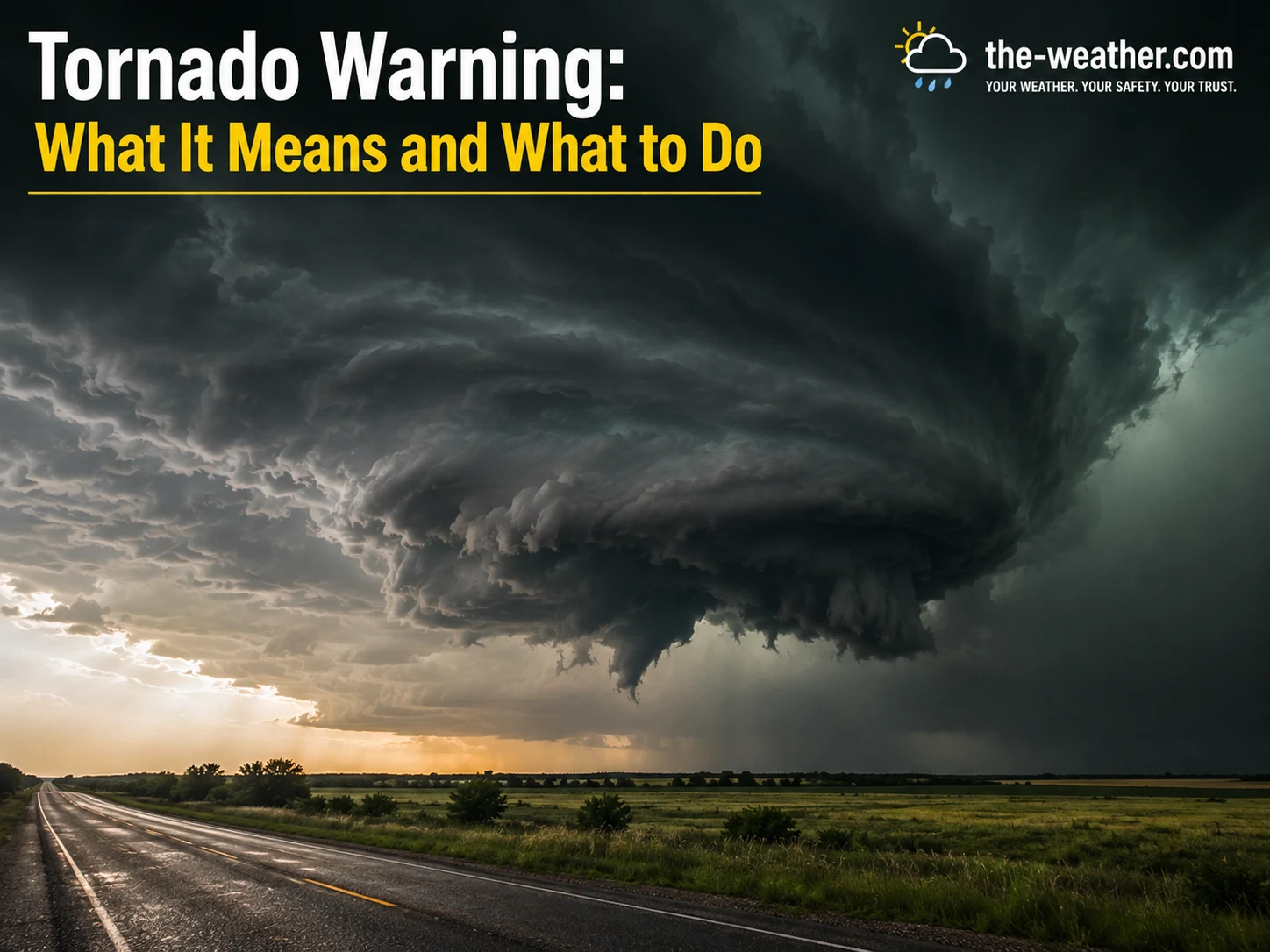

A tornado warning is the most urgent alert the National Weather Service issues for tornado events. Unlike a tornado watch, which signals that conditions are favourable for tornado development, a warning means a tornado has already been confirmed by a trained spotter on the ground or detected by Doppler radar. When a warning is issued for your county, the tornado is either already on the ground or imminent.
Tornadoes are the most violent atmospheric storms on Earth. An EF5 tornado produces wind speeds exceeding 200 mph and can level reinforced concrete structures. Even a weak EF0 tornado at 65 mph is capable of causing serious injury and significant property damage. The difference between life and death during a tornado warning is almost always a matter of whether the occupants were in the right shelter before the storm arrived.
Tornado Warning vs Tornado Watch: The Key Difference
Atmospheric conditions are favourable for tornadoes to develop. No tornado has been confirmed yet. Be prepared to act. Monitor NOAA Weather Radio, know your shelter location, and be ready to move immediately if a warning is issued. A watch may cover a large area for several hours.
A tornado has been confirmed by a spotter or detected on Doppler radar. It is occurring or imminent in the warned area. Take shelter immediately. Go to the lowest floor of a sturdy building, interior room, away from windows. Do not wait to see the tornado or receive additional confirmation.
| Alert type | Meaning | Urgency | Action | Typical duration |
|---|---|---|---|---|
| Tornado Watch | Conditions favourable for tornadoes | Moderate | Prepare, monitor updates | 4 to 8 hours |
| Tornado Warning | Tornado confirmed or radar-indicated | Immediate | Take shelter now | 30 to 60 minutes |
| Tornado Emergency | Large, violent tornado threatening populated area | Extreme | Take shelter now, deepest interior | 15 to 45 minutes |
| Severe Thunderstorm Warning | Large hail or damaging winds confirmed | High | Seek shelter, move inside | 30 to 90 minutes |
How the NWS Issues Tornado Warnings
Tornado warnings are issued by local National Weather Service offices based on two types of evidence. The first is a confirmed sighting by a trained storm spotter on the ground. The second is a radar-indicated tornado, identified by Doppler velocity data showing the characteristic rotating signature of a mesocyclone or confirmed debris signature at the surface.
A radar-indicated warning may be issued before a tornado has touched down, giving residents precious additional minutes to reach shelter. A spotter-confirmed warning means the tornado is already on the ground. Both carry equal urgency. The NWS does not wait for visual confirmation before issuing a warning when radar data is conclusive.
What to Do Immediately When a Tornado Warning Is Issued
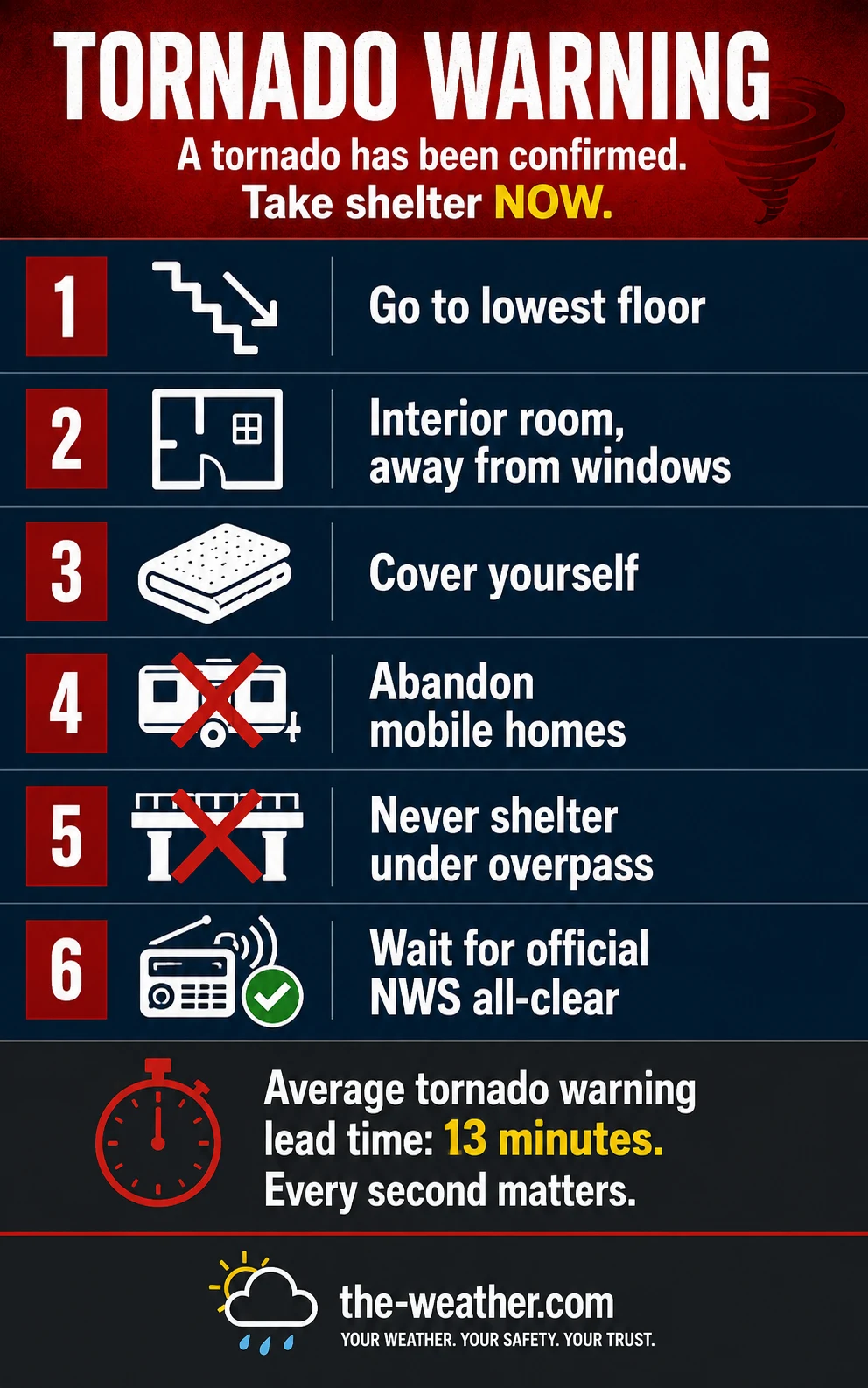
- Stop what you are doing and move to shelter immediately. Do not finish a phone call, gather belongings, or wait to confirm the warning through a second source. The warning has already been confirmed by the NWS. Every second spent not moving toward shelter is a second closer to the tornado arriving.
- Go to the lowest floor of a sturdy building. Basement or storm cellar is the safest option. If no basement is available, go to an interior room on the lowest floor, such as a bathroom, closet, or hallway, away from all exterior walls and windows.
- Get as many walls between you and the outside as possible. Interior rooms provide multiple walls of protection. A bathroom in the centre of a house is significantly safer than a bedroom on an exterior wall. Cover yourself with a mattress or heavy blankets if available.
- Do not open windows. This is a persistent myth. Opening windows does not equalise pressure and wastes time that should be spent reaching shelter.
- If in a vehicle, do not try to outrun the tornado. Tornadoes can change direction rapidly and move faster than traffic allows. If a tornado is visible and imminent, abandon the vehicle and seek a sturdy building. If no building is available, lie flat in a low ditch away from vehicles and trees with hands protecting your head.
- If in a mobile home or temporary structure, evacuate immediately. Mobile homes provide virtually no protection against tornadoes even when tied down. Move to a nearby sturdy building before the tornado arrives. If a warning is issued and no building is accessible, a low ditch is safer than remaining in a mobile home.
- Monitor NOAA Weather Radio for the warning cancellation. Do not leave shelter until the warning has been officially cancelled. A tornado warning remains active until the NWS issues a cancellation or the warning period expires. Do not assume it is safe because the sound has stopped.
Warning Polygons: Why Your Exact Location Matters
Since 2007 the National Weather Service has issued tornado warnings as storm-based polygons rather than county-wide alerts. Instead of warning an entire county, the NWS draws a precise polygon around the projected path of the storm, targeting only the area directly at risk. A warning polygon may cover only a portion of a county, or it may cross multiple county lines following the storm's actual track.
This matters for two reasons. First, if you are in the warned county but outside the polygon boundary, you are not in the immediate threat area, though you should still monitor the situation closely. Second, if you are inside the polygon, the warning is specifically for your location and you should act immediately regardless of where you are within the county. Modern weather apps display warning polygons on a map. Cross-referencing your location against the polygon boundary takes 10 seconds and tells you precisely whether you are in the direct path.
Common Tornado Myths That Cost Lives
These are the most widely circulated tornado misconceptions. Several of them have directly contributed to deaths by leading people to take dangerous actions during a warning.
False. Structural damage from tornadoes is caused by extreme wind pressure and flying debris, not pressure differential. Opening windows wastes critical shelter time and may actually increase damage by allowing wind to enter the structure. Go to shelter immediately, do not open windows.
False and deadly. Wind speeds are amplified in the narrow gap beneath an overpass and debris is funnelled through it at high velocity. Multiple deaths have been directly attributed to this myth. A low ditch away from vehicles and trees is safer than an overpass. A sturdy building is far safer than either.
False. Tornadoes have struck downtown areas of major US cities including Dallas, Nashville, Atlanta, and Salt Lake City. Urban terrain does not deter tornadoes. Tall buildings and urban canyons can alter local wind patterns but do not prevent tornado impacts.
Usually false and often fatal. Tornadoes can move at 60 mph or faster and can change direction unpredictably. Traffic, road geometry, and limited visibility make vehicle escape unreliable. If a tornado is not immediately visible and a good escape route is clear, driving at right angles to the storm's path may create distance, but seeking a sturdy building is always the safer option.
False. This myth originated from the idea that tornadoes move from southwest to northeast and debris falls northwest of the path. In reality, tornado paths and debris fields are highly variable. The safest basement position is under a heavy workbench or staircase, away from windows on any side, covered by a mattress or blanket.
Where to Shelter During a Tornado Warning
Shelter choice is the single most important factor in tornado survival. These are the options in order of safety, from best to worst.
A purpose-built storm shelter or basement provides the highest level of protection. Underground shelters are rated to withstand EF5 winds. If you live in Tornado Alley, a storm shelter is the most important home safety investment available.
A poured concrete or block basement with the floor above intact provides strong protection. Stay away from windows even in the basement. Get under a heavy workbench or staircase for additional overhead protection.
An interior bathroom, closet, or hallway on the lowest floor, away from all exterior walls and windows. Cover yourself with a mattress or heavy blankets. This is the best option when no basement is available.
Mobile homes and vehicles provide virtually no protection against tornadoes. Abandon immediately and seek a sturdy building. If no building is accessible, a low ditch away from vehicles and trees is safer than remaining in a mobile home or car.
A highway overpass is one of the most dangerous places to shelter during a tornado. Wind speeds are amplified in the gap beneath the overpass and flying debris is funnelled through it. This is a widely circulated myth that has led to deaths. Never shelter under an overpass.
Gymnasiums, auditoriums, warehouses, and shopping centres have wide roof spans with minimal interior support. These roofs collapse readily under tornado winds. If caught in one, move to a small interior room or restroom if time allows.
Tornado Warning: Decision Flowchart
Go to lowest floor, interior room, away from windows. Now.
Find nearest sturdy building immediately
Abandon immediately. Seek any sturdy building.
Lie flat in low ditch, away from trees and vehicles. Hands over head.
Who Is Most at Risk During a Tornado Warning
Mobile homes are the most dangerous place to be during a tornado regardless of tie-down anchoring. A tornado watch in your area is the signal to identify a nearby sturdy building before a warning is issued. Do not wait for the warning to make this plan.
Night-time tornadoes are significantly more deadly than daytime tornadoes. People who are asleep cannot see approaching weather or hear sirens from inside a closed home. A NOAA weather radio with a 90dB siren in the bedroom is the only reliable alert system for sleeping households.
Tents, campers, and open-air work sites provide no tornado protection. A portable NOAA weather radio with SAME county programming provides alerts even in areas with no cell coverage. The Midland ER310 is the standard recommendation for this use case.
Vehicles are extremely vulnerable to tornado winds. A car can be rolled and thrown significant distances by EF2 or higher winds. If a tornado warning is issued while driving, seek a sturdy building immediately. Do not shelter under an overpass.
Gymnasiums, auditoriums, and open-plan office floors have large roof spans that collapse readily under tornado winds. Staff and students should know the designated shelter rooms in advance. Do not shelter in a gymnasium during a tornado warning.
Many urban apartments and townhouses have no basement. Know in advance which floor and which interior room provides the best protection. An interior bathroom or stairwell on the lowest floor is the best available option in a building without a basement.
How NOAA Weather Radio Alerts You During a Tornado Warning
A tornado warning issued at 3am is the most dangerous scenario in severe weather preparedness. Outdoor sirens are designed for people who are already outside. They are not reliable for waking people inside modern well-insulated homes with windows closed and air conditioning running.
A NOAA weather radio with SAME county programming placed in your bedroom will:
- Sound an 85 to 90 dB alert siren automatically from standby, loud enough to wake most sleepers
- Broadcast the full NWS warning message including the tornado's confirmed location and projected path
- Operate on battery backup if mains power has been knocked out by the approaching storm
- Work completely independently of Wi-Fi, cell towers, and internet
- Alert only for your specific county when SAME programming is configured correctly
After the Tornado Warning Passes
Remaining in shelter until the warning is officially cancelled is as important as taking shelter in the first place. Multiple tornadoes can occur within a single warning period. A tornado that has passed your location may be followed by a second rotation within the same storm system.
- Wait for the official NWS cancellation broadcast on NOAA Weather Radio or published to the NWS website before leaving shelter.
- Check for structural damage before re-entering any building. A structure that appears intact may have compromised load-bearing elements. Do not enter a building with visible foundation cracks, leaning walls, or roof damage until it has been inspected.
- Watch for downed power lines. Treat every downed line as energised. Stay at least 30 feet away and report to your utility company immediately.
- Do not use open flame indoors until you have confirmed there are no gas leaks. If you smell gas, leave the building immediately and call your gas utility from outside.
- Check on neighbours, particularly elderly or mobility-limited residents who may need assistance after the storm.
Recommended Emergency Equipment
As an Amazon Associate we earn from qualifying purchases at no extra cost to you.
Frequently Asked Questions
What is a tornado warning?
A tornado warning is issued by the National Weather Service when a tornado has been confirmed by a storm spotter or detected by Doppler radar. It means a tornado is occurring or imminent in the warned area. Take shelter immediately in the lowest floor of a sturdy building, away from windows. Do not wait for additional confirmation.
What is the difference between a tornado warning and a tornado watch?
A tornado watch means conditions are favourable for tornado development. Be prepared. A tornado warning means a tornado has been confirmed or detected by radar and is occurring or imminent. Take shelter immediately. The watch gives you preparation time; the warning requires immediate action. Do not confuse the two.
Where should I go during a tornado warning?
Go to the lowest floor of a sturdy building, in an interior room away from windows, ideally a basement or storm cellar. If no basement is available, use an interior bathroom, closet, or hallway on the lowest floor. Cover yourself with a mattress or heavy blankets. Never shelter under a highway overpass.
How long does a tornado warning last?
Tornado warnings are typically issued for 30 to 60 minutes. The NWS will cancel the warning once the tornado has dissipated or moved out of the warned area. Do not leave shelter until the warning has been officially cancelled via NOAA Weather Radio or the NWS website. Do not assume it is safe because outdoor sounds have stopped.
Is a tornado emergency different from a tornado warning?
Yes. A tornado emergency is a rare, higher-urgency alert issued when a confirmed, large and extremely dangerous tornado is threatening a populated area. It is reserved for the most catastrophic tornado situations. The protective action is the same as a standard warning: take shelter immediately in the lowest floor of a sturdy building, away from windows, in the deepest interior room available.
Sources
Tornado warning definitions and shelter guidance from NOAA National Weather Service Tornado Safety. Enhanced Fujita Scale wind speed ranges from NOAA Storm Prediction Center. Average warning lead time from NWS performance statistics. NOAA Weather Radio information from weather.gov/nwr. No manufacturer compensation was received. As an Amazon Associate we earn from qualifying purchases.
Lena Thornton
Weather Station Analyst and CWOP Contributor. Lena has researched, reviewed and analysed weather stations and instruments for over a decade. She contributes observation data to the Citizen Weather Observer Program (CWOP) and writes exclusively for the-weather.com.