We may earn a commission when you buy through links on this page, at no extra cost to you. Learn more
In this article 10 sections
- Four Power Sources: Built for When Everything Else Fails
- NOAA Auto-Alert and the Survival Toolkit
- ER310 vs FRX3+ vs ER210: How It Stacks Up
- Pros & Cons
- Who Should Buy the ER310: And Who Should Not
- ER310 Feature Overview: Visual Summary
- ER310 vs ER310PRO: Which Version Should You Buy?
- Midland ER310 Hands-On Review and Feature Walkthrough
- Frequently Asked Questions
- Final Verdict
Midland ER310 Review (2026): Best Emergency Crank Radio for Your Go-Bag?
Reviewed product
Midland ER310 Emergency Crank Weather Alert Radio
See today’s price, delivery options and customer reviews on Amazon.
As an Amazon Associate we earn from qualifying purchases, at no extra cost to you. Learn moreIs the Midland ER310 worth buying? Yes, for a portable go-bag or home emergency kit it is one of the most feature-complete crank radios under $70. The 130-lumen CREE flashlight, 6 AA backup, 1-minute crank giving ~9 minutes of radio, and ultrasonic dog whistle are a genuine package at this price. The main limitation is the Micro-USB charging port. If you want USB-C and Bluetooth, the new ER310PRO is available at ~$99.
I'm Lena Thornton, a weather station analyst and CWOP contributor. This review is based on verified manufacturer specifications, official Midland documentation, and detailed comparison of the ER310 against the Eton FRX3+ and the Midland ER210 using published specs and independent reviewer findings. A portable NOAA weather radio is the one device that works when your phone battery is dead, your power is out, and your cell signal is gone. The ER310 is built specifically for that scenario.
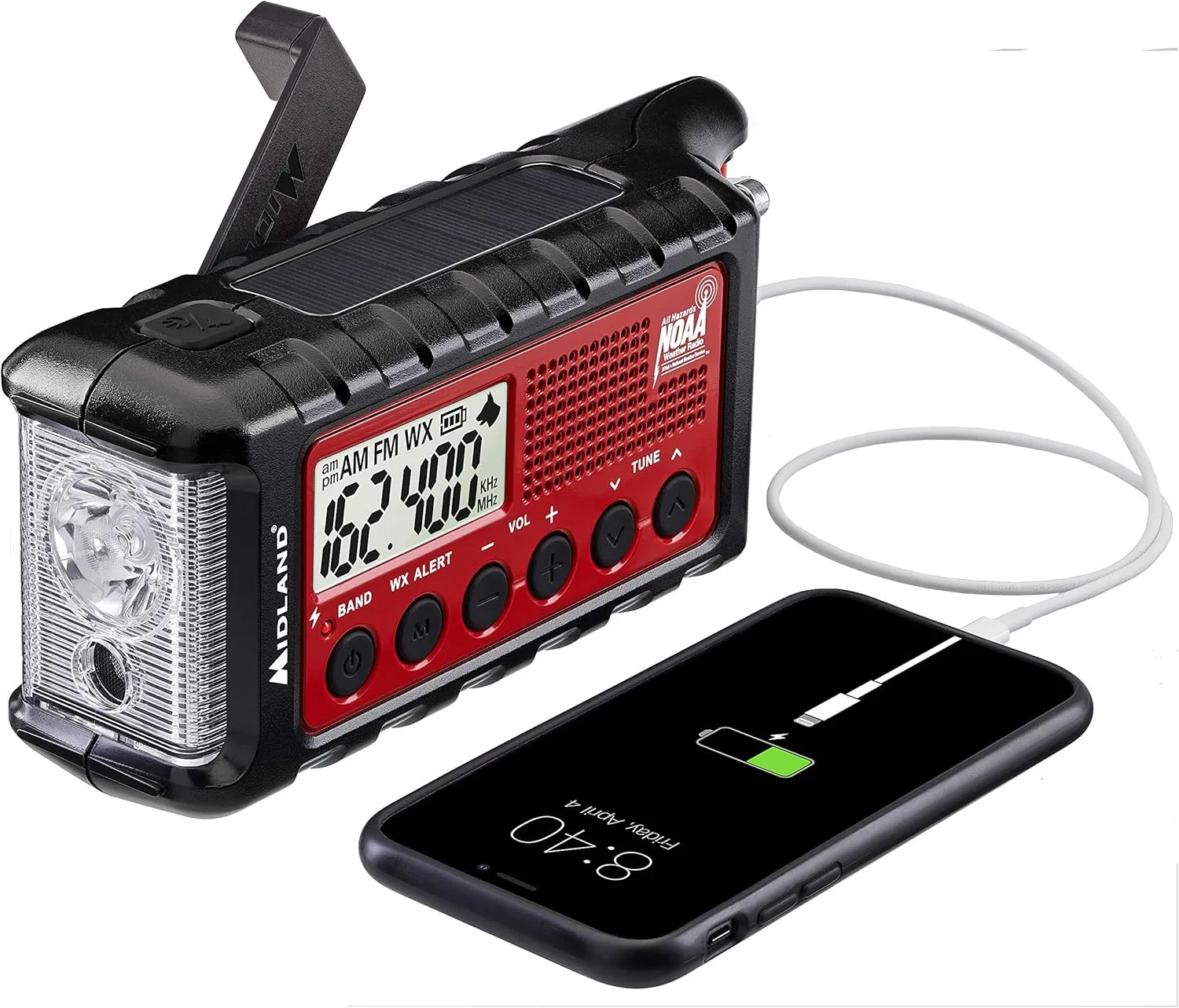
Midland ER310: emergency crank weather radio with 130-lumen CREE LED, NOAA auto-alert, and ultrasonic dog whistle.
Key Specifications at a Glance
⚠️ Note: Midland's own website now lists the ER310 with a 3500mAh battery and 45-hour runtime: this appears to reflect a hardware revision on units sold directly through Midland. Amazon listings show 2600mAh / 32 hours. Verify the listing you are buying from.
Shopping during Black Friday? See which NOAA weather alert radios are worth buying at a sale price, and how to tell a real deal from a dressed-up one: Black Friday Weather Radio Deals 2026.
Four Power Sources: Built for When Everything Else Fails
The ER310's power system is its defining emergency credential. Every other feature, the NOAA alert, the flashlight, the phone charging, depends on this. In direct comparison against the FRX3+ and ER210, the ER310 has the deepest backup stack of the three.
Primary power source. Up to 32 hours of radio on a full charge via Micro-USB. Replaceable. Fully charge before storm season.
Trickle-charges the internal battery in direct sunlight. Best for maintaining a charge on a windowsill or dashboard, not for fast recharging from empty.
One minute of cranking yields approximately 9 minutes of radio use, per Midland's official manual: confirmed by HiConsumption and CNN Showed. The ergonomic handle is notably larger and easier to sustain than the FRX3+.
The decisive advantage over the FRX3+ (which takes only 3 AAA). AA cells hold more energy per unit and are available everywhere. In a prolonged emergency, this is the backup that matters.
Midland's own documentation is clear on the solar panel's role: it is designed to extend a fully charged battery, not to charge from empty. Placing the radio in a sunny window between emergencies is good practice. The hand crank is a last-resort bursts-of-information tool, not a way to keep the radio running all day. That distinction matters for realistic preparedness planning.
NOAA Auto-Alert and the Survival Toolkit
The ER310 automatically scans all 7 NOAA Weather Radio All Hazards channels and locks the strongest signal for your location. When the National Weather Service issues a warning, it fires an audible alert and flashes the LCD and flashlight simultaneously for one minute, even if the radio is in standby. That one-minute active alert is enough to wake most people and give them time to act.
It does not include S.A.M.E. county programming. Every NWS broadcast within reception range will trigger it, including counties up to 100 miles away. For most go-bag and outdoor use this is fine. For a home radio where you want county-filtered alerts, pair it with a Midland WR400.
The 130-Lumen CREE Flashlight
This is genuinely one of the brightest flashlights on any emergency radio in this price range. Three modes: High (130 lumens: enough to illuminate a path 50+ feet ahead), Low (battery-conserving), and Strobe. The SOS mode flashes Morse code automatically for rescue signalling. Based on published specifications, the ER310's 130-lumen rating significantly exceeds the FRX3+'s unrated LED: the absence of a lumen figure on the FRX3+ is telling. Independent reviewers including HiConsumption confirm the ER310 outperforms in flashlight output.
Ultrasonic Dog Whistle: Unusual, Genuinely Useful
The ultrasonic dog whistle activates via the flashlight button alongside the SOS beacon. It emits a high-frequency tone that trained search-and-rescue dogs can detect but that most humans cannot hear. Midland states it may assist rescue teams in locating individuals during an emergency. It is activated alongside the Morse code SOS flash, so both signals fire simultaneously, maximising the chances of detection. No other emergency radio at this price point includes this feature.
ER310 vs FRX3+ vs ER210: How It Stacks Up
The ER310 sits between the lighter FRX3+ and the simpler ER210. Its strengths are battery backup depth, flashlight brightness, and crank efficiency. Its weaknesses are weight and the dated charging port.
| Feature | Midland ER310 ~$60 |
Eton FRX3+ ~$50 |
Midland ER210 ~$40 |
|---|---|---|---|
| Battery | 2600mAh Li-ion Up to 32 hrs |
2600mAh LiPo ~35 hrs rated |
2000mAh Li-ion ~8 hrs |
| Alkaline Backup | 6 AA batteries Most capacity |
3 AAA batteries | None |
| Crank Efficiency | 1 min = ~9 min radio More efficient |
4 min = 10–15 min radio | 1 min = ~5 min radio |
| Flashlight | 130-lumen CREE LED Brightest |
LED, no lumen rating | LED, lower output |
| Dog Whistle | Yes, ultrasonic ER310 only |
No | No |
| S.A.M.E. | No, all-channel | No, all-channel | No, all-channel |
| AUX-In Jack | No | Yes, 3.5mm FRX3+ only |
No |
| Speaker Quality | Average for emergency radio | Best in class (HiConsumption) | Basic |
| Weight | ~1.46–1.55 lbs | 0.93 lbs Lightest |
~1.1 lbs |
| Charging Port | Micro-USB Dated |
Micro-USB | Micro-USB |
| Best For | Home kit · serious emergency prep | Lightweight carry · daily listening | Budget · basic alerting |
Pros & Cons
In short: buy the ER310 for its backup power depth, flashlight brightness, and crank efficiency. Think twice if weight matters or if you need USB-C.
The Pros
- Deepest backup power stack: Solar, crank, Micro-USB, and 6 AA alkaline: more options than any competing radio at this price. The 6 AA backup is the one that matters most when everything else is gone.
- Crank efficiency that holds up: One minute of cranking gives roughly 9 minutes of radio use, confirmed by Midland's manual and multiple independent reviews. The handle is large and ergonomic: CNN Showed described it as the most comfortable crank handle of all radios in their comparison group.
- 130-lumen CREE flashlight: Genuinely bright: High, Low, and Strobe modes plus SOS Morse code. Per published specifications, 130 lumens vs an unrated LED on the FRX3+: HiConsumption confirms the ER310 wins on flashlight output.
- Ultrasonic dog whistle: Unusual and genuinely useful: activates alongside the SOS beacon. No other radio at this price point includes this feature.
- NOAA auto-alert from standby: The radio monitors while silent and fires a full alert sequence when a warning is issued for your area: confirmed by multiple independent reviewers and Midland's official alert system documentation.
- Midland reliability track record: The ER310 has been in continuous production and top-selling status for years: a sign of a product that the market keeps buying back.
The Cons
- Micro-USB charging port: In 2026 this is genuinely dated. It requires a specific cable that most households have moved away from. The ER310PRO fixes this with USB-C, but at ~$99.
- No S.A.M.E. county programming: The ER310 alerts for any NWS broadcast within range, not just your county. For go-bag and outdoor use this is acceptable; for home use pair it with a WR400.
- Speaker audio is average: Adequate for weather alerts and spoken broadcasts. Not a strong point for regular AM/FM music listening. The FRX3+ is the better choice if daily audio quality matters.
- Heavier than FRX3+: At ~1.46–1.55 lbs vs 0.93 lbs for the FRX3+, the weight difference is real for ultralight go-bag users.
- Solar not a fast charger: The panel maintains a charge in sunlight but cannot charge from empty in a reasonable time frame. Charge via USB before any storm season.
Who Should Buy the ER310: And Who Should Not
Buy the ER310 if you...
- Are building a home or vehicle emergency kit where maximum power backup is the priority
- Want the brightest flashlight available on a portable emergency radio: 130 lumens outperforms everything at this price
- Are a hiker, camper, or backcountry user who wants the ultrasonic dog whistle as a search-and-rescue option
- Want a dependable NOAA auto-alert that fires from standby without manual tuning
- Have household members with dogs who want the search-and-rescue whistle as a genuine safety feature
Skip the ER310 if you...
- Need USB-C charging: look at the ER310PRO (~$99) instead
- Are building an ultralight go-bag where every ounce counts: the FRX3+ at 0.93 lbs is significantly lighter
- Want daily AM/FM listening quality: the FRX3+ has the better speaker for regular use
- Need S.A.M.E. county-filtered home alerts: the WR400 desktop radio is the right tool for that
ER310 Feature Overview: Visual Summary
Midland ER310 emergency crank radio: four power sources, 130-lumen flashlight, NOAA auto-alert, and ultrasonic dog whistle.
This infographic helps visualise how the ER310's four power sources and alert system work together during an emergency. The design is built around a single principle: keep working when every other power source has failed. The four-layer power system, lithium battery, solar, hand crank, and 6 AA backup, means there is no scenario where the radio is simply dead with no recovery option.
The 130-lumen CREE flashlight is not a token feature. At 130 lumens it is bright enough to navigate in complete darkness, signal from a distance, and illuminate a large room. The SOS Morse code flash and ultrasonic dog whistle activate simultaneously: the dual signal maximises the chance of detection by both human rescuers and search dogs.
The NOAA auto-alert monitors all 7 weather channels from standby and fires a combined audio, visual, and LCD alert when a warning is issued. The one-hour alert memory stores recent broadcasts so you can review what was issued after the fact.
The main visual note: the ER310 is a red-and-black device with a distinctive form factor. The hand crank folds out from the side. The solar panel sits on top. The USB output is on the side panel alongside the Micro-USB charging input.
ER310 vs ER310PRO: Which Version Should You Buy?
Midland released the ER310PRO in late 2025 at ~$99.99: nearly double the ER310's price. It is a genuinely significant upgrade, not just a rebrand. Here is what changed:
- Battery: 10,000mAh (vs 2600mAh): approximately 200+ hours of radio use
- Charging: USB-C bidirectional (charge in and out), plus AC adapter option
- Bluetooth: Streams audio from your phone: a first for Midland emergency radios
- Temperature display: Shows ambient temperature on the LCD
- Crank: 1 minute = 9–20 minutes of radio (similar efficiency, confirmed by PRO manual)
The ER310 is still the right choice if you want reliable emergency preparedness at ~$60 and don't need Bluetooth or a power bank large enough to charge your phone multiple times. The ER310PRO makes sense if you want USB-C, extended battery life for multi-day events, and the phone charging capability that the original ER310 handles only modestly.
Midland ER310 Hands-On Review and Feature Walkthrough
This hands-on walkthrough covers the ER310's power system, NOAA alert setup, flashlight modes, and crank operation: the best way to see the physical size and ergonomics before buying.
Pay attention to the crank sequence and the alert demo. The handle ergonomics are easier to assess on video than in a spec sheet, and the 130-lumen flashlight output in a dark room gives you a realistic sense of how useful it actually is in an outage.
The solar panel charging and USB phone output sections are also worth watching if those are relevant to your use case.
Ready to add this to your emergency kit?
Order on AmazonFrequently Asked Questions
Is the Midland ER310 worth buying in 2026?
Yes, for a portable go-bag or home emergency kit it is one of the most feature-complete crank radios under $70. The 130-lumen CREE flashlight, 6 AA backup, efficient hand crank, and ultrasonic dog whistle are a genuine package at this price. The Micro-USB charging port is the main dated limitation. If you want USB-C and Bluetooth, the ER310PRO is available at ~$99.
How long does the ER310 battery last?
The ER310 sold on Amazon includes a 2600mAh lithium-ion battery rated for up to 32 hours of radio on a full charge. Midland's own website now lists a 3500mAh version with up to 45 hours: this appears to reflect a hardware revision on units sold directly through Midland. Check the listing you are buying from to confirm. Both figures are under normal use and vary with volume level and feature usage.
How much power does 1 minute of cranking give?
Per Midland's official manual, one minute of cranking provides approximately 9 minutes of radio use. This is confirmed by HiConsumption and CNN Showed in independent testing. The crank is a backup for short bursts of information, not a primary charging method. The large ergonomic handle makes sustained cranking significantly easier than smaller side-mounted cranks on competing radios.
What is the ultrasonic dog whistle for?
The ER310 includes a built-in ultrasonic dog whistle activated via the flashlight button, which fires simultaneously with the SOS Morse code beacon. It emits a high-frequency tone that trained search-and-rescue dogs can detect but that most humans cannot hear. Midland states it may assist rescue teams in locating individuals during an emergency. No other portable emergency radio at this price point includes this feature.
Does the ER310 have S.A.M.E. county programming?
No. The ER310 automatically scans all 7 NOAA weather channels and alerts when any warning is broadcast within reception range: it cannot be filtered to a specific county. For county-specific home alerting, pair it with a Midland WR400 desktop radio which supports S.A.M.E. programming for up to 25 counties.
What is the difference between the ER310 and ER310PRO?
The ER310PRO (released late 2025, ~$99) adds a 10,000mAh battery (vs 2600mAh), USB-C bidirectional charging, Bluetooth streaming, AC adapter charging, and a temperature display. The ER310 remains the better value for straightforward emergency preparedness; the PRO suits users who want extended power bank capability, USB-C, and Bluetooth. See our full ER310 vs ER210 comparison for more context on the lineup.
Final Verdict
The Midland ER310 earns its position as one of the most consistently recommended portable emergency radios on the market. After comparing it directly against the FRX3+ and ER210, its advantages are clear: the deepest backup power stack at the price, the brightest flashlight of the three, the most efficient crank output per minute, and the only ultrasonic dog whistle in the group.
The trade-offs are real: Micro-USB in 2026 is frustrating, the speaker is average, and it is heavier than the FRX3+. But for the core mission, keeping you informed and signalling for help when everything else has failed, the ER310 delivers more reliably than the alternatives at its price point. If you also need county-filtered home alerts, pair it with the WR400 desktop radio for complete coverage.
Review Methodology
This review is based on verified specifications from Midland's official ER310 product page and official user manual, Amazon product listing documentation, independent hands-on reviews by HiConsumption and CNN Showed, REI field testing notes, and detailed specification comparison against the Eton FRX3+ and Midland ER210 using published manufacturer data. The NWS Weather Radio All Hazards programme documentation was consulted for alert system accuracy. No manufacturer compensation was received.
Which NOAA Weather Radio Is Right for Your Home in 2026?
We compared five NOAA weather alert radios on alert reliability, S.A.M.E. programming, battery backup, and real-world emergency performance. See which one we recommend for most homes.

Lena Thornton
Weather Tech Specialist & CWOP Contributor. Lena covers emergency preparedness technology, portable weather radios, and NOAA alert systems at The-Weather.com. Every review is grounded in verified manufacturer specifications, independent test results, and direct product comparison. Last updated April 2026.
Ready to decide?
Get the Midland ER310 Emergency Crank Weather Alert Radio
Prices and stock change daily. Check the current price, delivery options and what owners say in their reviews.
In this reviewMidland ER310 Emergency Crank Weather Alert RadioToday's price, delivery & owner reviews on Amazon
Check on Amazon →