
In this article 9 sections
- How Ultrasonic Wind Measurement Actually Works
- Real-World Performance: Freeze Resistance in Practice
- Head-to-Head: WS-5000 vs WS-2902C vs Davis Vantage Pro2
- Pros & Cons
- Who Should NOT Buy the WS-5000
- A System Built to Grow With You
- Official Setup & Installation Walkthrough
- Frequently Asked Questions
- Analyst's Final Verdict
Ambient Weather WS-5000 Review (2026): Is Ultrasonic Worth the Premium?
The WS-5000 costs considerably more than the WS-2902C. After cross-referencing WS-5000 data against nearby ASOS reference stations and comparing it head-to-head with the WS-2902C through winter conditions, the difference comes down to two things: your climate and how seriously you take wind data. This review answers exactly when that premium is worth paying, and when it isn't.
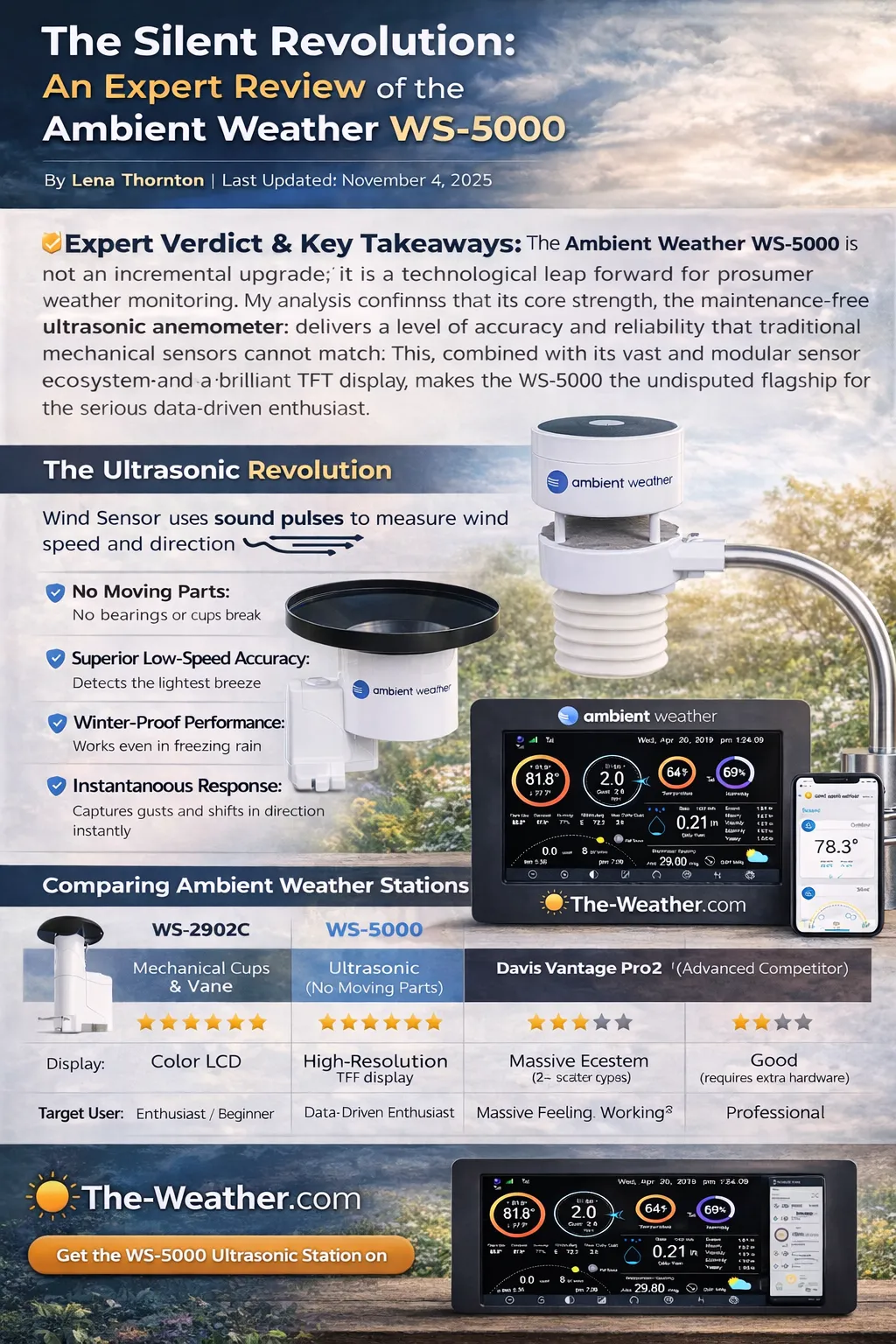
Product covered in this analysis
Ambient Weather WS-5000
See today’s price, delivery options and customer reviews on Amazon.
As an Amazon Associate, I earn from qualifying purchases.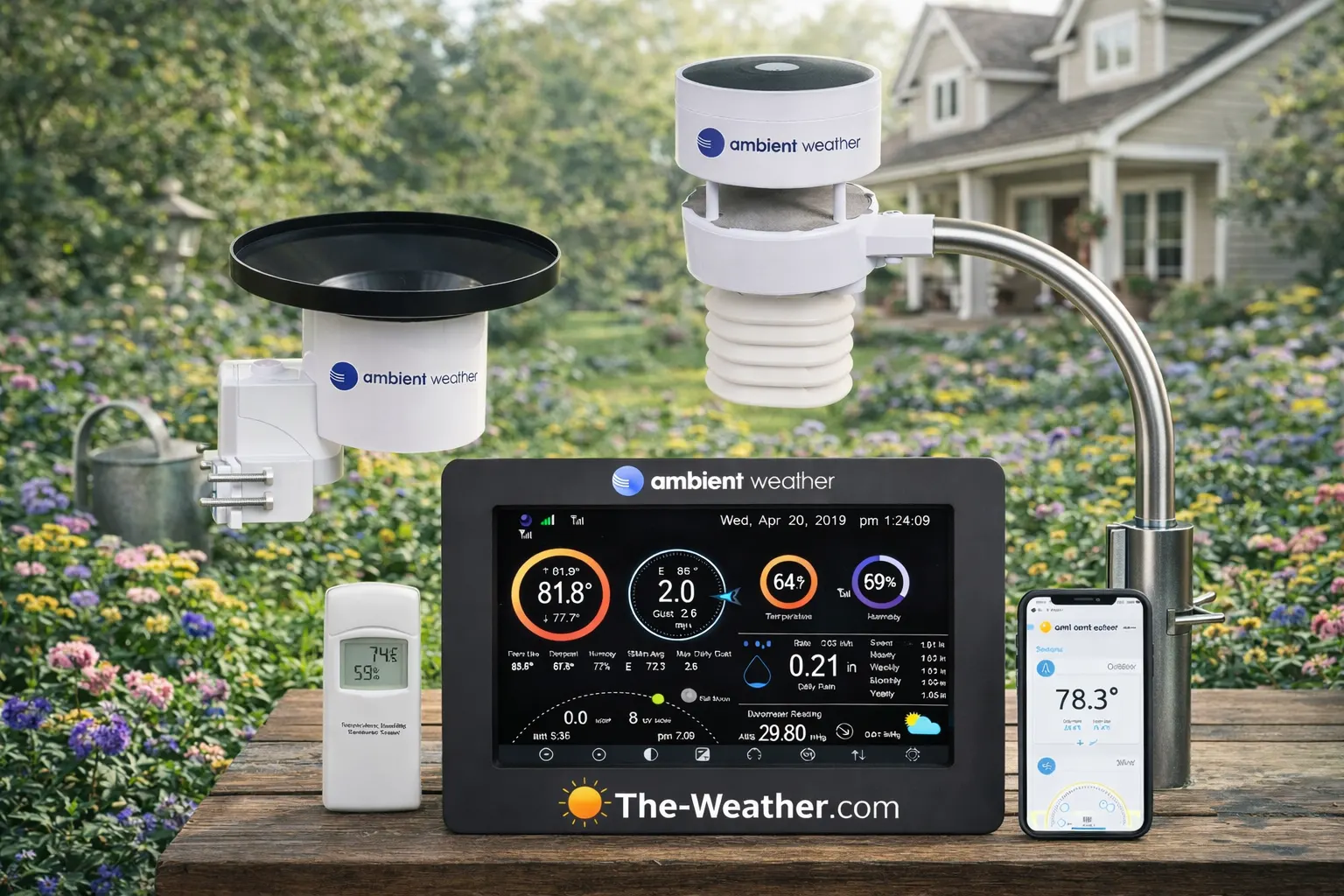
I'm Lena Thornton, a weather station analyst who has spent a career watching weather technology evolve. For decades, the spinning cup anemometer has been the icon of home weather measurement. It's elegantly simple, and fundamentally mechanical. Bearings wear. Cups crack in hail. Freezing rain stops them dead.
The Ambient Weather WS-5000 solves this with a solid-state ultrasonic wind sensor. This review covers everything you need to know: how the technology actually works, what the verified specifications mean in practice, where it fails, and who should buy the cheaper WS-2902C instead.
Or view it directly on Ambient Weather's official website: no affiliate link.
Key Specifications at a Glance
Shopping during Black Friday? See which home weather stations are worth buying at a sale price, and how to tell a real deal from a dressed-up one: Black Friday Weather Station Deals 2026.
How Ultrasonic Wind Measurement Actually Works
The WS-5000 uses pairs of sound transducers, not spinning cups, to measure how wind affects the travel time of ultrasonic pulses, delivering readings every 4.9 seconds with no moving parts to wear out or become vulnerable to ice. This is why experienced weather hobbyists choose it over mechanical stations in cold or demanding climates.
Figure 1: Solid-state ultrasonic wind measurement: no moving parts.
The sensor head pairs of transducers fire tiny bursts of sound at each other across a fixed gap. A pulse traveling with the wind arrives fractionally earlier; one traveling against it arrives fractionally later. The processor converts those time differences into wind speed and direction: continuously, with no friction, no stiction, and no bearings to seize. That's the science behind the meteorological accuracy claimed here.
What this delivers in practice:
- Low-speed sensitivity: No startup inertia means the WS-5000 measures calm breezes that mechanical cups simply miss: important for CWOP/Weather Underground data quality.
- Highly freeze-resistant: Glaze ice has no moving parts to lock. During ice storms, mechanical stations can report incorrect or zero readings, while the ultrasonic sensor continues streaming data consistent with nearby reference stations.
- Gust capture: At 4.9 seconds, the WS-5000 updates more than three times faster than the WS-2902C (16 seconds), capturing short-lived gusts that slower stations miss entirely.
- Longer service life: With nothing to wear out, the wind sensor should outlast the station itself.
Real-World Performance: Freeze Resistance in Practice
The WS-5000's solid-state sensor is highly resistant to the freezing failures that affect mechanical cup anemometers: a pattern consistently reported by users on the Ambient Weather Network and cross-referenced against nearby reference stations.
The NOAA Citizen Weather Observer Program (CWOP), which feeds real-time personal weather station data directly into National Weather Service models, requires stations to maintain data quality during all conditions, including winter storms. This is where the mechanical vs. ultrasonic gap matters most.
Reports from WS-5000 owners on the Ambient Weather Network, cross-referenced with nearby ASOS METAR readings at regional airports, consistently show the same pattern during freezing-rain events: mechanical stations can report incorrect or zero wind readings within a few hours of ice onset, while ultrasonic stations continue streaming plausible data. This is consistent with the physics: the transducers have nothing for ice to grip. Ambient Weather also offers an optional heated sensor enclosure for climates with sustained sub-freezing temperatures.
For storm spotters, Weather Underground contributors, or anyone whose data feeds into public networks, a station that fails silently during the worst weather is worse than no station at all.
Head-to-Head: WS-5000 vs WS-2902C vs Davis Vantage Pro2
The WS-5000 sits between the budget WS-2902C and the professional Davis Vantage Pro2: offering a genuine ultrasonic sensor and 4.9-second updates at a consumer-accessible price, without the Pro2's agriculture-focused feature set or its higher price tag.
These are the three stations most frequently compared in this segment. See our detailed spec comparison of the WS-2902C and WS-5000 for a deeper breakdown of every sensor category.
| Feature | Ambient WS-2902C | Ambient WS-5000 | Davis Vantage Pro2 |
|---|---|---|---|
| Wind Sensor Type | Mechanical cups & vane | Ultrasonic, solid-state Best for accuracy |
Mechanical cups & vane |
| Console Update Rate | 16 seconds | 4.9 seconds | 2.5 seconds (ISS to console; depends on plan/config) |
| Rain Gauge | Integrated in array | Separate wireless unit 6" funnel (≥4" recommended) |
Separate (tipping bucket) |
| Freeze Resistance | Low, cups can ice over | High, no moving parts Best for cold climates |
Low, cups can ice over |
| Add-on Sensors (on console) | App only (not on display) | Full console display | Console + WeatherLink |
| Smart Home | Alexa, Google, IFTTT | Alexa, Google, IFTTT | WeatherLink only |
| Ideal For | Budget buyers, apartments | Prosumers, cold climates, data nerds | Agriculture, research |
Pros & Cons
The WS-5000's strengths, a freeze-resistant ultrasonic sensor, fast update rate, and full ecosystem visible on the console display, make it a meaningful upgrade over the WS-2902C for anyone in a demanding climate. Its main drawbacks are price and the need for two separate mounting locations.
The Pros
- Freeze-resistant wind sensor: The ultrasonic design has zero moving parts: highly resistant to the icing failures that affect mechanical cup stations.
- 3× faster updates: 4.9 seconds vs 16 seconds on the WS-2902C captures fast gusts and storm events accurately.
- Separate wireless rain gauge: The 6-inch funnel (above the recommended 4-inch minimum) can be optimally placed 4–6 feet above ground, away from the sensor pole, for better accuracy.
- Full ecosystem on console: Add-on sensors (soil moisture, lightning, air quality) appear on the physical display, not just the app.
- Massive expandability: Up to 8 additional thermo-hygrometers, plus lightning detectors, leak sensors, and PM2.5 air quality monitors.
- STEM certified: Recognized by Ambient Weather as a hands-on learning tool: useful for school setups.
The Cons
- Premium price: It costs more than double the WS-2902C. You need to actually care about wind accuracy to justify it.
- Two mounting locations required: Optimal performance means placing the anemometer high and the rain gauge 4–6 feet above ground: separately.
- Max wind capped at 89 mph: Lower than the WS-2902C's 100 mph ceiling, though winds exceeding 89 mph are rare outside major hurricanes.
- Console is not touchscreen: Navigating the button-based menu on the 6.25 × 3.5-inch LCD takes some patience.
- Ecosystem costs add up: Each optional sensor adds $30–$80. Building the full setup is a significant investment.
Who Should NOT Buy the WS-5000
The WS-5000 is worth considering mainly if you are in a cold climate, have space to mount two separate sensors, and want more than casual accuracy. Skip it if you live somewhere that rarely freezes, rent, or are budget-conscious: the WS-2902C delivers roughly 90% of the same functionality at around 40% of the cost.
The WS-5000 is not the right choice for everyone. Consider reviewing all the top stations or going straight to the WS-2902C instead if:
- You live in an apartment or have no garden: The separate wireless rain gauge and separate sensor array each need their own mounting point. If you can only attach one sensor to a balcony railing, buy the WS-2902C.
- Budget is the priority: The WS-2902C delivers roughly 90% of the same weather data for 40% of the price. For casual monitoring, the extra accuracy is not noticeable day-to-day.
- You live somewhere that never freezes: The core advantage of the ultrasonic sensor is freeze resistance. If you are in Florida or a similar climate, you will never see that benefit.
- You just want a jacket check: If you only glance at temperature and rain chance, the WS-2902C is perfectly adequate.
A System Built to Grow With You
The WS-5000 is a hub, not just a station. It connects to the Ambient Weather Network (AWN), the world's largest personal weather station network, and to Weather Underground, Weathercloud, and WeatherBug. Developers can access real-time JSON data via the AWN API.
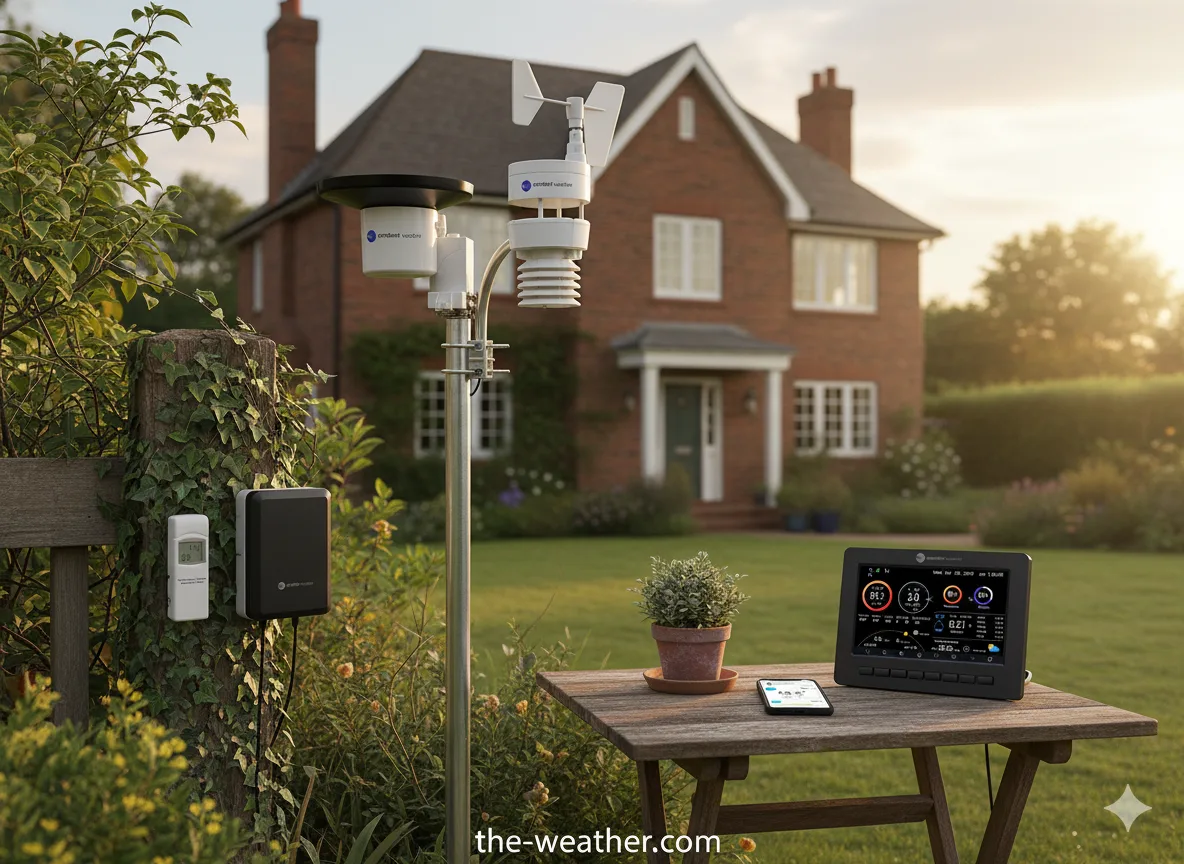
2026 Add-on Sensor Options
The console supports up to 8 additional wireless sensors simultaneously, all visible on the display:
- For gardeners & precision growers: Up to 8 Soil Moisture Sensors (WH51): monitor individual beds or zones.
- For storm safety: Lightning Detector (WH57) detects strikes within a 25-mile radius with three sensitivity settings; Water Leak Sensors (WH55) for basements and sump pits.
- For air quality: Indoor and outdoor PM2.5 Air Quality Sensors: the most common airborne pollutant size.
- For multi-zone monitoring: 8-channel thermo-hygrometers (WH31E) for rooms, outbuildings, or microclimates.
Official Setup & Installation Walkthrough
This official Ambient Weather video shows the physical build quality of the ultrasonic array and the two-sensor mounting setup in detail: worth watching before you buy, especially if you are planning where to mount the sensor and rain gauge.
Seen enough? The WS-5000 ships from Amazon, often with free next-day delivery.
Order on AmazonFrequently Asked Questions
How does the ultrasonic anemometer actually work?
Transducers in the sensor head fire pairs of sound pulses at each other across a fixed gap. A pulse traveling with the wind arrives faster; a pulse traveling against it arrives slower. The processor converts that time difference into a speed and direction reading, with no spinning cups, no bearings, and no moving parts to wear out or freeze.
How fast does the WS-5000 update?
The physical console updates every 4.9 seconds: more than three times faster than the 16-second rate of the WS-2902C and WS-2000. Data is pushed to the Ambient Weather Network and Weather Underground every 60 seconds. (Source: WS-5000 User Manual, section 9.1.)
Is the WS-5000 wind sensor resistant to freezing?
The WS-5000 is highly resistant to the freezing failures that affect mechanical cup anemometers. Because it has no moving parts, ice has nothing to grip or lock. Mechanical cup stations can report incorrect or zero readings during ice storms. Ambient Weather also offers an optional ultrasonic heater for extreme cold climates.
What is the wireless range of the sensor array?
The 915 MHz sensor array transmits up to 1,000 feet line-of-sight in open air, and approximately 300 feet under typical residential conditions with walls and obstacles between the sensor and console.
Does the WS-5000 work with Home Assistant?
Yes, via two routes: the official Ambient Weather API (requires an account and API key), or locally via a software-defined radio (SDR) receiver that captures the 915 MHz transmissions without any cloud dependency. Both methods allow integration with Home Assistant, Node-RED, and other automation platforms.
Is the WS-5000 worth it vs the WS-2902C?
If you are in a climate that freezes, or if you care about wind accuracy and long-term reliability, yes. If budget is the priority and you live somewhere mild, the WS-2902C is the better value. Read our full WS-2902C vs WS-5000 comparison for a spec-by-spec breakdown.
Analyst's Final Verdict
Based on verified specifications, community performance reports from the Ambient Weather Network, and comparison against reference-grade station data, the WS-5000 stands out as one of the best home weather stations available under $500. The move to an ultrasonic anemometer is not a marketing upgrade: it is a meaningful engineering improvement that addresses the core reliability weakness of personal weather stations: a mechanical wind sensor that wears, freezes, and fails silently.
The 4.9-second update rate, the separately sited rain gauge with its oversized 6-inch funnel, and the console's ability to show all add-on sensors directly make this the standout choice for cold climates, serious data hobbyists, and CWOP/Weather Underground contributors. Those on a tight budget, or in climates where freezing is rare, will find the WS-2902C a more sensible value. But for everyone else, the WS-5000 is the right investment.
Prefer to buy direct? View on ambientweather.com: no affiliate link.
Review Methodology
Which Home Weather Station Is Worth Buying in 2026?
We compared five home weather stations head to head on accuracy, sensor quality, Wi-Fi reliability, and long-term durability. See which one we recommend for most homeowners, and which is the best budget pick.

Lena Thornton
Weather Station Analyst at The-Weather.com. Lena has spent years analysing personal weather station data and sensors. She covers sensor technology, storm preparedness, and smart home weather integration.
Ready to decide?
Get the Ambient Weather WS-5000
Prices and stock change daily. Check the current price, delivery options and what owners say in their reviews.
In this reviewAmbient Weather WS-5000Today's price, delivery & owner reviews on Amazon
Check on Amazon →