
As an Amazon Associate, I earn from qualifying purchases.
In this article 8 sections
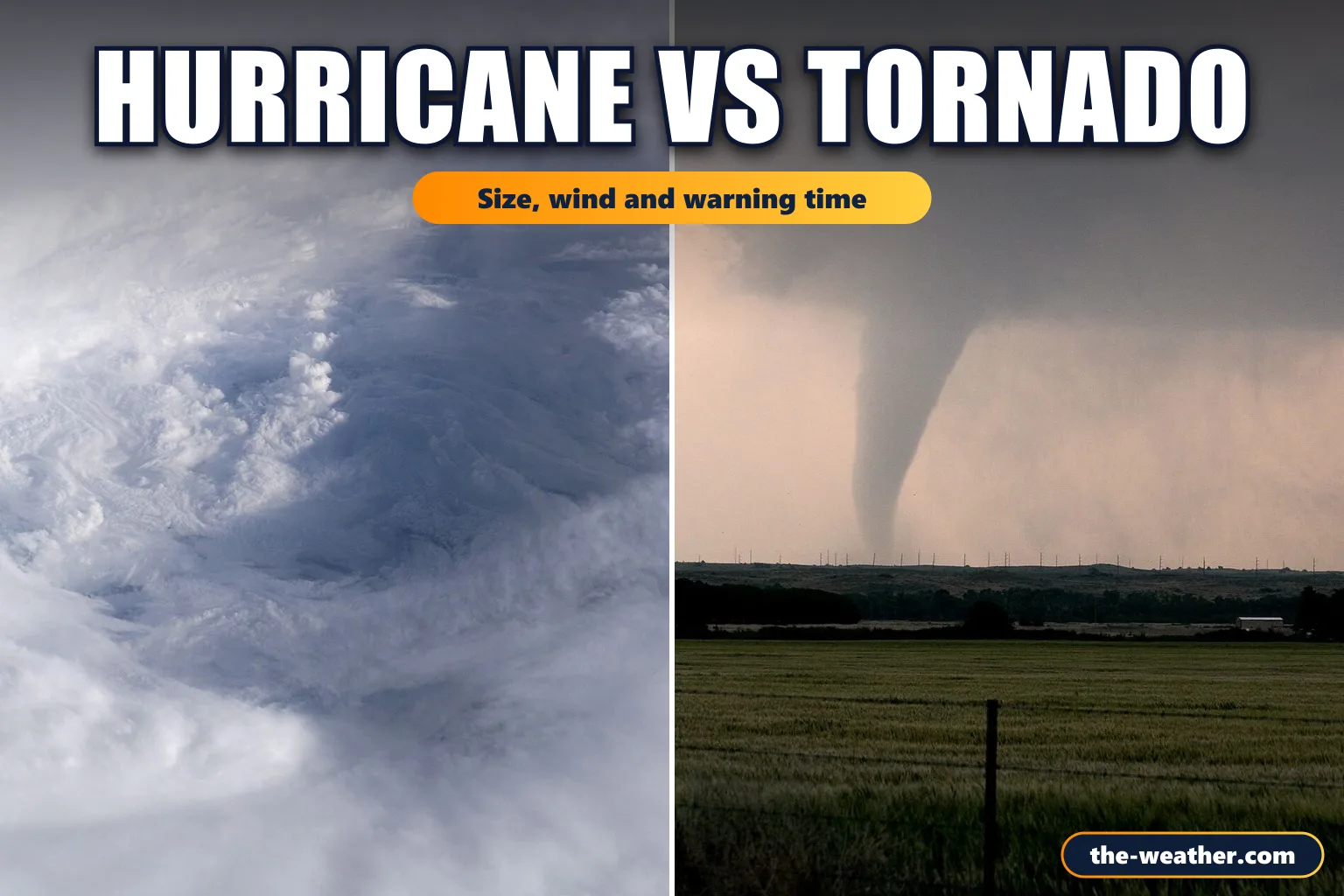
Both spin, both bring destructive wind, and both can show up in the same news week. But a hurricane and a tornado are very different storms: one can be bigger than a state and last for days, the other is often just a few hundred feet across and gone in minutes. Here is the difference, with the official numbers.
Short answer: a hurricane is a huge, long-lived storm that forms over warm tropical ocean water. NASA describes hurricanes as circulations "60 to over 1,000 miles across" that "persist over several days or weeks". A tornado is a small, violent column of rotating air that grows out of a severe thunderstorm, "rarely more than a few hundred feet across" and typically lasting "only a few minutes". Tornadoes can have stronger peak winds (NASA: 100 to 300 mph), but hurricanes affect far larger areas, and a landfalling hurricane can even produce tornadoes.
Editorial Research
- Written by
- Lena Thornton, Weather Station Analyst & CWOP Contributor
- Based on
- NASA Global Precipitation Measurement FAQ on tornadoes and hurricanes, the National Hurricane Center's Saffir-Simpson scale, the Storm Prediction Center's Enhanced Fujita scale, and NWS Columbia (SC) on tornadoes in tropical systems
- Research last verified
- October 24, 2026
Hurricane vs Tornado: Side by Side
| Hurricane | Tornado | |
|---|---|---|
| Size | 60 to over 1,000 miles across | Rarely more than a few hundred feet across at the ground |
| How long it lasts | Several days or weeks | Typically a few minutes |
| Where it forms | Always over warm tropical ocean water | Out of severe thunderstorms, mostly over land |
| Wind | 74 mph or more sustained (Category 1 starts at 74 mph) | Up to 100 to 300 mph in strong tornadoes (NASA); EF0 starts at 65 mph |
| Rating scale | Saffir-Simpson, Category 1 to 5, based on maximum sustained wind | Enhanced Fujita, EF0 to EF5, wind estimated from the damage |
| Main dangers | Storm surge, flooding rain, wind, tornadoes, over a very large area | Extreme wind and flying debris along a narrow path |
| Warning time | Days of forecasts, with watches and warnings ahead of landfall | Often minutes |
Size, duration, formation and tornado wind range from NASA GPM. Scales from the National Hurricane Center and Storm Prediction Center.
How Each One Forms
Hurricanes are fed by warm ocean water. Warm, moist air rises, thunderstorms cluster, and with the right conditions the whole system starts to rotate around a low-pressure center. NASA notes that hurricanes always form over warm tropical oceans. Over land or cold water they lose their fuel and weaken. Our page on how hurricanes form walks through the steps.
Tornadoes grow out of severe thunderstorms. NASA points to the high wind-shear environment of the U.S. Central Plains: winds that change speed and direction with height help a storm rotate, and in some storms that rotation reaches the ground as a tornado.
Both usually spin the same way. NASA says hurricanes always, and tornadoes usually, rotate counterclockwise in the Northern Hemisphere, and clockwise in the Southern Hemisphere.
The Two Rating Scales
The Saffir-Simpson Hurricane Wind Scale of the National Hurricane Center is based only on a hurricane's maximum sustained wind speed:
| Category | Sustained wind |
|---|---|
| 1 | 74-95 mph |
| 2 | 96-110 mph |
| 3 (major) | 111-129 mph |
| 4 (major) | 130-156 mph |
| 5 (major) | 157 mph or higher |
The Enhanced Fujita (EF) Scale of the Storm Prediction Center works differently. Tornado winds are almost never measured directly, so surveyors rate a tornado from the damage it leaves. The SPC stresses that the EF scale is "a set of wind estimates (not measurements) based on damage":
| Rating | Estimated 3-second gust |
|---|---|
| EF0 | 65-85 mph |
| EF1 | 86-110 mph |
| EF2 | 111-135 mph |
| EF3 | 136-165 mph |
| EF4 | 166-200 mph |
| EF5 | Over 200 mph |
One more difference: a hurricane category is known while the storm is still at sea. A tornado rating usually comes after it is over, when the damage survey is done.
Want the full hurricane scale explained? See hurricane categories.
When a Hurricane Brings Tornadoes
The two storms are not always separate. NASA notes that a hurricane making landfall may trigger many tornadoes. According to the National Weather Service office in Columbia, South Carolina, these tornadoes most often form in thunderstorms in the outer rain bands, well away from the center, mostly in the right front quadrant of the storm (relative to its direction of motion). They are usually relatively weak and short-lived, but the NWS stresses they still pose a significant threat.
That is why a hurricane warning and a tornado warning can be active for the same county on the same day. Our page on hurricane watch vs warning explains the hurricane alerts, and what to do during a tornado warning covers the tornado side.
Which Is Worse?
It depends on what you compare. At one spot, the strongest tornadoes have the most extreme winds of any storm. But a tornado's path is narrow and short. A hurricane spreads storm surge, flooding rain, damaging wind and sometimes tornadoes over hundreds of miles, for hours or days. For a whole region, a major hurricane is usually the bigger disaster. For the house in a tornado's path, a violent tornado is hard to beat.
The practical answer is the same for both: get the warning in time. Tornado warnings can come with only minutes to spare, often at night, when your phone may be on silent. A NOAA Weather Radio with alerts turned on wakes you up for both storm types. Our Midland ER40 review looks at a hand-crank emergency radio that receives NOAA weather broadcasts.
Hurricane vs Tornado FAQ
What is the main difference between a hurricane and a tornado?
Size and lifetime. NASA describes hurricanes as 60 to over 1,000 miles across, lasting days or weeks. Tornadoes are rarely more than a few hundred feet across and typically last a few minutes.
Which has stronger winds, a hurricane or a tornado?
A strong tornado. NASA gives tornado winds of 100 to 300 mph. A Category 5 hurricane has sustained winds of 157 mph or more, but over a far larger area.
Can a hurricane cause tornadoes?
Yes. A landfalling hurricane can trigger many tornadoes, mostly in the outer rain bands of the right front quadrant. They are usually weak and short-lived, but still a significant threat.
Do hurricanes and tornadoes spin the same way?
Usually. In the Northern Hemisphere hurricanes always and tornadoes usually spin counterclockwise; in the Southern Hemisphere clockwise.
Why is a tornado rated after it happens?
Because its wind is rarely measured. The Enhanced Fujita rating is an estimate based on a survey of the damage.
Update Log
- October 24, 2026: First version, based on NASA, National Hurricane Center, Storm Prediction Center and National Weather Service information.
Sources
- NASA GPM: What is the difference between a tornado and a hurricane?
- National Hurricane Center: Saffir-Simpson Hurricane Wind Scale
- Storm Prediction Center: Enhanced F Scale for Tornado Damage
- NWS Columbia, SC: Tornadoes in Tropical Systems
- Photo: NASA astronaut Ed Lu: eye of Hurricane Isabel from the International Space Station (2003); NOAA NSSL (Sean Waugh): tornado over the Kansas plains, public domain, via Wikimedia Commons
More storm basics: How hurricanes form · What is a waterspout? · What is storm surge?