
When a tornado warning is issued at 3 a.m. or the power is out for days, a NOAA weather radio still works: no Wi-Fi, no cell network, no app. The right model depends on where you will use it. A desktop alert radio wakes you up for warnings in your county; a portable crank or solar radio keeps you informed and charged when everything else is down.
Shopping during Black Friday? See which NOAA weather alert radios are worth buying at a sale price, and how to tell a real deal from a dressed-up one: Black Friday Weather Radio Deals 2026.
Live in Houston or Southeast Texas? County codes, local NOAA transmitters and a 5-step setup: weather alert radio for Houston and Southeast Texas flooding.
Quick Picks
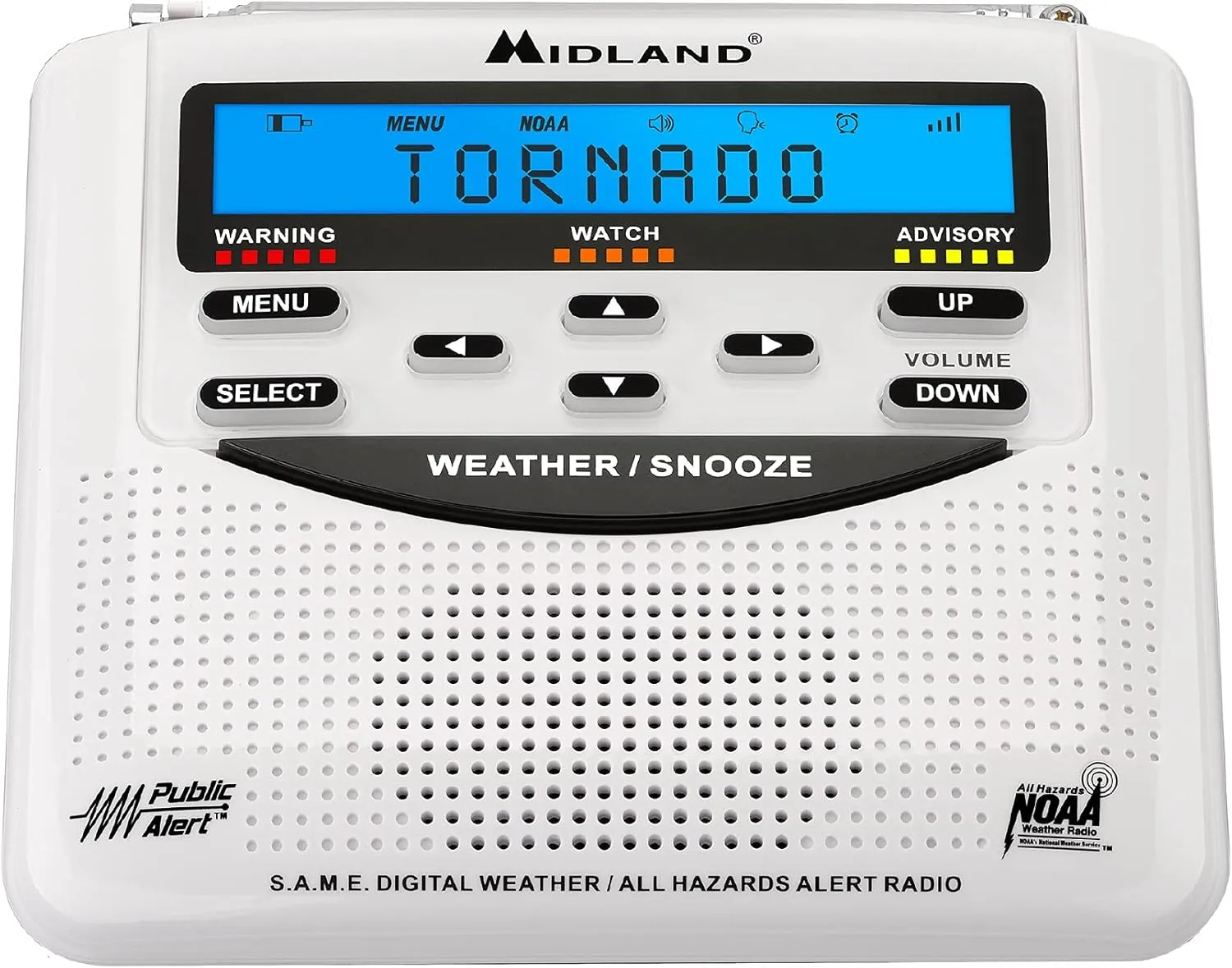
Midland WR120B
Desktop alert radio with S.A.M.E. county filtering, a 90 dB siren and battery backup.
Check price on Amazon Read our review →
Midland WR400
More alert types, voice and LED alerts, and a memory of the last 10 alerts.
Check price on Amazon Read our review →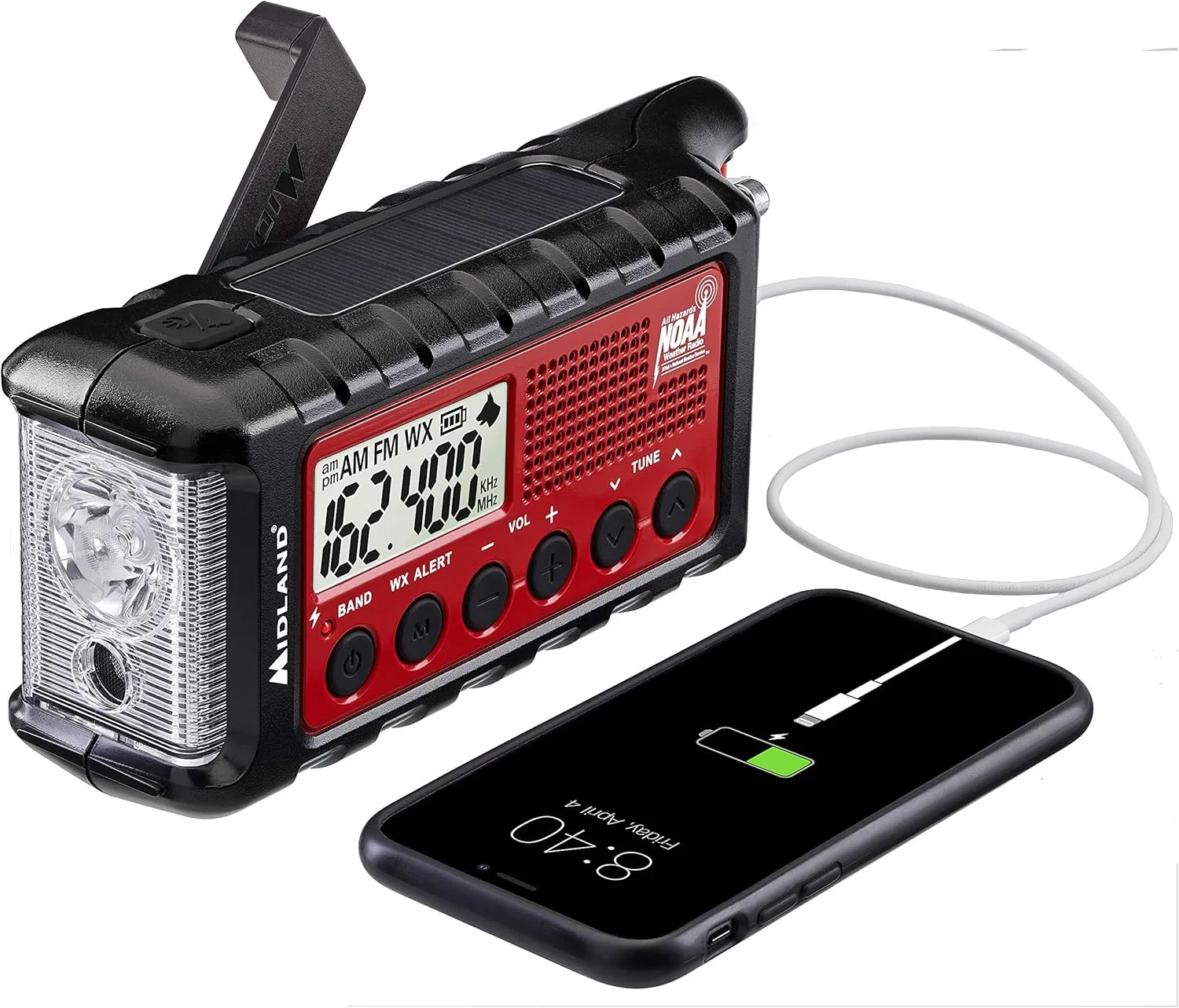
Midland ER310
Crank, solar and AA power, a bright flashlight and NOAA weather alert in one rugged radio.
Check price on Amazon Read our review →
Greadio 4000mAh
A larger battery that can top up a phone, four ways to charge and a motion-sensor lamp.
Check price on Amazon Read our review →
FosPower Solar Crank Radio
Small and light: solar, crank, USB and AAA power with AM/FM/NOAA and an SOS siren.
Check price on Amazon Read our review →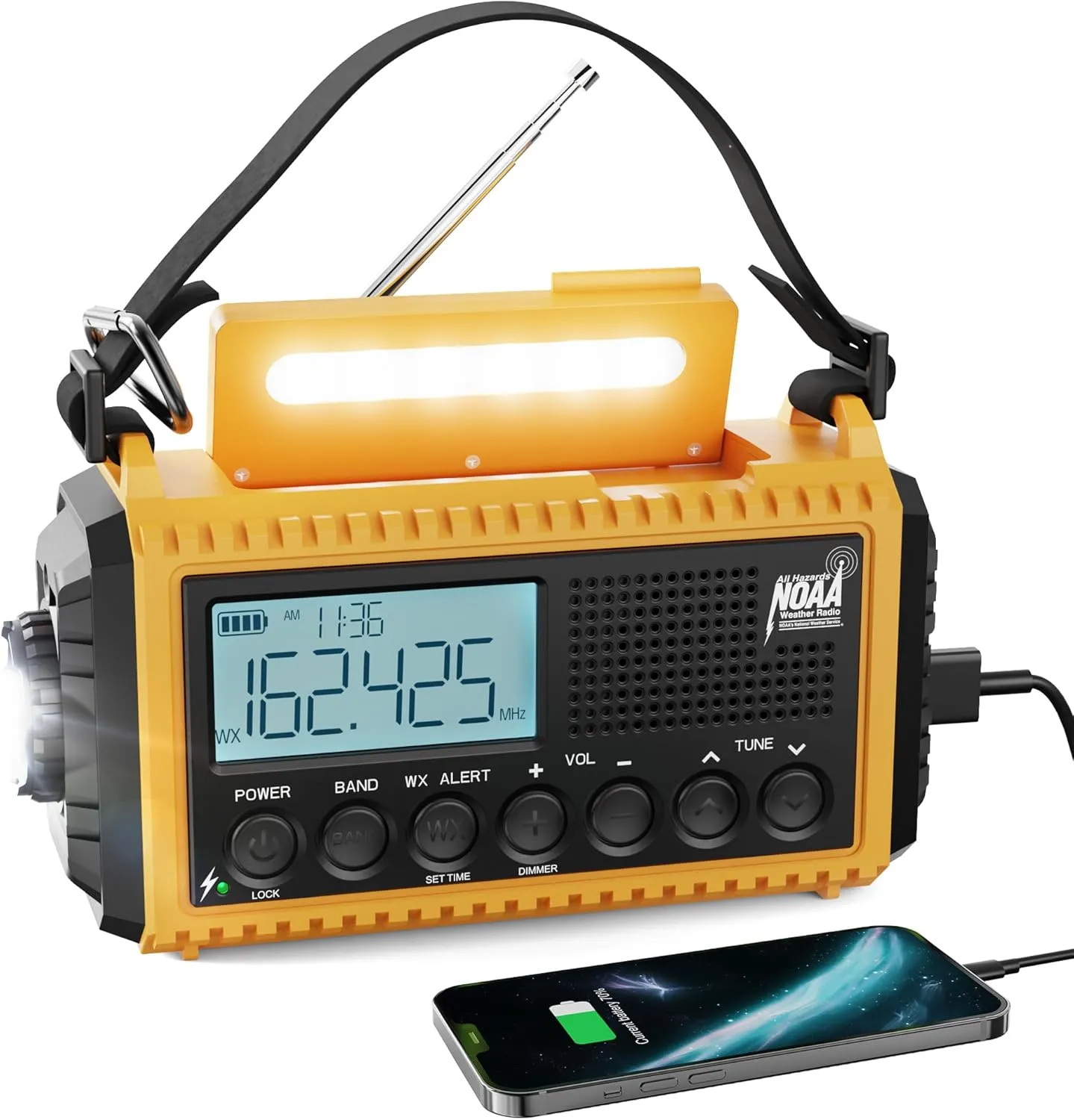
Raynic 5000mAh
A 5000 mAh battery with crank, solar and USB charging for longer outages.
Read our review →First Decide: Alert Radio, Crank Radio, or Both?
🔔 Desktop alert radio
Stays plugged in at home, silent until the National Weather Service issues a warning for your county, then sounds a loud siren, also at night. With S.A.M.E. programming it ignores warnings for other counties. How to program SAME codes. On the Gulf Coast? See the SAME codes and transmitters for twelve Gulf Coast counties.
Best for: bedrooms, tornado and flash-flood areas, anyone who must be woken up.
🔋 Portable crank or solar radio
Runs without the grid: hand crank, solar panel and batteries. Lets you follow NOAA broadcasts and AM/FM news during a long outage, adds a flashlight and can top up a phone.
Best for: go-bags, hurricanes, camping, power outages of a day or more.
Many households have both: an alert radio that wakes them up, and a crank radio in the emergency kit. Unsure whether you need one at all? Read why weather radios still work without Wi-Fi.
Side-by-Side Comparison
| Radio | Type | Alerts | Power | Best for |
|---|---|---|---|---|
| Midland WR120B | Desktop | S.A.M.E., 90 dB siren, 60+ alert types | AC + battery backup | Home, budget |
| Midland WR400 | Desktop | S.A.M.E., 85 dB siren, voice + LED, 80+ alert types | AC + battery backup | Bedside |
| Midland ER310 | Portable | NOAA weather alert | Crank, solar, 2600 mAh, AA | Go-bag |
| Greadio 4000mAh | Portable | NOAA weather band | Crank, solar, USB, 4000 mAh | Outages, phone charging |
| FosPower | Portable | NOAA weather band, SOS siren | Crank, solar, USB, AAA | Small kits |
| Raynic 5000mAh | Portable | NOAA weather band | Crank, solar, USB, 5000 mAh | Long outages |
Figures are manufacturer specifications as summarized in our reviews.
1. Midland WR120B: Best for Home
The WR120B does one job very well: it stays quiet until there is a warning for your county, then sounds a 90 dB siren with a color-coded light. S.A.M.E. programming lets you store up to 25 counties, and batteries keep it working when the power fails. It is the radio we suggest for most bedrooms and kitchens.
- S.A.M.E. county filtering: fewer false alarms
- Loud 90 dB siren with three volume levels
- Battery backup during power outages
- Desktop radio: not made for a go-bag
- Programming takes a few minutes with the manual
Check the WR120B on Amazon Full WR120B review →
2. Midland WR400: Best Bedside Alert Radio
The WR400 adds more alert types, voice alerts, LED flash and a silent mode, and remembers the last 10 alerts so you can see what you missed. Its 85 dB alarm is loud enough to wake a household. Choose it over the WR120B if you want more control over how you are alerted.
- 80+ alert types with siren, voice, LED or silent modes
- Alert memory for the last 10 alerts
- S.A.M.E. county programming
- Desktop only; not battery-only portable
- Costs more than the WR120B
Check the WR400 on Amazon Full WR400 review →
3. Midland ER310: Best for the Go-Bag
The ER310 is built for when the grid is down. One minute of cranking gives about nine minutes of radio (Midland manual), the 2600 mAh battery lasts up to 32 hours of listening, and six AA batteries work as backup. A 130-lumen flashlight, NOAA weather alert and an ultrasonic dog whistle make it a complete emergency tool.
- Three power sources plus AA backup
- Bright 130-lumen flashlight
- NOAA weather alert
- No S.A.M.E. county filtering
- Larger and heavier than pocket radios
Check the ER310 on Amazon Full ER310 review →
4. Greadio 4000mAh: Best Power Bank Radio
The Greadio doubles the battery capacity of many basic crank radios, so it can play NOAA broadcasts for many hours and still top up a phone. It charges by USB, solar, hand crank or a replaceable Li-ion battery, and its flip-up lamp switches on when it detects motion.
- 4000 mAh battery doubles as a power bank
- Four ways to charge
- Motion-sensor reading lamp
- No S.A.M.E. county filtering listed
- Solar charging is slow; treat it as a top-up
Check the Greadio on Amazon Full Greadio review →
5. FosPower Solar Crank Radio: Most Compact
A small, light radio for car kits and backpacks: solar panel, hand crank, micro-USB and AAA batteries, AM/FM and NOAA weather bands, a flashlight and an SOS siren to signal for help.
- Compact and light
- Four power options including AAA batteries
- SOS siren and flashlight
- Smaller battery than the Greadio or Raynic
- No S.A.M.E. county filtering listed
Check the FosPower on Amazon Full FosPower review →
6. Raynic 5000mAh: Biggest Battery
For long outages, the Raynic's 5000 mAh battery gives the most reserve of the portable radios here, with crank, solar and USB charging to refill it.
- Largest battery in this guide
- Several ways to recharge
- Bulkier than compact crank radios
Also researched: the Eton Quest and the Eton Odyssey. Comparing Midland models? See all Midland radios and our 5 best NOAA weather alert radios.
Which One Should You Buy?
Building a full emergency kit? Our 72-hour weather survival guide lists what to pack, and how NOAA Weather Radio works explains the alert system behind these radios.
Frequently Asked Questions
What is S.A.M.E. on a weather radio?
Specific Area Message Encoding. You enter the code of your county, and the radio only sounds the alarm for warnings that apply to that area, instead of every warning from the transmitter. How to program SAME codes.
Do weather radios need Wi-Fi or a cell signal?
No. They receive NOAA Weather Radio broadcasts directly from National Weather Service transmitters, so they keep working when internet and cell networks are down.
Can a crank radio replace a desktop alert radio?
Not fully. Most crank radios do not sound an automatic county alarm while you sleep. For night-time warnings, use a desktop alert radio with S.A.M.E.; keep a crank radio for outages and evacuations.
Which batteries should I keep with my radio?
Check the radio's manual for the battery type (for example AA or AAA backup) and keep a fresh set in your emergency kit. Recharge built-in batteries every few months so they are full when you need them.
