
As an Amazon Associate, I earn from qualifying purchases.
In this article 6 sections
Our Research Methodology: How We Evaluate Weather Stations and Sensors
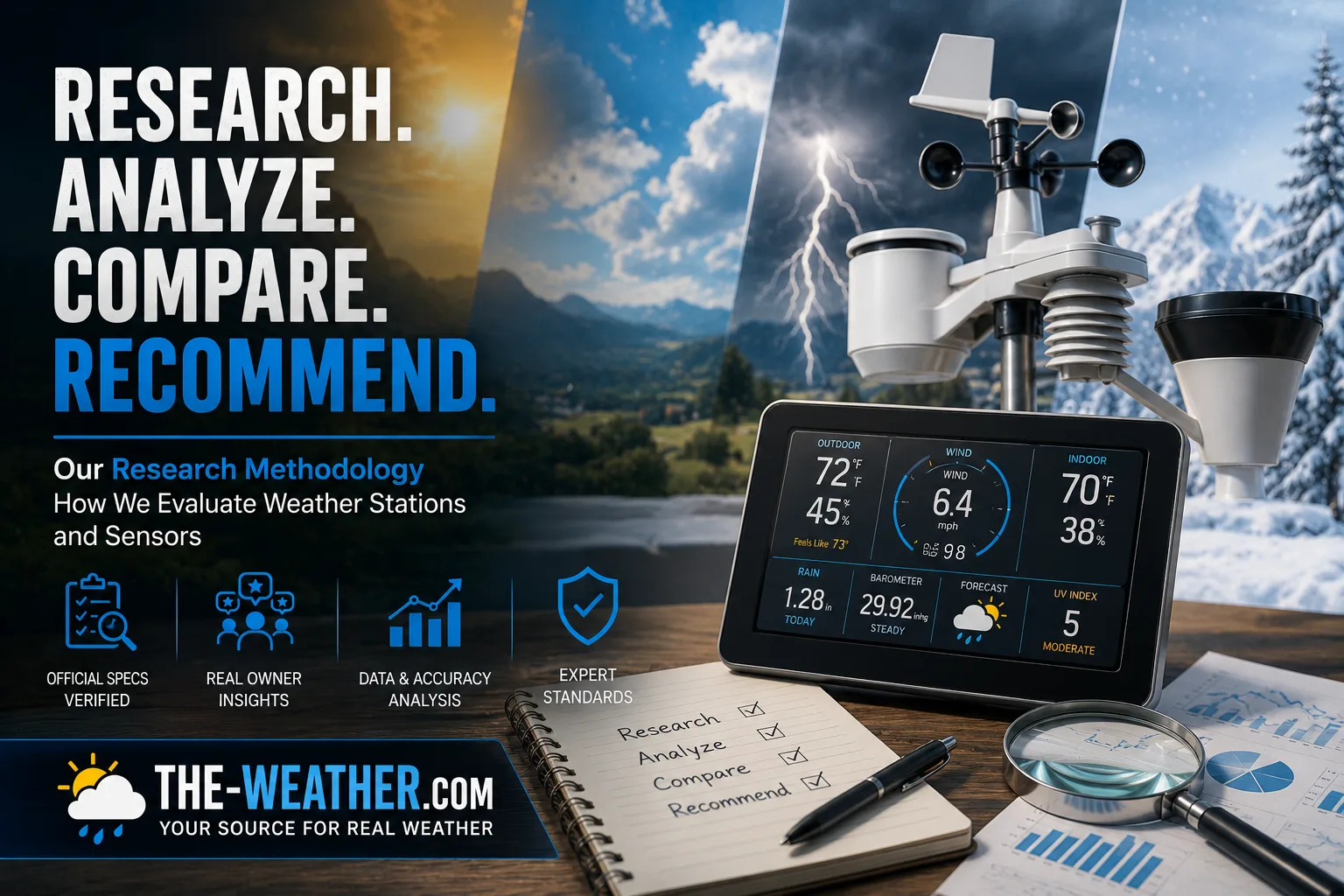
Important: How our reviews work
We do not purchase and hands-on test every product we write about. Most consumer weather stations cost $50–$500 and reviewing dozens of them through personal purchase would not be financially or practically viable for a small independent site.
What we do instead is described in full on this page: a structured research process combining manufacturer specifications, official support documentation, and our own expertise in weather monitoring. Where we have not tested a product ourselves, we say so clearly in the review. We never present research-based conclusions as hands-on test results.
At The-Weather.com, our goal is to give buyers accurate, honest information about weather stations, hygrometers, temperature sensors, and alert radios, so they can make a confident purchase decision without wading through manufacturer marketing copy or thin affiliate content.
This page explains exactly how we research and write every piece of content on the site: what sources we use, how we score products, what rules we follow on accuracy, and how our affiliate relationships work.
What We Do and What We Do Not Do
- Verify all specifications from official manufacturer documentation
- Check official support articles and manuals for known issues and fixes
- Read and cite official support documentation and manuals
- Contribute weather data to CWOP as active weather station operators
- Disclose clearly when we have not personally tested a unit
- Update pages when specifications change or products are discontinued
- Apply consistent accuracy rules across all content
- Remove or correct any claim we cannot verify from an official source
- Present research-based conclusions as hands-on test results
- Invent accuracy figures or test data we did not collect
- Use "most common" or "always" without data to support it
- Copy manufacturer marketing language as editorial opinion
- Accept payment from manufacturers to influence review scores
- Publish superlatives like "best ever" without evidence
- Hardcode prices: they change and go stale
- Use AI-generated content without editorial review and fact-checking
Our Research Sources
Every claim on this site traces back to at least one of the following source types. We prioritise primary sources, manufacturer documentation, over secondary sources: aggregator sites, forums, or other reviews.
Product pages, user manuals, specification sheets, and official support articles. Always our first and primary source for accuracy figures, range, connectivity requirements, and included sensors.
We read the makers' support articles, FAQs and troubleshooting guides to find known issues, setup steps and fixes. We do not use Amazon customer reviews or star ratings.
Manufacturer troubleshooting pages, FAQ articles, and support knowledge bases. Critical for our setup and not-connecting pages: all steps are sourced from official support docs, not guesswork.
As active CWOP contributors, we have direct experience operating home weather stations and understanding the practical differences between sensor types, placement strategies, and data quality in real-world conditions.
NOAA, NWS, and WMO guidance on sensor siting, accuracy standards, and measurement protocols. Referenced when discussing placement recommendations and measurement accuracy context.
We check Amazon listings directly to confirm product availability, bundle contents, and model-specific inclusions, particularly important for products where different bundles include different sensors.
How We Score Products
Where we apply editorial scores to individual products, each category is weighted equally at 25% of the overall score. We never apply an overall score without scoring all four categories. Scores reflect our assessment based on the research sources described above: they are not based on Amazon star ratings or manufacturer-supplied data.
We do not apply AggregateRating schema (star ratings derived from Amazon or other platform reviews): those ratings reflect buyer sentiment on price and delivery as much as product quality. Our editorial scores reflect our own assessment only.
Our Accuracy Rules
We apply a consistent set of accuracy rules across all content on this site. These exist because weather station content is full of unverifiable claims: inflated accuracy figures, invented test data, and copied marketing copy presented as editorial opinion.
- Accuracy figures come from official specs only. We never state or imply a sensor is more or less accurate than its official specification without a source. Example: if Ambient Weather lists ±2°F temperature accuracy and a retailer lists ±1°F, we use the manufacturer's specification until we can verify otherwise.
- No invented test data. We use "per official specs" or "per the manual", never invented figures presented as our own measurements. Example: if the manufacturer publishes no battery life figure, we say so rather than estimating one.
- "Most common" requires data. Without quantified data we do not claim what is most common. Example: rather than "the most common complaint is Wi-Fi dropout," we write "the station needs 2.4GHz Wi-Fi, which can complicate setup on mesh networks."
- No absolute superlatives without evidence. "Best ever," "nothing touches it," "most accurate available": none of these appear without supporting data.
- Prices are never hardcoded. Prices change. We never put specific prices in titles, meta descriptions, or schema markup.
- Discontinued products are disclosed. When a product is retired or discontinued we note it clearly so buyers can check current availability.
- Bundle-dependent features are flagged. When a feature depends on the specific bundle purchased, UV sensor, lightning detector, rain gauge, we note this and advise buyers to verify before purchasing. Example: the AcuRite Atlas lightning detector is included in some bundles and sold separately in others: we note this on every Atlas page rather than stating it as a universal inclusion.
- Specifications may change. Every review includes a note that specifications should be verified on manufacturer websites before purchasing.
Affiliate relationship disclosure
The-Weather.com participates in the Amazon Associates programme. When you click an affiliate link on this site and make a purchase on Amazon, we earn a small commission at no extra cost to you. This is how we fund the research and writing that goes into every page on the site.
Affiliate relationships do not influence our editorial scores, recommendations, or the accuracy rules described on this page. We recommend products we believe are genuinely good choices for the use cases described, not products that earn higher commissions. Where a product is not the right fit we say so clearly, including in the "Not right for you if" sections that appear on every product review.
No manufacturer has paid us to review or recommend their products. No manufacturer has been given editorial approval over content before publication. All review scores, comparisons, and recommendations are independent editorial judgements.
Our Update Policy
Weather station products change frequently: new firmware revisions alter features, bundles are updated, products are discontinued, and prices shift. We update pages when:
- A product's specifications change materially
- A product is discontinued or replaced
- New owner report patterns emerge that change our assessment
- A factual error is identified: corrections are made immediately
- A linked page changes slug or is removed
The dateModified field in our page schema is updated every time a page is edited. If you spot an error or outdated information, please contact us: we take accuracy seriously and fix confirmed errors promptly.
Questions About Our Methodology
If you have a question about how we evaluated a specific product, want to flag an inaccuracy, or would like to understand our reasoning on a specific recommendation, you can reach us through the contact page. We read every message and respond to factual questions and correction requests.
If you are a manufacturer or PR agency looking to have a product reviewed, we do not accept payment for reviews and we do not guarantee positive coverage. We may accept review samples at our discretion: any product reviewed with a supplied sample will be disclosed clearly in the review.

Lena Thornton
Weather Station Analyst & CWOP Contributor. Lena has researched, reviewed and analysed weather stations and environmental sensors from AcuRite, Ambient Weather, Davis Instruments, La Crosse Technology, ThermoPro, Govee, SensorPush, Midland, and Sainlogic. Updated June 2026.