
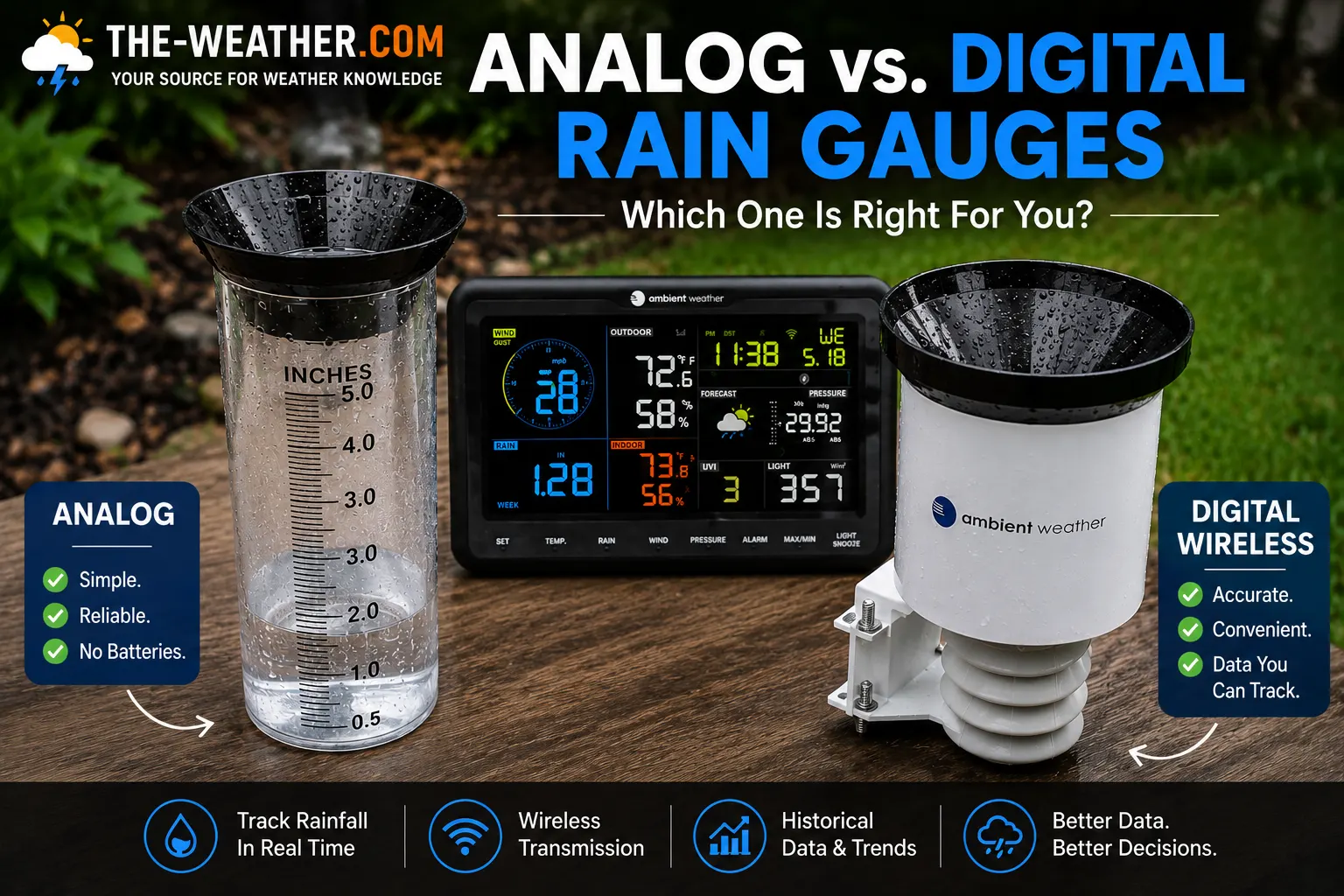
Analog gauges offer CoCoRaHS-approved accuracy with no maintenance. Digital wireless gauges log data automatically: the right choice depends on how you use the data.
Rain gauges divide into two fundamentally different types. Analog cylinder gauges are the scientifically accepted standard: no batteries, no electronics, no moving parts, and the only type currently accepted by CoCoRaHS for citizen observer reporting. Digital wireless gauges use a tipping bucket mechanism that logs data automatically and displays totals on an indoor console without any manual reading or emptying.
The right choice depends on what you need the data for. If you are filing rainfall reports with CoCoRaHS or the National Weather Service, an analog gauge is required. If you want rainfall history logged automatically while you are away from home, a wireless gauge is the practical choice. If you want rainfall alongside wind, temperature, UV, and humidity in one system, a full weather station with an integrated rain gauge makes more sense than a standalone unit.
Correct placement has a larger effect on accuracy than which gauge you choose: a cheap gauge in the right spot outperforms an expensive one under a tree every time. The placement section below covers the NWS siting rules that apply to every gauge type.
Flood Watch in your area? How to tell whether the rain is getting dangerous: how much rain is too much. Living in the Houston area? See the weather alert radio for Houston and Southeast Texas flooding.
Quick Picks by Use Case
| If you want... | Best pick | Key reason |
|---|---|---|
| CoCoRaHS / NWS accuracy | Climalytic TROPO | Currently CoCoRaHS accepted, laser-engraved gradations, improved calibration |
| Proven analog at lower cost | Stratus RG200 | NOAA standard for decades, 4-inch opening, 0.01-inch resolution |
| Wireless data logging | La Crosse 724-1415BL | Large catchment area, 300 ft range, daily/weekly/monthly history |
| Budget, no setup needed | AcuRite 5-inch (00850A3) | Lowest cost, magnifying optics |
| Wireless with alerts | AcuRite 02446M | Self-emptying, rainfall alerts, history, date and time display |
| Full weather station + rain | Ambient WS-2902C | Wind, UV, solar, rainfall: Wi-Fi upload to Weather Underground |
Which Rain Gauge Is Right for You? Decision Tree
Types of Rain Gauges: From Basic to Professional
There are five main types of rain gauge in use today, from the simple cylinder gauges sold for home gardens to the weighing gauges used by national meteorological agencies. Understanding what each measures and how helps in choosing the right model and interpreting its readings correctly.
The most common home type. Rain collects in a graduated inner tube that you read manually. Simple, accurate when placed correctly, no moving parts. Used by CoCoRaHS observers worldwide. Examples: TROPO, Stratus, AcuRite 5-inch.
Two small pivoting cups take turns filling and tipping, each tip recording 0.01 inches. Self-emptying and wireless: data transmits automatically. Used in most consumer digital weather stations. Accuracy can be affected by very heavy rainfall (tips too slowly to keep up) and very light rainfall (evaporation before tipping).
Measures rainfall by weight rather than volume. The collection bucket sits on a scale, as rain accumulates the weight increases and is converted to a depth reading. Highly accurate across all rain rates including very heavy rain and snow. Used by professional weather networks and aviation meteorology. Not commonly available as consumer products.
Uses an infrared or laser beam across the gauge opening: raindrops interrupt the beam and the timing and frequency of interruptions are used to calculate rainfall rate and drop size. Very high accuracy and can measure rain intensity in real time. Research and professional use only.
A pressure-sensitive surface detects the impact of each raindrop. The Ecowitt WS90 and Tempest WeatherFlow use this technology: it eliminates the tipping bucket mechanism entirely with no moving parts. Can underperform in very light drizzle where drop size is too small to generate a reliable signal. A newer consumer technology with a growing track record.
Analog vs Digital: Which Type Do You Need?
- Graduated cylinder: read by hand, empty after rain
- No batteries, no electronics, no setup
- Scientifically accepted measurement standard
- Currently accepted by CoCoRaHS: TROPO and Stratus
- Can measure snowfall (melt and read)
- Lasts years with no maintenance
- Best for: CoCoRaHS observers, serious gardeners, areas without reliable Wi-Fi
- Self-emptying sensor: data logs automatically
- Displays daily, weekly, monthly totals indoors
- Optional rainfall alerts by threshold
- Some models upload to Weather Underground
- Requires batteries and occasional sensor cleaning
- Not currently accepted by CoCoRaHS
- Best for: convenience, remote monitoring, weather station integration
Rain Gauge Accuracy: What Actually Affects Your Readings
Most people assume accuracy is determined by the gauge itself. In practice, five external factors have a larger combined effect on reading accuracy than the gauge design. Understanding these is essential before placing any gauge: analog or digital.
Wind pushes falling rain away from the gauge opening, causing systematic under-measurement. World Meteorological Organization guidance names wind as one of the largest sources of gauge error, and the loss grows with wind speed. Wider gauge openings and steeper funnels reduce this effect. Siting away from wind-channelling structures is the most effective mitigation.
Heavy rain hitting the ground near a low-mounted gauge can splash water in: inflating readings. Conversely, large drops hitting the rim of the gauge can splash out: deflating readings. Mounting at the correct height (2 to 5 feet) and away from hard surfaces reduces both effects. Inner tube gauges like the Stratus reduce splash-out by funnel geometry.
Water sitting in an analog gauge in warm weather evaporates. In summer conditions, leaving water in a tube gauge for 24 to 48 hours can produce measurable loss, particularly in hot, dry climates. Empty and record the reading as soon as possible after each rainfall event. Self-emptying tipping bucket gauges avoid this issue entirely.
A larger opening collects a more representative sample of rainfall and reduces the proportional effect of individual large drops, splash, and rim wetting. The NOAA observer network uses 8-inch openings as the standard. For home use, 4-inch openings (Stratus, TROPO) are accepted as adequately accurate by CoCoRaHS. Gauges with openings smaller than 4 inches introduce more variability.
Analog cylinder gauges do not drift in calibration: the markings are fixed. Tipping bucket gauges can drift if the bucket mechanism becomes dirty or partially blocked, causing cups to fill unevenly. Annual inspection and cleaning of the bucket mechanism maintains factory accuracy. Digital gauges do not typically offer user calibration: maintenance is the only correction available.
Trees, buildings, and roof overhangs intercept rainfall before it reaches the gauge, causing significant under-measurement. A gauge under a tree canopy can read far less than actual rainfall. The NWS siting rule, place at twice the distance of the nearest obstruction height, exists specifically to avoid this. It is the most commonly violated placement guideline.
What this guide adds
Check Your Rain Gauge's Accuracy at Home in 5 Minutes
You do not have to trust the label. Any rain gauge, analog or digital, can be checked with a kitchen measuring jug, because rainfall is simply a volume of water spread over the area of the opening. Pour a known amount of water in and see what the gauge reads.
| Opening diameter | Water for 0.10 inch | Water for 0.50 inch | Water for 1.00 inch |
|---|---|---|---|
| 4 inch (CoCoRaHS gauges such as the Stratus and TROPO) | 20.6 mL | 103 mL | 206 mL |
| 6 inch | 46.3 mL | 232 mL | 463 mL |
| 8 inch (NWS standard gauge) | 82.4 mL | 412 mL | 824 mL |
| Any other size | mL for 1 inch of rain = 12.87 × (diameter in inches)². In metric: 1 mm of rain over a 10 cm opening is 7.85 mL. | ||
How to run the test
- Measure the inside diameter of the funnel opening (not the outside of the rim).
- Measure the water for 0.50 inch from the table, using a jug or syringe marked in mL.
- Analog gauge: pour it into the funnel and read the inner tube at eye level. It should read 0.50 inch.
- Tipping bucket or digital gauge: pour very slowly, over 5 to 10 minutes, like steady rain. Pouring fast makes the bucket miss water and read low. Then compare the console total with 0.50 inch.
- If a digital gauge reads clearly low or high, clean the funnel screen and bucket, check that the sensor is level, and test again before you buy a replacement.
Reporting to CoCoRaHS? The network asks volunteers to use a 4-inch manual gauge and to read it once a day, preferably at 7:00 a.m. local time, also on dry days. Readings taken before 4:30 a.m. or after 9:30 a.m. do not appear on the daily maps.
Sources: CoCoRaHS: why manual measurements are required · CoCoRaHS / NWS observer training · Volumes calculated from the area of the opening (1 cubic inch = 16.39 mL).
Which Rain Gauge Should You Buy? By Buyer Type
| If you are... | Best pick | Why |
|---|---|---|
| A gardener tracking weekly watering | AcuRite 5-inch (00850A3) | Low cost, no setup, magnifying optics: check after rain and adjust watering accordingly |
| A CoCoRaHS volunteer or NWS spotter | Climalytic TROPO | Currently accepted by CoCoRaHS, improved calibration, 13.5-inch capacity |
| A weather hobbyist wanting the most accurate analog | Climalytic TROPO | CoCoRaHS approved, laser-engraved gradations, larger capacity |
| A budget buyer who still wants CoCoRaHS accuracy | Stratus RG200 | Currently CoCoRaHS accepted, proven decades-long track record |
| Someone who wants automation: no manual emptying | La Crosse 724-1415BL | Self-emptying, large catchment, 300 ft range, daily and weekly totals on console |
| Someone who wants rainfall alerts on their phone | AcuRite 02446M | Configurable threshold alerts, self-emptying, history on indoor console |
| Someone who wants rainfall + full weather data | Ambient WS-2902C | Rain + wind + UV + solar + temp + humidity: Wi-Fi upload to Weather Underground |
| A cold-climate buyer who leaves gauges outdoors year-round | Stratus RG200 | Freeze-resistant design: bring indoors below 32°F (0°C); or check freeze-proof models separately |
The Best Rain Gauges Reviewed
The TROPO addresses a calibration characteristic found in older designs. The TROPO uses precision laser-engraved gradations and a mathematically computed cylinder taper intended to improve on this. Both the TROPO and Stratus read to 0.01-inch resolution, but the TROPO aims for tighter agreement with laboratory reference measurements.
Design improvements extend beyond accuracy. The 13.5-inch total capacity, compared to 11 inches for the Stratus, means the outer cylinder rarely needs emptying mid-storm in most US climates. The steeper funnel handles wind-driven rain better than the flatter Stratus funnel. The included snap-on funnel cap stays on in high wind. A removable handle and pour spout make emptying the outer cylinder significantly cleaner after heavy events.
- Field-tested and approved by CoCoRaHS
- Larger capacity and more mounting options than older 4-inch gauges
- Improved calibration over older designs
- 13.5-inch capacity: largest in class
- Snow measurement capable
- No batteries, no electronics, no setup
- Higher price than the Stratus
- Manual reading and emptying required
- No wireless or data logging
- Newer product: less long-term durability data than Stratus
The Stratus RG200 has been used by official weather observers across the United States for decades. It is the lowest-cost path to CoCoRaHS-accepted accuracy. Its 4-inch diameter opening meets CoCoRaHS standards and the inner graduated tube reads to 0.01-inch precision. The outer cylinder catches overflow for heavy rainfall events. For snow measurement, remove the inner cylinder and funnel, let snow accumulate in the outer cylinder, bring indoors to melt, then measure the liquid equivalent.
Many long-term CoCoRaHS observers have used the same Stratus gauge reliably for years or decades. Choose the TROPO if the latest precision engineering matters most; choose the Stratus if proven longevity and lower cost are the priority.
- Decades of proven field use
- Currently CoCoRaHS and NOAA accepted
- Most affordable accepted gauge
- Made in USA
- Snow measurement capable
- No batteries, no electronics
- Slightly less precise than TROPO per independent comparisons
- 11-inch capacity: smaller than TROPO
- Flatter funnel: more wind deflection than TROPO
- Manual reading and emptying required
Catchment area is the most important accuracy factor for a tipping bucket gauge. The La Crosse 724-1415BL's oval opening measures 4.5 inches by 6.9 inches: one of the larger consumer-grade catchment areas available. For comparison, many budget wireless gauges use openings of approximately 4 inches by 2.5 inches, which are more susceptible to wind deflection errors. The console displays event, hourly, daily, weekly, and monthly rainfall totals and can be configured to alarm at a chosen rainfall threshold in 0.1-inch increments.
Note: the console rolls over historical data at the end of each period rather than retaining a long-term log. Buyers who want permanent historical records should note readings regularly or consider a Wi-Fi connected weather station with cloud logging such as the Ambient WS-2902C.
- Large catchment area: reduces wind deflection error
- 300 ft range: longest of digital picks here
- Configurable rainfall alarm
- Daily, weekly, monthly history on console
- Self-emptying, no manual emptying
- Console data rolls over: no permanent long-term log
- No Wi-Fi or cloud upload
- Not currently CoCoRaHS accepted
The 02446M sits between a standalone rain gauge and a full weather station. The self-emptying collector handles drainage automatically after each event. The indoor console displays current rainfall rate, daily total, and historical records alongside date and time. Configurable rainfall alerts notify you when a chosen threshold is reached: useful for gardeners who want to know when enough rain has fallen to skip supplemental watering.
- Self-emptying, no manual maintenance after rain
- Configurable rainfall alerts
- Rainfall history and date/time on console
- Established AcuRite brand with US support
- No Wi-Fi or cloud upload
- Not currently CoCoRaHS accepted
- Smaller catchment area than La Crosse 724-1415BL
The 00899 covers the basics well: wireless transmission from an outdoor tipping bucket sensor to an indoor console showing daily and weekly rainfall totals. It is the right choice for buyers who want wireless convenience without paying for alerts, longer history, or a larger catchment area. For everyday garden watering decisions and general rainfall awareness it delivers what most buyers need at the lowest wireless price.
- Lowest-cost wireless option
- Simple setup: reliable basic performance
- Daily and weekly totals on indoor console
- No rainfall alerts
- Smaller catchment than La Crosse model
- No Wi-Fi or cloud upload
- Not currently CoCoRaHS accepted
The AcuRite 5-inch is an easy, low-cost first rain gauge. The magnifying optic effect, as water fills the tube, the markings appear larger, makes readings noticeably easier than plain-tube designs without requiring close inspection. It is not currently CoCoRaHS accepted and is less accurate than the TROPO or Stratus, but for everyday garden watering decisions and general rainfall awareness it is more than adequate.
In cold climates, bring the acrylic tube indoors when temperatures are expected to drop below 32°F (0°C) to prevent cracking. In moderate climates it handles year-round outdoor use without issues. The 5-inch capacity is sufficient for most rainfall events but will need emptying after heavy storms.
- Lowest-cost gauge in this roundup
- Magnifying optics: easy to read
- No batteries, no setup
- Among the most sold gauges on Amazon
- Not currently CoCoRaHS accepted
- Not freeze-proof
- 5-inch capacity only
- Less accurate than TROPO or Stratus
The WS-2902C is a complete personal weather station that includes a tipping bucket rain gauge as part of its 5-in-1 outdoor sensor array. It logs hourly, daily, weekly, and monthly rainfall totals and uploads automatically to the Ambient Weather Network and Weather Underground via 2.4GHz Wi-Fi. For buyers deciding between a standalone wireless rain gauge and a full station, the WS-2902C is often the better value: rainfall data plus eight additional measurements for a moderate price step up. For a full review see the Ambient Weather WS-2902C review.
Check Ambient WS-2902C Price As an Amazon Associate, we earn from qualifying purchases at no extra cost to you.Full Comparison
| Model | Type | CoCoRaHS | Wireless | Resolution | Best for |
|---|---|---|---|---|---|
| Climalytic TROPO | Analog | ✓ Currently accepted | ✗ | 0.01 inch | Highest accuracy, CoCoRaHS |
| Stratus RG200 | Analog | ✓ Currently accepted | ✗ | 0.01 inch | Proven accuracy, lower cost |
| La Crosse 724-1415BL | Digital | ✗ | ✓ 300 ft | 0.01 inch | Best wireless accuracy |
| AcuRite 02446M | Digital | ✗ | ✓ + alerts | 0.01 inch | Wireless + alerts |
| AcuRite 00899 | Digital | ✗ | ✓ | 0.01 inch | Budget wireless |
| AcuRite 5-inch (00850A3) | Analog | ✗ | ✗ | Standard | Budget, everyday use |
| Ambient WS-2902C | Full station | ✗ | ✓ Wi-Fi + WU | 0.01 inch | Rain + full weather data |
7 Mistakes That Make Rain Gauges Inaccurate
These are the most common reasons a correctly purchased rain gauge delivers wrong readings. Most are placement errors that cost nothing to fix.
Tree canopy intercepts a large fraction of rainfall before it reaches the ground. Gauges under trees can read far below actual precipitation.
Buildings block wind-driven rain from one direction and can cause updrafts that deflect rain away from the gauge. The NWS 2× rule, place at twice the height distance of any obstruction, exists to prevent this.
Even a slight tilt creates asymmetric collection: rain hitting one side of the funnel at an angle has more splash-out potential. A perfectly level gauge collects from all directions equally. Use a spirit level when mounting.
Above 5 feet, wind speed increases and deflects more rainfall away from the gauge opening. The NWS recommended height is 2 to 5 feet above ground. Higher is not more accurate: it is less accurate in most conditions.
Below 2 feet, splash-in from the ground surface inflates readings during heavy rain. Heavy drops hitting hard ground or gravel near a low-mounted gauge can splash water into the collection funnel.
Bird droppings, spider webs, leaves, and algae accumulate in the funnel and collection tube over time. A partially blocked funnel slows water flow into the inner tube, causing under-reading in heavy rain. Monthly inspection prevents this.
Irrigation spray landing in or near a rain gauge inflates readings: making rainfall appear higher than it was. Locate the gauge well away from any irrigation heads or spray zones.
Correct Rain Gauge Placement: Step by Step
Per NWS cooperative observer siting guidance, the following placement rules apply to all rain gauge types.
- Open area: no overhead canopy
- 2 to 5 feet above ground level
- At least 2× the height of the nearest obstruction
- Perfectly level: check with a spirit level
- Away from irrigation, sprinklers, and gutters
- Allow 24 hours after first installation to acclimate
- Clean monthly: check funnel for debris
- Under tree canopy: large under-measurement
- Near roof overhangs: runoff inflates readings
- Against walls: blocks wind-driven rain
- Near HVAC exhaust: thermal and moisture interference
- Mounted on a tilt: uneven collection
- Near gutters: splash and drainage contamination
- Below 2 feet: ground splash inflates readings
Rain Gauge Maintenance: Keeping Readings Accurate
Most rain gauge inaccuracy from mechanical causes can be prevented with routine maintenance. The schedule differs slightly between analog and digital tipping bucket gauges.
- Inspect funnel opening: remove leaves, spider webs, bird droppings
- Check gauge is still level: posts can shift over a season
- Rinse the collection tube or bucket area with clean water
- Check for algae growth in clear tubes: a small amount of mineral oil slows algae without affecting readings
- Inspect the bucket mechanism: ensure both cups pivot freely without sticking
- Check that the funnel screen (if present) is clear of fine debris
- Verify the console battery level: weak batteries cause missed transmissions
- Confirm wireless signal is still registering at the console
- Bring non-freeze-proof analog tubes indoors below 32°F (0°C)
- For tipping bucket sensors: remove standing water from the collection area before hard freezes
- Replace batteries with lithium cells: alkaline batteries lose capacity rapidly below freezing
- Confirm the freeze-proof rating of your specific gauge before leaving it outdoors
- Bird droppings in funnel: rinse with warm water, check tube is clear
- Spider webs: spiders are attracted to the tube opening; a light coat of petroleum jelly on the outer rim discourages them
- Leaves in funnel, particularly an issue in autumn; weekly checks during leaf fall season
- Tipping bucket stuck: debris in the cup mechanism causes systematic under-reading; rinse and manually check pivot action
How We Chose These Rain Gauges
Our recommendations are not based on independent hands-on testing of every model. Instead they are built on a structured evaluation of documented sources: the same approach used by weather observer networks when assessing gauge suitability. Here is exactly what informed each pick.
Capacity, resolution, opening diameter, construction materials, and temperature ratings sourced directly from manufacturer product pages and documentation: verified at time of writing.
Approval status, siting guidelines, and accuracy expectations from the CoCoRaHS network and National Weather Service cooperative observer programme: primary sources rather than secondary summaries.
Warranty terms, support articles and replacement-part availability: what the makers themselves say about long-term use.
Discussions from CoCoRaHS observer forums, Weather Underground station owner communities, and weather enthusiast boards: where experienced observers share multi-year real-world performance data that manufacturer specs cannot capture.
Opening diameter, funnel geometry, inner tube graduation precision, and catchment area: factors that directly determine accuracy independent of the gauge brand. Larger openings and steeper funnels are objectively measurable advantages.
Whether replacement inner tubes, funnels, or bucket mechanisms are available separately. A gauge with no replacement parts available is effectively a disposable product: important context for a long-term outdoor instrument.
What the makers say about UV resistance, freeze protection and sensor life, plus the materials each gauge uses.
Price relative to accuracy, durability, and features, not lowest price, but best combination of the above for each buyer type. A basic gauge that delivers what a gardener needs is better value than a premium gauge with features they will never use.
Frequently Asked Questions
What is the most accurate rain gauge for home use?
For analog accuracy, the Climalytic TROPO is the current top pick: currently CoCoRaHS accepted, with laser-engraved gradations and improved manufacturing tolerances over older designs. The Stratus RG200 is the proven, lower-cost alternative used by official observers for decades. For digital accuracy, the La Crosse 724-1415BL has one of the larger tipping bucket catchment areas in the consumer category, which reduces wind deflection error.
What is the difference between a tipping bucket and an analog rain gauge?
An analog gauge collects rainfall in a graduated cylinder you read manually and empty yourself: no batteries, no electronics, the scientifically accepted standard. A tipping bucket uses small seesawing cups that fill and tip, each recording 0.01 inches and transmitting wirelessly to an indoor console. Tipping bucket gauges log data automatically but are not currently accepted by CoCoRaHS due to accuracy limitations at very light rain rates and in high-wind conditions.
Can I use a rain gauge for CoCoRaHS reporting?
CoCoRaHS currently approves three gauge designs for observer reporting: the Climalytic TROPO, the Stratus 4-inch gauge (such as the RG200) and the standard 8-inch NWS gauge. Digital tipping bucket gauges are not currently accepted. Verify the current approved gauge list at cocorahs.org before purchasing, as accepted models may be updated.
Where should I place a rain gauge?
In an open area with no overhead canopy, at 2 to 5 feet above ground, perfectly level. Place at least twice the height distance from any nearby obstruction, if a tree is 10 feet tall, the gauge should be at least 20 feet away. Correct placement has a larger effect on accuracy than which gauge you choose.
How often should I empty a rain gauge?
Analog rain gauges should be emptied after each rainfall event, or at least every 24 hours if recording daily totals. Leaving water sitting longer introduces evaporation error, particularly in warm weather. In hot summer conditions, even a few hours of standing water can show measurable loss.
Can wind affect rainfall measurements?
Yes, wind is one of the most significant sources of rain gauge measurement error. Wind deflects falling rain away from the gauge opening, causing systematic under-measurement. Wind is one of the largest sources of gauge error, and the loss grows with wind speed and exposure. Wider openings, steeper funnels, and correct siting away from wind-channelling structures all reduce this effect.
What size rain gauge is best?
A larger opening gives more accurate readings by reducing the proportional effect of splash and wind deflection. The NOAA observer network uses 8-inch openings as their standard. For home use, 4-inch openings like the Stratus and TROPO are accepted as adequately accurate by CoCoRaHS. Gauges with openings smaller than 4 inches introduce more measurement variability, particularly in wind and light rain.
How often should I clean a rain gauge?
Analog gauges should be inspected monthly and cleaned whenever debris is visible. Bird droppings, spider webs, leaves, and algae are the most common causes of blocked funnels. Tipping bucket gauges should have the collection area inspected monthly and the bucket mechanism checked seasonally: debris in the cup will cause systematic under-reading.
Can rain gauges freeze?
Most plastic and acrylic analog gauges are not freeze-proof: water expanding as it freezes can crack the inner measurement tube. Bring non-freeze-proof gauges indoors when temperatures are expected to drop below 32°F (0°C). Tipping bucket wireless sensors should not be left with standing water during hard freezes as ice can jam the bucket mechanism.
Do digital tipping bucket gauges need calibration?
Tipping bucket gauges are factory calibrated and do not require user calibration in normal use. Accuracy can drift if the bucket mechanism is dirty or partially blocked, causing cups to fill unevenly. Annual inspection and cleaning of the bucket mechanism maintains factory accuracy. Digital gauges do not typically offer user calibration: maintenance is the correction available.
Does the Ambient WS-2902C include a rain gauge?
Yes. The WS-2902C includes a tipping bucket rain gauge as part of its 5-in-1 outdoor sensor array, measuring to 0.01-inch resolution with automatic daily and weekly totals uploaded to Weather Underground and the Ambient Weather Network via Wi-Fi. It is a practical choice for buyers who want rainfall data alongside wind, temperature, humidity, UV, and solar radiation in one system.
Related pages
- Best home weather stations: full pillar including stations with integrated rain gauges
- Ambient Weather WS-2902C review: Wi-Fi weather station with integrated rain gauge
- Ecowitt Wittboy Pro HP2564 review: haptic piezoelectric rain gauge, no tipping bucket
- All you need to know about rain: rainfall types, measurement, and weather patterns
Community Feedback
This page is not based on independent hands-on testing: analysis is based on manufacturer documentation, CoCoRaHS approval records and NWS siting guidance. A common siting mistake is mounting too close to structures: a gauge under a roof overhang or tree canopy reads low.

Lena Thornton
Weather Station Analyst & CWOP Contributor. Lena researched, reviewed and analysed rain gauge options using CoCoRaHS approval records, NWS siting guidance, manufacturer documentation and Amazon product data. Updated July 2026.