
As an Amazon Associate, I earn from qualifying purchases.
In this article 10 sections
- Why a gas furnace stops when the power goes out
- Step 1: how many watts your furnace needs
- Step 2: how long a power station keeps the fan running
- What makes your runtime shorter (or longer)
- Step 3: getting the power to the furnace (call an electrician)
- The safety bit: carbon monoxide
- Which size makes sense for a furnace?
- Power stations that fit a furnace backup
- My take
- Quick Answers
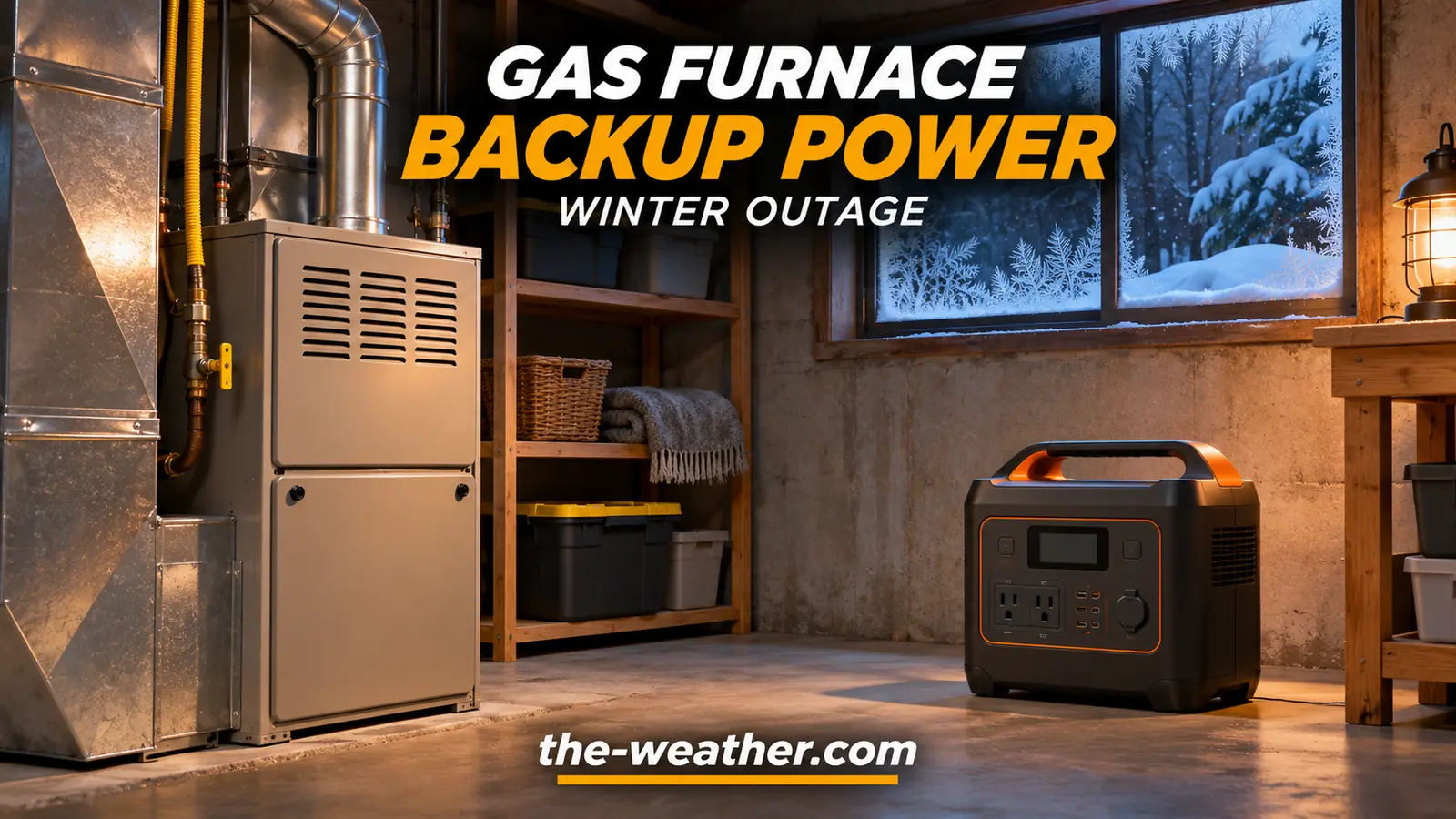
Here is the winter storm surprise nobody enjoys: the gas is still flowing, but the house is getting cold. A gas furnace burns gas, yet it needs electricity for the fan that pushes warm air through the vents, the small fan that clears the exhaust, and the control board. No power, no heat. A portable power station (a big rechargeable battery with normal wall outlets) can fill that gap for a while. How long, and how to hook it up safely, is what this page is about.
Short answer: the big electricity user in a gas furnace is the blower fan. The Department of Energy puts an older single-speed (PSC) blower at 500 to 550 watts while heating; a variable-speed (ECM) blower uses less. With the runtime formula power station makers print in their own manuals, a 2,000 Wh station runs a 550 W blower (blower only, our calculation) for about 3 hours of fan time, which can stretch to roughly 6 hours on the clock if the furnace runs half of each hour. Many furnaces are wired straight into the house, so getting the power there safely, and checking that your furnace works on a station at all, is a job for a licensed electrician, not an extension cord.
Editorial Research
- Written by
- Lena Thornton, Weather Station Analyst & CWOP Contributor
- Based on
- Blower motor figures from the Department of Energy's Building America Solution Center, the electrical data in Goodman's AMVC8 furnace specification sheet and Goodman's 80%, 90% and 95% gas furnace service instructions, CPSC carbon monoxide guidance, the runtime formula in the Jackery Explorer 1500 user manual, and the makers' own specifications for the power stations named. We did not test these products; every runtime below is our own calculation, shown step by step.
- Research last verified
- November 28, 2026
Why a gas furnace stops when the power goes out
Gas makes the heat, electricity moves it. Inside the cabinet you have:
- the blower (circulator fan), which pushes the warm air through your ducts: by far the biggest load;
- the inducer (induced draft fan), a small fan that pulls the exhaust out through the vent pipe;
- the igniter and control board, which light the burners and run the show.
Goodman's AMVC8 specification sheet says it plainly: "All furnaces are manufactured for use on 115 VAC, 60 Hz, single-phase electrical supply." That is normal household power, the same kind a power station puts out.
Step 1: how many watts your furnace needs
The Department of Energy's Building America Solution Center gives the two numbers that matter, in its page on ECM air handler fans:
- older single-speed PSC blowers "typically consume between 500 and 550 watts when providing heating and cooling";
- variable-speed ECM blowers use "about 400 watts in cooling mode" and "can operate on as little as 80 watts" (DOE ties that low figure to continuous fan mode, not heating).
Not sure which one you have? A furnace sheet that says "variable speed" or "ECM" points to the second kind. Your installer or the label inside the blower door can tell you for sure.
Your own furnace, the careful way: look at the electrical data on the rating plate or in the installation manual. Goodman lists a "Minimum Circuit Ampacity" for each AMVC8 model: 7.75 or 10.6 amps. That figure is not what the furnace uses while running; it is made bigger on purpose for wire sizing (Goodman's formula is 1.25 × the blower amps plus the inducer amps). Because of that formula, amps × 115 volts gives a rough number above the furnace's rated running power, useful for a first comparison only:
- 7.75 A × 115 V = about 890 W
- 10.6 A × 115 V = about 1,220 W
That rough number is not a sizing rule. It says nothing about the moment a blower motor starts and pulls extra power (what a station's "peak" or "surge" rating is for), and it does not tell you whether your furnace will work on a station at all. The better figures are the blower and inducer amps on your furnace's own rating plate and in its manual. Your electrician checks those, together with the wiring, grounding and polarity, before you count on any station.
Step 2: how long a power station keeps the fan running
A power station never gives you every watt-hour on the box: turning battery power into wall-outlet power costs some energy. Jackery prints the formula in its Explorer 1500 user manual: battery Wh × 0.85 ÷ the device's watts. We use the same 0.85 for every size below.
What makes your runtime shorter (or longer)
Treat the table as a planning estimate, not a promise.
- Shorter: the inducer, igniter and control board come on top of the blower; a very cold night or a drafty house makes the furnace run more of each hour; the station was not full when the power went out.
- Longer: a variable-speed blower that runs below our 400 W planning number; a lower thermostat setting; closing doors to rooms you do not need.
One honest conclusion from the math: for an ice storm that knocks the power out for days, a power station alone will not heat a house. It bridges the first cold hours, or it keeps the furnace going at night while a solar panel or a generator outside recharges it by day. Want to see your own mix of furnace, fridge and phone? Try the power station and generator size calculator.
Step 3: getting the power to the furnace (call an electrician)
This is the part where the plan usually meets reality. Many gas furnaces have no plug. Goodman's gas furnace service instructions (2009 edition) call for a "separate fused branch electrical circuit" and say "An electrical disconnect must be provided at the furnace location." So the furnace is wired into the house, and the station has to reach it through the house wiring in a safe way.
The Department of Energy's Building America Solution Center puts the safe route in one sentence: "Engage a licensed electrical contractor to design, permit, and install generator circuitry to interconnect with the household breaker box with a transfer switch that prevents backfeeding". The same goes for a power station. Backfeeding means power flowing back into the utility lines, which is dangerous for the line workers repairing them. So no homemade double-plug cords, and no plugging into a dryer outlet.
Two more reasons to let a pro set it up, both from Goodman's own manual:
- "Line polarity must be observed when making field connections." If the power leads are reversed, "the furnace will fail to operate", and a "poor unit ground" can cause the same error.
- The furnace "must be electrically grounded". Ask your electrician to check that your setup with the station keeps polarity and ground right, and test it on a calm day, not in the middle of the storm.
Also ask the electrician whether your station's output suits your furnace's control board. We did not find a furnace maker's statement about power station or inverter types in the manuals we read, so we will not guess for you.
The safety bit: carbon monoxide
A gas furnace still burns gas during an outage, and a winter storm is also when people get creative with heat. The CPSC's winter safety tips say: "Install battery-operated CO alarms or CO alarms with battery backup on each level and outside separate sleeping areas at home." A CO alarm that runs on batteries keeps watching when the grid does not. And if you also use a gas generator, it goes outside, at least 20 feet from the house; more in generator vs power station for storm outages.
Which size makes sense for a furnace?
- About 1,000 Wh: a couple of hours of heat to take the edge off, but not a night. Better as the fridge or phone battery.
- About 2,000 Wh: about 6 hours on the clock at half-hour cycles in our table, if your furnace works on the station at all.
- 3,500 Wh and up: about 11 hours of a 550 W blower at half-hour cycles in our table, and room to add the fridge. These are heavy home units, often with extra battery packs and solar input.
Power stations that fit a furnace backup
We picked these from the makers' own specifications: a continuous output well above the blower figures on this page, and enough battery for several hours of fan time in our table. We have not tested them with any furnace: whether one works with yours is for your electrician to confirm.
The 2,000 Wh class
Anker SOLIX S2000
Why it is on the list: 2,010 Wh and 1,500 W continuous according to Anker, LiFePO4 cells and a UPS switchover of 10 ms or less. About 3 hours of PSC blower time in our table, or 6 hours on the clock if the furnace runs half of each hour.
Research basis: Anker SOLIX S2000 specifications. New model: check the listing for the US version.
More surge headroom
BLUETTI FridgePower
Why it is on the list: 2,016 Wh LiFePO4, 1,800 W continuous and 3,600 W peak, 10 ms UPS, according to BLUETTI. The same runtime class as the S2000 in our table, with more room for a blower motor's start.
Research basis: BLUETTI FridgePower product page.
For a long winter night
Jackery HomePower 3600 Plus
Why it is on the list: 3,584 Wh and 3,600 W output, expandable to 21 kWh with extra battery packs, according to Jackery. About 5.5 hours of PSC blower time in our table, roughly 11 hours on the clock at half-hour cycles.
Research basis: Jackery HomePower 3600 Plus product page.
Affiliate links: we may earn a commission if you buy through them, at no extra cost to you. We have not tested these power stations ourselves.
My take
Start with two things that cost little: a battery CO alarm on every level, and a call to an electrician to ask what it takes to feed your furnace from a backup source. Then do the math with your own furnace's numbers. If a station of about 2,000 Wh covers your usual winter outage, great. If your outages last days, a station alone is a bridge, not a heater, and the electrician's transfer switch becomes the real project. Either way, do it before the forecast turns white. Nobody enjoys reading a wiring diagram with mittens on.
Want the warnings too while the grid is down? See our winter storm emergency alerts during power outages.
Plan the whole house: backup power for storm outages in 4 steps · power station and generator size calculator
Quick Answers
Can a portable power station run a gas furnace?
On paper, often yes, for a while; whether it works with your furnace depends on its wiring and electrical setup. The blower is the big load: the Department of Energy puts single-speed blowers at 500 to 550 W while heating. A 2,000 Wh station runs that for about 3 hours of fan time. Connecting it to a hard-wired furnace is a job for a licensed electrician.
How many watts does a gas furnace use?
Mostly the blower: 500 to 550 W for a single-speed (PSC) blower in heating, and less for a variable-speed (ECM) one, which can run on as little as 80 W at low speed, according to the Department of Energy. The inducer and controls add a bit on top.
What size power station do I need for a furnace?
Start with the blower and inducer amps on your furnace's rating plate, and let your electrician confirm the station suits your furnace. For runtime, in our calculation, about 2,000 Wh gives about 6 hours and about 3,600 Wh about 11 hours with a 550 W blower, if the furnace runs half of each hour.
Can I plug my furnace into a power station with an extension cord?
Many furnaces are hard-wired with a disconnect switch, not a plug. The Department of Energy advises a licensed electrical contractor and a transfer switch that prevents backfeeding. Goodman's manual also warns that reversed polarity or a poor ground makes the furnace fail to operate.
Do I still need a CO alarm if I use a power station?
Yes. The furnace still burns gas. The CPSC advises battery-operated CO alarms or CO alarms with battery backup on each level and outside sleeping areas.
Sources: DOE Building America Solution Center: ECM air handler fans · Goodman AMVC8 specification sheet · Goodman service instructions, 80%, 90% and 95% gas furnaces (RS6610004, 2009) · DOE Building America Solution Center: generators for backup power · CPSC: winter weather safety tips (2025) · Jackery Explorer 1500 user manual · Anker SOLIX S2000 · BLUETTI FridgePower · Jackery HomePower 3600 Plus