
As an Amazon Associate, I earn from qualifying purchases.
In this article 11 sections
- Why storms and sump pumps are a bad combination
- The 4 kinds of backup, side by side
- Kind 1: a battery backup pump
- Kind 2: a combo system
- Kind 3: a battery inverter for the pump you have
- Kind 4: a water-powered backup pump
- Can a portable power station run a sump pump?
- How to choose in three questions
- Backup systems by kind
- My take
- Quick Answers
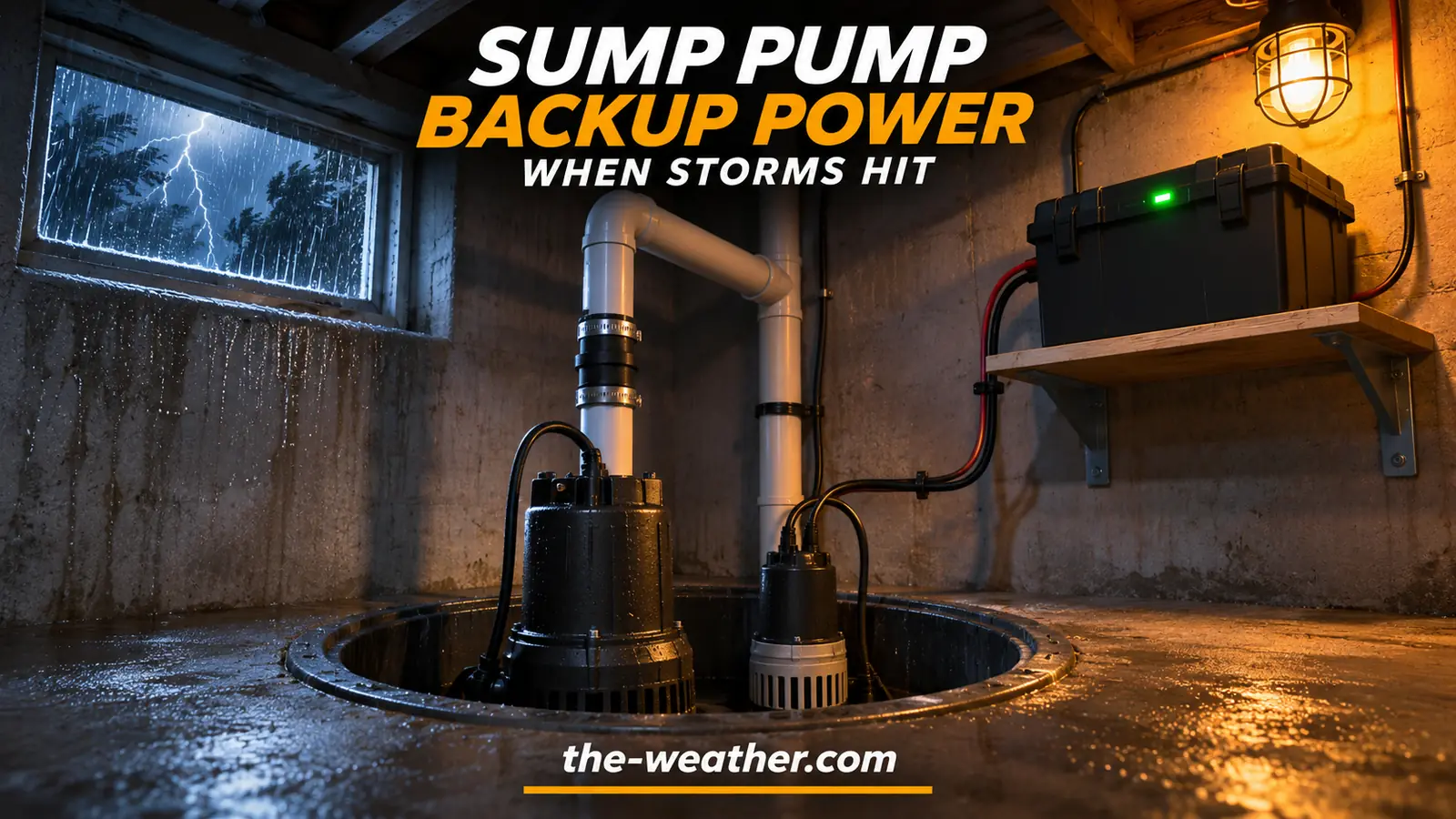
A sump pump has one annoying habit: it is needed most at exactly the moment the power is most likely to go out. A thunderstorm parks over the house, the rain pours into the pit, and then the lights flicker off. A backup is what keeps the basement dry for the next few hours. There are four kinds, and they are not the same thing. Here is how they differ, using the makers' own manuals.
Short answer: there are 4 kinds of sump pump backup: (1) a second battery backup pump on a 12-volt battery, (2) a combo system with the main pump and the backup pump in one unit, (3) a battery inverter that runs the pump you already have, and (4) a water-powered pump that uses city water pressure and needs no battery at all. A normal portable power station can also run a pump, but only switches over by itself if it has a UPS function. Basement Watchdog's manual, for example, says its Big Standby battery "has been designed to run this system for 60 hours, based on a 10% duty cycle".
Editorial Research
- Written by
- Lena Thornton, Weather Station Analyst & CWOP Contributor
- Based on
- The installation manuals of the Basement Watchdog Special (BWSP-A) and Combo (CITS-50), the Wayne ESP15/ESP25, the Liberty Pumps SumpJet and the Zoeller 540 FLEX, PumpSpy's product information, and the runtime formula in the Jackery Explorer 1500 manual. We did not test these products. Every runtime we work out ourselves is labeled as our own calculation.
- Research last verified
- November 27, 2026
Why storms and sump pumps are a bad combination
Your main sump pump runs on house power. When a storm brings heavy rain and takes the power down at the same time, the pit keeps filling while the pump sits still. A backup closes that gap. One thing every manual agrees on: a backup is a backup. Wayne says its ESP25 battery system "does not replace a regular primary pump", and Liberty and Zoeller say the same about their water-powered pumps. Keep the main pump in good shape too.
The 4 kinds of backup, side by side
| Kind | How it works | Switches on by itself? | Good fit if | Watch out for |
|---|---|---|---|---|
| 1. Battery backup pump | A second, smaller pump in the pit with its own float, on a 12 V battery with a charger | Yes | You have a pit with room for a second pump | Less pumping power than the main pump; the battery wears out with age |
| 2. Combo system | A new main pump and a battery backup pump, sold together | Yes | Your main pump is old anyway | A bigger job: you replace the main pump too |
| 3. Battery inverter | A box with a battery that powers your existing pump when the grid goes down | Yes | Your main pump is good and you want its full pumping power | Big pumps drain the battery fast; it does not help if the main pump itself fails |
| 4. Water-powered pump | Uses the pressure of city water to suck water out of the pit | Yes | You have city water with good pressure and want no battery at all | Needs municipal water and a backflow device; uses water while it runs |
| Portable power station | A big rechargeable battery with outlets; you plug the pump into it | Only with a UPS function and the pump plugged in already | You also want power for the fridge and phones | Runtime depends on how often the pump runs (see our math below) |
Kind 1: a battery backup pump
This is the classic "battery backup for a sump pump". The manual of the Basement Watchdog Special gives a clear picture of how it works:
- Pumping capacity: "1850 GPH @ 10'" (gallons per hour, with the water lifted 10 feet).
- Run time: the Big Standby battery "has been designed to run this system for 60 hours, based on a 10% duty cycle". Duty cycle means the share of time the pump actually runs. 10% is 6 minutes in every hour.
- Battery: the manual lists the Big Standby battery or the Maintenance Free (AGM) Standby Battery (BW-27AGM), and says "DO NOT use an automotive battery with this system".
- Warning: when there is "less than ½ hour of pumping power left", an alarm sounds that you cannot silence. That is your cue to swap or charge the battery.
Wayne's ESP15 and ESP25 manual adds two practical facts: the battery box takes sizes "24C, 24VCM, 27C, 27CM, and 27F", and after a long outage "it will take two to four days to bring a deep cycle battery back to full charge". If storms come in a row, that matters. The manual also says "All wiring MUST be performed by a qualified electrician."
Kind 2: a combo system
A combo replaces your main pump and adds a battery backup in one go. The Basement Watchdog Combo (CITS-50) manual lists "AC pump pumping capacity . . . . 3540 GPH @ 10'" and "DC pump pumping capacity . . . . 1850 GPH @ 10'". So on battery you have roughly half the pumping power of the main pump: plenty for a normal rain, less for a downpour.
Kind 3: a battery inverter for the pump you have
An inverter box keeps your existing pump running on battery power. The advantage: full pumping power. The catch: a main pump uses far more power than a small 12-volt backup pump, so the same battery is empty much sooner. PumpSpy, for example, sells a 2000 watt "Primary Sump Pump Backup Power System" for this job. Check two things before buying: the pump's amps on its label must fit the inverter's limit, and you need a deep cycle battery of the right size (often sold separately).
Kind 4: a water-powered backup pump
No battery, no electricity: these pumps use the pressure of your water supply. The SumpJet manual from Liberty Pumps is very clear about the conditions:
- "The SumpJet is designed for use with municipal water supply". So this kind is not for a home on a private well, where the well pump itself stops in an outage.
- "Recommended minimum water pressure (ahead of backflow prevention device) = 30 psi".
- "The SumpJet uses approximately 1 gallon of water to remove 2 gallons of sump water, depending on elevation."
- It needs an RP/RPZ backflow device in many places, so dirty sump water can never get into your drinking water, and "Do not use a garden hose."
The Zoeller 540 FLEX manual says the same in its own words: "the FLEX® must be installed with a listed backflow device", and "This pump is to be used as a backup to your primary pump." Because the backflow device and the water line are plumbing work, this is one to discuss with a plumber.
Can a portable power station run a sump pump?
It can, if it is big enough for the pump's startup, the pump is fine on it according to its manual, and you do the math for how often it runs. Here is an example, our own calculation:
Two lessons from the table. First, in a heavy storm a big main pump empties a power station quickly. A small 12-volt backup pump is built to sip power for days. Second, the station only helps without you if it works as a UPS (it passes wall power through and takes over by itself). Anker lists 10 ms or less for the SOLIX S2000. Without UPS, someone has to be home, awake and in the basement when the power drops.
How to choose in three questions
- City water with good pressure? A water-powered pump is the no-battery option. On a private well, skip it.
- Is your main pump in good shape? Then add a battery backup pump (kind 1) or an inverter (kind 3). Old pump? A combo system (kind 2) replaces it at the same time.
- Do you also want power for the fridge and phones? A large power station with UPS can share the job, as long as the math above works for your pump. For the fridge side, see our battery backup for a refrigerator page.
Whatever you choose: test it. The Basement Watchdog and Wayne manuals both describe how to test the system. Pour a bucket of water into the pit with the main pump unplugged, and watch the backup do its job before the storm does the test for you.
Backup systems by kind
We picked these from their manuals and product information, one or two per kind. We have not tested them.
Kind 1: battery backup pump
Basement Watchdog Special (BWSP)
Why it is on the list: a backup pump with its own controller and alarms. Its manual gives 1,850 GPH at 10 feet and up to 60 hours on the Big Standby battery at a 10% duty cycle. The current CONNECT version is Wi-Fi capable with an add-on module, according to its Amazon listing. The battery is sold separately.
Research basis: Basement Watchdog Special (BWSP-A) manual.
Kind 2: combo system
Basement Watchdog Combo (CITS-50)
Why it is on the list: a preassembled main pump and backup pump. The manual lists 3,540 GPH at 10 feet for the main pump and 1,850 GPH for the battery pump.
Research basis: Basement Watchdog Combo CITS-50 manual.
Kind 3: inverter for the pump you have
PumpSpy 2000 Watt backup power system
Why it is on the list: made to run an existing main sump pump on battery power during an outage. Check your pump's amps against PumpSpy's limit, and plan for a deep cycle battery.
Research basis: PumpSpy product page.
Kind 4: water-powered, no battery
Liberty Pumps SumpJet
Why it is on the list: no battery to wear out. According to its manual it needs municipal water at a recommended 30 psi or more and uses about 1 gallon of water to remove 2 gallons from the pit. Plan for the backflow device and a plumber.
Research basis: SumpJet installation manual.
Affiliate links: we may earn a commission if you buy through them, at no extra cost to you. We have not tested these systems ourselves.
More options per kind
| Kind | Product | Shop |
|---|---|---|
| 1. Battery backup pump | Basement Watchdog Emergency (BWE), the entry model | Check on Amazon |
| 1. Battery backup pump | Zoeller Aquanot 508 | Check on Amazon |
| 1. Battery backup pump | Liberty Pumps 442-10A-EYE StormCell, with NightEye alarm | Check on Amazon |
| 2. Combo system | Wayne WBPS50, 1/2 HP | Check on Amazon |
| 2. Combo system | Zoeller AquaNot Spin 508 ProPak (M53 main pump, per its listing) | Check on Amazon |
| 2. Combo system | Liberty Pumps PC237-441 | Check on Amazon |
| 3. Battery inverter | Liberty Pumps LNV75 (up to 1/2 HP pumps, per its listing) | Check on Amazon |
| 4. Water-powered | Zoeller 540 FLEX | Check on Amazon |
| Power station with UPS | BLUETTI FridgePower (2,016 Wh, fridge and sump pump) | Check on Amazon |
| High water alarm | Liberty Pumps ALM-2-1 | Check on Amazon |
My take
If I had to pick one rule: match the backup to your water and your pit, not to the biggest number on the box. City water and no wish for batteries: water-powered. Good main pump: a battery backup pump, and replace its battery before it gets old. Want the fridge covered too: a big power station with UPS, with the math done for your own pump. And buy a high water alarm either way. It costs little and it is the one device that tells you something is wrong before the carpet does.
Storms coming? Our weather radio for power outages page covers how to hear the warnings when the grid is down.
Plan the whole house: backup power for storm outages in 4 steps · power station and generator size calculator
Quick Answers
How long does a sump pump battery backup last?
It depends on how often the pump runs. Basement Watchdog's manual says its Big Standby battery is designed to run its Special system for 60 hours at a 10% duty cycle (6 minutes per hour). In a downpour the pump runs more, so the battery lasts shorter.
Can I use a car battery for a sump pump backup?
Not as the normal battery. The Basement Watchdog manual says "DO NOT use an automotive battery with this system", and only mentions a car battery as a temporary fix in a severe emergency. Use the deep cycle or AGM battery the manual lists.
Do water-powered sump pumps need electricity?
No. They use the pressure of your water supply. The SumpJet manual says it is designed for municipal water, recommends at least 30 psi, and uses about 1 gallon of water to remove 2 gallons of sump water.
Can a portable power station run a sump pump?
Yes, if it can handle the pump's startup and you do the math. In our example, a pump with 9.7 amps on its label draws about 1,115 VA while running, which we use as 1,115 W (the safe side); at a 10% duty cycle, a 2,000 Wh station lasts about 15 hours in our calculation. It only switches over by itself if it has a UPS function.
How long does a sump pump backup battery take to recharge?
Wayne's ESP15/ESP25 manual says that under normal conditions it takes two to four days to bring a deep cycle battery back to full charge after it has been discharged.
Sources: Basement Watchdog Special (BWSP-A) manual · Basement Watchdog Combo CITS-50 manual · Wayne ESP15/ESP25 manual · Liberty Pumps SumpJet installation manual · Zoeller 540 FLEX installation instructions · PumpSpy 2000W backup power system · Jackery Explorer 1500 user manual · Anker SOLIX S2000