
As an Amazon Associate, I earn from qualifying purchases.
In this article 11 sections
- How long is food safe without power?
- Step 1: find out how much power your fridge uses
- Step 2: the runtime formula the makers use
- Why runtimes online disagree (and what makes yours shorter)
- Step 3: check the surge, not only the size
- The handy trick: leave it plugged in (UPS)
- What about the freezer?
- Which size power station makes sense for a fridge?
- Power stations that fit a fridge backup
- My take
- Quick Answers
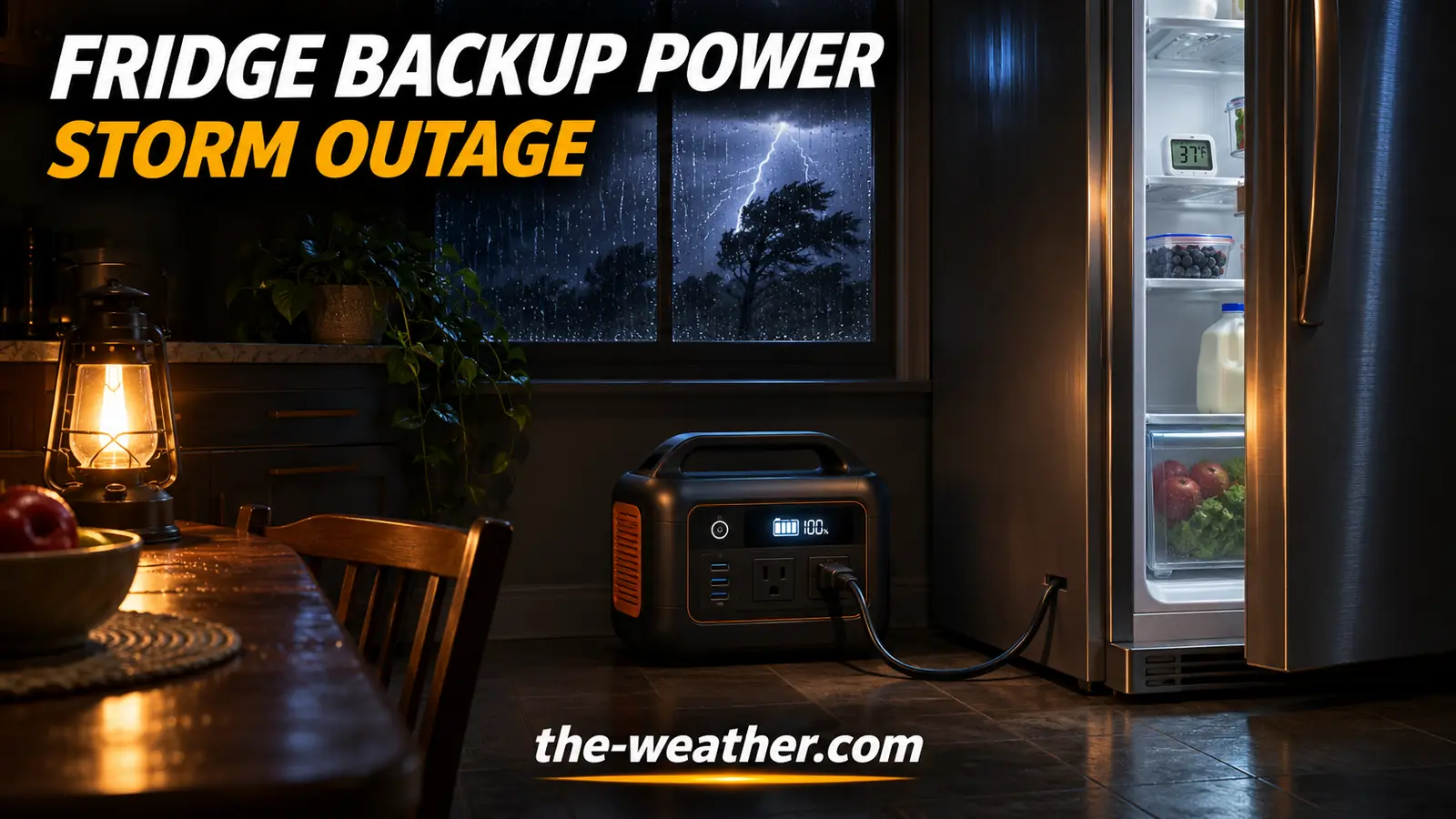
The storm knocked the power out, and the first thing everybody in the house thinks about is the same: what about the food in the fridge? Good news first: a closed fridge buys you a few hours. After that, a portable power station (a big rechargeable battery with normal wall outlets) can keep it cold. How long depends on two numbers you can find yourself in a minute. Here is how.
Short answer: an unopened fridge keeps food safe for about 4 hours without power, a full freezer for about 48 hours (FDA for the fridge, CDC for the freezer). To know how long a power station runs your fridge, take the kWh per year from the yellow EnergyGuide label, turn it into watts, and use the formula power station makers print in their own manuals: battery Wh × 0.85 ÷ watts = hours. For a fridge with a 630 kWh label, that is roughly 12 hours on a 1,024 Wh station and about a day on a 2,000 Wh station.
Editorial Research
- Written by
- Lena Thornton, Weather Station Analyst & CWOP Contributor
- Based on
- FDA and CDC food safety guidance for power outages, the EnergyGuide label example of the Department of Energy's Building America Solution Center, the runtime formula in the Jackery Explorer 1500 user manual, and the makers' own specifications for the power stations named. We did not test these products; every runtime below is our own calculation, shown step by step.
- Research last verified
- November 27, 2026
How long is food safe without power?
Before you buy anything, know your free buffer. The agencies agree on the numbers:
- Fridge: "The refrigerator will keep food cold for about 4 hours if it is unopened" (FDA). The FDA wants a fridge at 40 °F or below.
- Freezer: "A full freezer will keep food safe for 48 hours and a half-full freezer will keep it safe for 24 hours" (CDC).
- After 4 hours: the CDC says "throw out refrigerated foods like meat, fish, eggs, milk and leftovers". The FDA puts it as food that "has been above 40° F for two hours or more". And the CDC sums it up in its own motto: "When in doubt, throw it out."
So the fridge is the one in a hurry. The freezer, if it is full and you keep the door shut, can wait much longer. A cheap fridge thermometer, which the FDA advises keeping, turns guessing into knowing.
Step 1: find out how much power your fridge uses
A fridge does not run all the time. The compressor (the part that makes the cold, and the hum) switches on and off. So the sticker on the back with "amps" tells you the maximum, not what it uses over a day. The better number is on the yellow EnergyGuide label: the estimated kWh per year.
The Department of Energy's Building America Solution Center shows an example label of a fridge with an estimated use of 630 kWh per year, approximately 1.7 kWh a day. Turned into an average:
- 630 kWh ÷ 365 days = 1.73 kWh a day, or 1,726 Wh (watt-hours).
- 1,726 Wh ÷ 24 hours = about 72 watts on average.
No label anymore? Look up your model number on the maker's website; the EnergyGuide label is usually there as a PDF. A summer kitchen and a door that opens every ten minutes push the real use up, so treat the label as the calm-day figure.
Step 2: the runtime formula the makers use
A power station never gives you every watt-hour on the box. Turning battery power into normal 120-volt outlet power costs some energy. Jackery prints its own formula right in the Explorer 1500 user manual: "The actual working time = 1534.68Wh* 0.85 / operating power of your device in watts." We use the same 0.85 for every station below. Other brands may do a bit better or worse, so read it as a planning number, not a promise.
Want the quick version for your own fridge? Hours ≈ battery Wh × 0.85 × 8.76 ÷ the kWh number on your label. For a 1,024 Wh station and a 630 kWh fridge: 1,024 × 0.85 × 8.76 ÷ 630 ≈ 12 hours.
Why runtimes online disagree (and what makes yours shorter)
Search for this question and you will find answers for the same 1,000 Wh station that run from a few hours to more than a day. Many of those articles come from power station makers, and each one quietly assumes a different fridge. That is why we show the math: swap in the number from your own label and you get your own estimate.
Treat the result as a planning estimate, not a promise. The label figure is "based on a standard test procedure", and a real kitchen in a storm is not a test lab. Your fridge will run shorter when:
- the door opens often (every opening lets the cold out, and the compressor has to make it again);
- the kitchen is warm, for example in a summer outage;
- the fridge is older than its label, or the label belongs to a different model;
- the power station is not fully charged when the power goes out, or other devices share it.
Want a real number instead of a label number? Use a plug-in electricity usage monitor: a small meter between the plug and the wall. Leave it on the fridge for a full day and you have your fridge's real daily use, door openings included.
Step 3: check the surge, not only the size
Power station makers list two output numbers: a continuous one and a peak (or surge) one. The peak is there for motors and compressors, which pull extra power for a moment when they start. A fridge is a small load for most stations that size, but a very small station can trip off at that moment. If you are not sure, the amps on the fridge sticker × the volts on it (115 or 120) gives you its maximum running watts; stay well under the station's continuous rating.
The handy trick: leave it plugged in (UPS)
Several stations can work as a UPS (uninterruptible power supply): the station sits between the wall and the fridge, passes wall power through, and switches to its battery when the grid drops. Anker lists a switchover of 10 ms or less for the SOLIX S2000 and 10 ms for the C1000 Gen 2; BLUETTI says its FridgePower takes over in 10 ms. That means no running to the kitchen at 3 a.m. The fridge just keeps humming. One note from us: a UPS only buys the battery's runtime, so the table above still decides how long you are covered.
What about the freezer?
Same method: chest and upright freezers carry an EnergyGuide label too. But remember the CDC numbers. A full freezer keeps food safe for 48 hours with the door shut. In a short outage, the fridge is the one that needs the battery first. In a long one (after a hurricane or an ice storm the power can stay out for days), you can let the freezer take turns with the fridge. Keep a freezer thermometer inside: the FDA says frozen food can be refrozen if "the freezer thermometer reads 40° F or below".
Which size power station makes sense for a fridge?
- About 300 Wh: only a few hours of fridge. Better for the phone, the router and the weather radio.
- About 1,000 Wh: covers a night for an efficient fridge, or the 4-hour gap plus a lot more. Easy to carry.
- About 2,000 Wh: roughly a day for an average fridge. The sweet spot for most storm outages.
- 3,000 Wh and up: fridge plus freezer for a long outage, especially with solar panels to top up. These are heavy home units.
Power stations that fit a fridge backup
We picked these from the makers' own specifications: a size that matches the table above, a battery type with many charge cycles (LiFePO4, also called LFP), and enough surge for a compressor. We have not tested them.
Strong fit for about a day of fridge
Anker SOLIX S2000
Why it is on the list: 2,010 Wh and 1,500 W continuous according to Anker, LiFePO4 cells and a UPS switchover of 10 ms or less. In our table that is about a day for a 630 kWh fridge.
Research basis: Anker SOLIX S2000 specifications. New model: check the listing for the US version.
Built with a fridge in mind
BLUETTI FridgePower
Why it is on the list: 2,016 Wh LiFePO4, 1,800 W continuous and 3,600 W peak, 10 ms UPS, according to BLUETTI. Its product page names fridges and sump pumps as uses. With our formula, a fridge that uses 2 kWh a day runs about 20 hours on it.
Research basis: BLUETTI FridgePower product page.
Strong fit for a night of fridge
Anker SOLIX C1000 Gen 2
Why it is on the list: 1,024 Wh, 2,000 W continuous with up to 3,000 W peak and a 10 ms UPS switchover, according to Anker. About 12 hours for a 630 kWh fridge in our table.
Research basis: Anker support: C1000 Gen 2 specifications.
For a long outage: fridge plus freezer
Jackery HomePower 3600 Plus
Why it is on the list: 3,584 Wh and 3,600 W output, expandable to 21 kWh with extra battery packs, according to Jackery. In our formula that is about 42 hours of an average fridge, or a fridge and a freezer taking turns.
Research basis: Jackery HomePower 3600 Plus product page (3,584 Wh, 3,600 W, expandable to 21 kWh with extra battery packs).
Affiliate links: we may earn a commission if you buy through them, at no extra cost to you. We have not tested these power stations ourselves.
My take
Start with the free part: a fridge thermometer and a closed door. Then read the yellow label on your own fridge, do the one-line math, and buy the size that covers your usual outage, not the worst one you can imagine. For most homes in storm country, a 1,000 to 2,000 Wh station that sits on UPS duty next to the fridge is the calm middle ground. And keep it charged: a power station is a bit like an umbrella, it only helps if it is ready before the storm.
Planning for a winter storm? Read our winter storm emergency alerts during power outages too, so you hear the warnings while the grid is down.
Plan the whole house: backup power for storm outages in 4 steps · power station and generator size calculator
Quick Answers
How long will a power station run a refrigerator?
Use battery Wh × 0.85 ÷ the fridge's average watts. For a fridge with a 630 kWh per year EnergyGuide label (about 72 W on average), a 1,024 Wh station gives about 12 hours and a 2,000 Wh station about a day.
How long does food stay safe in a fridge without power?
About 4 hours if you keep the door closed, according to the FDA and CDC. After 4 hours without power, the CDC says to throw out refrigerated foods like meat, fish, eggs, milk and leftovers.
How long does a freezer last without power?
The CDC says a full freezer keeps food safe for 48 hours and a half-full freezer for 24 hours, as long as the door stays shut.
What size power station do I need for a fridge?
About 1,000 Wh covers a night for an efficient fridge; about 2,000 Wh covers roughly a day for an average one. Check the peak (surge) output too, because the compressor pulls extra power when it starts.
Can a power station switch on by itself when the power goes out?
Yes, if it has a UPS function. Anker lists 10 ms or less for the SOLIX S2000 and BLUETTI 10 ms for the FridgePower. The fridge stays plugged into the station, the station into the wall.
Sources: FDA: power outages, key tips for consumers about food safety · CDC: discarding food after a power outage · DOE Building America Solution Center: EnergyGuide label example · Jackery Explorer 1500 user manual · Anker SOLIX S2000 · Anker SOLIX C1000 Gen 2 specifications · BLUETTI FridgePower