As an Amazon Associate, I earn from qualifying purchases.
In this article 12 sections
- Why a Radio When You Have a Phone
- Power Source Types Explained
- Radio Types and What They Cover
- Features That Actually Matter
- Choosing by Disaster Type
- Which Radio Do You Actually Need?
- Emergency Radio Types Compared
- S.A.M.E. Codes: How County-Specific Alerts Work
- Common Mistakes That Leave You Unprepared
- Emergency Radio Maintenance Checklist
- What the Official Sources Say
- Frequently Asked Questions
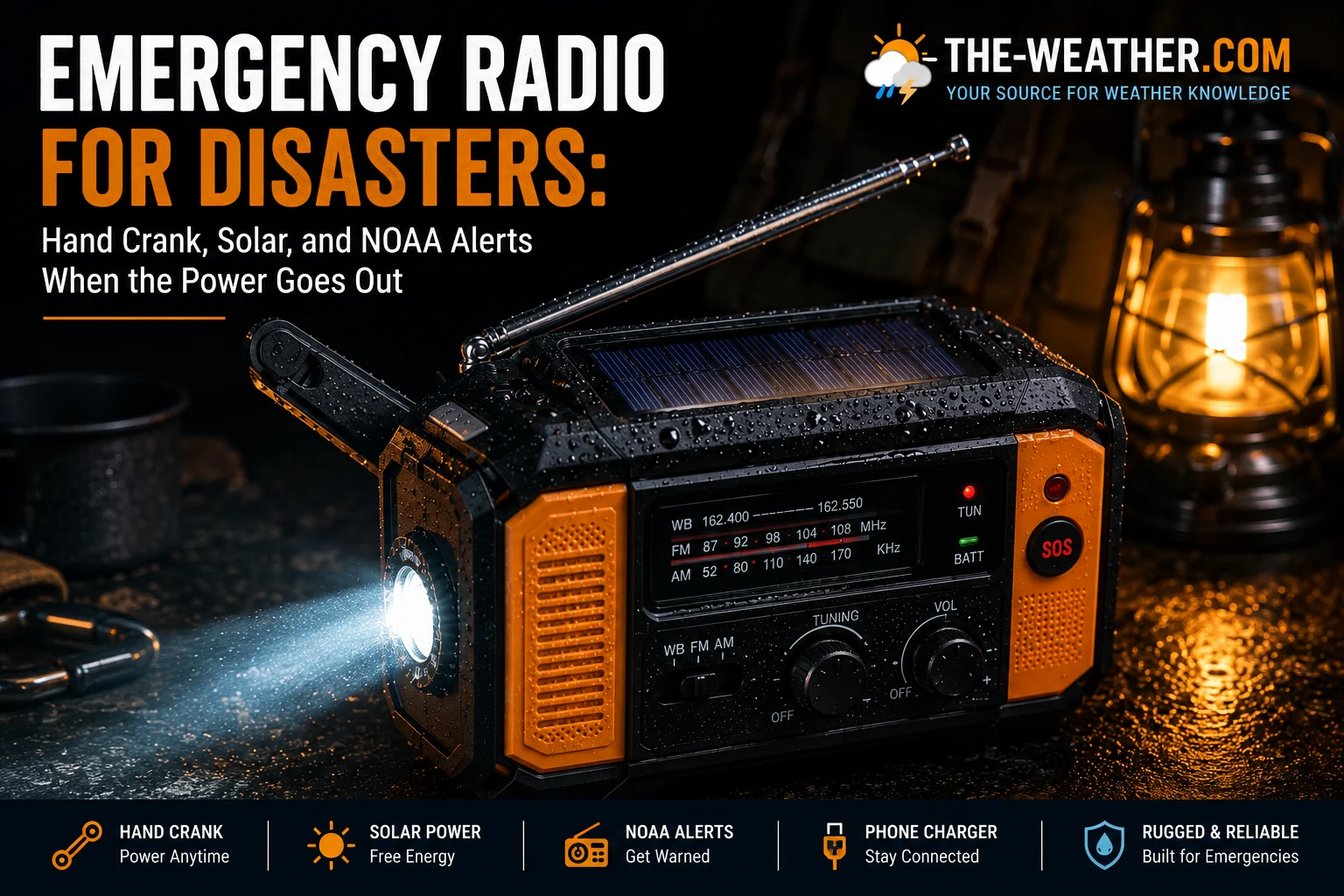
When a hurricane makes landfall, a wildfire cuts power to your county, or a tornado takes out cell towers, your phone becomes useless. The internet goes down. Alerts stop coming through. The only device that still works is one that does not depend on any of that infrastructure: a backup radio.
A dedicated emergency radio receives NOAA weather alerts, AM/FM broadcasts, and in some cases shortwave signals from stations that operate on hardened transmitters designed to stay on air during disasters. It runs on hand crank power, solar panels, or batteries when the grid is gone. It does not need Wi-Fi, cell service, or a functioning power outlet.
This guide covers what features actually matter, which power types suit which scenarios, and how to choose the right radio for your household before a disaster, not during one.

Lena Thornton: Weather Station Analyst & CWOP Contributor
Specifications verified against official documentation
Do not wait until a storm is named. Emergency radios sell out in the 48 hours before a major hurricane or winter storm. Stock and prices spike at exactly the moment you need one most. The right time to buy is now, during normal conditions.
At a Glance
Why a Radio When You Have a Phone
Smartphones depend on three things that disasters routinely knock out: cell tower connectivity, internet infrastructure, and battery power. When a major storm hits, cell networks become overloaded within minutes. Towers lose power. Fiber lines get cut. Even if your phone has battery left, there may be no signal to use it.
Wireless Emergency Alerts, the loud tones that come through on your phone, also depend on working cell infrastructure. If the towers are down, those alerts do not reach you.
A dedicated emergency radio operates on an entirely separate system. NOAA's Weather Radio All Hazards network runs on 162 MHz frequencies from over 1,000 transmitters across the US. They do not depend on cell towers or the internet, so a failing cell network does not silence them.
NOAA's Weather Radio All Hazards network covers all 50 states, the adjacent coastal waters and Puerto Rico. It broadcasts 24 hours a day, 7 days a week, and issues alerts for weather, technological hazards, national emergencies, and public safety events, not just storms.
Power Source Types Explained
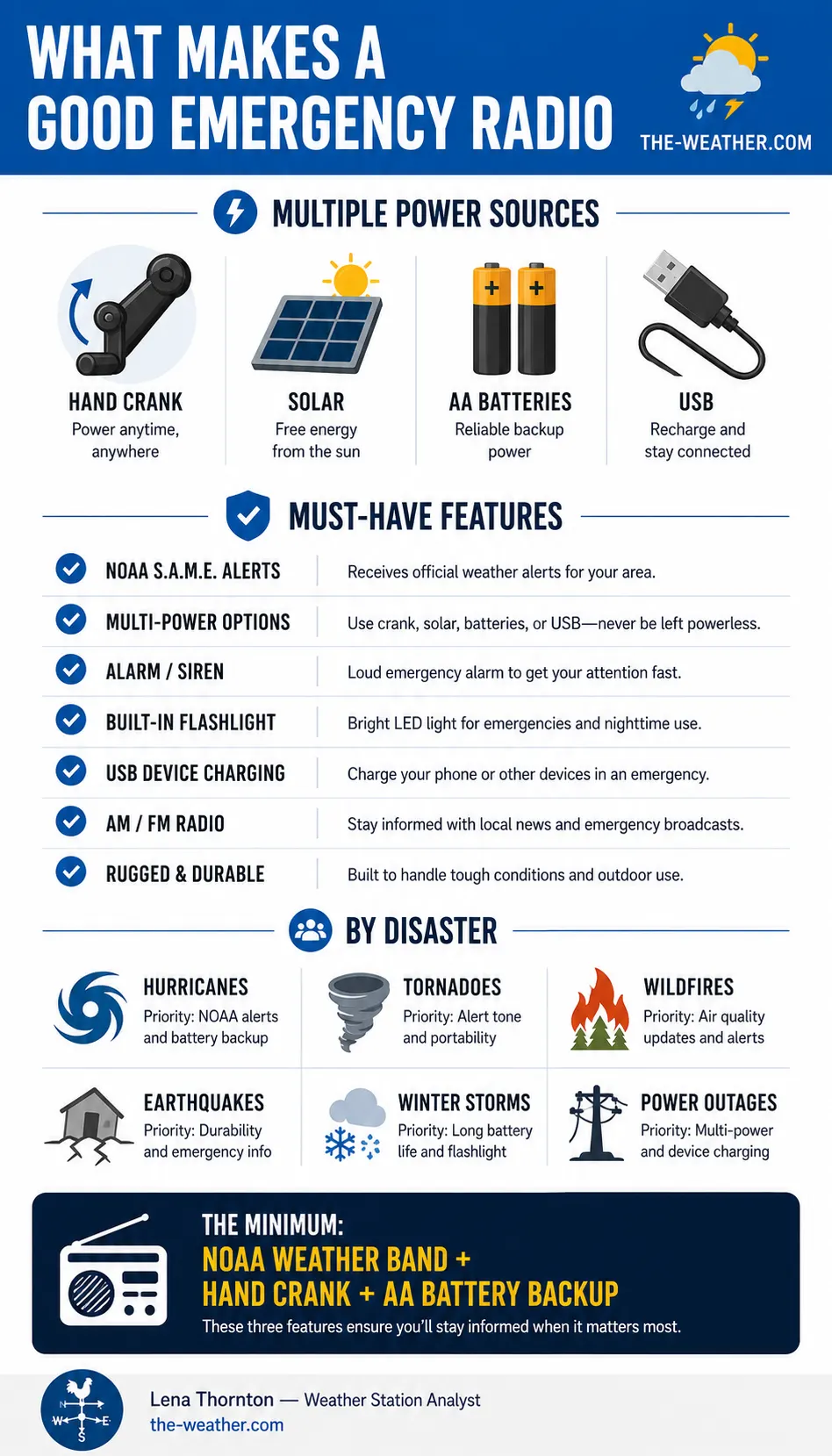
The most critical feature of any disaster radio is how it gets power when yours is gone. A radio with only one power source is a single point of failure. The best emergency radios combine at least three.
Hand Crank
Always availableGenerates power from manual rotation. Slow, typically 1 minute of cranking yields 5–10 minutes of radio. Essential as a last resort when all other power is exhausted. Gets tiring quickly during extended use.
Solar Panel
Weather dependentCharges the internal battery in direct sunlight. Useless at night or during heavy cloud cover. Best used proactively: charge in the morning, use the stored battery power throughout the day and night.
AA/AAA Batteries
Stockpile-ableStandard alkaline batteries are the most reliable power source in a kit: they store for 5–10 years and are available everywhere. Always have a fresh set in the radio and extras in your kit. Do not rely solely on rechargeable batteries for emergencies.
USB / Built-in Battery
Charge before stormsInternal lithium battery charged via USB. Provides the most comfortable listening experience. Charge to 100% when a storm is forecast. Some models double as a power bank to charge your phone: a useful secondary function.
Power redundancy is the rule, not a bonus. Always have a radio that takes standard disposable AA or AAA batteries. Hand cranks get tiring for extended use and solar panels require good weather. Standard alkaline batteries are your most dependable fallback in any scenario.
Radio Types and What They Cover
| Radio Type | Receives Alerts | Can Transmit | License Needed | Best For |
|---|---|---|---|---|
| NOAA Weather Radio | Yes, weather + hazards | No | None | Household alert monitoring |
| AM/FM Radio | Yes, EAS broadcasts | No | None | Local news and EAS alerts |
| Shortwave Radio | Yes, international | No | None to receive | Long-range, off-grid info |
| FRS/GMRS Walkie-Talkie | No alerts | Yes, short range | FRS: none / GMRS: yes | Family communication |
| Ham Radio | Yes, many bands | Yes, long range | Yes (Technician class) | Advanced preparedness, nets |
For most households, a combination NOAA/AM/FM emergency radio covers all monitoring needs. Add FRS/GMRS walkie-talkies if you need to communicate with family members in different locations. Ham radio is the most capable option but requires a license to transmit legally.
Features That Actually Matter
What to Look For
Choosing by Disaster Type
Different disasters create different communication problems. The right radio depends partly on where you live and what threats are most likely.
Hurricanes
Long lead time but extended power outages lasting days to weeks. You need a radio with large battery capacity and solar charging for multi-day use. A model that charges phones via USB is especially useful during prolonged outages.
Tornadoes
Little warning time, often minutes. The most important feature is the alarm siren that wakes you when an alert triggers. Keep the radio near your bed with S.A.M.E. programmed to your county. Alert speed matters more than battery size.
Wildfires
Evacuation orders can come with very little notice. A portable, lightweight radio you can grab and take in the car is more valuable than a large home unit. AM radio is often the fastest source of local evacuation route updates.
Earthquakes
Infrastructure damage is often widespread and unpredictable. Cell towers and power may be out for extended periods across large areas. A radio with maximum power independence (crank + solar + batteries) covers the longest potential outage windows.
Winter Storms
Extended power outages in freezing temperatures. Cold reduces battery capacity noticeably: lithium batteries hold up better than alkaline in cold. Keep the radio indoors and warm. A radio with AA backup is important when the internal battery drains faster than expected in the cold.
Power Outages
The most common scenario. Cause can be storms, grid failure, or equipment issues. A home base radio with S.A.M.E. alerts and a dedicated desktop unit like the Midland WR120C covers everyday outage scenarios without needing full survival radio features.
Which Radio Do You Actually Need?
The right answer depends on two things: what you need the radio to do, and whether you need to receive information, send it, or both. Work through this decision tree to find your fit.
Radio Decision Flowchart
Emergency Radio Types Compared
If you prefer a direct side-by-side, here is every relevant feature across the four main radio types you will encounter in emergency preparedness.
| Feature | NOAA Weather Radio | Multi-Band Emergency Radio | FRS / GMRS | Ham Radio |
|---|---|---|---|---|
| Receives NOAA alerts | Yes | Yes | No | Depends on model |
| S.A.M.E. county filtering | Yes (most models) | Yes (most models) | No | No |
| AM / FM reception | No | Yes | No | Some models |
| Shortwave reception | No | Select models | No | Yes |
| Can transmit (talk) | No | No | Yes | Yes |
| Hand crank / solar power | Some models | Yes (most models) | No, battery only | Some portable models |
| License required | None | None | FRS: none / GMRS: yes | Yes, Technician class |
| USB phone charging | Rarely | Yes (most models) | No | No |
| Typical price range | $30–$70 | $50–$150 | $30–$100 per pair | $100–$500+ |
| Best for | Home alert monitoring | Full emergency kit | Family comms, short range | Advanced preparedness |
S.A.M.E. Codes: How County-Specific Alerts Work
S.A.M.E. stands for Specific Area Message Encoding. It is a system built into NOAA weather radios that lets you filter alerts to only your county or region, rather than receiving every alert broadcast in your state.
Without S.A.M.E., a NOAA radio in coastal Florida might wake you up for a tornado warning in a county 150 miles away. With S.A.M.E. programmed to your county code, the alarm only sounds for alerts affecting your area. This dramatically reduces false alarms and alert fatigue, which means you actually pay attention when the alarm goes off.
Find your S.A.M.E. county code with our free SAME code lookup or see our full walkthrough at how to program S.A.M.E. codes. You will need it when setting up any NOAA weather radio with S.A.M.E. filtering capability.
S.A.M.E. radios also let you select which alert types you want to receive. You can choose to hear tornado warnings, hurricane watches, and civil emergency messages while filtering out less urgent advisory-level alerts. This level of control is what separates a quality emergency radio from a basic one.
Common Mistakes That Leave You Unprepared
Most people who own an emergency radio are still not properly prepared. These are the errors that show up consistently, and how to avoid each one.
Keeping the internal battery empty
Most people charge their emergency radio once when they buy it, then never again. A lithium battery left discharged for months degrades. When you actually need the radio, it may have only minutes of power left.
Never testing the radio
A radio sitting in a drawer for two years may have a dead battery, a corroded battery terminal, or a stuck button. Finding this out during a tornado warning is too late. Radios need to be tested periodically to confirm they work.
Not programming S.A.M.E. county codes
Without S.A.M.E. codes entered, your radio receives alerts for every county in broadcast range, often dozens. Alert fatigue sets in quickly. Many people turn the alert function off entirely because it fires too often. Then they miss the one that matters.
Assuming your phone is enough
Wireless Emergency Alerts on phones depend on working cell towers. In a major storm, towers lose power, get overwhelmed by simultaneous calls, or sustain physical damage. In the first hours of a hurricane or major tornado outbreak, cell networks in affected areas routinely fail.
Buying a radio with only one power source
A radio that runs only on USB charging is useless when the power is out and your portable charger is dead. A radio that runs only on AA batteries becomes useless when you run out of batteries on day three of an outage. Single-source radios create single points of failure.
Storing the radio somewhere inaccessible
A radio stored in a basement storage room, attic, or garage does not help when a tornado warning sounds at 2 a.m. Emergency radios need to be somewhere you can reach them in seconds, in the dark, while half asleep.
Emergency Radio Maintenance Checklist
A radio you never test is a radio you cannot trust. These checks take less than 10 minutes and should be done twice a year: a good trigger is when clocks change in spring and autumn.
Every 6 Months
Power checks
Reception and settings
What the Official Sources Say
You do not have to take our word for it. Here is what the National Weather Service and Ready.gov (the preparedness site of the U.S. government) say about emergency radios. We read both pages on October 12, 2026.
- The network: the National Weather Service describes NOAA Weather Radio All Hazards as "a nationwide network of radio stations broadcasting continuous weather information". It has more than 1,000 transmitters, covering all 50 states, the adjacent coastal waters and Puerto Rico.
- Always on: it broadcasts official warnings, watches, forecasts and other hazard information 24 hours a day.
- Seven channels: 162.400, 162.425, 162.450, 162.475, 162.500, 162.525 and 162.550 MHz.
- In the official kit list: Ready.gov puts a "battery-powered or hand crank radio and a NOAA Weather Radio with tone alert" on its basic emergency supply list, next to a flashlight, extra batteries and a "cell phone with chargers and a backup battery".
- Where to keep it: Ready.gov advises keeping the kit in a set place that everyone in the household knows, and going through it once a year.
Need the code for your county? Our free SAME code lookup gives you the six-digit code and the station that serves your county, with the data of the National Weather Service.
Sources: National Weather Service, NOAA Weather Radio and Ready.gov, Build A Kit.
Frequently Asked Questions
What is the best radio for survival situations?
For survival use, a multi-power emergency radio with hand crank, solar panel, battery, and USB charging covers every scenario. Look for NOAA weather band reception, AM/FM, and a built-in flashlight. The Midland ER310PRO and Kaito Voyager X are widely recommended for this use case.
What radios will work if cell towers are down?
AM/FM radios, NOAA weather radios, shortwave radios, and ham radios all work independently of cell towers. They receive broadcasts from transmitters that operate on separate infrastructure. A dedicated emergency radio with NOAA weather band capability is the most practical choice for most households.
What radio would survive an EMP?
Simple analog radios with minimal electronics are most resistant to electromagnetic pulse. Storing a basic AM/FM or shortwave radio in a metal Faraday cage when not in use provides additional protection. Avoid radios with complex digital circuits for EMP preparedness.
What good is a portable radio during a disaster?
A portable radio receives emergency broadcasts, NOAA weather alerts, and local news when internet and cell service are unavailable. It requires no infrastructure beyond broadcast towers, which are hardened against most disasters. It is the only communication device that works reliably during widespread power outages.
What is the most reliable emergency radio?
The most reliable emergency radios combine multiple power sources, receive NOAA weather alerts with S.A.M.E. filtering, and have a simple, durable build. The Midland ER310PRO is consistently ranked among the top choices for reliability and feature set at its price point.
Can anyone use a ham radio in an emergency?
In a genuine life-threatening emergency, FCC rules allow anyone to transmit on ham radio frequencies without a license. For everyday preparedness communication, a Technician class license is required to transmit legally. Listening to ham radio frequencies requires no license.
What kind of radio do I need in an emergency?
For most households, a NOAA weather alert radio with hand crank and solar backup is the minimum. Add AM/FM for local news and broadcasts. If you want to communicate with others rather than just listen, you will need FRS/GMRS walkie-talkies or a licensed ham radio.
What is the 3-3-3 rule for radio?
The 3-3-3 rule is an amateur radio emergency convention: transmit on a designated frequency at 3 minutes past the hour, 33 minutes past the hour, and 3 minutes before the hour. It helps separated groups find each other on a common channel during a disaster when normal communication is disrupted.