
As an Amazon Associate, I earn from qualifying purchases.
In this article 10 sections
- Three Pacific Zones, Three Forecast Centers
- Why Hurricanes Almost Never Hit California
- The Exception: The San Diego Hurricane of 1858
- The Modern Example: Hurricane Hilary (2023)
- Hawaii: Rare, but Real
- When Is Pacific Hurricane Season?
- Living Out West or in Hawaii: Be Ready Anyway
- Pacific Hurricane FAQ
- Update Log
- Sources
Ask most Americans where hurricanes hit and they will say Florida, the Gulf Coast or the Carolinas. Yet the eastern Pacific, off Mexico, is a busy hurricane factory too. So why do Los Angeles and San Diego almost never see one, and why is a hurricane in Hawaii big news? NOAA's hurricane researchers have a clear answer, and a couple of surprising exceptions.
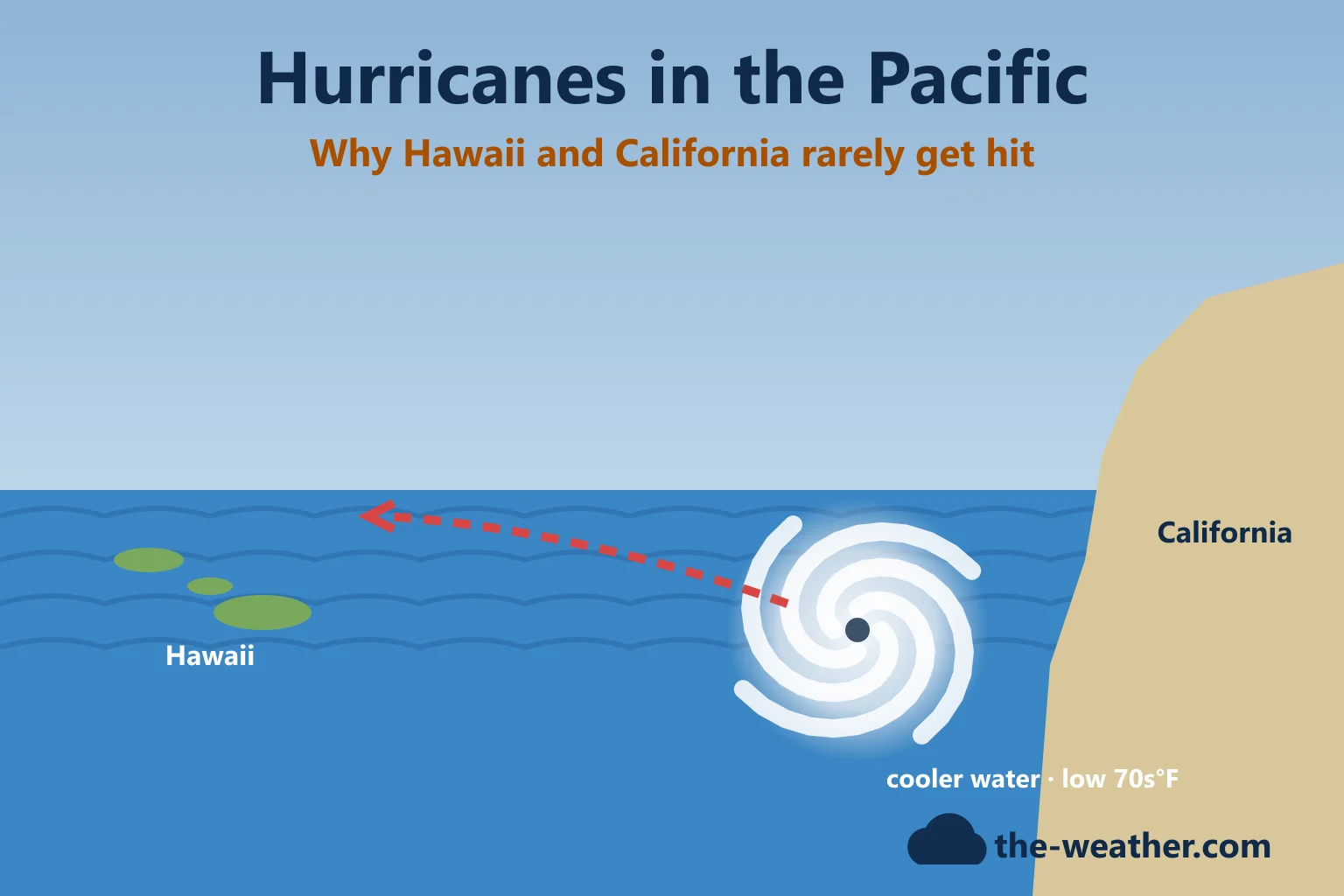
Short answer: yes, there are hurricanes in the Pacific; the eastern Pacific season officially runs from May 15 to November 30. They almost never hit the U.S. West Coast for two reasons, according to NOAA: they usually move west-northwest, away from the coast, and the ocean off California rarely gets above the lower 70s°F, too cool to keep a hurricane going. Their leftover moisture can still bring heavy rain to the Southwest, and Hawaii has been hit, most famously by Hurricane Iniki in 1992 (NOAA Hurricane Research Division).
In the news (October 20, 2026): forecasters were watching a disturbance several hundred miles south of southern Mexico that was expected to strengthen into a tropical depression; if named, it would be called Vance (Fox Weather). The National Hurricane Center's outlook of 11 a.m. PDT that day gave it a 90 percent chance of forming within 48 hours, moving west to west-northwest well offshore of southern Mexico (NHC). For official, current information, check the National Hurricane Center. The rest of this page applies to every eastern Pacific season.
Editorial Research
- Written by
- Lena Thornton, Weather Station Analyst & CWOP Contributor
- Based on
- NOAA's Hurricane Research Division FAQ (West Coast, seasons, El Niño, names, history), NOAA's National Ocean Service, the National Weather Service, the Japan Meteorological Agency and the National Hurricane Center's storm surge risk maps
- Research last verified
- October 20, 2026
Three Pacific Zones, Three Forecast Centers
| Part of the Pacific | Storms are called | Forecast center |
|---|---|---|
| Eastern North Pacific (off Mexico and Central America) | Hurricanes | National Hurricane Center |
| Central North Pacific (around Hawaii) | Hurricanes | Central Pacific Hurricane Center |
| Northwest Pacific (Guam, Asia) | Typhoons | Regional: Japan Meteorological Agency's RSMC Tokyo; U.S.: Joint Typhoon Warning Center |
Names per ocean: NOAA National Ocean Service. Forecast centers: National Weather Service and the NOAA HRD FAQ.
One big difference in the northwest Pacific: the official warnings for your area come from your own country's weather service, such as PAGASA in the Philippines, JMA in Japan or the NWS office in Guam for Guam and the Marianas. The Japan Meteorological Agency tracks typhoons for the whole region, but it says this regional information is not the official warning for each area (JMA RSMC Tokyo). Our typhoon season page lists the weather services for the most visited typhoon areas.
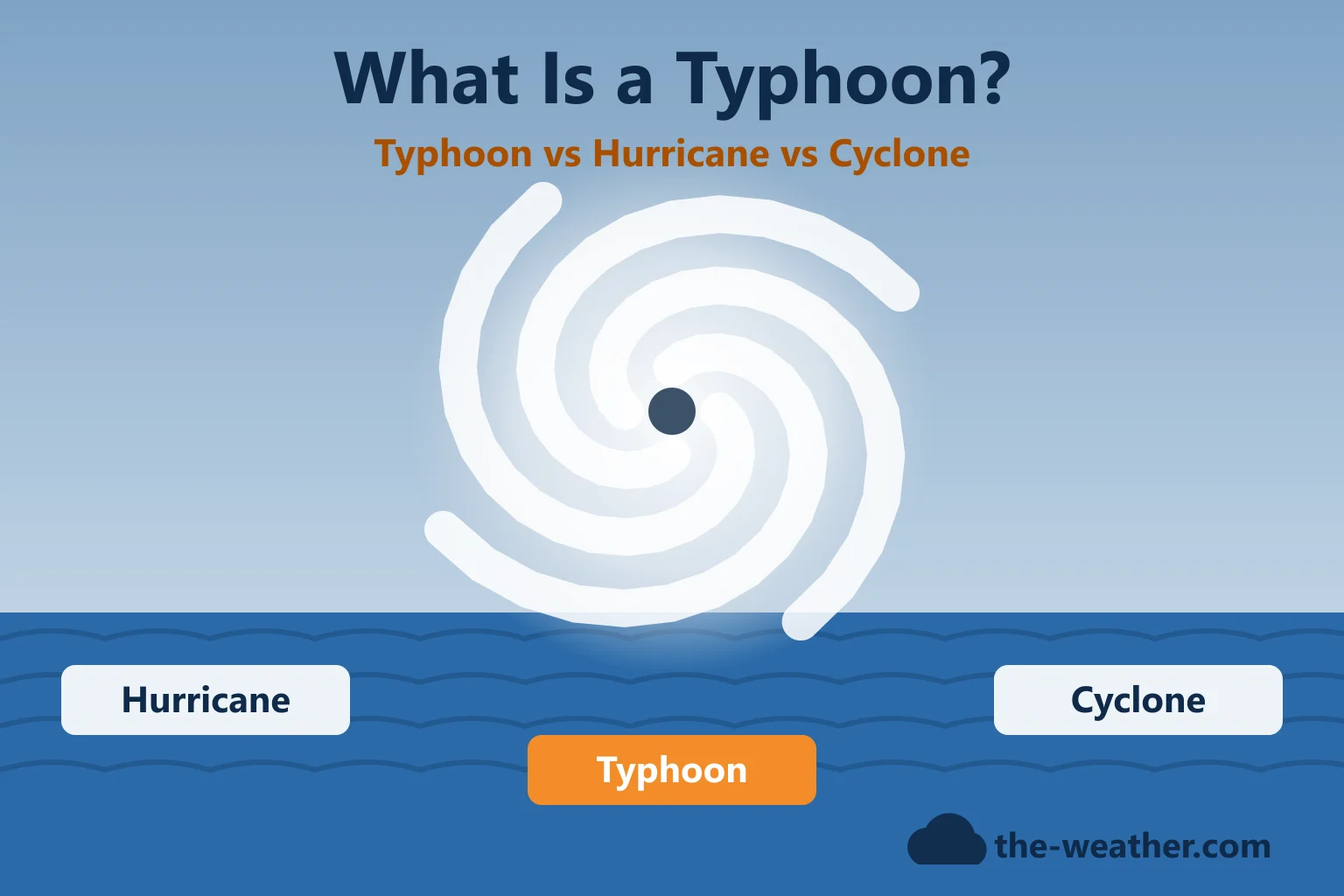
Same kind of storm, different name once it is far enough west: a storm in the northwest Pacific is a typhoon. That naming rule is explained on our main page, What Is a Typhoon?
Why Hurricanes Almost Never Hit California
NOAA's Hurricane Research Division gives two main reasons:
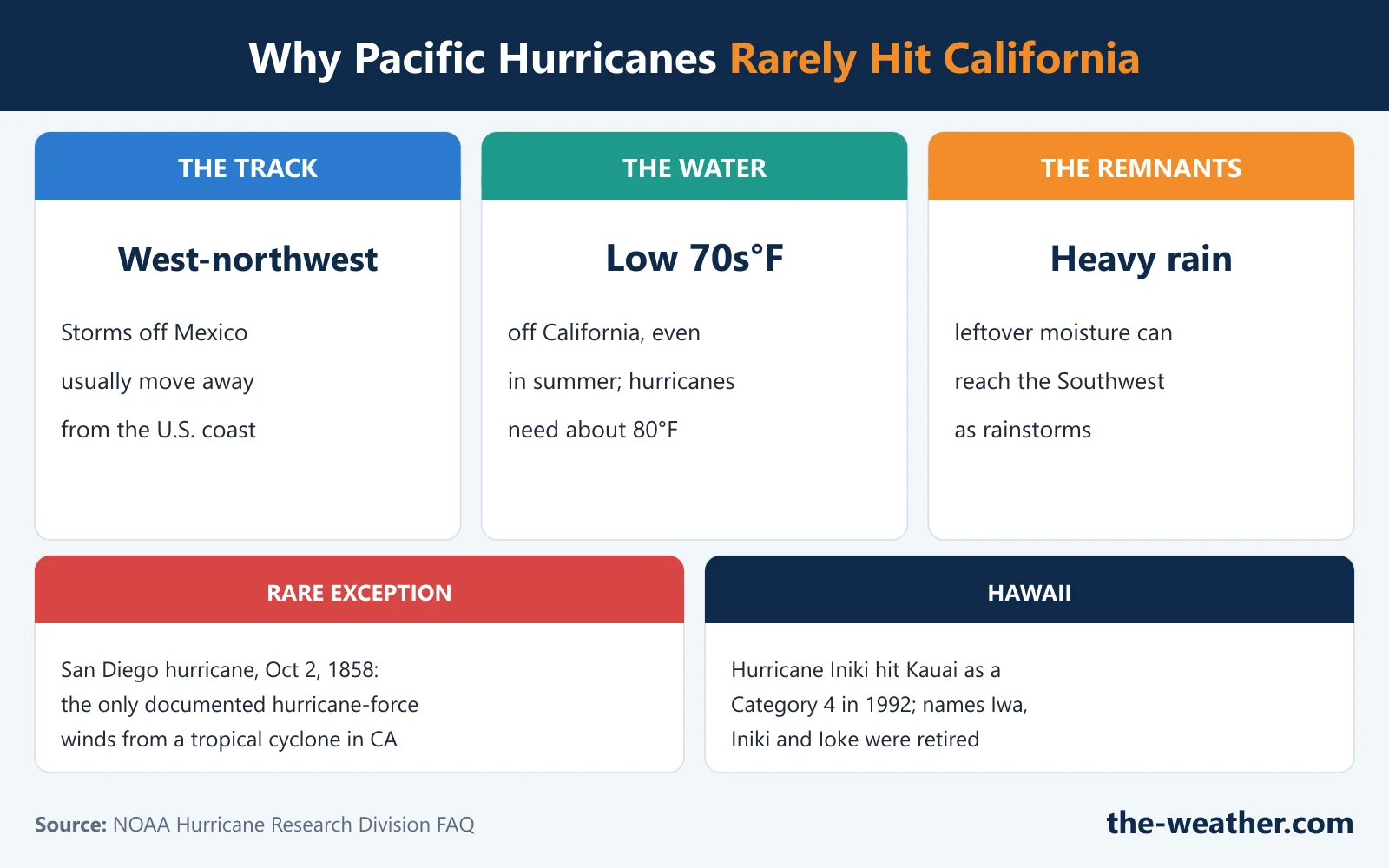
- The track. Hurricanes in the tropics tend to move west-northwest after they form. In the Atlantic, that brings many of them toward the U.S. East Coast; Atlantic hurricanes strike the U.S. mainland just under twice a year on average. In the northeast Pacific, the same west-northwest track takes the storms farther offshore, away from the West Coast.
- The water. On the East Coast the Gulf Stream supplies warm water above 80°F. Along the West Coast, NOAA says ocean temperatures "rarely get above the lower 70s, even in the midst of summer". For the occasional storm that does head toward California, that cooler water quickly weakens it.
That does not mean Pacific storms never matter to the mainland. NOAA notes that the remnants of these storms can move over the Southwestern United States and bring heavy rainfall. In our reading of NOAA, that means the Southwest is more likely to feel a Pacific hurricane as heavy rain than as wind. If you track rain at home, our page on tracking rainfall during a flood watch is handy for those events.
The Exception: The San Diego Hurricane of 1858
"Never" is a strong word in weather. NOAA's Hurricane Research Division describes how researchers rediscovered a hurricane that struck San Diego on October 2, 1858. It caused unprecedented damage in the city and is the first and only documented case of hurricane-force winds from a tropical cyclone in California's recorded history. NOAA adds that 1858 may have been an El Niño year, which could have let the storm keep its strength over warmer-than-usual water.
The Modern Example: Hurricane Hilary (2023)
Hilary is the best recent answer to "can a Pacific hurricane reach California?" According to the National Hurricane Center's official report, Hilary reached Category 4 well off southwestern Mexico, weakened as it approached land and made landfall as a tropical storm in Baja California. In post-storm analysis, the NHC found it lost its tropical characteristics shortly after that landfall, before reaching Southern California.
It still made history. Hilary led to the first-ever coastal and inland tropical storm watches and warnings for Southern California. Its moisture brought historic, flooding rain to parts of the Southwest: more than 10 inches in parts of the Southern California mountains, daily or monthly rainfall records in Los Angeles and San Diego, and an all-time daily record of 2.20 inches in Death Valley, more than that spot averages in an entire year (NHC Tropical Cyclone Report: Hurricane Hilary). It is a textbook case of what NOAA describes: the wind fades over cool water, the rain does not.
Hawaii: Rare, but Real
Hawaii sits in the central North Pacific, where the Central Pacific Hurricane Center issues advisories, at least every 6 hours and every 3 hours when coastal watches or warnings are in effect (NWS). Direct hits are uncommon, but they happen. NOAA's history timeline notes that Hurricane Iniki hit Kauai as a Category 4 storm in 1992, and NOAA lists Iwa (1982), Iniki (1992) and Ioke (2006) among the Central Pacific names retired from use, most of them for damage to or impacts on the Hawaiian Islands.
Two things are worth knowing if you live there. First, storm surge is not only an East Coast issue: the National Hurricane Center's National Storm Surge Risk Maps include Hawaii and Southern California (NHC). Second, NOAA's researchers note that the part of the Pacific between 140°W and the date line has been suggested to see more storms forming in El Niño years, though they add this "has not been completely documented yet". For El Niño itself, see our El Niño page.
When Is Pacific Hurricane Season?
For the eastern Pacific, the National Hurricane Center's official dates are May 15 to November 30. NOAA describes a broad peak: activity starts in late May or early June, runs until late October or early November, and is busiest in late August and early September. For the northwest Pacific (typhoons) there is no official season at all; see our typhoon season page.
Living Out West or in Hawaii: Be Ready Anyway
Rare is not never. Ready.gov points out that hurricanes can happen along any U.S. coast or in any territory in the Atlantic or Pacific. The same basics apply as on the East Coast: know where to find official updates (our guide Where Is the Hurricane Right Now? lists them), know what a hurricane watch and warning mean, and have a way to get alerts when the power is out (see our emergency weather radios).
Pacific Hurricane FAQ
Are there hurricanes in the Pacific Ocean?
Yes. The eastern and central North Pacific have hurricanes, with an official eastern Pacific season from May 15 to November 30. In the northwest Pacific the same storms are called typhoons.
Why don't hurricanes hit California?
NOAA gives two reasons: Pacific hurricanes usually move west-northwest, away from the coast, and the ocean off California rarely gets above the lower 70s°F, which is too cool to sustain a hurricane. Their remnants can still bring heavy rain to the Southwest.
Has a hurricane ever hit California?
NOAA's researchers documented a hurricane that struck San Diego on October 2, 1858. It is the first and only documented case of hurricane-force winds from a tropical cyclone in California's recorded history.
Has a hurricane hit Hawaii?
Yes. NOAA notes that Hurricane Iniki hit Kauai as a Category 4 storm in 1992. The names Iwa, Iniki and Ioke were retired from the Central Pacific list, mostly because of damage or impacts on the Hawaiian Islands.
Did Hurricane Hilary hit California?
Not as a hurricane. The NHC's report says Hilary made landfall as a tropical storm in Baja California and lost its tropical characteristics before reaching Southern California. It still caused the first-ever tropical storm watches and warnings for Southern California and historic flooding rain in the Southwest.
Update Log
- October 20, 2026: First version, with a dated news box on a possible eastern Pacific storm. Hilary details from the NHC's official storm report.
Sources
- NOAA Hurricane Research Division: Tropical Cyclone FAQ ("Why Do Hurricanes Never Hit the West Coast of the United States?", seasons, El Niño, retired names, history timeline)
- NOAA National Ocean Service: hurricane vs typhoon
- Japan Meteorological Agency: RSMC Tokyo Typhoon Center
- National Weather Service: Hurricane and Tropical Storm Watches, Warnings, Advisories and Outlooks
- National Hurricane Center: National Storm Surge Risk Maps
- National Hurricane Center: Tropical Cyclone Report, Hurricane Hilary (2023)
- Ready.gov: Hurricanes
- News box: Fox Weather
More in this series: What is a typhoon? · Typhoon season · How hurricanes form · Track a hurricane live