
As an Amazon Associate, I earn from qualifying purchases.
In this article 10 sections
Planning a trip to Japan, the Philippines or Guam, or moving there for work? Then "when is typhoon season?" is a fair question. The honest answer is a little surprising: officially, there is no typhoon season, because the northwest Pacific can produce typhoons in any month. But there is a clear busy period, and a quiet one. Here is what NOAA's hurricane researchers say about when and where typhoons strike.
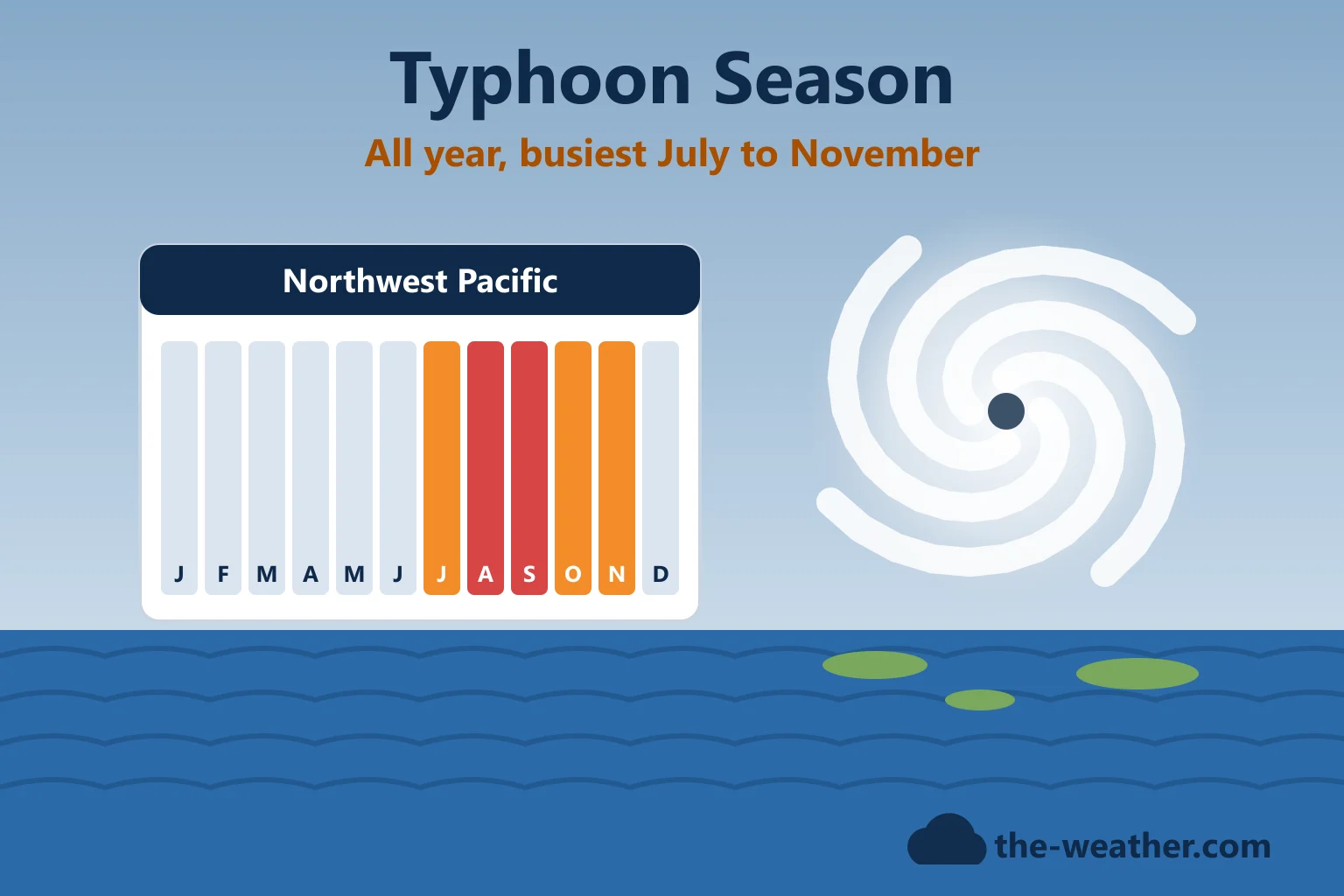
Short answer: the northwest Pacific has tropical cyclones "all year round regularly", so there is no official typhoon season. The main season runs from July to November, with a peak in late August and early September. The quietest time is February and the first half of March (NOAA Hurricane Research Division). The busiest months differ by place: July to October in the Philippines (PAGASA), August and September for Japan (JMA). For comparison, the Atlantic hurricane season officially runs from June 1 to November 30.
Editorial Research
- Written by
- Lena Thornton, Weather Station Analyst & CWOP Contributor
- Based on
- NOAA's Hurricane Research Division FAQ (seasons by basin, country rankings, El Niño effects, typhoon names and history), NOAA's National Ocean Service, PAGASA and Japan Meteorological Agency climatology, and Ready.gov
- Research last verified
- October 20, 2026
The Typhoon Calendar, Month by Month
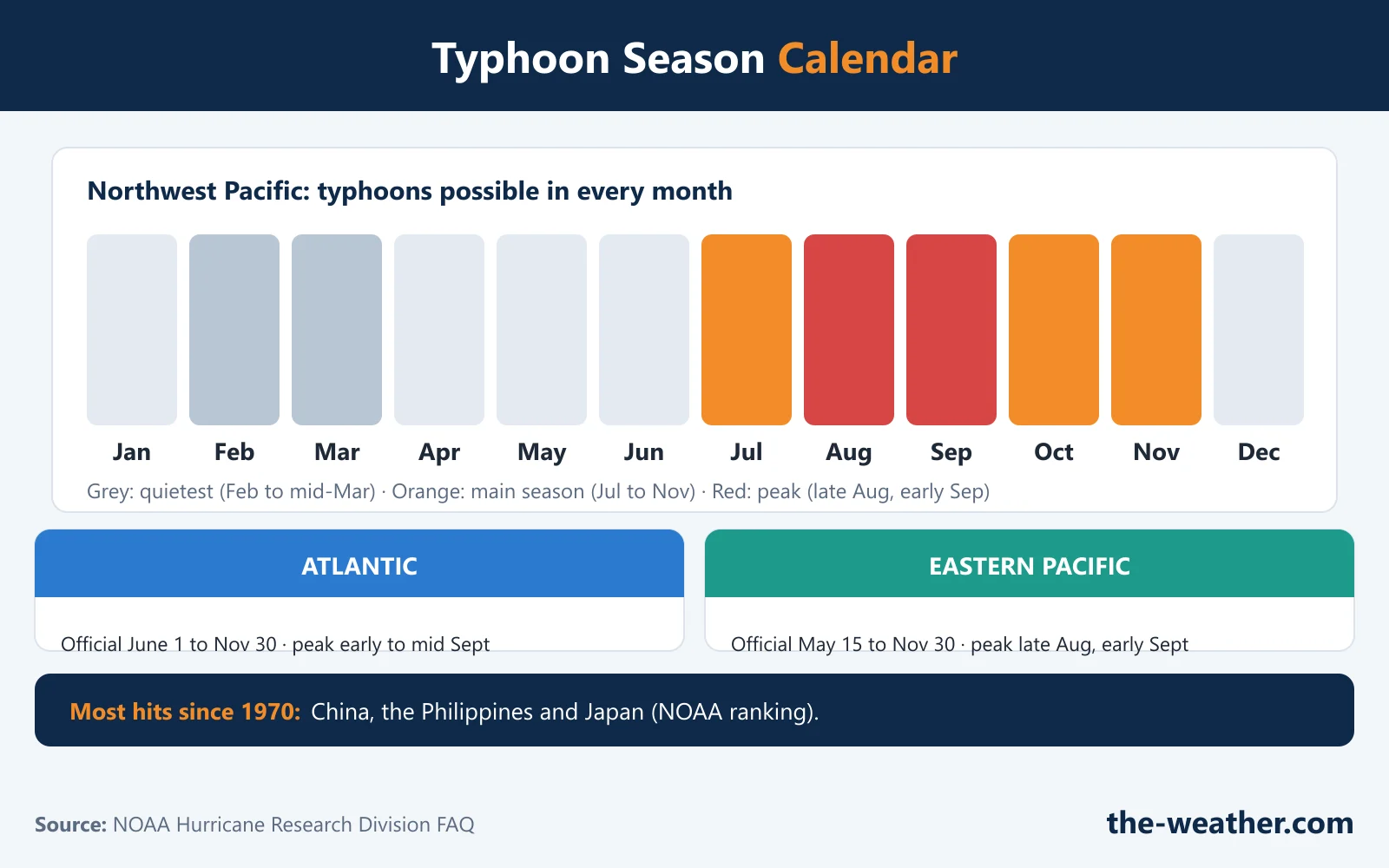
| Ocean | Season | Peak |
|---|---|---|
| Northwest Pacific (typhoons) | All year; main season July to November | Late August to early September |
| North Atlantic (hurricanes) | Officially June 1 to November 30 | Early to mid September |
| Eastern North Pacific (hurricanes) | Officially May 15 to November 30 | Late August to early September |
| North Indian Ocean (cyclones) | April to December | Double peak in May and November |
| Southwest Pacific (cyclones) | Late October or early November to early May | March |
Source: NOAA Hurricane Research Division, "When Is Hurricane Season?". Globally, NOAA says September is the most active month and May the least active.
Why the late-summer peak? NOAA explains that tropical cyclones need warm ocean water (80°F at the surface), easy thunderstorm development, light winds aloft and enough large-scale spin. The full recipe is in our page on how hurricanes and typhoons form.
The Busy Months Differ by Place
The NOAA dates above describe the northwest Pacific as a whole. The storms do not reach every country at the same time, so look at the numbers for the place you care about:
| Place | Busiest months | Source |
|---|---|---|
| Philippines | July through October, "when nearly 70%" of typhoons develop. About 20 tropical cyclones a year in the region, with 8 or 9 crossing the Philippines. | PAGASA |
| Japan | August and September: on average about 3.3 tropical storms and typhoons approach Japan in each of those months (1991-2020 averages), against 2.1 in July and 1.7 in October. | Japan Meteorological Agency |
| Guam and the Northern Mariana Islands | Typhoons can come in any month. The NWS office in Guam publishes the local outlook. | NWS Guam |
In our view, this is the table to use when you plan a trip: the region-wide "late August to early September" peak is a good summary, but the Philippines stays busy into October.
Where Do Typhoons Hit Most?
NOAA's Hurricane Research Division ranks countries by tropical cyclone hits at hurricane strength. Because some regions have longer records than others, it also gives a fairer ranking for the satellite era, since 1970. In that list, the top three are all in the typhoon zone:
- China
- The Philippines
- Japan
Mexico, the United States, Australia, Taiwan, Vietnam, Madagascar and Cuba complete the top ten. Japan's year 2004 is a memorable example: NOAA's FAQ lists it as a high-impact event: 10 tropical cyclones made landfall in Japan that year.
Typhoons are not a new topic in the region. NOAA's history timeline notes that the Manila Observatory in the Philippines was founded in 1865 and made its first typhoon forecast in 1879.
Typhoon Season and Guam
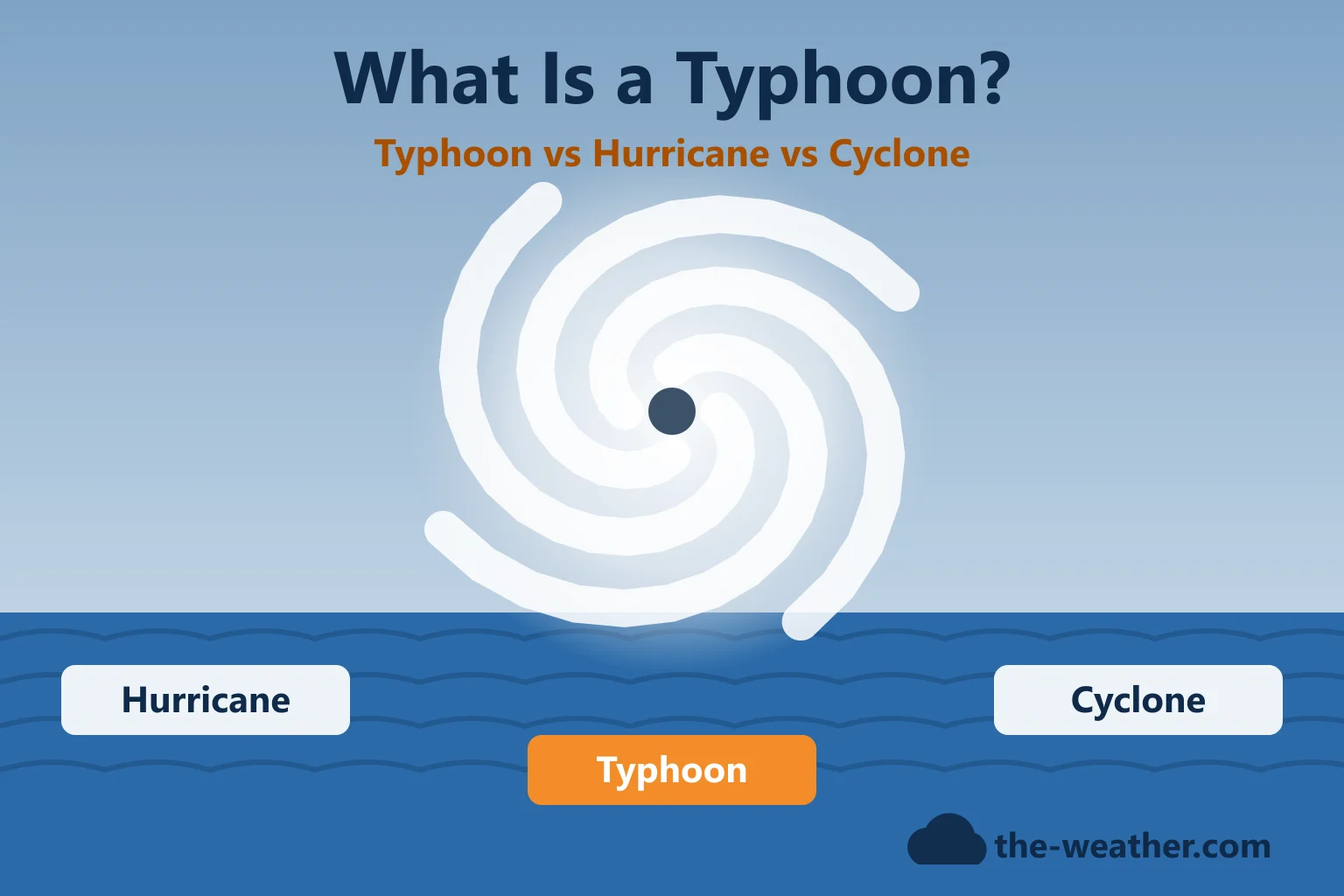
For Americans, the typhoon zone is home turf in Guam and the Northern Mariana Islands. Ready.gov notes that hurricanes can hit any U.S. coast or territory in the Atlantic or Pacific, and that "in parts of the western North Pacific, hurricanes are called typhoons" (Ready.gov). The U.S. military's Joint Typhoon Warning Center was formed on Guam in 1959, according to NOAA's history timeline. Two super typhoons that hit Guam are on our super typhoon page.
Guam lies in the northwest Pacific, where typhoons can come in any month. The basin-wide July to November window is only a rough guide for the islands; the local National Weather Service office in Guam issues the watches and warnings for the islands, and it publishes a western North Pacific tropical cyclone outlook.
In the news (October 2026): Typhoon Champi passed just south of Guam over the weekend of October 17-18, 2026 (Fox Weather), inside the northwest Pacific's July to November main season. We will update or remove this box.
Does El Niño Change Typhoon Season?
It changes where the typhoons form more than how many there are. According to NOAA's Hurricane Research Division, during El Niño the northwest Pacific sees fewer typhoons forming west of 160°E and more forming between 160°E and the International Date Line, and they tend to form closer to the equator. During La Niña the opposite happens. The total number does not change much.
That is quite different from the Atlantic, where NOAA says El Niño increases wind shear and tends to suppress hurricanes. If you want the bigger picture of how the two phases play out, see our El Niño vs La Niña hurricane seasons page.
Why Typhoons Can Have Two Names
If you follow a storm in the Philippine news and in international news, you may see two different names. NOAA explains why: since January 1, 2000, northwest Pacific storms get names contributed by the members of the World Meteorological Organization's Typhoon Committee. Most are not personal names but flowers, animals, birds, trees or even foods, and they are not used in alphabetical order. On top of that, the Philippine weather service PAGASA keeps its own separate list for any system that threatens the Philippines. For how names work in the Atlantic, read why we name tropical storms and hurricanes.
Traveling During Typhoon Season
Our own practical view, for travelers: a trip in the busy months for your destination is not by itself a reason to cancel, but it is a reason to plan for a flexible day or two, to check the official forecasts before you fly and during your stay, and to know how you will get local alerts. These are the official weather services for the most visited typhoon areas:
| Destination | Official weather service |
|---|---|
| Guam and the Northern Mariana Islands | National Weather Service Guam |
| Philippines | PAGASA |
| Japan | Japan Meteorological Agency (JMA) |
| Taiwan | Central Weather Administration (CWA) |
Always follow local authorities' instructions during your stay. The official sources for each ocean are in our guide Where Is the Hurricane Right Now?, and what the alerts mean is in Hurricane Watch vs Warning.
Typhoon Season FAQ
When is typhoon season?
There is no official typhoon season, because the northwest Pacific has typhoons in every month. NOAA says the main season runs from July to November, with a peak in late August and early September, and the quietest time is February and the first half of March.
What is the peak month for typhoons?
NOAA's Hurricane Research Division puts the peak in late August and early September for the northwest Pacific. Worldwide, September is the most active month for tropical cyclones. Per country it differs: PAGASA gives July through October for the Philippines, and JMA's averages show August and September as the busiest months for Japan.
Which countries get the most typhoons?
In NOAA's ranking of tropical cyclone hits since 1970, China, the Philippines and Japan are the top three. All three are in the northwest Pacific typhoon zone.
Does Guam have a typhoon season?
Guam is in the northwest Pacific, where typhoons can form in any month, so there is no official season. The northwest Pacific as a whole is busiest from July to November, but that is only a rough guide for Guam. The NWS office in Guam issues the local outlook, watches and warnings.
Is typhoon season the same as hurricane season?
No. The Atlantic hurricane season officially runs from June 1 to November 30 and the eastern Pacific from May 15 to November 30. The northwest Pacific has no official season, though its busiest months overlap with the Atlantic's.
Update Log
- October 20, 2026: First version. Seasons, rankings and El Niño effects from NOAA's Hurricane Research Division; weather service links checked on this date; per-country peak months from PAGASA and JMA.
Sources
- NOAA Hurricane Research Division: Tropical Cyclone FAQ (seasons by basin, country rankings, El Niño, names, history timeline)
- NOAA National Ocean Service: hurricane vs typhoon
- PAGASA: Tropical Cyclone Information (Philippine peak months)
- Japan Meteorological Agency: tropical cyclone statistics (1991-2020 averages)
- Ready.gov: Hurricanes
- National Weather Service Guam
- News box: Fox Weather on Typhoon Champi
- Official weather services: PAGASA, JMA, CWA Taiwan
More in this series: What is a typhoon? · Super typhoons · Hurricanes in the Pacific · How hurricanes form