
Our picks in this guide
Compare the models in this guide
See today’s price, delivery options and customer reviews on Amazon.
As an Amazon Associate, I earn from qualifying purchases.In this article 7 sections
The short answer: El Niño seasons have averaged approximately 10 named storms and 5 hurricanes since 1950. La Niña seasons have averaged approximately 15 named storms and 8 hurricanes, roughly 50% more activity. The mechanism is wind shear: El Niño increases it over the Atlantic, disrupting storm development. La Niña reduces it, allowing storms to organise and intensify more freely.
All historical hurricane statistics on this page are derived from NOAA's HURDAT2 Atlantic Hurricane Database. ENSO phase classifications use NOAA's Climate Prediction Center Oceanic Niño Index. 2026 forecast figures are from NOAA's official May 2026 Atlantic Hurricane Season Outlook.
- El Niño seasons average ~10 named storms and ~5 hurricanes: La Niña seasons average ~15 and ~8
- The mechanism is wind shear: El Niño increases it, La Niña reduces it
- Many of the most active Atlantic seasons on record (2005, 2020, 2010) occurred during La Niña conditions
- El Niño does not eliminate hurricane risk: every El Niño season has produced significant storms
- 2023 was a notable exception: 20 named storms despite El Niño, driven by record Atlantic warmth
- NOAA's 2026 outlook forecasts a below-normal season with 55% probability, tied to the El Niño confirmed in June 2026
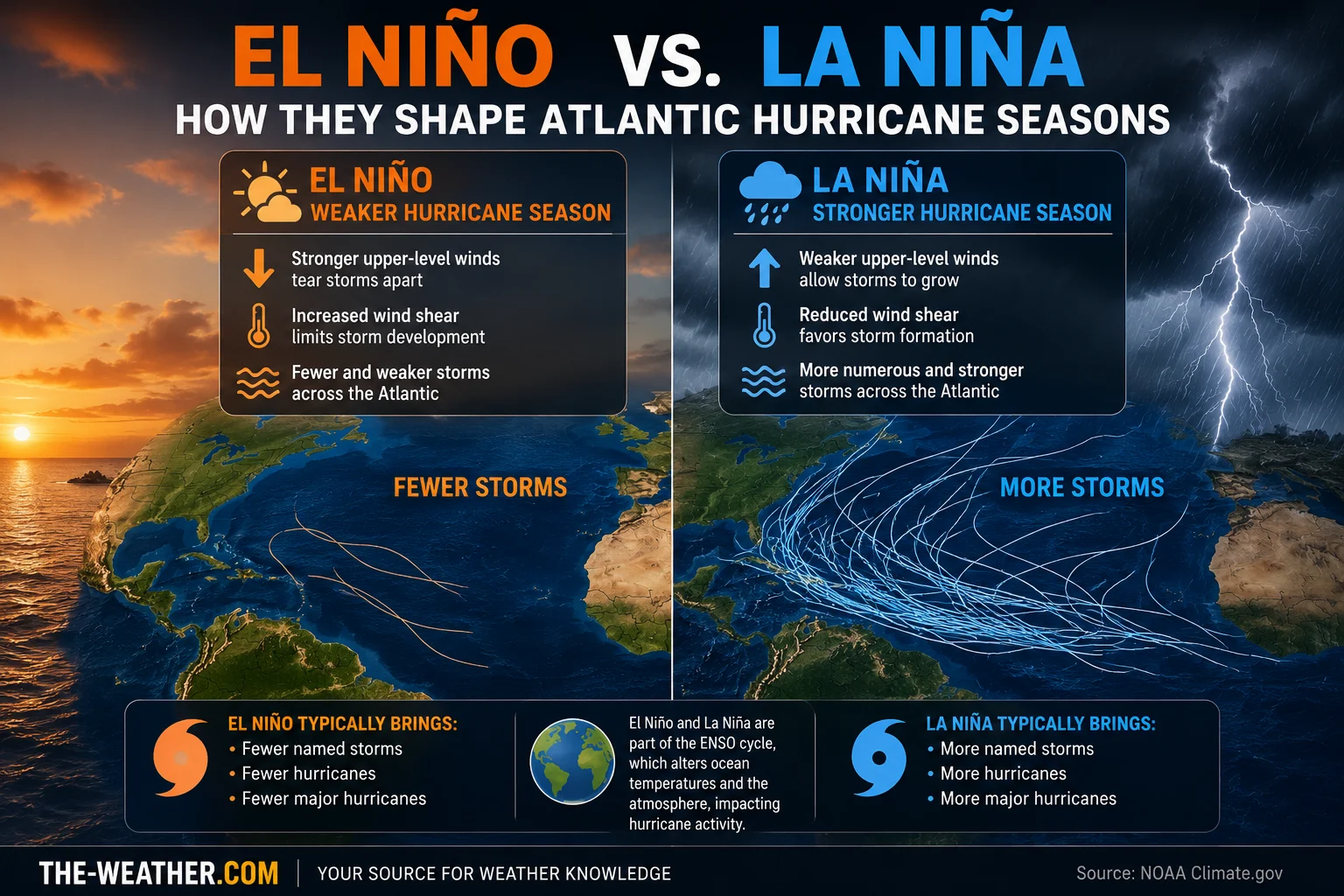
Storm track frequency maps clearly show the difference: El Niño seasons produce fewer, less intense Atlantic storms while La Niña seasons produce more frequent and often more powerful systems.
This page covers the full historical comparison across all three ENSO phases, the most significant seasons in each phase, the exceptions that prove the rule, and what the 2026 season outlook means in context. For equipment recommendations see our best weather stations for hurricane season.
October 2026 update: NOAA's August update lowered the outlook to 2 to 6 hurricanes, and by late September the Atlantic still had no hurricane, a first since 1914. Read why the 2026 Atlantic hurricane season has had no hurricanes. The season runs until November 30.
The Numbers: All Three ENSO Phases Compared
The statistics below reflect published averages drawn from NOAA NHC HURDAT2 historical data, classified by ENSO phase using NOAA CPC ONI records spanning 1950 through 2025. Exact values vary slightly across studies depending on the classification period and ENSO threshold used: treat these as representative averages rather than precise fixed figures.
The infographic below summarises the key differences between El Niño and La Niña hurricane seasons, including average storm counts, wind shear levels, and notable historical examples from each phase.

El Niño and La Niña hurricane season comparison: statistics, wind shear, and notable example seasons side by side.
La Niña produces roughly 50% more named storms and 58% more hurricanes than El Niño on average. In strong El Niño years specifically, the suppression is even more pronounced: strong El Niño seasons have produced approximately two-thirds the named storms and half the hurricanes of the 1991–2020 climatological average.
The numbers tell only part of the story. What the averages hide is variability: the spread around these means is substantial. An El Niño season that averages 10 named storms might produce 6 in one year and 15 in another (as 2023 demonstrated). The ENSO phase shifts the probability distribution, but it does not constrain individual season outcomes tightly.
Full Comparison: El Niño vs La Niña vs Neutral
| Variable | El Niño | Neutral | La Niña |
|---|---|---|---|
| Avg named storms (1950–2025) | ~10 | ~13 | ~15 |
| Avg hurricanes (1950–2025) | ~5 | ~7 | ~8 |
| Atlantic wind shear | Increased | Normal | Reduced |
| Storm intensification | More difficult | Normal | Easier |
| Multi-US landfall probability | ~28% | ~48% | ~66% |
| Major hurricane landfall rate | ~0.25/year | Varies | ~0.74/year |
| Eastern Pacific activity | Above normal | Normal | Below normal |
| Most active recorded season | 2023–20 storms (exception) | Various | 2020–30 named storms |
| Typical seasonal outlook | Below normal | Near normal | Above normal |
Sources: NOAA NHC HURDAT2, Florida Climate Center, NOAA AOML historical analysis. Multi-landfall probability and major hurricane rate from Florida Climate Center/NOAA AOML research.
Why ENSO Affects Atlantic Hurricanes: The Mechanism
The connection works through a direct atmospheric pathway. El Niño warms the central Pacific, which reorganises tropical atmospheric circulation. Stronger upper-level westerly winds develop over the Caribbean and tropical Atlantic: the wind shear that meteorologists use as their primary predictor of seasonal hurricane activity.
Wind shear, the difference in wind speed and direction between the lower and upper atmosphere, disrupts developing tropical cyclones by tilting their circulation, separating the surface low from its upper-level outflow. A storm trying to organise in high shear is constantly having its structure pulled apart before it can deepen.
La Niña does the opposite. The cooler eastern Pacific reduces the upper-level westerlies over the Atlantic, allowing tropical cyclones to build more organised vertical structures. The result is more storms, stronger storms, and longer tracks.
Most Notable Seasons by ENSO Phase
Most notable El Niño hurricane seasons
Most notable La Niña hurricane seasons
The 2023 Exception: When El Niño Lost
The 2023 Atlantic hurricane season produced 20 named storms: well above the long-term average and well above what any El Niño season had previously produced. It is the most important exception in the modern ENSO-hurricane record and illustrates the limits of seasonal outlooks.
The reason 2023 defied El Niño suppression: record-warm Atlantic sea surface temperatures provided so much energy and moisture to developing storms that they largely offset El Niño's wind shear effect. Atmospheric scientists described it as a battle between two competing forces, and in 2023, Atlantic warmth won decisively.
2023 does not invalidate the El Niño relationship. Over 75 years of data, the ENSO-hurricane connection is statistically solid. But it does demonstrate that ENSO is one of several variables that determine seasonal activity, and in a warming climate the Atlantic sea surface temperature factor is growing in relative importance. A strong El Niño in a warmer ocean is not the same as a strong El Niño in a cooler one.
Preparedness Regardless of ENSO Phase
A below-normal seasonal outlook is not a reason to reduce preparedness. A home weather station paired with a NOAA weather alert radio gives you local data and official warnings independent of the seasonal forecast. The probability of two or more US hurricane landfalls drops to 28% during El Niño years compared to 66% during La Niña, but 28% is still nearly one in three seasons. For the specific location that gets hit, the seasonal statistics are irrelevant.
Wind, rain, barometric pressure, and lightning detection in one station: tracks the metrics that matter as any storm approaches, independent of what the seasonal outlook says.
S.A.M.E. county programming delivers official NWS hurricane warnings independent of internet and cellular networks: essential in any ENSO phase when a storm is near.
Frequently Asked Questions
Does La Niña guarantee more hurricanes?
No. La Niña increases the probability of a more active Atlantic hurricane season, but factors including Atlantic sea surface temperatures, atmospheric moisture, the West African monsoon, and the position of the jet stream also influence seasonal activity. A La Niña year with unusually cool Atlantic waters might produce a near-normal season. ENSO is the strongest seasonal predictor available, not a guarantee.
Does El Niño reduce Atlantic hurricanes?
Yes, on average. El Niño increases upper-level wind shear over the Atlantic, disrupting tropical cyclone development. Since 1950, El Niño seasons have averaged around 10 named storms and 5 hurricanes: compared to around 15 named storms and 8 hurricanes during La Niña seasons. However, El Niño does not eliminate hurricane risk: every El Niño season has produced significant storms.
Which ENSO phase produces the most Atlantic hurricanes?
La Niña produces the most active Atlantic hurricane seasons on average. Many of the most active seasons on record, including 2020 with 30 named storms, 2005 with 28, and 2010 with 19, occurred during La Niña conditions. Reduced wind shear allows storms to organise and intensify more freely.
Can a major hurricane still hit during El Niño?
Yes. El Niño reduces the probability of an active season but does not eliminate landfall risk. Hurricane Andrew reached Category 5 during a 6-storm El Niño season in 1992 and devastated South Florida. The 2004 season hit Florida with four separate hurricanes during a neutral-to-El Niño transition. NOAA officials consistently note that it only takes one storm to make a damaging season.
Why does La Niña increase Atlantic hurricane activity?
La Niña reduces upper-level wind shear over the Atlantic basin, allowing tropical cyclones to build more organised vertical structures and intensify more rapidly. La Niña also tends to coincide with warmer Atlantic sea surface temperatures in some years, providing additional energy for storm development.
The mechanism, NOAA's 2026 forecast in detail, and why a quiet season never means zero risk.
Wind, rain, and pressure tracking stations for monitoring any storm that does develop.
Sources
- NOAA NHC HURDAT2: Atlantic hurricane database: historical storm counts by season
- NOAA CPC ONI: ENSO phase classifications 1950–2025
- NOAA AOML: El Niño and Atlantic hurricane season research
- Florida Climate Center / NOAA: Landfall probability analysis by ENSO phase
- NOAA 2026 Atlantic Hurricane Season Outlook: Issued May 2026–8–14 named storms, 55% below-normal probability
No manufacturer compensation received. Season averages computed from NOAA NHC HURDAT2 data classified by ENSO phase using NOAA CPC ONI. Individual season figures from NOAA NHC official records.

Lena Thornton
Weather Station Analyst & CWOP Contributor. Lena researches and analysed historical hurricane season data and ENSO relationships using official NOAA sources. Updated July 2026.
Ready to decide?
Find your pick on Amazon
Prices and stock change daily. Check the current price, delivery options and what owners say in their reviews.
Our top picksCompare our picks on AmazonToday's price, delivery & owner reviews on Amazon
Check on Amazon →