
As an Amazon Associate, I earn from qualifying purchases.
In this article 8 sections
Your phone buzzes: "Winter Weather Advisory". A day later it is a "Winter Storm Watch". Then a "Warning". Three words, three very different messages, and most people are never quite sure which one should make them drop everything. Here is the plain-English version from the National Weather Service, plus a quick way to know what to do with each one.
Short answer: a warning is the most serious: a hazardous event "is occurring, imminent or likely" and "conditions pose a threat to life or property", so take protective action now. A watch means the risk "has increased significantly" but the timing or location "is still uncertain": get your plan ready. An advisory is for an expected event that is less serious than a warning but can still "cause significant inconvenience" (National Weather Service).
Editorial Research
- Written by
- Lena Thornton, Weather Station Analyst & CWOP Contributor
- Based on
- National Weather Service pages that explain watches, warnings and advisories, the NWS cold weather alert page and the criteria page of one local NWS office (State College, Pennsylvania) as an example
- Research last verified
- October 21, 2026
Which Is Worse: Watch, Warning or Advisory?
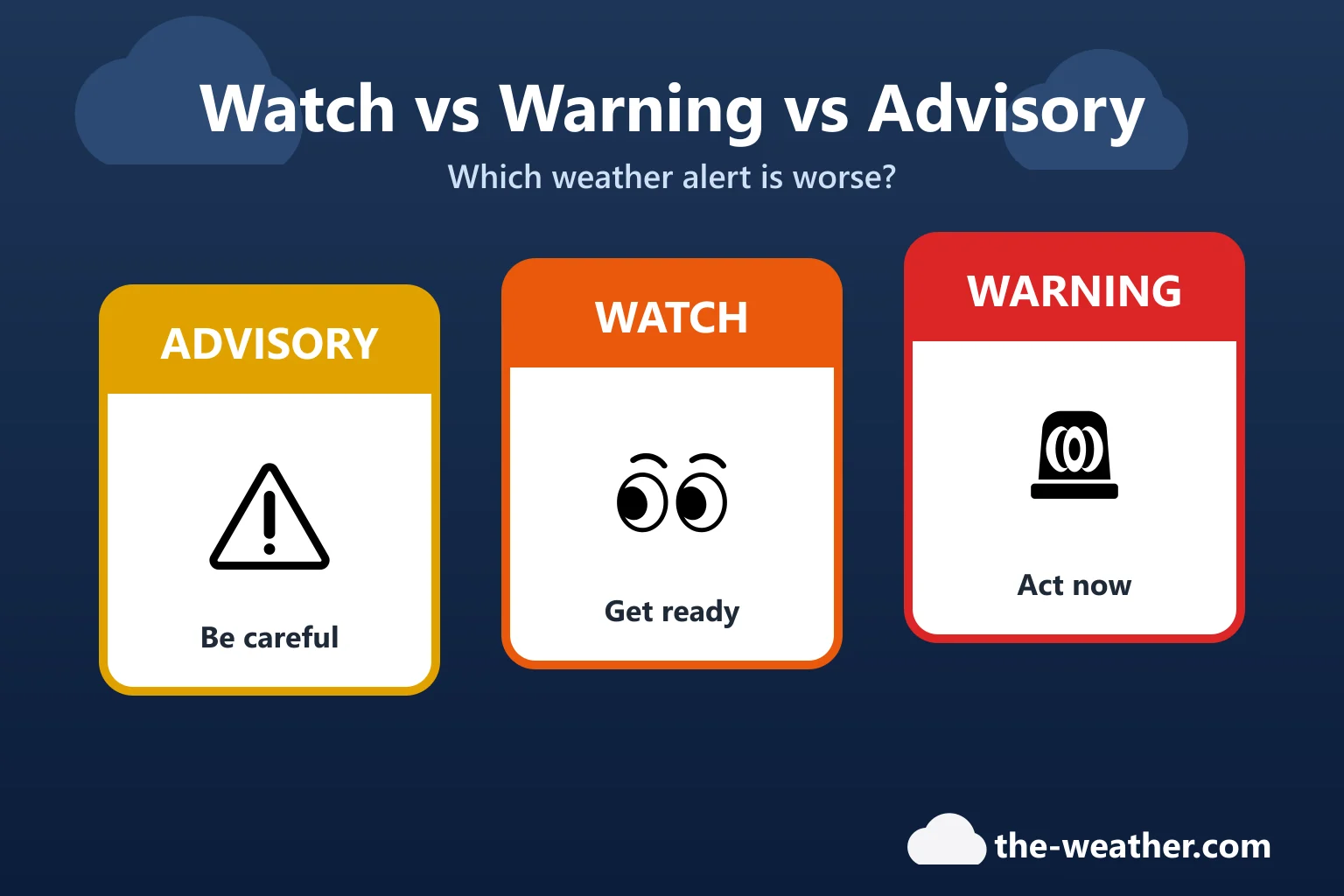
A warning usually calls for protective action right away. The other two answer different questions, which is why "is a watch worse than an advisory?" has no simple yes or no:
Advisory
Expected, less serious
The event is happening or likely, but the impact is smaller: think slick roads, a few inches of snow, a hot afternoon.
Do: be careful and adjust your plans.
Watch
Possible, could be serious
The ingredients for a dangerous event are there, but nobody knows yet exactly where or when.
Do: have a plan and keep listening.
Warning
Expected or happening, dangerous
The dangerous event is occurring, imminent or likely in your area.
Do: take protective action now.
A rough way to remember it: a watch is mostly about uncertainty (a dangerous event is possible), an advisory is about a less serious event that is expected, and a warning is about a dangerous event that is happening or likely. These are general NWS guidelines; the exact products and criteria differ per hazard and per local office.
| How likely? | How serious? | What to do | |
|---|---|---|---|
| Warning | Occurring, imminent or likely | A threat to life or property | "Take protective action" |
| Watch | Possible; timing or place still uncertain | May lead to a warning, or be canceled | Have a plan, listen for updates and possible warnings |
| Advisory | Occurring, imminent or likely | Less serious than a warning, "significant inconvenience" | Use caution; it can still become dangerous if you ignore it |
Quoted wording from the National Weather Service office in San Angelo, Texas; the other cells are our summary.
What to Do for Each Alert
During a watch
- Check your plan: where you would shelter, how you would get alerts if the power goes out, what you would need for a few days at home.
- Keep your phone charged and your weather radio on.
- Think twice about travel and outdoor plans. The NWS says people "should listen for later information and possible warnings especially when planning travel or outdoor activities".
During a warning
- Act now: "people in the path of the storm need to take protective action".
- Follow the instructions in the warning itself. A tornado warning, a flash flood warning and an extreme cold warning each ask for something different.
- Do not wait to see it with your own eyes.
During an advisory
- Slow down: allow extra time on the road, dress for the conditions, check on people who struggle with heat or cold.
- Do not ignore it. In the NWS's words, advisory conditions "if caution is not exercised, could lead to situations that may threaten life or property".
Examples for Different Kinds of Weather
Many hazards use watches, warnings and advisories, but not every hazard has all three, and the names change. Some examples you are likely to see:
| Hazard | Advisory | Watch | Warning | Our guide |
|---|---|---|---|---|
| Frost and freeze | Frost Advisory | Freeze Watch | Freeze Warning | Frost advisory vs freeze warning |
| Cold and wind chill | Cold Weather Advisory | Extreme Cold Watch | Extreme Cold Warning | Why cold weather is dangerous |
| Heat | Heat Advisory | Extreme Heat Watch | Extreme Heat Warning | Heat advisory vs extreme heat warning |
| Flooding | Flood Advisory | Flood Watch (and Flash Flood Watch) | Flood Warning, Flash Flood Warning | Flash flood watch |
| Tornadoes | - | Tornado Watch | Tornado Warning | Tornado warning |
| Hurricanes | - | Hurricane Watch | Hurricane Warning | Hurricane watch vs warning |
| Fire weather | - | Fire Weather Watch | Red Flag Warning | Fire weather watch vs red flag warning |
Names from the National Weather Service safety pages listed under Sources. The cold names changed on October 1, 2024: Wind Chill Advisories became Cold Weather Advisories, and Wind Chill Watches and Warnings became Extreme Cold Watches and Warnings (National Weather Service). Winter storms have their own alerts with their own criteria; our separate guide explains them: winter storm alerts explained.
Why the Same Snow Can Be an Advisory in One Town and a Warning in the Next
The criteria are not the same everywhere: local NWS offices publish their own, because 4 inches of snow means something very different in Buffalo than in Atlanta. The NWS office in State College, Pennsylvania, for example, issues a Winter Storm Warning for heavy snow at "5 or 6 inches depending on location" and a Winter Weather Advisory at "2 or 3 inches depending on location".
Want your own office's numbers? Search for "NWS" plus your city and "watch warning advisory criteria".
How to Hear a Warning When It Counts
A warning only helps if it reaches you, also at 3 a.m. and also when the power is out. A NOAA weather alert radio with S.A.M.E. coding sounds an alarm for your own county. Our guides show how to program the S.A.M.E. code, where to find the code for your county with our free SAME code lookup, and which NOAA weather alert radios we recommend.
Watch, Warning and Advisory FAQ
Which is worse, a watch or a warning?
A warning. A watch means a dangerous event is possible but the timing or place is still uncertain; a warning means it is occurring, imminent or likely and threatens life or property.
Is an advisory worse than a watch?
Not exactly: they measure different things. An advisory is for an event that is expected but less serious. A watch is for an event that could be serious but is not certain yet. Treat a watch as "get ready" and an advisory as "be careful".
What is the difference between a watch and a warning?
Certainty. With a watch the risk has increased but the occurrence, location or timing is still uncertain. With a warning the event is occurring, imminent or likely.
What is a weather advisory?
A National Weather Service alert for weather that is occurring or likely and less serious than warning level, but that causes significant inconvenience and could threaten life or property if you are not careful.
Are the criteria the same everywhere?
No. Each local NWS office sets its own criteria, for example how many inches of snow make a winter storm warning. Check your local office's criteria page.
Update Log
- October 21, 2026: First version, based on National Weather Service definitions.
Sources
- National Weather Service San Angelo: Watch, Warning, Advisory Explained
- National Weather Service: Understanding Cold Weather Alerts
- National Weather Service: revised watch, warning and advisory products for cold (2024)
- National Weather Service alert pages for floods, tornadoes, hurricanes and fire weather
- National Weather Service: heat products renamed (Extreme Heat Watch and Warning, 2025)
- National Weather Service State College: Watch, Warning and Advisory Criteria