
As an Amazon Associate, I earn from qualifying purchases.
In this article 10 sections
- Frost Advisory vs Freeze Watch vs Freeze Warning
- Why Frost Forms When It Is Above 32°F
- Will It Frost Tonight? A 2-Minute Check
- How to Protect Plants Tonight
- Separate From the Plant Alerts: Pipes and Pets
- The Growing Season: Why Alerts Stop After the First Hard Freeze
- Track Frost at Home
- Frost and Freeze FAQ
- Update Log
- Sources
The first cold nights of fall bring three alerts that sound almost alike: Frost Advisory, Freeze Watch and Freeze Warning. For your tomatoes, your flowerpots and the pipe in the garage, the difference matters. Here is what each one means, how cold it has to get, and what to do tonight.
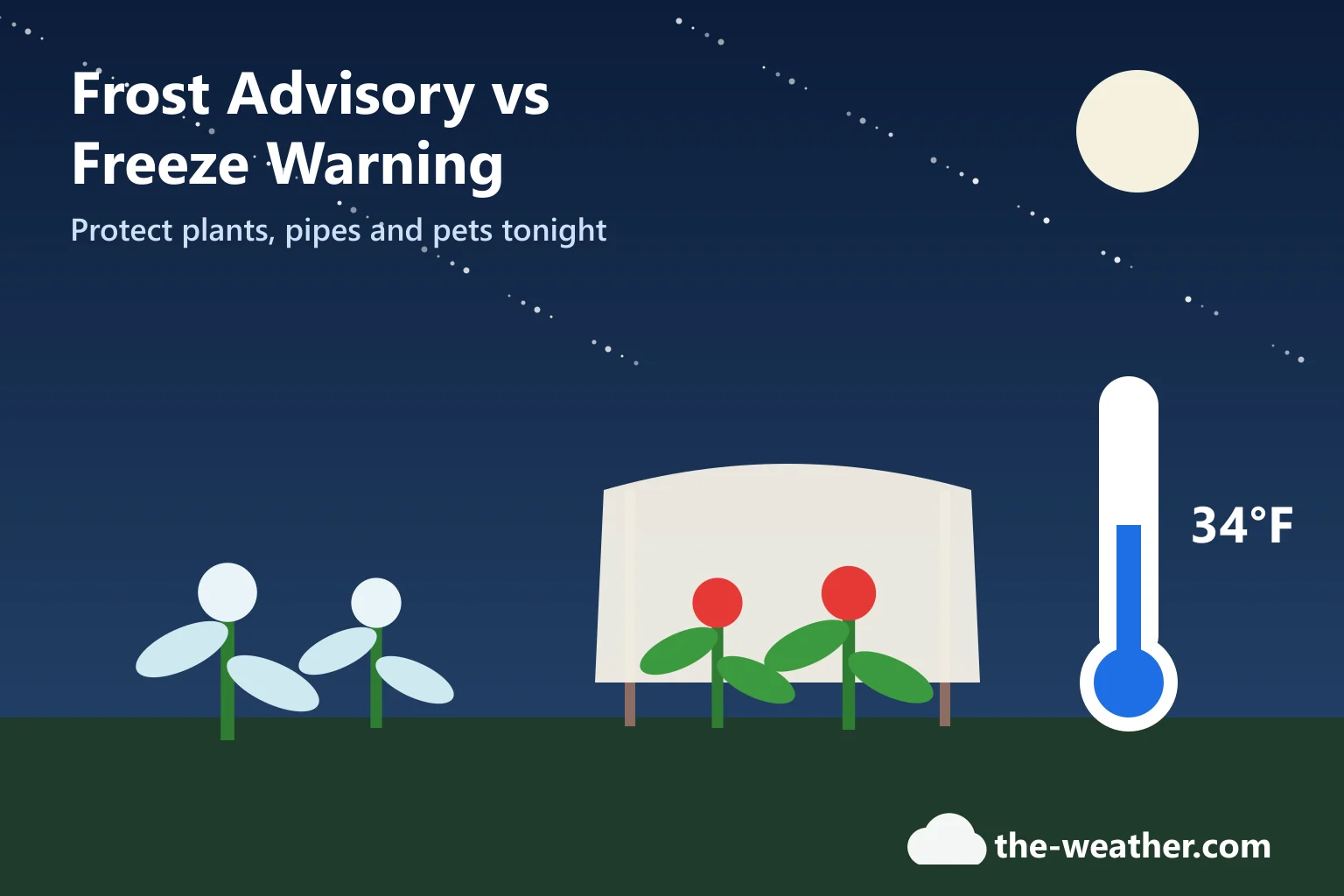
Short answer: a Frost Advisory means "areas of frost are expected or occurring, posing a threat to sensitive vegetation", usually on nights in the low to mid 30s. A Freeze Watch means "significant, widespread freezing temperatures" are possible within the next 24 to 36 hours. A Freeze Warning means temperatures are forecast to go below 32°F for a long period of time, cold enough to kill some crops and garden plants (National Weather Service). That is the general NWS description: the exact criteria, and the months in which these alerts are issued, differ per local NWS office.
Editorial Research
- Written by
- Lena Thornton, Weather Station Analyst & CWOP Contributor
- Based on
- National Weather Service cold weather alert definitions, frost and freeze information from the NWS Tallahassee and Charleston (West Virginia) offices, NWS New York home tips for frigid cold, and frost protection advice from Colorado State University Extension
- Research last verified
- October 21, 2026
Frost Advisory vs Freeze Watch vs Freeze Warning
Frost Advisory
Frost expected
Some offices use forecast lows of about 33 to 36°F on clear, calm nights (Tallahassee example). Frost can form on the ground and on plants even when the air is just above freezing.
Do: cover tender plants, bring pots inside.
Freeze Watch
A freeze is possible
Widespread freezing temperatures are possible within the next 24 to 36 hours.
Do: plan which plants and pipes you will protect.
Freeze Warning
A freeze is expected
Temperatures forecast below 32°F for a long period. Below 28°F for a longer time, most crops and garden plants can be killed.
Do: protect plants, pipes and pets tonight.
Definitions: National Weather Service. The temperatures are examples, not national limits: each NWS office sets its own criteria, and the 33 to 36°F range is the one used by the NWS Tallahassee office.
Why Frost Forms When It Is Above 32°F
On a clear, calm night, the ground loses heat fast: in the words of the NWS Tallahassee office, "heat radiates away from the ground, leaving the air very close to the ground the coldest". That is why "frost can form at or near ground level while observed air temperatures are slightly above freezing". Colorado State University Extension calls these "radiation frosts": they "occur on calm clear nights that lack cloud cover to hold in heat".
A frost night has three ingredients: a clear sky, little or no wind, and moist air near the ground (the Tallahassee office mentions humidity near the surface that will "approach or reach 100%").
Will It Frost Tonight? A 2-Minute Check
- Read your local forecast and alerts on weather.gov: a Frost Advisory or Freeze Warning for your county is the clearest answer.
- Look at the overnight low. Lows in the mid 30s or colder put frost on the table, especially in low spots of the yard.
- Check the sky and the wind. Clear and calm means more risk; clouds or a steady breeze keep the ground warmer.
- Check the dew point on your weather station or in the forecast. Frost forms when the surface of a plant, car or lawn cools below freezing and moisture from the air settles on it as ice once the surface reaches the frost point. The dew point is a useful clue for that, not an exact prediction: a dew point near or below freezing and a cold forecast low make frost more likely. The air temperature at thermometer height is only a clue, because surfaces can get colder than the air.
How to Protect Plants Tonight
- Cover them, but keep the cover off the leaves. Colorado State University Extension: "The covers need to be held off the plants to prevent the plants from freezing where they touch the cover." Old sheets, blankets or garden fabric over stakes work well.
- Uncover them in the morning. "To recharge the heat stored in the soil, the blankets and sheets must be removed in the daytime."
- Bring pots and hanging baskets inside or into a garage.
- Know your plants. The NWS advice is short: "Know the temperature thresholds of your plants and crops." The Freeze Warning numbers above are a good rule of thumb: below 32°F hurts some plants, below 28°F for a while kills most tender ones.
Separate From the Plant Alerts: Pipes and Pets
Frost and freeze alerts are about plants and crops. Pipes and pets have their own cold-weather risks, also on nights without a plant alert, so treat these tips as general cold-weather advice:
- Pipes: the NWS New York office advises: "Allow faucets to drip slowly to keep unheated pipes from freezing" and "Insulate water supply lines that run through unheated areas", such as the basement, crawl spaces, attic and garage. Opening sink cabinets lets warmer air reach the plumbing.
- Pets: make sure they "are not overly exposed to extreme cold and have plenty of food and water that has not frozen" (NWS).
The Growing Season: Why Alerts Stop After the First Hard Freeze
Frost and freeze alerts are about plants, so they are only issued during the local growing season. The NWS Charleston (West Virginia) office defines it as "the period between the average (median) date of the last Spring freeze and the average date of the first Fall freeze". The Charleston office, for example, stops frost and freeze headlines for a county once a hard freeze has occurred there, so you will not see them again until spring. And since the National Weather Service's Hazard Simplification, "Hard Freeze Watches and Warnings will no longer be issued": they are folded into the Freeze Watch and Freeze Warning, with extra wording when a hard freeze is expected.
When the cold becomes dangerous for people rather than plants, the alerts change name: Cold Weather Advisory, Extreme Cold Watch and Extreme Cold Warning. See watch vs warning vs advisory for the full list.
Track Frost at Home
A weather station with an outdoor temperature and humidity sensor shows you the overnight low and the dew point at your own house, which can differ from the official reading at the airport. Place the sensor in the shade at about 5 feet; our guide to installing a home weather station explains why. Not sure which station fits? Try our weather station quiz.
Frost and Freeze FAQ
What is a freeze warning?
A National Weather Service alert that temperatures are forecast to go below 32°F for a long period of time, cold enough to kill some crops and garden plants. Protect sensitive plants, outdoor pipes and pets.
What is a freeze watch?
An alert that significant, widespread freezing temperatures are possible within the next 24 to 36 hours. It is issued in autumn until the end of the growing season and in spring at its start.
What is a frost advisory?
An alert that areas of frost are expected or occurring and can damage sensitive plants. Some offices, such as Tallahassee, issue it for forecast lows around 33 to 36°F on clear, calm nights.
Can it frost at 35 or 36 degrees?
Yes. On clear, calm nights the ground and plants cool faster than the air at thermometer height, so frost can form while the official temperature is slightly above freezing. What counts is how cold the surface gets, not only the air.
Which is worse, a freeze watch or a freeze warning?
A freeze warning. A watch means freezing temperatures are possible; a warning means they are expected.
Update Log
- October 21, 2026: First version, based on National Weather Service definitions and university extension advice.
Sources
- National Weather Service: Understanding Cold Weather Alerts
- National Weather Service Tallahassee: Frost and Freeze Information
- National Weather Service Charleston, WV: Frost/Freeze Information
- National Weather Service: Before Extreme Cold
- National Weather Service New York: Home Preparedness Tips for Prolonged Frigid Cold
- Colorado State University Extension: Frost Protection and Extending the Growing Season
More weather basics: Watch vs warning vs advisory · What does chance of rain mean? · Why cold weather is dangerous