
As an Amazon Associate, I earn from qualifying purchases.
In this article 9 sections
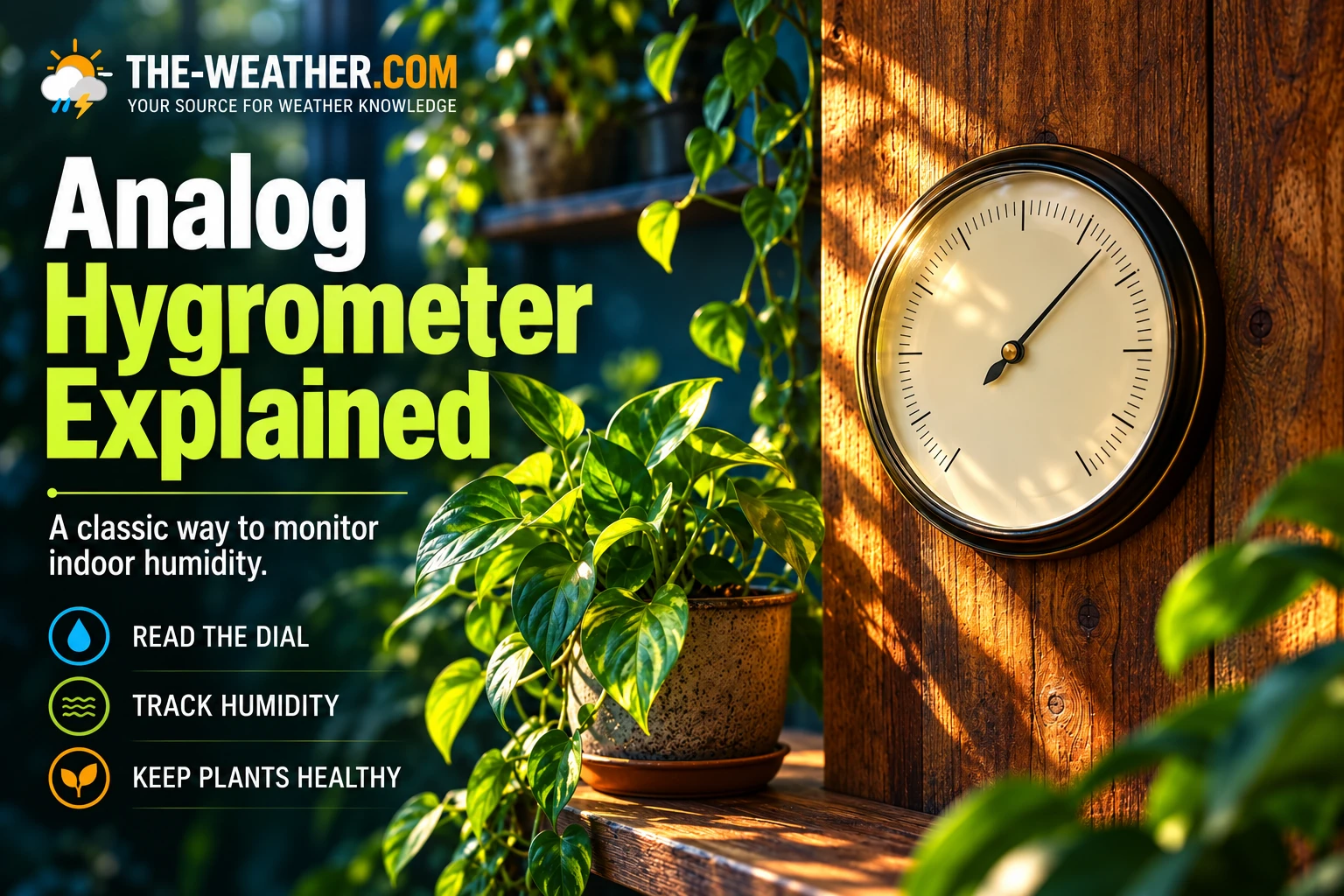
An analog hygrometer shows the humidity with a needle on a dial, no batteries and no screen. Inside is a material that grows a little longer when the air turns humid and shorter when it dries out: a hair, a synthetic hair or a coated metal coil. A dial like this is not a precision instrument, and it drifts if you never look after it. Checked and adjusted twice a year, it does a fine job in a living room or a humidor. This page explains the three kinds, what the World Meteorological Organization (WMO) and the hygrometer maker TFA Dostmann say about them, what to check on a listing, and how to regenerate and adjust a dial.
Short answer: an analog hygrometer suits you if you want a battery-free dial for a living room, a cigar humidor or a greenhouse, and you are happy to check it twice a year. Do not expect lab accuracy: WMO calls even a professional hair recorder "satisfactory though not very precise", and a small household dial makes no promise at all, so check a new one before you trust it. Pick one with an adjusting screw on the back, so you can correct the needle. If you want alarms, a history graph or readings on your phone, buy a digital one instead.
Editorial Research
- Written by
- Lena Thornton, Weather Station Analyst & CWOP Contributor
- Based on
- WMO Guide to Instruments and Methods of Observation, chapter "Measurement of Humidity" (2018 preliminary edition), TFA Dostmann's instructions for analog hygrometers, the U.S. EPA page on mold and moisture and Boveda's cigar storage pages
- Hands-on testing
- Not performed by The-Weather.com
- Research last verified
- October 30, 2026
Three Kinds of Analog Hygrometer
| Kind | What moves the needle | Good to know |
|---|---|---|
| Hair hygrometer | Human hair, which WMO says gets about 2% to 2.5% longer from 0% to 100% humidity; a lever makes that tiny change visible on the dial | The classic. WMO: ammonia is very destructive to natural hair, so keep it away from stables (and, our advice, away from the cat litter box) |
| Synthetic hair hygrometer | A synthetic hair instead of human hair; TFA calls its patented synthetic-hair hygrometer "particularly precise" | That is the maker's own claim; TFA gives no accuracy figure for it |
| Bimetallic (coil) hygrometer | TFA: "a coated bimetallic coil that spirals around a metal wire" takes the place of the hair | TFA regenerates and adjusts it the same way as a hair hygrometer; we found no published accuracy figure |
Sources: WMO, chapter 4, sections 4.6.1 and 4.6.4; TFA Dostmann web page and instructions. For a living room or a humidor, any of the three will do, as long as it has an adjusting screw; the screw matters more than the kind (our judgement).
Analog hygrometers
See analog hygrometers on Amazonopens in a new tabTip: the results mix dials with digital models. Look for a needle, and for an adjusting screw in the photos of the back (our advice).
Analog or Digital?
| Analog (dial) | Digital | |
|---|---|---|
| Power | None | Batteries or a cable |
| Accuracy | WMO: a good hair hygrograph (a professional instrument that draws humidity on a paper chart) in perfect condition records to about ±3% at moderate temperatures, more in the cold. Household dials give no such figure | Depends on the sensor; see the accuracy in our hygrometer picks |
| Upkeep | TFA: regenerate at least every six months, adjust if needed | Check it now and then, for example with the salt test |
| History, alarms, app | No | On many models |
| Lifespan of the hair | WMO: with proper care, the hairs of a hygrograph may last several years in a temperate climate | Not applicable |
Sources: WMO, chapter 4, sections 4.6.1 and 4.6.7; TFA Dostmann. WMO's figures are for professional recording instruments, not for a decorative dial, so treat them as the best case (our reading).
Which Humidity Are You Aiming For?
| Where | Target | Source |
|---|---|---|
| Your home | Below 60%, ideally 30% to 50% | U.S. EPA, mold and moisture page |
| Cigar humidor | 65% to 72% | Boveda |
For a greenhouse, the right humidity depends on the plants; our greenhouse hygrometer page goes into that. Our tip for every use: choose a dial where your target sits in the middle of the scale with clear markings, not squeezed into a corner. A needle that has to point at 69% between two tiny ticks is a guessing game.
What to Check on a Listing
- An adjusting screw on the back. TFA describes a small screw behind a hole in the back (slotted, cross-head or plastic, depending on the model) to set the needle. Without one, you can only note the error, not fix it. If the listing shows no photo of the back and does not mention adjustment, ask the seller before you buy.
- The kind of sensor. Hair, synthetic hair or bimetallic coil (see the table above). If the listing does not say, ask.
- The scale. Does it cover your target range clearly?
- Indoor or outdoor. TFA: for outdoor use the device must be weatherproof and suitable for outdoor use, and placed where it is protected from sun and rain. If the listing does not say outdoor, keep it inside.
- Size and mounting for a humidor. Check that the dial fits your humidor lid or wall; our humidor hygrometer page compares options.
- A thermometer on the same dial. Handy, but it does not make the humidity reading more accurate.
Our checklist, based on TFA and WMO.
Who Should Skip an Analog Hygrometer
- Skip it if you want an alarm when humidity climbs, or a graph to see what happened overnight: that is digital only. For a damp basement, see our basement hygrometer picks.
- Skip it for a grow tent, where you check often and act fast; our grow tent page covers digital options.
- Skip it if you will never regenerate or check it. A dial that drifted is still pretty, but it is no longer a measuring instrument.
Our own judgement.
How to Regenerate and Adjust an Analog Hygrometer
TFA says its hygrometers are adjusted at the factory, but transport, storage and long use in dry rooms weaken how the material reacts to moisture, so a check may be needed right after you buy one. TFA's advice: always check a new hygrometer against a well-set device before you first use it. WMO describes the same effect for hair: kept in very dry air for a long time, the instrument can shift its zero, and placing it in saturated air for long enough can reverse that.
- Regenerate. Soak an ordinary tea towel in warm water and wring it out until it no longer drips. Wrap the hygrometer in it completely for about 15 to 30 minutes. When you unwrap it, the needle should ideally be between 90% and 99% (TFA).
- Do not adjust to the wet towel. TFA warns that a damp cloth does not give a clear reference value. This step only brings the material back into shape.
- Compare. Put the hygrometer right next to several other hygrometers or a precision reference instrument, in a normal indoor climate with a little air movement, and wait 30 to 45 minutes (TFA).
- Adjust. Turn the small screw on the back carefully with a fine screwdriver until the needle shows the reference value. TFA's tip: the closer the reference is to the conditions where the hygrometer will hang, the better; in a dry place adjust in the lower part of the scale, in a humid place in the upper part.
No reference instrument at home? The salt test gives one: WMO lists a saturated table salt (sodium chloride) solution at 75.3% relative humidity at 25 °C (77 °F); our salt test page rounds this to 75% and shows how, step by step. Boveda also sells a calibration kit for hygrometers and says its calibration formula is accurate within ±0.5%. A dial without a screw? Run the salt test anyway and remember the difference, for example "reads 4% high" (our tip).
Keep the Dial Honest
| Do this | Why |
|---|---|
| Tap the case lightly before reading | WMO advises this for the hair hygrograph, to free tension in the mechanism; it does no harm on a dial either (our advice) |
| Keep dust away | WMO: most kinds of dust cause errors in hair instruments, perhaps as much as 15% relative humidity |
| Never touch an open hair element with your fingers | WMO; on instruments where the hair is exposed, it is cleaned with distilled water and a soft brush |
| Hang it in a central, airy spot | TFA: not right next to a heat source, an outside wall, windows or doors, and out of direct sunlight |
| Regenerate twice a year | TFA: at least every six months |
Sources: WMO, chapter 4, sections 4.6.3, 4.6.5 and 4.6.7; TFA Dostmann web page and instructions.
Analog Hygrometer FAQ
Are analog hygrometers accurate?
Not very, unless you check them. WMO calls even a professional hair hygrograph "satisfactory though not very precise", good for about ±3% in perfect condition. Household dials give no figure, so check yours against a reference or with the salt test, and adjust it with the screw on the back.
Do analog hygrometers need batteries?
No. The needle is moved by a hair, a synthetic hair or a coated bimetallic coil that reacts to the humidity.
How do I calibrate an analog hygrometer?
TFA's method: wrap it in a damp tea towel for 15 to 30 minutes, then place it next to a reliable reference for 30 to 45 minutes and turn the adjusting screw on the back to match. The salt test (75.3% at 25 °C, per WMO) also works as a reference.
Why does my analog hygrometer read wrong after months in a dry room?
TFA says long use in dry rooms weakens how the material reacts, and WMO says a hair instrument kept in very dry air for a long time can shift its zero. The damp towel step brings it back; adjust afterwards against a reference.
Can I use an analog hygrometer in a cigar humidor?
Yes, if you check it. Boveda advises 65% to 72% for cigars, so pick a dial that shows that range clearly and test it before you trust it. Our humidor hygrometer page compares options.
Can an analog hygrometer go outside?
Only if the maker says it is weatherproof and made for outdoor use. TFA adds that it must be protected from sun and rain.
Sources
- WMO Guide to Instruments and Methods of Observation, Volume I, Chapter 4: Measurement of Humidity (2018 preliminary edition)
- TFA Dostmann: Ways to Measure Humidity and instructions for use, analog hygrometer (07/2018)
- U.S. EPA: A Brief Guide to Mold, Moisture and Your Home
- Boveda: What's the RH for Cigars? and Can I calibrate a hygrometer using any Boveda RH?