
As an Amazon Associate, I earn from qualifying purchases.
In this article 7 sections
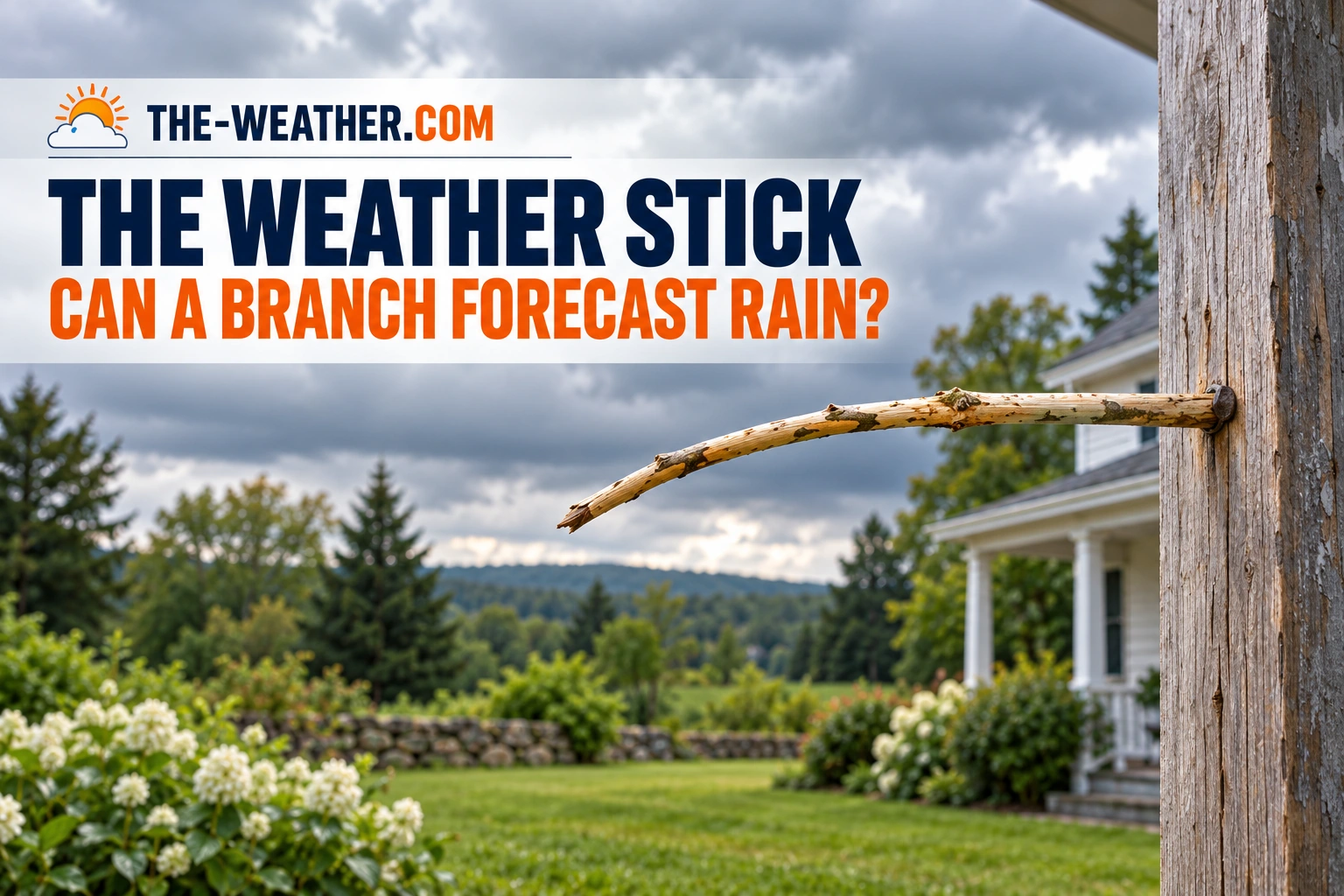
A weather stick is the simplest "weather instrument" you will ever hang on a porch: a thin strip of balsam fir nailed to a post. When the stick bends down, wet weather is supposed to be coming; when it bends up, fair weather. It sounds like a folk tale, and partly it is, but there is real wood science behind the bending. Here is how it works, what it can and cannot tell you, and how it compares with a barometer.
Short answer: a weather stick reacts to humidity, not to the weather itself. Its underside is compression wood, which the U.S. Forest Products Laboratory describes as wood that "shrinks excessively longitudinally" compared with normal wood. In dry air that side shrinks and the stick curls one way; in damp air it swells back. Damp air often comes before rain, so the stick can hint at wet weather, but it gives no number, no trend and no real forecast.
Editorial Research
- Written by
- Lena Thornton, Weather Station Analyst & CWOP Contributor
- Based on
- USDA Forest Products Laboratory (Wood Handbook definition via the USDA National Agricultural Library), Farmers' Almanac on the folk tradition, and our own explanation of humidity and weather
- Research last verified
- October 29, 2026
What Is a Weather Stick?
A weather stick is a branch, traditionally balsam fir, stripped of its needles and mounted so one end can move freely. The Farmers' Almanac describes it as a long-standing folk forecaster that people still make at home from a cut branch. The reading is simple:
- Stick points up: dry air, fair weather expected.
- Stick points down: damp air, rain or snow may be on the way.
How It Works: Compression Wood
Conifer branches grow a special kind of wood on their lower side. The USDA National Agricultural Library, quoting the Forest Products Laboratory's Wood Handbook, defines compression wood as "abnormal wood formed on the lower side of branches and inclined trunks of softwood trees" and adds that it "shrinks excessively longitudinally, compared with normal wood".
That is the whole trick (our explanation). Wood takes up and gives off moisture with the humidity of the air. When the air dries out, the compression wood on the underside shrinks lengthwise much more than the top side, so the stick bends. When the air turns humid, it swells again and the stick bends back. A weather stick is really a slow, wooden hygrometer: a humidity indicator, the same thing the strand of hair did in old hair hygrometers.
Does a Weather Stick Really Predict Rain?
Partly. Our honest reading:
| What it does well | What it cannot do |
|---|---|
| Shows that the air is getting more humid or drier | Give a number you can compare or record |
| Hint at approaching wet weather, because humid air often comes before rain | Tell rain from humid but dry weather, such as a muggy summer day |
| Work without batteries, forever | Show pressure, wind or a trend over hours, or forecast a storm in time to act |
Our own comparison. The Farmers' Almanac also notes that a weather stick is a humidity indicator, not a barometer.
So enjoy it as a charming porch decoration with a bit of real physics inside. Just do not cancel the picnic on its word alone: it may simply be reacting to a humid evening. For warnings, the National Weather Service and a NOAA Weather Radio beat any stick.
Weather Stick, Hygrometer or Barometer?
| Weather stick | Hygrometer | Barometer | |
|---|---|---|---|
| Measures | Humidity change, roughly | Relative humidity in % | Air pressure |
| Gives a number | No | Yes | Yes |
| Good for weather hints | A rough hint of damp air | Indoor and outdoor comfort, mold risk | The best home indicator of changing weather, especially the trend |
Our summary. More: what is a hygrometer and high vs low barometric pressure.
Make Your Own Weather Stick
If you have a balsam fir branch, you can try it yourself. The Farmers' Almanac says balsam fir works best and most other woods do not. Our steps, with the Almanac's figures:
- Cut a thin side branch, about 10 to 15 inches long, with a piece of the main stem attached.
- Strip off the needles and the bark from the thin part.
- Let it dry in a warm, dry place for several weeks; the Almanac mentions four to six weeks.
- Nail the stem piece to an outdoor post or frame, sheltered from direct rain, with the thin end free to move. Mount it upside down from the way it grew on the tree, as the Almanac says; otherwise the readings come out reversed.
- Watch it for a week next to a hygrometer, and you will see it follow the humidity.
The last step is the fun one: you get to test your stick against a real instrument. Our hygrometer picks are a good partner for the experiment.
Weather Stick FAQ
How does a weather stick work?
The underside of a fir branch is compression wood, which shrinks much more lengthwise than normal wood when it dries. In dry air the stick bends one way, in humid air it swells back. It reacts to humidity, not directly to rain.
Which way does a weather stick point for rain?
Down. By tradition, a stick bending down means damp air and possible rain or snow, and a stick pointing up means dry, fair weather.
Are weather sticks accurate?
They show humidity changes, roughly. They give no number and cannot tell rain from a humid but dry day, so they are a fun indicator, not a forecast (our reading).
What wood is a weather stick made of?
Traditionally balsam fir. Other conifers also grow compression wood under their branches, but the Farmers' Almanac says most other woods do not work well as a weather stick.