
As an Amazon Associate, I earn from qualifying purchases.
In this article 9 sections
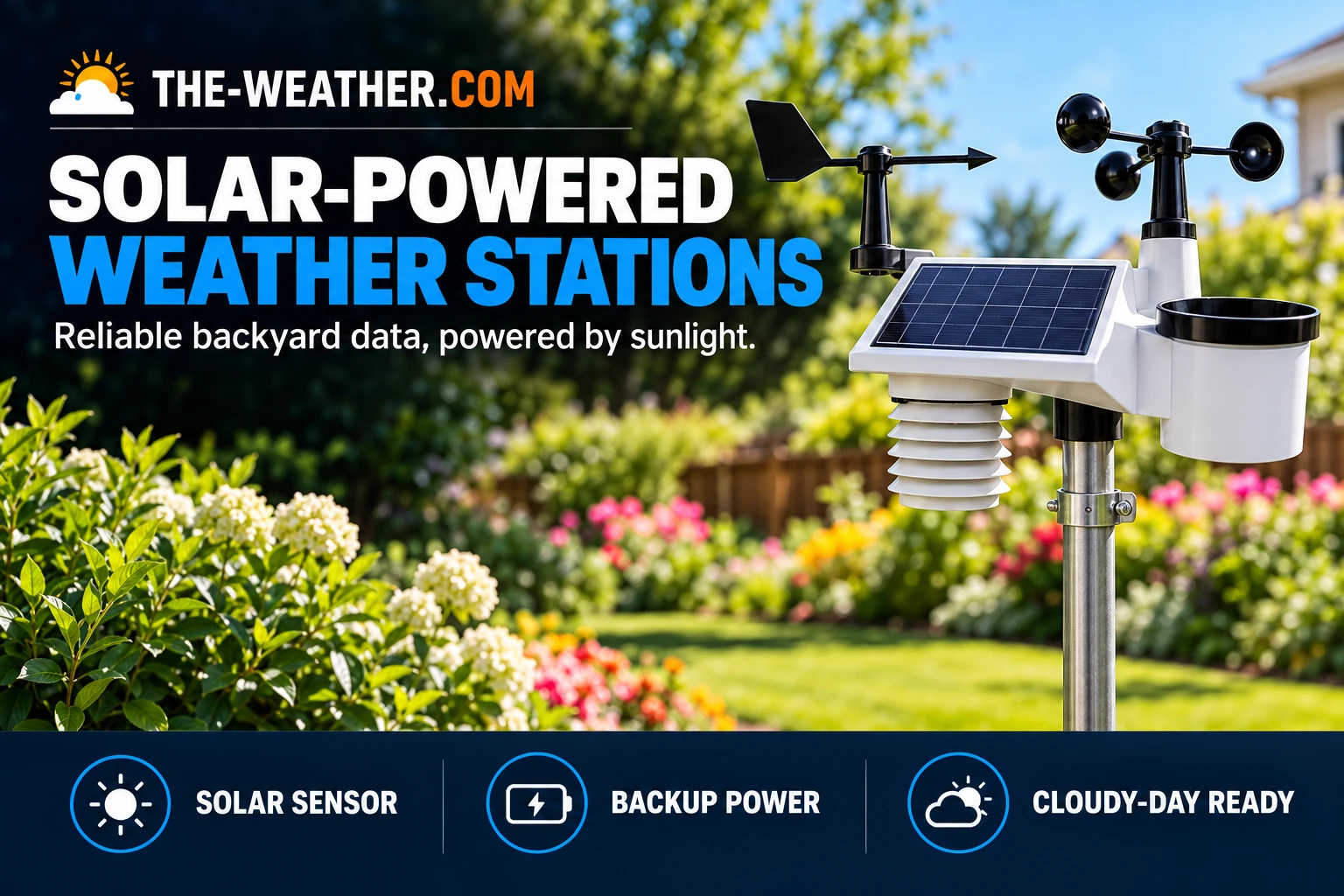
"Solar powered" on a weather station box can mean two very different things. On some stations the sun really runs the outdoor sensor, with a battery or backup cells for dark spells. On others the solar panel only spins a small fan, and the sensor still lives on AA batteries. This page sorts five popular stations by how they actually use the sun: four with a solar-powered sensor and one with a solar-powered fan. It also covers what keeps them running in the dark, what is in each box, and what that means for winter and maintenance.
Short answer: for an outdoor sensor that truly runs on sunlight, look at the Ambient Weather WS-2902C, the Davis Vantage Vue, the WeatherFlow Tempest or the Ecowitt WS90 sensor (sold in the Wittboy Pro). Each has a solar panel as its main power and a backup for dark spells: AA batteries, a lithium cell or a built-in rechargeable battery. Solar only covers the outdoor sensor: the indoor display, hub or gateway needs its own power. AcuRite's Iris and Atlas also have solar panels, but AcuRite says they power an internal fan; the sensor itself runs on 4 AA batteries unless you add AcuRite's optional Solar Power Pack.
Editorial Research & Review
- Written by
- Lena Thornton, Weather Station Analyst & CWOP Contributor
- Based on
- Manufacturer manuals, specification pages and support articles from Ambient Weather, Davis Instruments, WeatherFlow, Ecowitt and AcuRite, plus our research-based reviews of each station
- Hands-on testing
- Not performed by The-Weather.com
- Research last verified
- October 29, 2026
Solar weather stations in one place
See solar weather stations on Amazonopens in a new tabBefore you pick one from a search: three things to check on any listing
Two Kinds of "Solar Powered"
| Type | What the sun does | What powers the sensor when the sun is weak | Examples |
|---|---|---|---|
| Solar-powered sensor | Main power for the outdoor sensor | Backup AA batteries, a lithium cell or a built-in rechargeable battery | Ambient WS-2902C, Davis Vantage Vue, WeatherFlow Tempest, Ecowitt WS90 |
| Solar-assisted fan | Runs an internal aspirating fan, a small fan that pulls air past the temperature sensor so sunshine heats it less | AA batteries, day and night (or the optional Solar Power Pack) | AcuRite Iris, AcuRite Atlas |
Our summary of the manufacturer documents listed under Sources.
Neither type is "better" across the board. The fan type puts the sun to work on temperature accuracy instead of power. It just means you still buy batteries, so read the power line on the listing before you assume you never will (our advice).
Five Stations: Solar Sensor or Solar Fan
The packages are not the same, so read the "In the box" column first: one is a sensor without a display, one has an app instead of a screen.
| Station | Solar powers | Backup power | In the box and connection | Maker source | Amazon |
|---|---|---|---|---|---|
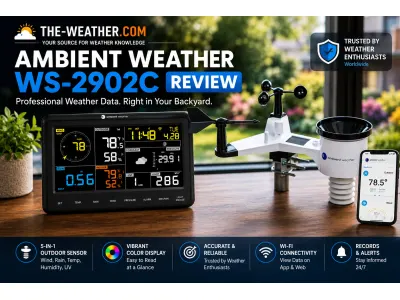 Ambient Weather WS-2902CRead review | The outdoor sensor array (primary power) | 3 AA batteries when solar energy is limited | Color display console with built-in Wi-Fi; the console uses a wall adapter | WS-2902D manual | Check on Amazon |
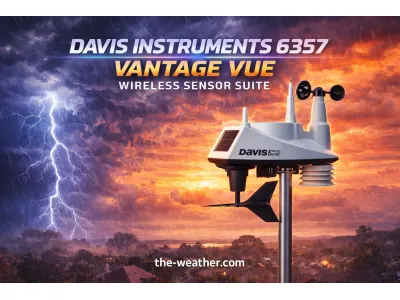 Davis Vantage Vue 6357 (sensor suite only)Read review | The integrated sensor suite | CR-123A lithium cell backs up the capacitor: 8 months without sun, more than 2 years with solar charging | Sensor suite only: no display and no Wi-Fi; console or WeatherLink Live sold separately | Vantage Vue FAQ | Check on Amazon |
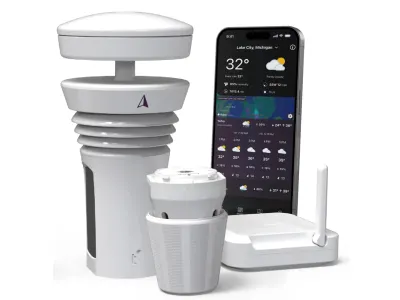 WeatherFlow Tempest (sensor, hub and app)Read review | The whole sensor, from four vertical panels | Built-in rechargeable LTO (lithium-titanate) battery, 1300 mAh | No display: a hub and the app; solid-state sensor with no moving parts | Tempest power article | Check on Amazon |
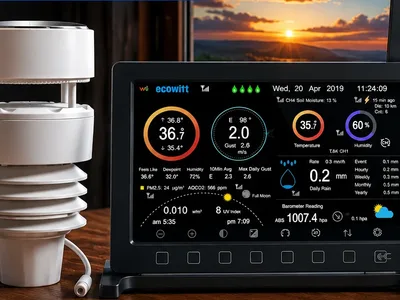 Ecowitt Wittboy Pro HP2564 (HP2560 console and WS90 sensor)Read review | The WS90 sensor (built-in 6.5 V panel) | 2 AA batteries (not included); optional 12 V supply for frost and snow, see Winter | HP2560 7-inch touchscreen console with Wi-Fi and the WS90 sensor; the WS90 sold alone needs an Ecowitt console or gateway | WS90 specifications | Check on Amazon |
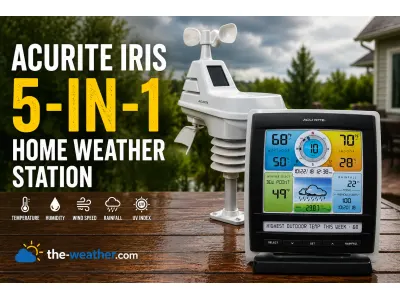 AcuRite Iris 5-in-1 (solar fan)Read review | Only the internal aspirating fan | 4 AA batteries run the sensor; optional AcuRite Solar Power Pack replaces them | Depends on the display it is sold with, from simple screens to Wi-Fi models | Iris 06014M instructions, Solar Power Pack | Check on Amazon |
Sources: Ambient Weather WS-2902D manual v1.29 (the review covers the WS-2902C; we cite the D manual because its product history lists only console, app and Wi-Fi changes between the WS-2902 versions, so we read the sensor array power as unchanged: our reading), Davis Vantage Vue FAQ, WeatherFlow "Solar Power / Rechargeable Battery", Ecowitt WS90 specifications, AcuRite Atlas specifications (which list the Solar Power Pack for the Iris, Atlas and Optimus), and our research-based reviews for what each package includes. Checked October 29, 2026. The AcuRite Atlas works like the Iris: three panels for the fan, 4 AA batteries or the Solar Power Pack. Davis uses the same solar, capacitor and lithium idea in the larger Vantage Pro2 (see our Vantage Pro2 review).
Which One Fits You?
Find your match
Our matching, based on the power and package facts above. Davis is the only maker here that states a no-sun runtime (8 months for the backup cell).
Three Things to Check on Any "Solar" Listing
An Amazon search for solar weather stations shows many brands this page does not cover. Before you buy any of them, check (our advice):
- What the panel powers. The sensor, or only a fan? Look for words like "primary power" or "aspirating fan" in the specifications.
- The backup. Which batteries does the sensor take, and are they included? Rechargeable cells, lithium AA or a built-in battery all behave differently in the cold.
- What is in the box. Sensor only, or a display too? Does the display need a wall plug, a hub or a gateway, and does it connect to Wi-Fi?
Winter, Shade and Short Days
A solar station is only as good as its worst week of light. Three things decide how it copes (our explanation, with the makers' figures):
- Size of the reserve. Davis says the Vantage Vue backup lithium cell lasts about 8 months without sunlight. WeatherFlow says the Tempest needs only about 4 hours of adequate sunlight every two weeks, as a rule of thumb, and that its firmware saves power in long low-light spells. Ambient and Ecowitt fall back on AA batteries when solar energy is limited.
- Panel direction: follow the manual. WeatherFlow says the Tempest's four vertical panels face south (north in the southern hemisphere), which it says helps at low sun angles at high latitudes. Ambient's manual says to align the "N" marker on the sensor array to north, which sets the panel direction for you. For any station, keep the panels out of the shade of trees and roof edges (our advice).
- Cold and snow. AcuRite recommends lithium AA batteries below −4 °F (−20 °C) for the Atlas, and lithium cells are the safer winter choice for any AA backup in very cold places (our advice). For frost and snow, Ecowitt recommends an optional 12 V extension cord power supply for the WS90, which it says can both heat and supply power; the input must stay within 5 to 20 V. Treat it as an option for harsh winters, not a promise that the sensor never stops (our reading).
Snow on the panel counts as shade, so a soft brush after a snowfall is part of owning a solar station in snow country, right up there with finding your ice scraper (our advice).
Keeping a Solar Station Charged
- Clean the panel. Ambient Weather's manual says to clean the solar panel and the solar radiation sensor every 3 months with a damp cloth; in harsh environments, inspect the batteries at the same time. It says to replace the batteries every 1 to 2 years.
- Replace the backup on time. Davis says the Vantage Vue backup cell needs replacing every few years, from 8 months without sunlight to more than 2 years depending on solar charging.
- Watch the battery level. WeatherFlow shows the Tempest battery level in the app (Settings, Stations, Status). For long dark spells it sells a Power Booster accessory.
- Something wrong? Our weather station troubleshooting page covers sensors that drop out, including power problems.
Who Can Skip Solar
If your only good mounting spot is in deep shade, on a north wall or under a big tree, a solar sensor will spend its life on backup power (our reading). In that case a battery station is simpler, or a station with an add-on power option, such as AcuRite's Solar Power Pack, Ecowitt's 12 V supply for the WS90 or WeatherFlow's Power Booster for the Tempest. Our Wi-Fi weather stations page compares more stations regardless of power.
Solar Powered Weather Station FAQ
Do solar powered weather stations work at night?
Yes. The Davis Vantage Vue runs on a capacitor with a lithium backup cell, and the Tempest on its built-in rechargeable battery. On the Ambient WS-2902C and the Ecowitt WS90 the panel is the main power and AA batteries take over when sunlight is limited.
Does the display run on solar too?
No. Solar powers the outdoor sensor. Ambient's manual lists a wall adapter for the WS-2902 console, and the hubs and consoles of the other systems need their own power too (our reading; check the listing for the exact power supply).
Do solar weather stations still need batteries?
Most take backup batteries: 3 AA in the Ambient WS-2902C, 2 AA in the Ecowitt WS90 and a CR-123A lithium cell in the Davis Vantage Vue. The WeatherFlow Tempest has a built-in rechargeable battery. AcuRite's Iris and Atlas run their sensors on 4 AA batteries; their solar panels power a fan.
Is there a solar weather station with cellular instead of Wi-Fi?
None of the four stations here is cellular out of the box. Ecowitt lists gateways with Wi-Fi and cellular options for the WS90 sensor, so check Ecowitt's gateway range if you have no Wi-Fi at the site.
Which way should the solar panel face?
Follow your station's manual. WeatherFlow says the Tempest panels face south in the northern hemisphere (north in the southern). Ambient's manual has you align the sensor's "N" marker to north, which sets the panel direction. In every case, keep the panel out of shade.
Is the AcuRite Iris solar powered?
Partly. Its solar panel runs an internal fan that reduces solar heating of the temperature sensor. The sensor itself runs on 4 AA batteries, unless you add AcuRite's optional Solar Power Pack.
Sources
- Ambient Weather: WS-2902D User Manual, version 1.29 (power and maintenance)
- Davis Instruments: Vantage Vue FAQ
- WeatherFlow: Tempest Solar Power and Rechargeable Battery
- Ecowitt: WS90 7-in-1 sensor specifications
- Ecowitt: Wittboy Pro HP2564 product page
- AcuRite: Iris 06014M sensor instructions (solar-powered fan, batteries)
- AcuRite: Atlas specifications (solar panels, batteries, Solar Power Pack)