
As an Amazon Associate, I earn from qualifying purchases.
In this article 10 sections
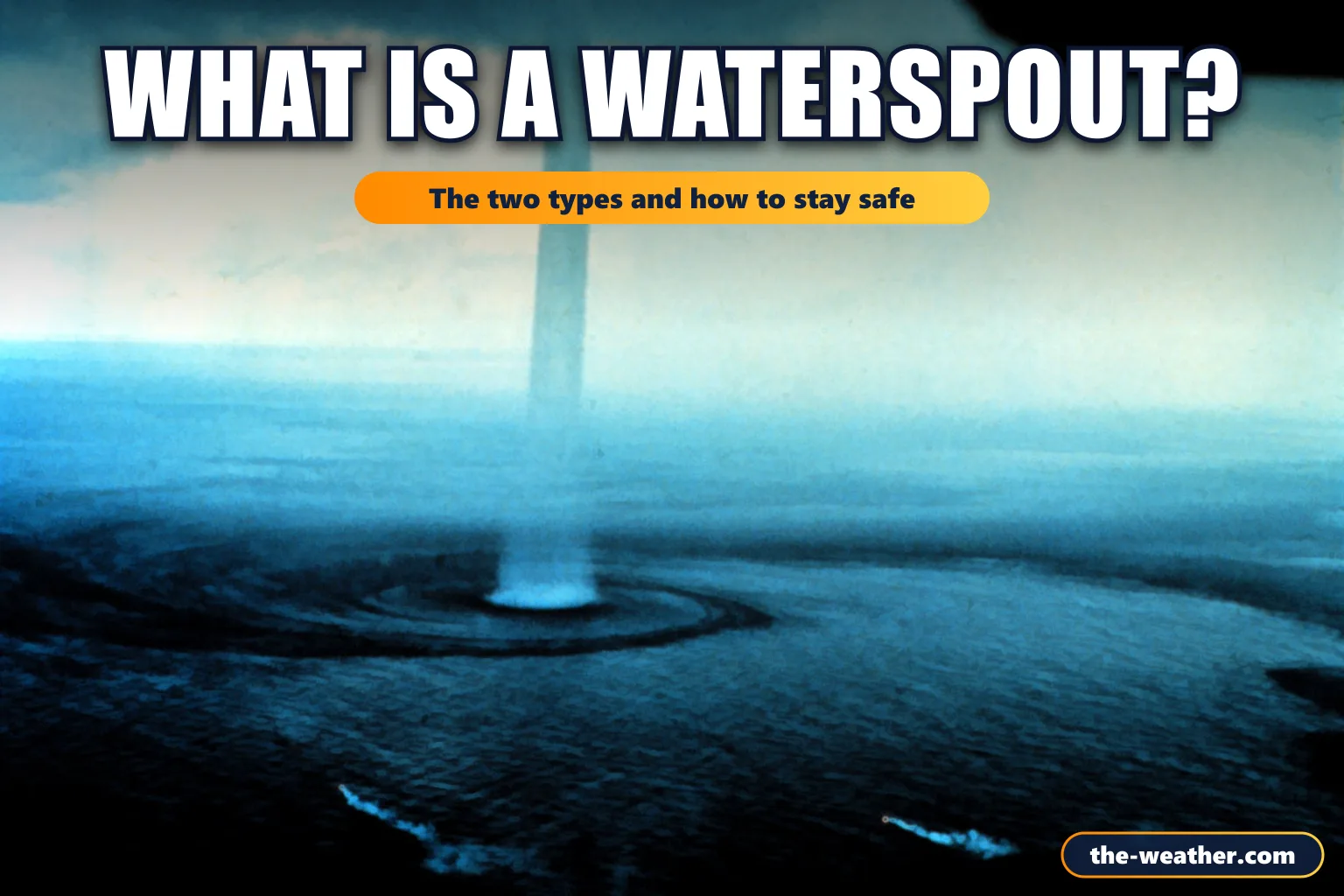
You are out on the water near the Florida Keys and a thin, spinning funnel drops from a line of puffy clouds. Is it a tornado? Should you run? Here is what a waterspout is, the two very different kinds, and what to do if you see one.
Short answer: NOAA defines a waterspout as "a whirling column of air and water mist" over water. There are two kinds. Tornadic waterspouts are real tornadoes that form over water or move from land onto water, with severe thunderstorms, strong winds, hail and lightning. Fair-weather waterspouts are far more common and usually weaker: they form along the flat base of growing cumulus clouds, start at the water surface and grow upward. NOAA's advice for boaters: move away at a 90-degree angle to the waterspout's movement, and never move closer to look.
Editorial Research
- Written by
- Lena Thornton, Weather Station Analyst & CWOP Contributor
- Based on
- NOAA National Ocean Service waterspout facts and the National Weather Service Key West waterspout page (local climatology and the 1969 Lower Keys measurements)
- Research last verified
- October 24, 2026
The Two Types of Waterspouts
| Fair-weather waterspout | Tornadic waterspout | |
|---|---|---|
| What it is | A spinning column that forms in calm-ish weather | A tornado over water |
| Parent cloud | The dark, flat base of a line of developing cumulus clouds | A severe thunderstorm |
| How it grows | From the water surface upward | From the thunderstorm downward |
| Weather around it | Light winds, usually no thunderstorm | Strong winds, large hail, lightning |
| Movement | Normally moves very little | Moves with the storm |
Based on NOAA National Ocean Service.
The Five Stages of a Fair-Weather Waterspout
The National Weather Service in Key West describes five stages. Knowing them helps you spot one early, often before the funnel is visible at all:
- Dark spot: a light-colored disc on the sea surface, surrounded by a dark patch. It is usually only visible from above.
- Spiral pattern: the main growth phase, with alternating dark and light bands spiraling around the dark spot.
- Spray ring: a ring of spray becomes visible around the dark spot, and a funnel starts to grow down from the cloud base. Once the spray ring forms, winds are over 40 knots (46 mph), according to NWS Key West.
- Mature waterspout: the spray ring is at its strongest and the funnel is at its longest and widest.
- Decay: cool downdrafts from nearby rain showers or contact with land weaken it. Waterspouts often dissipate abruptly, and a decaying one often looks very tilted.
NOAA notes that because fair-weather waterspouts grow from the surface up, the funnel is often only visible when the waterspout is nearly mature.
How Strong Is a Waterspout?
NWS Key West calls fair-weather waterspouts "smaller, slower, and weaker" than tornadic ones, but not harmless. Measurements from a 1969 research project in the Lower Keys found:
- an average wind speed of about 27 knots (31 mph),
- an average of 52 knots (60 mph) at the outer wall of three large, mature waterspouts,
- a highest rotational speed of 165 knots (190 mph).
NWS Key West adds that these waterspouts typically move at 10 to 15 knots (12 to 17 mph), and some are nearly stationary.
NWS Key West warns that winds of this strength are hazardous to small vessels and should always be avoided when possible. Tornadic waterspouts are as dangerous as any tornado.
Where and When Waterspouts Happen
The Florida Keys are famous for waterspouts. NWS Key West says observations at Key West International Airport since the late 1950s show anywhere from 20 to 70 forming each year. In local storm reports from May 2006 to September 2024, 75% of waterspouts were seen between May and September, with May and June the busiest months. Most reports came between noon and 8 PM.
Can a Waterspout Come Onshore?
Yes. NOAA says that if a waterspout moves onshore, the National Weather Service issues a tornado warning. Fair-weather waterspouts usually fall apart quickly once they reach land and rarely travel far inland. A tornadic waterspout can keep going as a tornado, so treat any warning as a real tornado warning. See what to do during a tornado warning.
What to Do if You See a Waterspout
- Move away at a right angle. NOAA's advice is to move at a 90-degree angle to the waterspout's apparent movement.
- Never move closer to investigate. NOAA is clear on this one, however good the photo would be.
- Watch the water under cloud lines. A dark spot or spiral pattern on the sea surface can show up before any funnel does.
- Listen to marine forecasts. A NOAA Weather Radio on board brings you National Weather Service forecasts and warnings, also away from cell coverage.
- On a beach: if a waterspout heads toward shore, go indoors as you would for a tornado.
Waterspout vs Tornado
A tornadic waterspout is a tornado, just over water. A fair-weather waterspout is a different animal: it does not need a severe thunderstorm and is usually much weaker. If you want the big picture on spinning storms, read hurricane vs tornado.
Waterspout FAQ
What is a waterspout?
NOAA defines it as a whirling column of air and water mist over water. Tornadic waterspouts are tornadoes over water; fair-weather waterspouts form under growing cumulus clouds and are usually weaker.
Is a waterspout a tornado?
Only the tornadic kind. Fair-weather waterspouts are not tornadoes: they form in light winds without a severe thunderstorm and grow from the water surface upward.
Are waterspouts dangerous?
Yes, especially for boats. A 1969 Lower Keys research project, cited by NWS Key West, measured an average of 31 mph and rotational winds up to 190 mph. Tornadic waterspouts are as dangerous as land tornadoes.
What should you do if you see a waterspout from a boat?
Move away at a 90-degree angle to its apparent movement, and never move closer to investigate.
How many waterspouts form in the Florida Keys?
NWS Key West says airport observations since the late 1950s show anywhere from 20 to 70 each year, mostly between May and September.
Update Log
- October 24, 2026: First version, based on NOAA and National Weather Service Key West information.
Sources
- NOAA National Ocean Service: What is a waterspout?
- National Weather Service Key West: Waterspouts
- Photo: NOAA (Dr. Joseph Golden): waterspout, public domain, via Wikimedia Commons
More storm basics: Hurricane vs tornado · Tornado warning: what to do · Types of clouds