
As an Amazon Associate, I earn from qualifying purchases.
In this article 6 sections
Your weather station says 29.65 inHg. Is that low? And what does it mean that it was 29.90 this morning? This page answers the two questions behind most barometer worries: what counts as high or low pressure, and what a drop tells you. The basics of what pressure is are on our page what is barometric pressure; here we stay with high, low and change.
Short answer: there is no official line between "high" and "low". The National Weather Service defines a high as an area where pressure is greater than the surrounding air, and a low as an area where it is lower. Using rough ranges of our own for sea-level readings: above about 30.20 inHg (1023 hPa) is high, 29.80 to 30.20 inHg is the everyday range, and below about 29.80 inHg (1009 hPa) is low. The direction of change usually tells you more than the number.
Editorial Research
- Written by
- Lena Thornton, Weather Station Analyst & CWOP Contributor
- Based on
- National Weather Service education and glossary pages, NOAA JetStream, the WMO records table and our own rough ranges (labelled as ours)
- Research last verified
- October 29, 2026
What Counts as High and Low Pressure?
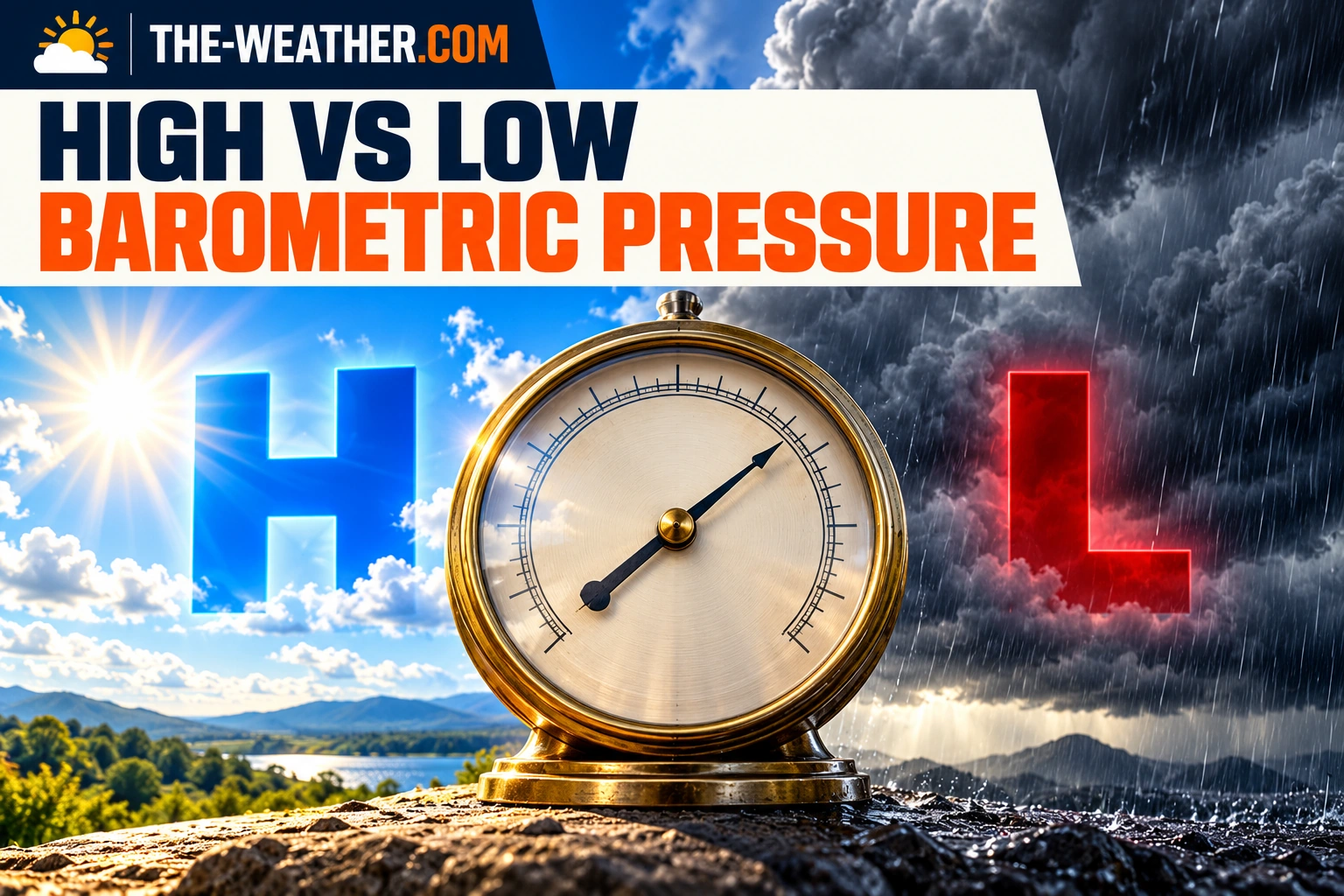
Highs and lows are relative. A National Weather Service Southern Region classroom activity puts it simply: "The pressure in a high is greater than the surrounding air. The pressure in a low is lower than the surrounding air." That is why a weather map shows an "H" and an "L" wherever pressure peaks or dips, whatever the exact number.
For your own barometer you still want a feel for the numbers. Our rough ranges for sea-level (relative) readings:
| Reading (sea level) | hPa (mb) | Our rough label | What you often see |
|---|---|---|---|
| Above about 30.20 inHg | above about 1023 | High | Often dry, settled weather |
| About 29.80 to 30.20 inHg | about 1009 to 1023 | Everyday range | Depends on the trend |
| Below about 29.80 inHg | below about 1009 | Low | Often clouds, rain or wind |
These ranges are our own, not an official scale; they match the ranges in our barometric pressure today tool. The standard sea-level reference is 29.92 inHg (1013.25 hPa), according to NOAA. The world records run from 870 hPa (25.69 inHg, eye of Typhoon Tip, 1979) to 1083.8 hPa (32.00 inHg, Agata, Russia, 1968) in the WMO records table.
One check before you compare: make sure your station shows sea-level (relative) pressure. The raw station pressure at your height is always lower, so in Denver it would look "low" every single day (our explanation).
What High and Low Pressure Do to the Weather
| High pressure | Low pressure | |
|---|---|---|
| Air movement | Air sinks and warms | Air rises and cools |
| Usual weather | Usually dry: moisture evaporates in the sinking air | Usually precipitation: water vapor condenses in the rising air |
| Wind direction (northern hemisphere) | Clockwise around the center | Counterclockwise around the center |
Source: National Weather Service Southern Region JetStream forecasting activity on highs and lows (hosted by NWS Shreveport). "Usually" is their word: a high in winter can still trap fog or cold air near the ground (our note).
What a Pressure Drop Means
A steady fall over several hours usually means a lower-pressure area is moving closer or deepening. Small ups and downs can also be the normal daily pressure cycle (our explanation). That is why the trend matters more than the number: 29.95 and falling fast says more about the next hours than a steady 29.75 (our reading).
- Our trend labels (the same as in our pressure tool, not an NWS scale): a change of less than 1 hPa in 3 hours is steady, 1 to under 3 hPa is rising or falling, 3 hPa or more in 3 hours is rising or falling fast.
- The weather service term: in National Weather Service terminology, "pressure falling rapidly" means a drop in station pressure of 0.06 inHg or more per hour, totalling 0.02 inHg or more. It is a reporting term in official observations, not a warning level for home barometers.
- Very low readings: the lowest sea-level pressure on record (tornadoes excluded) is 870 hPa, measured in the eye of Typhoon Tip in 1979 (WMO).
A drop is a reason to look at the forecast, not a forecast in itself. For warnings, always follow the National Weather Service and your local authorities.
Check Your Own Pressure
Our free barometric pressure today tool shows the latest reading for your ZIP code from the nearest NWS station, with the 3-hour trend and a 24-hour chart. Need another unit? The barometric pressure converter turns inHg into hPa, millibars and more. Feeling the change in your joints or head? Our main page covers what is known about pressure and the body; for health questions, ask your doctor.
High and Low Pressure FAQ
What is considered high barometric pressure?
There is no official threshold. In our own rough ranges, a sea-level reading above about 30.20 inHg (1023 hPa) is high, and it often comes with dry, settled weather.
What is considered low barometric pressure?
In our own rough ranges, a sea-level reading below about 29.80 inHg (1009 hPa) is low, often with clouds, rain or wind. Officially, a low is simply an area with lower pressure than the surrounding air.
Is 29.8 inHg high or low?
It sits at the bottom of the everyday range in our rough ranges, a little below the standard 29.92 inHg. Whether it matters depends on the trend: falling toward 29.8 suggests unsettled weather, rising toward it suggests improvement.
What does a drop in barometric pressure mean?
A steady fall over several hours usually means a lower-pressure area is moving closer or deepening, which often brings clouds, rain or wind. The faster the drop, the more likely a change; check your local forecast.
Which way does the wind blow around high and low pressure?
In the northern hemisphere, clockwise around highs and counterclockwise around lows, according to the National Weather Service.