
Product covered in this analysis
La Crosse Atomic Wall Clocks With Temperature
See today’s price, delivery options and customer reviews on Amazon.
As an Amazon Associate, I earn from qualifying purchases.In this article 8 sections
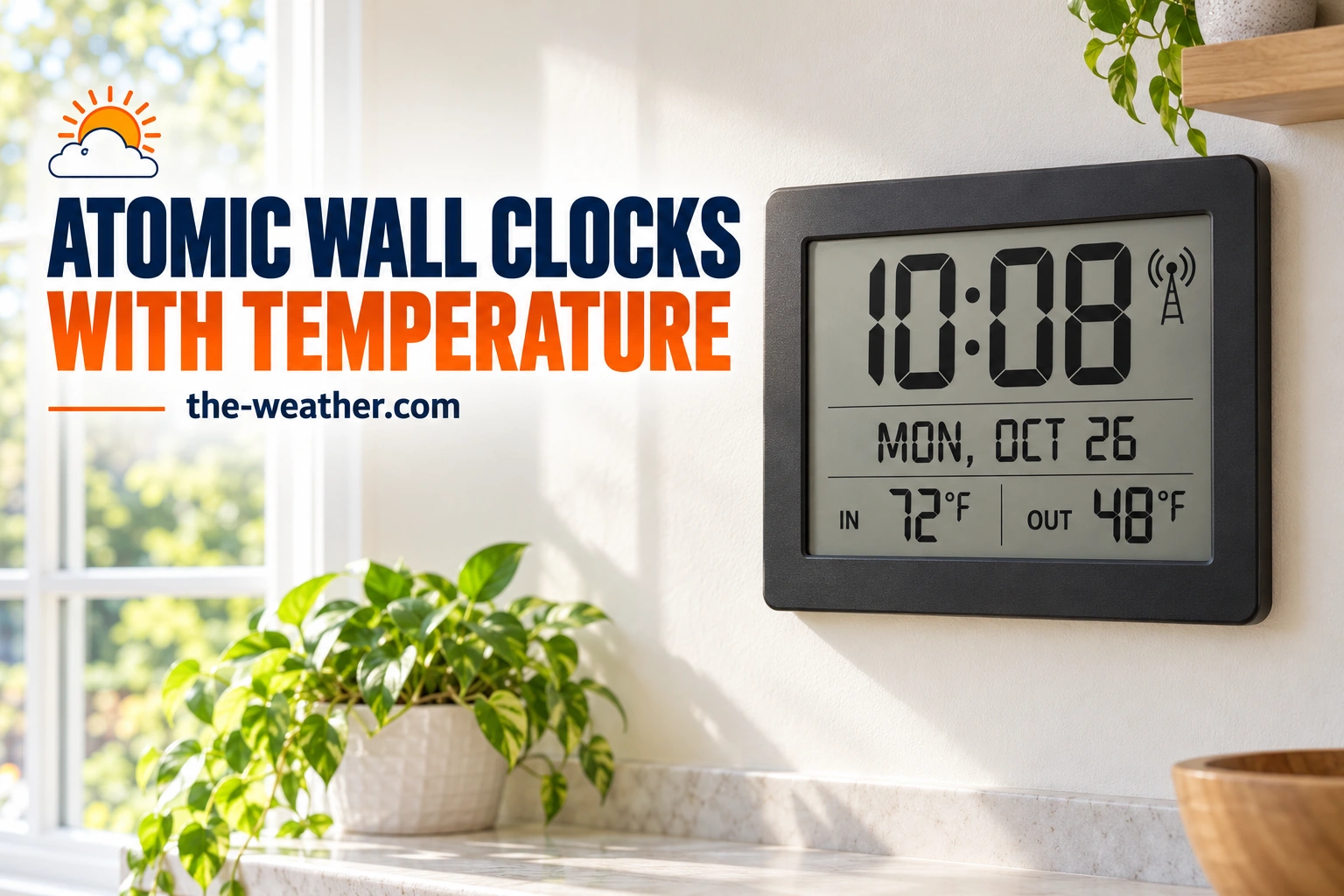
An atomic wall clock sets itself: at night it listens for the official U.S. time signal and corrects its own time, daylight saving time included. Add a temperature display, and a wireless outdoor sensor, and the kitchen clock doubles as a small weather clock. This page compares three La Crosse Technology models that La Crosse still sells, from their product pages and manuals, and adds what the spec sheets leave out: who should skip each one, how to set it up, and what to do when it will not sync.
Short answer: for time plus outdoor temperature, look at the La Crosse BBB86088V3 (11-inch case, 7 time zones including Alaska and Hawaii) or the smaller 513-1918S (its manual gives over 18 months of battery life for both the clock and the sensor). For just the time and the room temperature, the WT-8005U-S (Pacific, Mountain, Central and Eastern time only). Older versions such as the BBB86088 (v2) and the WS-8418U-IT are listed as retired by La Crosse, so check the exact model number on a listing.
Editorial Research & Review
- Written by
- Lena Thornton, Weather Station Analyst & CWOP Contributor
- Based on
- La Crosse Technology product pages and instruction manuals, and NIST Special Publication 960-14 on WWVB radio controlled clocks
- Hands-on testing
- Not performed by The-Weather.com
- Research last verified
- October 29, 2026
Three Atomic Weather Clocks Compared
| Model | Outdoor sensor | Temperature | Time zones | Case size | Batteries | Amazon |
|---|---|---|---|---|---|---|
| La Crosse BBB86088V3 | Yes, TX141-Bv4 included; over 330 ft open air, update about every 51 seconds | Indoor 32 to 122 °F; outdoor −40 to 140 °F | 7: Atlantic, Eastern, Central, Mountain, Pacific, Alaska, Hawaii | 11.00 x 8.54 in | Clock 2 AA, sensor 2 AA (not included); clock over 12 months, sensor over 24 months | Check on Amazon |
| La Crosse 513-1918S | Yes, TX191 included; over 330 ft open air, update about every minute | Indoor 32 to 122 °F; outdoor −40 to 140 °F | 7, including Atlantic, Alaska and Hawaii | 8.97 x 7.12 in | Clock 3 AAA, sensor 2 AA (not included); over 18 months each | Check on Amazon |
| La Crosse WT-8005U-S | No | Indoor only: 32 to 122 °F on the product page (the manual says 14.1 to 99.9 °F) | 4: Pacific, Mountain, Central, Eastern | 8.90 x 7.20 in | 2 AA (not included); up to 24 months per the manual | Check on Amazon |
Sources: La Crosse product pages (BBB86088V3, 513-1918S, WT-8005U-S), the BBB86088v3 setup sheet and the 513-1918S and WT-8005U manuals, checked October 29, 2026. Case size is length or width x height as La Crosse gives it. La Crosse lists all three as available; it lists the older BBB86088 (v2) and WS-8418U-IT as retired.
More atomic clocks
See atomic clocks on Amazonopens in a new tabTip: compare the model number on the listing with the table above (our advice).
Readability, Power and Extras
| BBB86088V3 | 513-1918S | WT-8005U-S | |
|---|---|---|---|
| Digit height | Not stated by La Crosse | Not stated | Not stated |
| Backlight | Not mentioned | Not mentioned | Not mentioned |
| Power | Batteries only listed | Batteries only listed | Batteries only listed |
| Humidity | Not listed | Not listed | Not listed |
| Alarm | Yes, with snooze | Yes, 10-minute snooze | Yes, with snooze |
| Other | Trend arrows for indoor and outdoor temperature | Custom date display, 3 daylight saving time options | 12/24-hour display, wall or freestanding |
From the La Crosse product pages, setup sheet and manuals. "Not stated" means we found nothing on it in La Crosse's documents. Our reading: case size is not digit size, so check the listing photos for the display; and without a backlight, you read the clock by room light at night.
Who Should Skip Which One
- Skip the BBB86088V3 if you want it small: at 11 inches wide it is the largest of the three.
- Skip the 513-1918S if you dislike AAA batteries in the clock; the other two use AA throughout.
- Skip the WT-8005U-S if you live in Alaska, Hawaii or the Atlantic time zone: La Crosse lists only Pacific, Mountain, Central and Eastern. Also skip it if you want the outdoor temperature.
- Skip all three if you want humidity, wind or rain: that is a weather station, and our weather station quiz helps you pick one. For a bedroom, a projection clock may suit you better; see our Newentor projection clock page.
Our own judgement, based on the specifications above.
First Setup, From the Manuals
- Sensor first. The La Crosse manuals start with the batteries in the outdoor sensor, then the clock.
- Wait for the outdoor reading. Once the clock shows the outdoor temperature, put the sensor outside in a shaded spot, out of the sun's heat (BBB86088v3 setup sheet and 513-1918S manual; the older v2 manual says after 5 minutes).
- Set your time zone and daylight saving time. Where clocks do not move forward in spring, the 513-1918S manual says to select DST OFF.
- Let it find the signal at night. The BBB86088v3 setup sheet says the clock searches when powered on and at 7:00 to 11:00 UTC (overnight in the U.S.), and the 513-1918S manual gives the same night hours; the WT-8005U manual says it searches for 1 hour between midnight and 6 a.m. until it receives the signal. A flashing tower icon means searching; a solid one means received.
- Search by hand if needed. The 513-1918S manual: press the PLUS button. The WT-8005U: the WWVB SEARCH button. The BBB86088v3: hold the MINUS button.
- Outdoor reading shows dashes? The BBB86088v3 setup sheet says: hold PLUS to search for the sensor; if it is still not connected after 3 minutes, bring the sensor inside next to the clock, take the batteries out of both, press any button on the clock 20 times, then put fresh alkaline batteries in the sensor first and the clock second.
More La Crosse help: how to reset a La Crosse weather station.
How an Atomic Clock Sets Itself
An "atomic" wall clock has no atoms ticking inside. It is a radio controlled clock that receives the time from NIST radio station WWVB near Fort Collins, Colorado, about 100 km (60 miles) north of Denver. NIST says the station broadcasts on 60 kHz around the clock, covers the continental U.S., and at night can also synchronize clocks in parts of Alaska and Hawaii. Clocks usually read the signal only periodically, often once every 24 hours, at night when it is strongest. NIST notes that consumers rely on these clocks as official time, accurate to within 1 second or less.
Clock Won't Set Itself? NIST's Placement Tips
| Problem source | What NIST advises |
|---|---|
| TVs and computer monitors | Keep the clock at least 1 to 2 meters (about 3 to 6 feet) away; some screens work near the WWVB frequency |
| Fridges, air conditioners, appliances with motors | Also 1 to 2 meters away; electric motors can cause interference |
| Metal buildings and metal roofs | Place the clock near a window; metal can block or weaken the signal |
| Basements | Try a spot above ground |
| Neon or fluorescent lights | They can cause interference; NIST suggests a test with a battery-powered AM radio to find the quietest spot |
| Wrong wall | Try another wall (for example east-west instead of north-south), since the antenna is directional; a wall or window facing Fort Collins, Colorado, helps |
Source: NIST Special Publication 960-14, "WWVB Radio Controlled Clocks: Recommended Practices for Manufacturers and Consumers" (2009 edition), Table 6 and consumer tips.
Our tip on top: after moving the clock, give it a night. These clocks search at night, so a clock that "does nothing" in the afternoon is usually just waiting for dark (our reading of the manuals and NIST).
Atomic Wall Clock FAQ
Which La Crosse atomic wall clocks show outdoor temperature?
Of the three current models here, the BBB86088V3 and the 513-1918S come with a wireless outdoor sensor. The WT-8005U-S shows indoor temperature only.
Do atomic clocks adjust for daylight saving time?
Yes, if daylight saving time is switched on in the clock's settings. Where clocks do not change, the 513-1918S manual says to select DST OFF.
Why won't my atomic clock set itself?
Usually interference or a weak signal. NIST advises keeping the clock 1 to 2 meters from TVs, monitors and appliances, trying a window or another wall, and avoiding basements. Then wait a night, since these clocks search for the signal at night.
Do atomic wall clocks work in Alaska and Hawaii?
NIST says the signal can reach parts of Alaska and Hawaii at night. Choose a clock with those time zones: the BBB86088V3 and 513-1918S list them, the WT-8005U-S does not.
Do these clocks have a backlight?
La Crosse does not mention a backlight for any of the three in its product pages, setup sheet or manuals, and all three run on batteries.
Sources
- La Crosse Technology: BBB86088V3 product page and setup sheet
- La Crosse Technology: 513-1918S product page and instruction manual (La Crosse document, hosted by Home Depot)
- La Crosse Technology: WT-8005U-S product page and WT-8005U manual
- La Crosse Technology: BBB86088v2 manual (older version; La Crosse document, hosted by Home Depot)
- NIST Special Publication 960-14: WWVB Radio Controlled Clocks (2009)
- NIST: Radio Station WWVB
Ready to decide?
Get the La Crosse Atomic Wall Clocks With Temperature
Prices and stock change daily. Check the current price, delivery options and what owners say in their reviews.
In this reviewLa Crosse Atomic Wall Clocks With TemperatureToday's price, delivery & owner reviews on Amazon
Check on Amazon →