
As an Amazon Associate, I earn from qualifying purchases.
In this article 8 sections
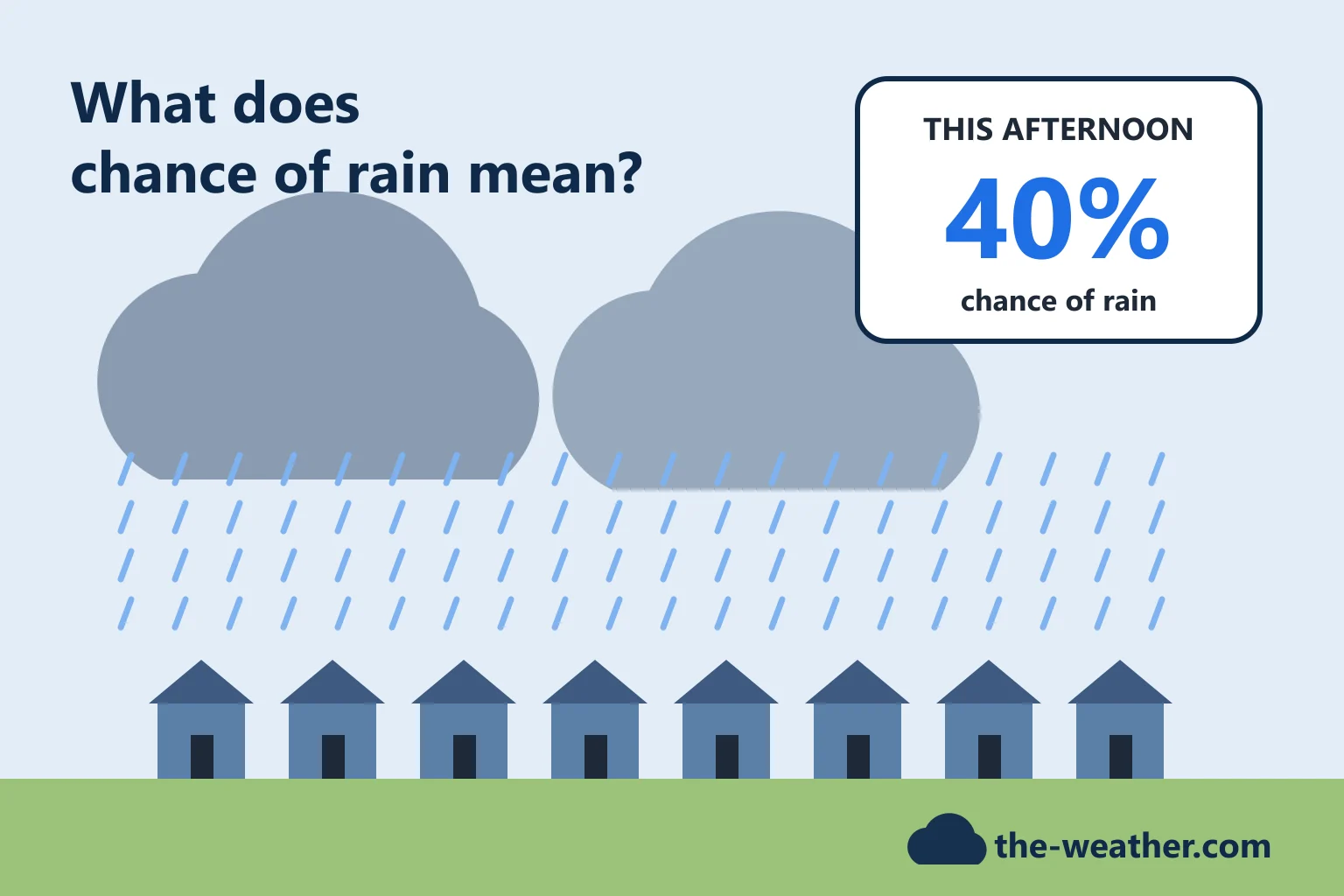
"40% chance of rain." Does that mean it rains for 40% of the day? Over 40% of town? Or that the forecaster is 40% sure? Most people guess one of those, and all three are wrong. The real meaning is simpler, and once you know it, you will know exactly when to grab the umbrella.
Short answer: in a National Weather Service forecast, the chance of rain (the "probability of precipitation", or PoP) is the chance that your spot gets at least 0.01 inch of rain during the forecast period. A 40% chance of rain this afternoon means a 40% chance of measurable rain at a specific spot in the forecast area, such as your street, between noon and 6 p.m. It does not mean that 40% of the area gets wet, or that it rains 40% of the time (National Weather Service).
Editorial Research
- Written by
- Lena Thornton, Weather Station Analyst & CWOP Contributor
- Based on
- National Weather Service explanations of the probability of precipitation (Paducah and Atlanta offices) and the NWS forecast terms used by the Binghamton office
- Research last verified
- October 21, 2026
What the Percentage Really Means
The National Weather Service defines the chance of rain with four simple parts:
- Measurable rain: at least 0.01 inch (one hundredth of an inch). A few drops that never wet the pavement do not count.
- Liquid: snow counts too, measured as the water it melts into.
- A time period: today, this afternoon, tonight. The percentage is for that whole period, not for one hour.
- A specific spot: your backyard, your street, your kid's soccer field. The percentage is the chance for that one spot, not the share of the area that gets wet. Neighboring spots in a detailed forecast can have different chances.
How Forecasters Get the Number: Confidence x Coverage
Here is the part almost nobody knows. The NWS office in Paducah, Kentucky explains the number as two things multiplied. Think of it as a way to understand the percentage, not as the one fixed calculation every forecaster always uses:
That is why two very different days can both be "40%":
| Confidence | Coverage | Chance of rain | What the day feels like | |
|---|---|---|---|---|
| Day A | 80% sure rain will develop | Only half the area gets it | 80% x 50% = 40% | Scattered showers: some neighborhoods get soaked, others stay dry |
| Day B | 40% sure the rain area arrives | If it does, everyone gets it | 40% x 100% = 40% | Either a wet day for everyone or no rain at all |
Both examples from the National Weather Service office in Paducah, Kentucky.
20%, 30%, 40%, 50% and More: What Each One Means
Forecasts pair the percentage with words. These are the terms the NWS office in Binghamton, New York uses, as an example; the wording can differ per forecast product and local office:
| Chance | Words in the forecast | Coverage words | Practical tip |
|---|---|---|---|
| 10% | (none) | Isolated, few | Usually dry, but check the latest forecast if your plans depend on it |
| 20% | Slight chance | Widely scattered | Go ahead with plans; check the radar before you leave |
| 30%, 40%, 50% | Chance | Scattered | Bring a rain jacket and have a plan B for outdoor events |
| 60%, 70% | Likely | Numerous | Expect rain; move what you can indoors |
| 80% to 100% | (none used) | Occasional, periods of | Rain is very likely; check how much |
Forecast words: National Weather Service Binghamton. The last column is our practical advice, not an NWS rule.
One thing the percentage does not tell you: how much rain. A 90% chance can mean a light drizzle, and a 30% chance can mean one short, heavy downpour. For amounts, look at the forecast text ("rainfall amounts of a quarter inch") or the hourly forecast graph on weather.gov.
Why Your Weather App Shows a Different Number
Not every weather app explains what its percentage means. The definition on this page is the one the National Weather Service uses in its own forecasts. If your app and weather.gov disagree, check the NWS forecast for your exact location by entering your ZIP code on weather.gov.
Will It Rain in the Next Hour? Check It Yourself in 5 Minutes
- Look at the radar. Radar shows where rain is now and which way it is moving, as green, yellow and red patches on the map. It cannot promise whether it will hit your exact street, but it shows what is coming. Our guide shows how to read weather radar.
- Check the hourly forecast on weather.gov for your ZIP code: the chance of rain per hour often tells you more than one number for the whole afternoon.
- Look up. Our guide on how to tell if a storm is coming without a forecast explains which cloud signs to watch.
- Watch the barometer. NOAA's old barometer rules link falling pressure with wind and rain. A home weather station shows the trend; our guide explains barometric pressure.
Chance of Rain FAQ
What does a 40% chance of rain mean?
A 40% chance that your spot gets at least 0.01 inch of rain during the forecast period. It does not mean that 40% of the area gets rain or that it rains 40% of the time.
What does a 30% chance of rain mean?
A 30% chance of measurable rain at any spot in the forecast area during the period. The NWS calls 30% to 50% a "chance", usually with "scattered" showers: some places get wet, many stay dry.
What does a 20% chance of rain mean?
A "slight chance": a 20% chance that your spot gets at least 0.01 inch of rain. Rain is possible but unlikely; check the radar before outdoor plans.
What does a 50% chance of rain mean?
An even chance of at least 0.01 inch of rain at your spot during the period. It can mean scattered showers that hit half the area, or a rain area that may or may not arrive.
Does a high chance of rain mean a lot of rain?
No. The percentage is about whether measurable rain falls, not how much. A 90% chance can be light drizzle. Check the forecast text or the hourly graph for amounts.
How much rain is "measurable"?
0.01 inch or more, measured as liquid. Snow counts as the water it melts into.
Update Log
- October 21, 2026: First version, based on National Weather Service explanations of the probability of precipitation.
Sources
- National Weather Service Paducah: Precipitation Probability (PDF)
- National Weather Service Atlanta: What is the meaning of PoP?
- National Weather Service Binghamton: Forecast Terms
More weather basics: Watch vs warning vs advisory · Frost advisory vs freeze warning · Free weather tools