
As an Amazon Associate, I earn from qualifying purchases.
In this article 7 sections
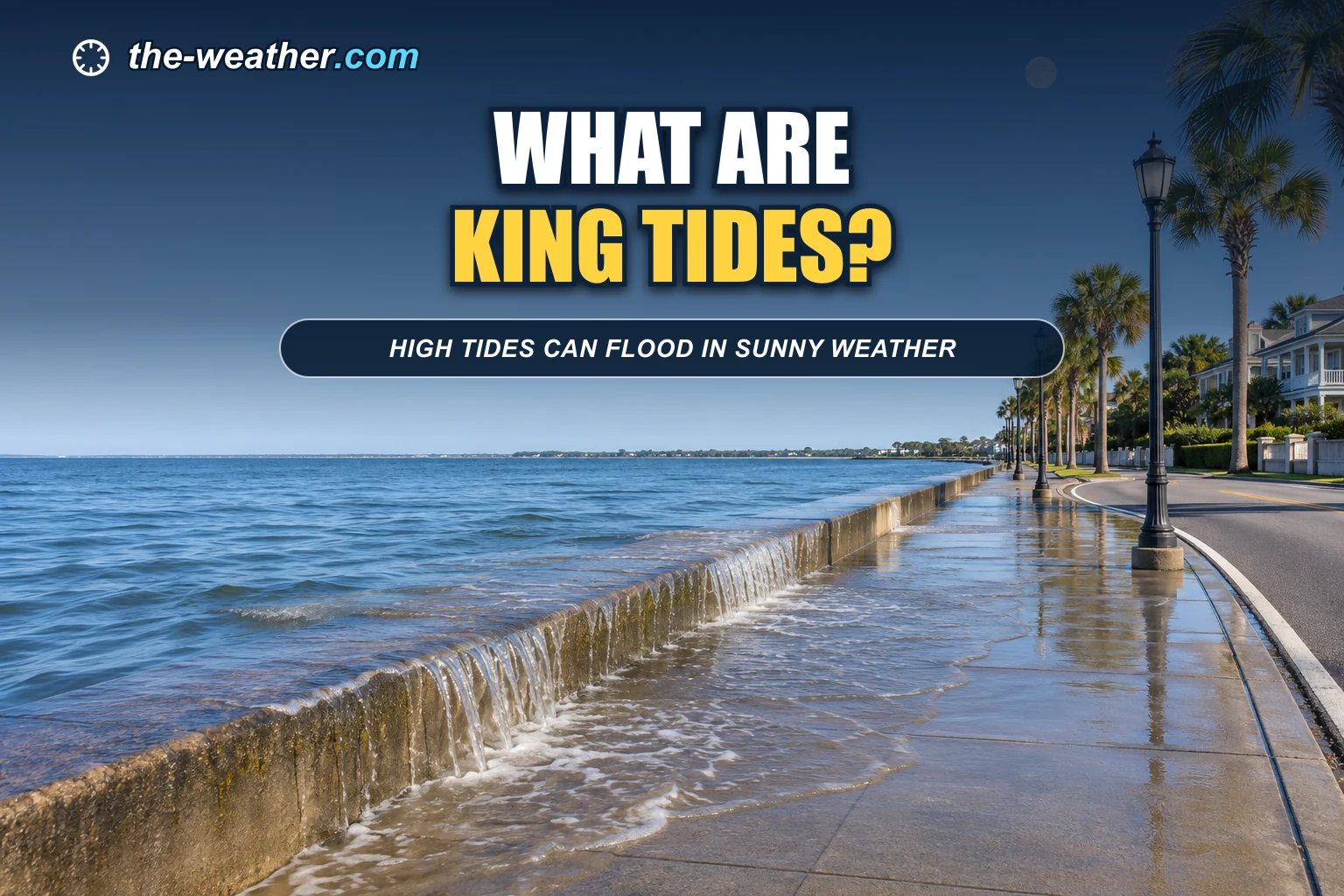
Blue sky, no wind, and still there is sea water in the street. That can be high tide flooding during an unusually high tide, the kind people call a king tide. The name sounds royal, but it is not an official term: it is what people call the highest tides of the year. Here is what causes them, why they flood streets on sunny days, and how to know when the next one comes.
Short answer: NOAA calls "king tide" "a popular, non-scientific term people often use to describe exceptionally high tides". They happen when a new or full moon (Sun, Earth and Moon in a line) comes close to the moment the Moon is nearest to Earth, its perigee. NOAA says that lines up typically 6 to 8 times a year. Because tides can be predicted, king tides can be predicted too, years ahead. Not every king tide floods: that depends on the local water level and the local coast. A storm or heavy rain at the same time makes flooding worse.
Editorial Research
- Written by
- Lena Thornton, Weather Station Analyst & CWOP Contributor
- Based on
- NOAA National Ocean Service pages on king tides, spring and neap tides, perigean spring tides and high tide flooding (all last updated September 23, 2026)
- Research last verified
- November 25, 2026
Water rising near you? See coastal flood alerts for your exact spot with our live tool: weather alerts near me.
What Causes a King Tide?
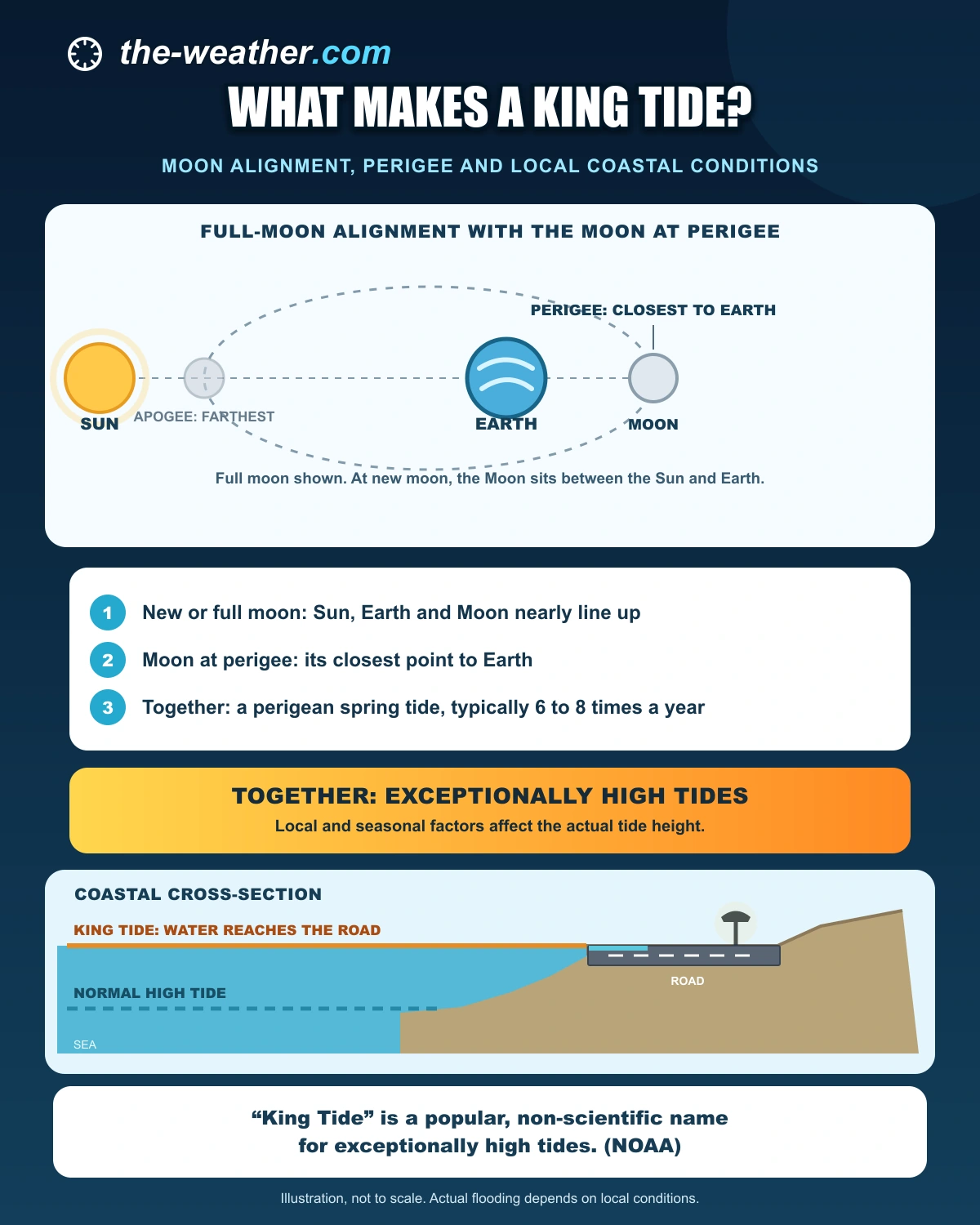
Tides are driven by the pull of the Moon and the Sun on the oceans. Two things make that pull extra strong:
- A new or full moon. Then the Sun, Earth and Moon are roughly in one line, and their pulls add up. These are called spring tides, which, as NOAA puts it, is "a common historical term that has nothing to do with the season of spring". Spring tides happen "twice each lunar month all year long" (NOAA).
- The Moon at its closest point to Earth. The Moon's orbit is an oval, not a circle. Its nearest point, the perigee, comes about every 28 days.
When both happen at about the same time, you get what scientists call a perigean spring tide: "when the moon is either new or full and closest to Earth" (NOAA). That is the tide most people mean by a king tide.
NOAA's own king tide page adds that higher than normal tides can also come with certain seasons, depending on where you are in the country (NOAA). So the exact king tide dates differ from coast to coast.
How Much Higher Is a King Tide?
Less than you might think, and that is the surprising part. NOAA writes that "it is not uncommon" for high tides during a perigean spring tide to be "more than a foot higher" than high tides during the weakest spring tides, when the Moon is farthest away. In places with a huge tidal range, like Anchorage, Alaska, the difference can be 3 feet or more.
A foot does not sound like much. But in the lowest spots along the coast, streets, parking lots and storm drains sit only just above the normal high tide. There, one extra foot can be enough to push sea water up through the drains and over the lowest seawalls, on a perfectly calm day.
Why King Tides Flood Streets on Sunny Days
NOAA calls this kind of flooding high tide flooding, also known as "sunny day" or "nuisance" flooding. It happens "when sea level rise combines with local factors to push water levels above the normal high tide mark" (NOAA).
And it is getting more common. According to NOAA, high tide flooding is now "twice as frequent" in U.S. coastal communities as it was 20 years ago, because of rising seas, sinking land and the loss of natural barriers like marshes. NOAA expects that the conditions that cause minor and moderate flooding today will cause moderate and major flooding by 2050.
King Tide Plus a Storm: When It Gets Serious
What a king tide does depends on the place: from a wet walkway to water in streets and buildings. NOAA sorts high tide flooding into minor, moderate and major (see our coastal flood alerts page for the levels). It gets worse when something else adds water at the same time:
- Storm surge: strong onshore wind and low air pressure push the sea onto the shore. On top of a king tide, a moderate storm can flood like a much bigger one. More on that in what is storm surge.
- Heavy rain: rain water cannot drain into a sea that is already at the top of the drains, so it backs up into the streets.
- Big waves: they wash over seawalls that a calm king tide would only just reach.
A recorded case (San Francisco, November 2026): on November 24, 2026 at 10:06 a.m., the tide gauge at Crissy Field near the Presidio measured 8.23 feet. That beat the November record of 7.97 feet from November 30, 1982, according to the National Weather Service (reported by Bay City News on NBC Bay Area). King tides came together with a storm along the California coast that week (FOX Weather). More on why California winters can bring extra coastal trouble: what El Niño means for a California winter.
How to Find the King Tide Dates for Your Coast
The good news: tides follow the Moon and the Sun, so they can be calculated years ahead. You do not need a forecast to know when the highest tides will come.
- NOAA tide predictions. On NOAA's Tides and Currents website, pick the prediction station nearest to your stretch of coast (not just the nearest big city), open the predicted high tides for the coming months and note the highest ones. They usually fall around a new or full moon. Keep in mind that predictions are based on the Moon and the Sun: wind, air pressure and rain can make the real water level higher or lower on the day.
- Your state or city. Some coastal states and cities publish their own king tide dates each season.
- Weather Service alerts for the days when the water is expected to cause flooding. A king tide can come with a Coastal Flood Advisory, Watch or Warning: see what each coastal flood alert means.
A NOAA weather radio can sound for coastal flood warnings too, if you set it to your county's SAME code and leave the Coastal Flood Warning alert switched on. Handy, because coastal flood warnings are not on the list of alerts the Weather Service sends to every phone (NWS).
King Tide Safety Tips
- Never drive through water on the road. You cannot see how deep it is, or whether the road underneath is still there.
- Move the car from low streets and parking lots before the high tide, not during it.
- Stay off seawalls, jetties and rocks at high tide, especially with waves. Taking a king tide photo is fine; taking it from the edge of a jetty is not.
- Watch the clock, not the sky. The highest water comes around the time of high tide, even when the weather is perfect.
Quick Answers
What is a king tide?
An exceptionally high tide. NOAA calls it "a popular, non-scientific term". Most king tides happen when a new or full moon falls close to the Moon's perigee, its closest point to Earth.
How often do king tides happen?
According to NOAA, the new or full moon lines up closely with the Moon's perigee typically 6 to 8 times a year. The exact dates and heights differ per coast.
Are king tides dangerous?
On a calm day they mostly flood low streets, parking lots and walkways. They become dangerous when a storm, heavy rain or big waves come at the same time.
Is a king tide the same as storm surge?
No. A king tide comes from the Moon and the Sun and can be predicted years ahead. Storm surge is extra water pushed ashore by a storm's wind and low pressure. The worst flooding comes when both happen together.
Do spring tides only happen in spring?
No. NOAA says the term "has nothing to do with the season of spring". Spring tides happen twice every lunar month, all year long.
Sources: NOAA: What is a King Tide? · NOAA: What are spring and neap tides? · NOAA: What is a perigean spring tide? · NOAA: What is high tide flooding? · NOAA Tides and Currents · FOX Weather live blog, November 24-25, 2026 · NBC Bay Area / Bay City News, November 24, 2026 (Crissy Field November record, citing the NWS)