
Our picks in this guide
Compare the models in this guide
See today’s price, delivery options and customer reviews on Amazon.
As an Amazon Associate, I earn from qualifying purchases.In this article 7 sections
"7400mWh power bank" sounds like plenty to keep a phone alive through a blackout. So can the FosPower A1 emergency radio really charge your phone, and how much? We checked the number that matters most and that the Amazon listing does not show: the rated USB output from the power bank's own safety test report. Here is what it means in phone terms, plus how fast the crank and the sun can refill it.
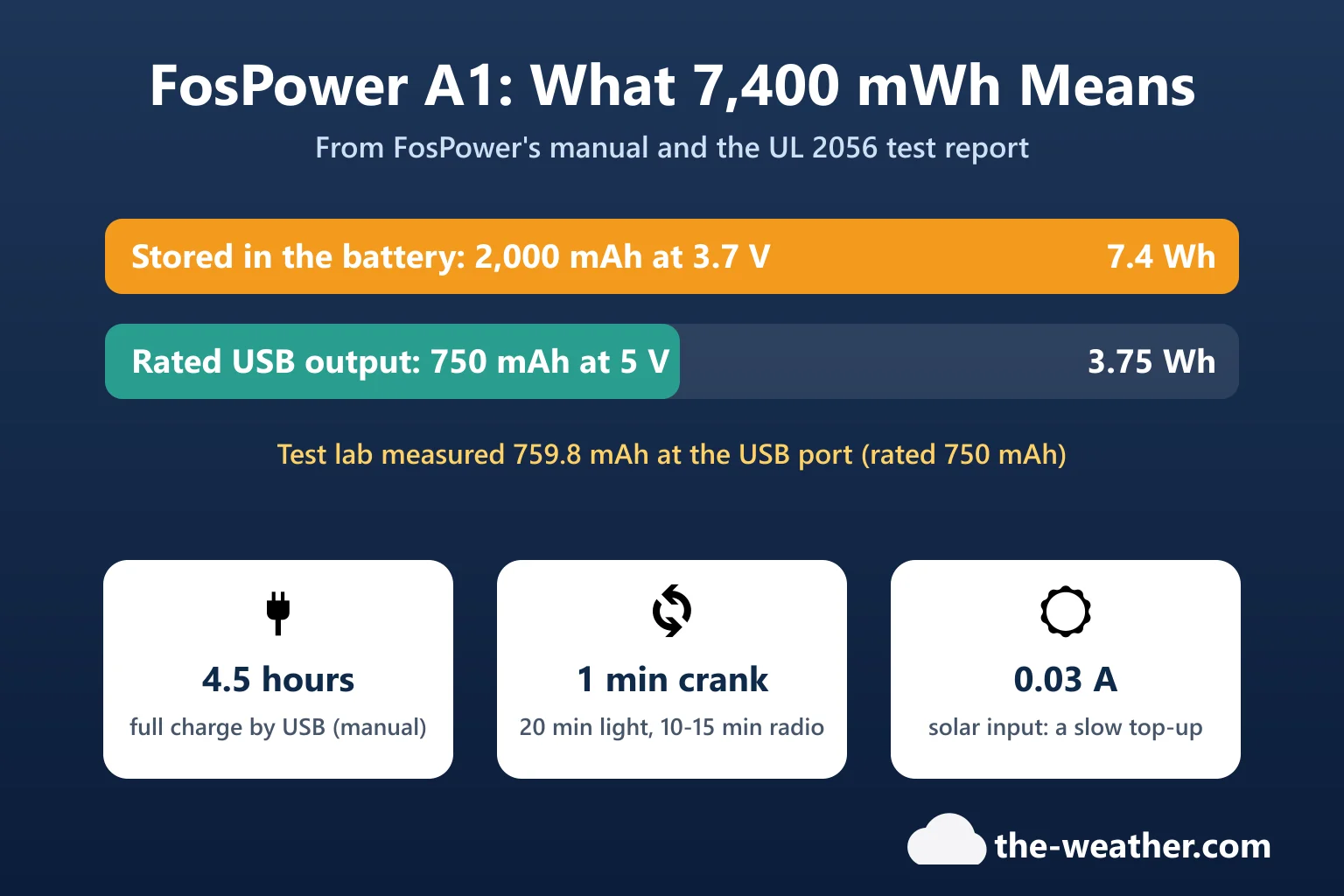
Short answer: yes, the FosPower A1 can charge a phone through its USB-A port, but only a little. Its battery stores 7.4 Wh (2,000 mAh at 3.7 V), while the UL 2056 test report rates the USB output at 750 mAh at 5 V, about 3.75 Wh. By our rough math that is at most a fifth to a third of a typical 3,000 to 5,000 mAh phone battery, before charging losses. Fine for calls, texts and checking the forecast; not for days of phone use.
Editorial Research
- Written by
- Lena Thornton, Weather Station Analyst & CWOP Contributor
- Based on
- SGS test report SZES190901540902 (UL 2056 power bank safety, model FOSPWB-2376, 2019) and FosPower's A1 operating instructions; phone estimates are our own arithmetic, explained below
- Hands-on testing
- Not performed by The-Weather.com; we did not charge phones with it
- Research last verified
- October 22, 2026
The Numbers From the Test Report
| Item | Test report (FOSPWB-2376) |
|---|---|
| Battery | 3.7 V, 2,000 mAh lithium-ion, 18650 cell (= 7.4 Wh, our math) |
| USB output | 5 V, 0.6 A |
| Rated output capacity | 750 mAh |
| Measured output capacity | 759.8 mAh (capacity test: pass) |
| USB input (Micro-USB in 2019) | 5 V, 0.45 A |
| Solar input | 5 V, 0.03 A |
| Charging temperature | 0 to 45 °C (32 to 113 °F) |
| Discharge (use) temperature | -10 to 60 °C (14 to 140 °F) |
The test report dates from 2019; newer units may differ in details such as the charging port (the current listing says USB-C). Why is the output lower than the battery? The battery works at 3.7 V and the USB port at 5 V, and converting costs energy. A 2,000 mAh battery never delivers 2,000 mAh at 5 V.
What That Means for Your Phone (Our Math)
We converted everything to watt-hours (mAh × volts ÷ 1,000), using about 3.85 V for a phone battery. These are upper limits: real charging loses some energy as heat, so expect less.
| Phone battery | Energy in the phone | Share from one full FosPower (3.75 Wh) |
|---|---|---|
| 3,000 mAh | about 11.6 Wh | up to about 32% |
| 4,000 mAh | about 15.4 Wh | up to about 24% |
| 5,000 mAh | about 19.3 Wh | up to about 19% |
Check your cable: the output is a USB-A port. Many new phones come with a USB-C to USB-C cable only, which will not fit; keep a USB-A cable for your phone with the radio.
The output is also slow: 0.6 A at 5 V is 3 watts, well below a modern wall charger. FosPower is honest about this in the manual: the feature "is intended to only charge USB devices for emergency use, not a normal power bank."
How Fast Can You Refill It?
- USB: about 4.5 hours for a full charge (manual).
- Hand crank: one minute at 130 to 150 turns gives about 20 minutes of light or 10 to 15 minutes of radio (manual). Topping up a phone by cranking takes a lot of cranking; FosPower calls crank and AAA charging of USB devices the "last charging option", and says not to keep the phone attached while you crank.
- Solar: the test report rates the solar input at 0.03 A at 5 V, which is 0.15 W. Our arithmetic: even in ideal full sun, refilling 7.4 Wh would take around 50 hours of sunshine, before losses. Treat solar as a way to keep the battery from going flat, which is exactly how FosPower describes it.
- AAA batteries: they run the radio when the internal battery is empty; alkaline only.
Getting the Most Out of It in a Blackout (Our Tips)
- Keep it charged before storm season by USB, and crank it for 3 to 5 minutes if it sat unused for more than 60 days (FosPower's advice).
- Put your phone in low-power mode before you plug it in, so the small charge lasts longer.
- Charge the phone first, listen later: FosPower says to switch the USB charging off while you listen to AM to avoid interference.
- Need days of phone power? Pair the radio with a dedicated power bank; the FosPower is your radio and light, not your main battery.
FosPower A1 emergency weather radio
Check the FosPower A1 on Amazonchoose a "Model A1" option · opens in a new tabAffiliate link: we may earn a commission if you buy through it, at no extra cost to you. Full overview: FosPower A1 review.
FosPower Phone Charging FAQ
Can the FosPower radio charge an iPhone or Android phone?
It has a standard USB-A output (5 V, 0.6 A), so it can charge phones with a cable that has a USB-A plug. Expect a small, slow top-up: the rated output is 750 mAh at 5 V.
How many times can the FosPower A1 charge a phone?
Not even once. By our math, one full FosPower gives at most about a fifth to a third of a typical 3,000 to 5,000 mAh phone battery, and less in practice.
Why does a 2,000 mAh battery give only 750 mAh?
The 2,000 mAh is measured at the battery's 3.7 volts; the 750 mAh is what comes out of the 5-volt USB port after conversion. The test lab measured 759.8 mAh at the port.
Can I charge my phone with the hand crank?
FosPower says you can, but only as a last option, and not with the phone attached while you crank. Charge the radio first, then connect the phone.
How long does the FosPower take to charge by solar?
A long time. The solar input is rated at 0.03 A at 5 V; by our estimate a full refill would need around 50 hours of ideal sunshine. FosPower presents solar as a way to maintain the battery.
Update Log
- October 22, 2026: First version, based on the UL 2056 test report and FosPower's manual.
Sources
- SGS test report SZES190901540902, UL 2056 power bank safety, FOSPWB-2376 (PDF)
- FosPower: Solar Crank Radio operating instructions (PDF)
- FosPower A1 Amazon listing (ASIN B07FKYHTWP), read October 22, 2026
Ready to decide?
Find your pick on Amazon
Prices and stock change daily. Check the current price, delivery options and what owners say in their reviews.
Our top picksCompare our picks on AmazonToday's price, delivery & owner reviews on Amazon
Check on Amazon →