
As an Amazon Associate, I earn from qualifying purchases.
In this article 7 sections
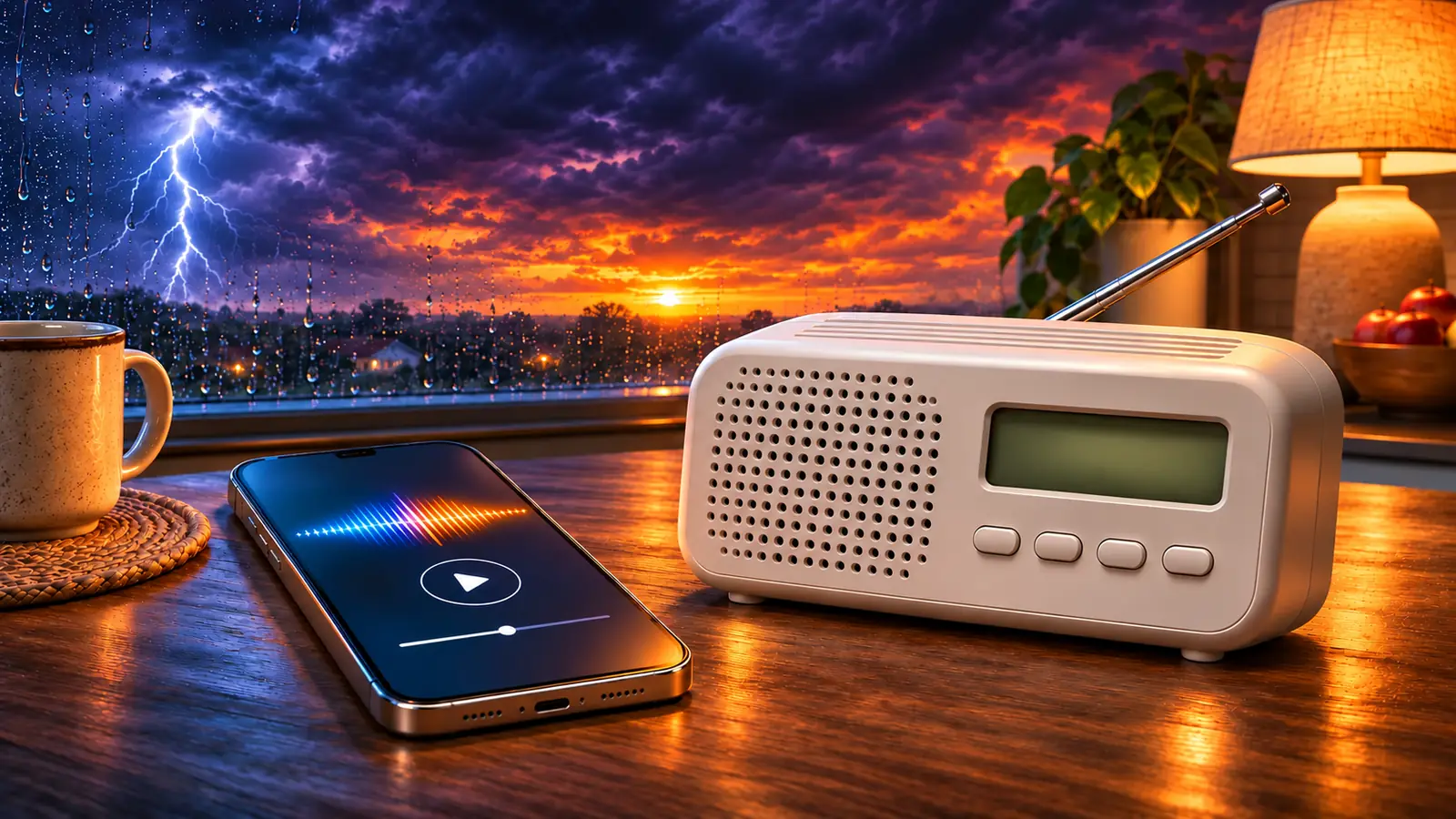
No weather radio in the house, or you are away from home and want to hear your local broadcast? You can often listen to NOAA Weather Radio online. Often, not always: it depends on whether someone (usually a volunteer) streams your transmitter. Here is where to look, how much delay to expect, and what your phone can do without a radio or an app.
Short answer: NOAA Weather Radio is streamed online by third parties, mostly community volunteers, not by one official national player. You find the streams in directories such as WXRadio, WeatherRadio.org and weatherUSA. When we checked on November 27, 2026, the WeatherRadio.org and weatherUSA lists together covered 178 of the 1,035 transmitters in the National Weather Service list, about 1 in 6. Streams run behind the radio, so for warnings at night your phone's emergency alerts and a real weather radio are the safer pair.
Editorial Research
- Written by
- Lena Thornton, Weather Station Analyst & CWOP Contributor
- Based on
- The National Weather Service pages on NOAA Weather Radio and Wireless Emergency Alerts, Ready.gov, WXRadio.org, and the WeatherRadio.org and weatherUSA stream lists, matched by call sign against the NWS county coverage listing
- Research last verified
- November 27, 2026
Where to listen to NOAA Weather Radio online
The national NOAA Weather Radio pages of the Weather Service list the frequencies, receivers and outages; we did not find a live audio player there. The live audio comes from third parties, mostly people with a weather radio, a computer and a good heart, who put their local broadcast online. Three directories collect those streams:
- WXRadio (from WXRadio.org). On the morning we looked, its server reported "Current SSL radio streams available 129".
- WeatherRadio.org, which calls itself "Free, community-provided NOAA Weather Radio streams" and names the volunteer behind each stream.
- weatherUSA, a table by state, city, call sign and frequency. In its own words, it "offers an audio streaming platform for NOAA Weather Radio" and also links to other streams.
Some local Weather Service offices also link to streams of their own transmitters. NWS Hanford in California, for example, lists "Live Broadcast" links for two transmitters on its weather radio page.
How to find a stream for your own area
- Look up your county in our SAME code look-up. Note the call sign of your transmitter (for example KEC61) and its frequency.
- Search for that call sign in the directories above. The call sign is the safest match: city names can belong to two transmitters.
- No hit? Try the other transmitters listed for your county. If none of them is streamed, the stream of a neighbouring county still tells you the forecast, but not necessarily your county's warnings.
The catch: delay, gaps and no alarm
A stream is a great way to hear the forecast. It is a poor way to be woken up by a tornado warning. WXRadio.org is admirably honest about it on its own front page:
- "These Streams should not be used for protection of life or property."
- "The audio may have a buffer delay as long as thirty seconds, plus any provider, network, or local stream delays."
- "In some events, such as Tornado Warnings, Network and other delays of several seconds may change your status from "Safe" to "Not Safe"."
- "a stream may be offline for various reasons when you may need it the most."
weatherUSA says the same on its radio page: "These audio streams should not be used for the protection of life or property!" and "The streams can be delayed 10 seconds to 2 minutes because of buffering or network delays."
Add the obvious one: a browser tab does not switch itself on at 3 a.m. A weather alert radio does. The Weather Service sends "a 1050 Hz tone alarm before broadcasting most warnings and many watch messages", and radios built for it react to that tone "even if the audio is turned off" (NWS receiver information). And a stream needs both power and internet, which a bad storm can take away.
What your phone can do without an app
Your phone probably already gets the most serious weather warnings, with no app and no sign-up. These are Wireless Emergency Alerts. The Weather Service: "No signup is required! Alerts are sent automatically to WEA-capable phones during an emergency." Ready.gov adds that "Older phones may not be WEA capable, and some cell phone models require you to enable WEAs", so check your phone's notification settings once.
The important part is which warnings reach your phone. The Weather Service lists the types it sends as Wireless Emergency Alerts (NWS):
Sent to your phone
- Tornado Warning
- Severe Thunderstorm Warning, "only when the damage threat is destructive"
- Flash Flood Warning, "only when the damage threat is considerable or catastrophic"
- Hurricane, Typhoon, Storm Surge and Extreme Wind Warnings
- Tsunami, Dust Storm and Snow Squall Warnings
Not on that list
- Watches (tornado watch, flood watch and so on)
- Severe Thunderstorm and Flash Flood Warnings below those damage levels
- Winter Storm Warnings, advisories and forecasts
These are still posted on weather.gov, and NOAA Weather Radio carries the forecasts plus, with its tone alarm, "most warnings and many watch messages" (NWS).
Each message is short: "up to 360 characters on 4G LTE networks and beyond", the Weather Service says. Think of it as the fire alarm, not the briefing. For the full message, the forecast and everything below warning level, you need the radio broadcast, a stream, or weather.gov.
Apps: the official one, and the rest
The FEMA app is the federal option. Ready.gov: it lets you "Receive real-time weather and emergency alerts from the National Weather Service for up to five locations nationwide." Handy for keeping an eye on a parent's town or the cabin.
Apps with "NOAA" or "weather radio" in the name are a mixed bag. Check who made the app (the developer name under the title) and what it actually does. An app that plays the volunteer streams above has the same delay and gaps as the website. An app that only shows alerts is not a radio.
Comparing all the options (radio, phone alerts, apps) for your household? That is a bigger question, and we went through it in do you still need a weather radio.
My take
A stream is perfect for one job: hearing the broadcast for a place where you are not, like a relative's town when a storm is heading their way. For your own house, let a radio set to your county do the night shift, with phone alerts as the second line. Streams are the nice extra; the radio and the phone alerts are the seatbelt and the airbag. And if you do buy a radio, our NOAA Weather Radio frequencies page shows which of the seven channels to set.
Quick Answers
Can I listen to NOAA Weather Radio online?
Yes, for many areas: volunteers stream their local transmitter, and directories like WXRadio, WeatherRadio.org and weatherUSA list them. On November 27, 2026 we found 178 of 1,035 transmitters in the WeatherRadio.org and weatherUSA lists.
Is there an official NOAA Weather Radio app?
We did not find one from the National Weather Service. The federal app with NWS alerts is the FEMA app, which covers "up to five locations nationwide". Your phone's Wireless Emergency Alerts need no app at all.
How long is the delay on a NOAA radio stream?
WXRadio.org says "as long as thirty seconds, plus any provider, network, or local stream delays". During a tornado warning, that matters.
Can I rely on a stream for warnings?
No. The stream operators say so themselves: "These Streams should not be used for protection of life or property." Use phone alerts plus a weather alert radio for warnings.
Does my phone get every weather warning?
No. Wireless Emergency Alerts cover the most dangerous warnings, such as tornado, destructive severe thunderstorm and considerable or catastrophic flash flood warnings. Watches and winter storm warnings are not on the NWS list.
Sources: NWS: NOAA Weather Radio · NWS: receiver information · NWS: county coverage listing · NWS Hanford: weather radio · NWS: Wireless Emergency Alerts · Ready.gov: alerts and warnings · WXRadio.org · WeatherRadio.org · weatherUSA radio