Product covered in this analysis
AcuRite Iris 5-in-1 Home Weather Station
See today’s price, delivery options and customer reviews on Amazon.
As an Amazon Associate, I earn from qualifying purchases.In this article 13 sections
- AcuRite Iris 5-in-1 Specifications
- What the AcuRite Iris 5-in-1 Measures
- Iris Versions, Displays and Parts
- Accuracy: What Decides Your Readings
- Sensor Placement (From AcuRite's Manual)
- Setup
- Pros and Cons
- AcuRite Iris 5-in-1 vs. Ambient Weather WS-2902C
- Troubleshooting the AcuRite Iris 5-in-1
- Who Should Buy the AcuRite Iris 5-in-1?
- Should You Buy the AcuRite Iris 5-in-1?
- Video: AcuRite Iris Direct-to-Wi-Fi Display Set-Up
- Frequently Asked Questions

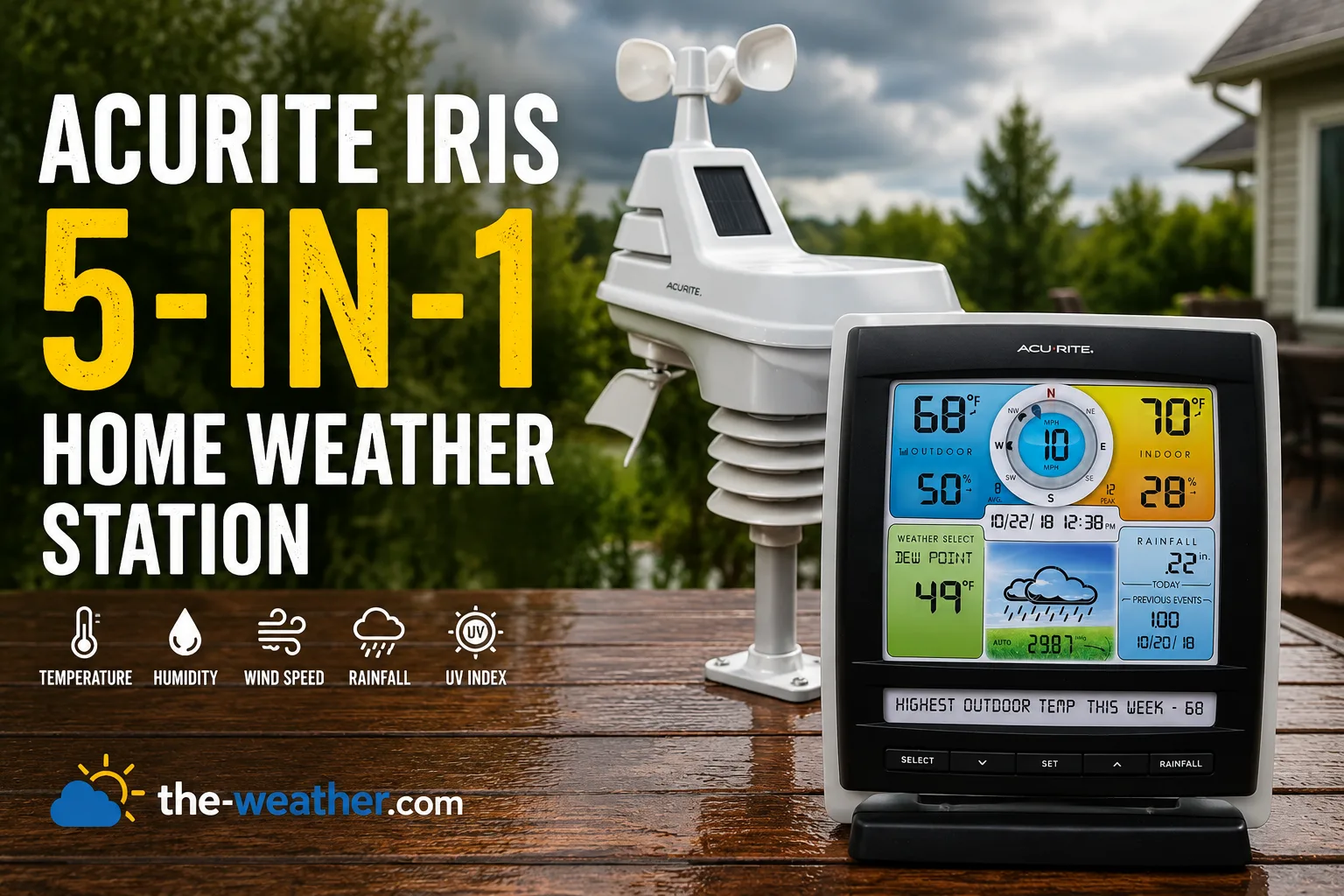
The AcuRite Iris 5-in-1 measures outdoor temperature, humidity, wind speed, wind direction and rainfall with one outdoor sensor, and sends the readings wirelessly to an indoor display. AcuRite sells the same sensor with many different displays, from simple screens to Wi-Fi models.
This review sticks to what AcuRite documents: what the sensor measures, how it must be placed, which versions and parts exist, and what to check before you buy. Where we give our own judgement, we say so.
The Iris is a sensible choice if you want temperature, humidity, wind and rain from one outdoor sensor, and you like the idea of a station you can repair: AcuRite sells the wind cups, the temperature and humidity board, the wind cup assembly and complete replacement sensors separately. It does not measure UV or light (that is the 7-in-1 Atlas), and like any backyard station it only reads well when it is mounted high, level and in the open, as AcuRite's own manual stresses.
Shopping during Black Friday? See which home weather stations are worth buying at a sale price, and how to tell a real deal from a dressed-up one: Black Friday Weather Station Deals 2026.
AcuRite Iris 5-in-1 Specifications
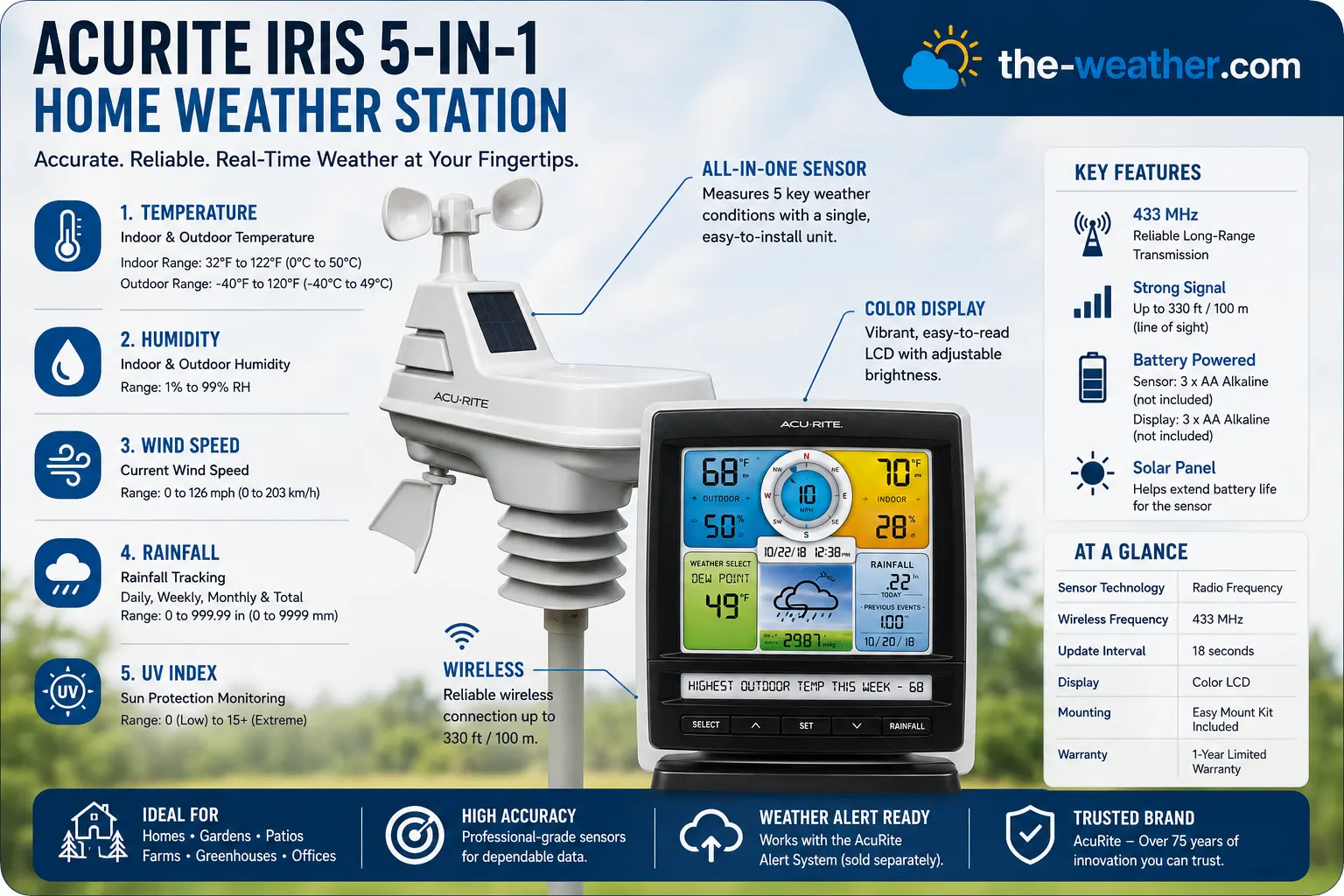
| Specification (outdoor sensor) | Value, per AcuRite's manual |
|---|---|
| Measures | Temperature, humidity, wind speed, wind direction, rainfall |
| Temperature range | -40°F to 158°F (-40°C to 70°C) |
| Humidity range | 1% to 99% |
| Wind speed | 0 to 99 mph (0 to 159 km/h) |
| Wind direction | 16 points |
| Rainfall | 0.01 inch (0.25 mm) and up |
| Data updates | Wind speed every 18 seconds, wind direction every 30 seconds (36 seconds on the 06004M), temperature and humidity every 36 seconds |
| Wireless range | 330 ft (100 m), depending on home construction materials |
| Power | 4 AA alkaline or lithium batteries; lithium below -4°F (-20°C) |
| Solar panel | Runs an internal fan that draws air into the sensor to reduce solar heating (single panel on 06004M, dual panel on 06014M) |
Source: AcuRite instruction manuals for the Iris sensor, models 06014M (dual solar panel) and 06004M (single solar panel). Note that -40°/158° and 1%/99% are also the values AcuRite uses as error codes: see our Iris troubleshooting guide.
Check AcuRite Iris Price on AmazonWhat the AcuRite Iris 5-in-1 Measures
The 5-in-1 name refers to five instruments in the outdoor sensor. Here is what each one does and what the data is useful for:
| Sensor | Measures | Useful for |
|---|---|---|
| Thermometer | Outdoor air temperature | Frost planning, daily comfort, gardening decisions |
| Hygrometer | Outdoor relative humidity (%RH) | Heat index, plant watering, dew point. See our hygrometer guide. |
| Anemometer | Wind speed | Storm preparedness, outdoor activity planning |
| Wind vane | Wind direction (16 points) | Watching weather change. See our wind vane guide. |
| Rain gauge | Rainfall, from 0.01 inch | Garden watering, rain totals |
What you see indoors depends on the display you pair it with: indoor readings, barometric pressure, a forecast or lightning (with the 06045M sensor) differ per display model. Check the display's own manual or product page before you buy. For a deeper look at the instruments themselves, see our weather instruments guide.
Iris Versions, Displays and Parts
This is where the Iris stands out, and where buyers most often get confused. According to AcuRite's compatibility charts:
| What | Model numbers (per AcuRite) | Good to know |
|---|---|---|
| Replacement sensor | 06014MA2BK (dual solar panel) | AcuRite's support pages also mention the 06014M and the single-panel 06004M |
| Wi-Fi displays | 06100M, 06101M, 06103M, 06102M, 06088M | Listed as Wi-Fi models; check the display's manual for what it connects to |
| Displays without Wi-Fi | 06090M, 06095M, 06096M, 06016M, 06022M, 06106M, 06058M | Data shows on the display only |
| Lightning add-on | 06045M | Needs an Iris display with a lightning option (such as 06058M, 06088M, 06102M) |
| Dual solar panel upgrade | 06003M (PRO+; the manual says 06003RM) | AcuRite: compatible with the single-panel sensor 06004M; see our PRO+ review |
| Wind cups / wind cup assembly | 06031RM (the chart writes 06031M) / 12123-5N1WCBSA | The assembly also replaces the bearings; see our wind cups guide |
| Temperature and humidity board | 11197-VN1HSPCB | Only for sensors 06004M, 06004RMA1, 06014M, 06014RMA1 and VN1TXCA2, and AcuRite also asks you to check the board itself first |
Sources: AcuRite compatibility charts and AcuRite support, checked October 19, 2026. Full matching steps in our AcuRite replacement sensor guide.
Accuracy: What Decides Your Readings
AcuRite's manual does not list accuracy tolerances in its specification table, so we will not invent any. What it does make very clear is that placement decides how accurate your readings are. In our view, that is the most useful thing to know before you buy: where you mount the sensor can affect your readings a lot, whatever the station costs.
Sensor Placement (From AcuRite's Manual)
- Mount at least 5 feet (1.5 m) high in an open area; higher is better for wind
- Point the solar cell south (it also orients the wind direction)
- Make it level with the bubble level on top
- Remove the plastic rain gauge stabilizer tab before use
- Keep display and sensor within 330 ft, and 3 ft from electronics
- Near heaters, air conditioners, chimneys or exhaust vents
- Above asphalt or concrete that radiates heat
- Near pools, spas or other water (affects humidity)
- Where a sprinkler can spray it
- With structures or trees around it that block wind and rain
AcuRite adds that the National Weather Service recommends 33 feet (10 m) for wind measurements. Few backyards allow that; AcuRite notes that your sensor gives an accurate reading for the spot where it is mounted. The included bracket screws onto a wooden post of 2"x4" or larger, or the sensor can go on a 3/4" steel pipe. See our anemometer guide for more on wind sensor placement.
Setup
The basic order from AcuRite's manual: set the A-B-C switch in the sensor to the same letter as your display, put 4 AA batteries in the sensor, remove the rain gauge stabilizer tab, then mount and level the sensor with the solar cell facing south. Wi-Fi displays then connect to your home network as described in the display's own manual; AcuRite's official set-up video for the Direct-to-Wi-Fi display is below.
Pros and Cons
- Five measurements from one outdoor sensor
- Many display options, with and without Wi-Fi
- Repairable: wind cups, wind cup assembly, temperature board and complete sensors sold separately
- Optional lightning sensor and dual solar panel upgrade
- Wireless range up to 330 ft
- No UV or light intensity (the 7-in-1 Atlas has them)
- Wind, rain and temperature sit in one unit, so they share one mounting spot
- Needs 4 AA batteries, lithium in cold climates
- Temperature can read high when the internal fan is blocked or not running
- So many versions that buying parts takes care: always check the model number
AcuRite Iris 5-in-1 vs. Ambient Weather WS-2902C
The Ambient Weather WS-2902C is one alternative worth comparing. The short version, from our comparison: the WS-2902C adds UV and solar radiation sensors, while the Iris family offers more display choices and a wide range of official replacement parts. We compare them point by point, with sources, in Ambient WS-2902C vs AcuRite Iris. Also choosing between AcuRite lines? See Notos vs Iris and our Atlas review.
Troubleshooting the AcuRite Iris 5-in-1
Most problems trace back to the connection, the tipping cups, the wind cups or the temperature board. The quick overview below comes from AcuRite's support pages; the full steps are in our AcuRite Iris troubleshooting guide.
| Problem | Likely cause (per AcuRite) | Where to start |
|---|---|---|
| Dashes or a frozen outdoor reading | Sensor and display lost their connection | A-B-C letters, distance, batteries, then the hard reset |
| No rainfall | Stabilizer tab still in place, or debris in the tipping cups | Remove the tab, clean the tipping buckets |
| Wind zero or low | Mounting height, obstructions, or cups that do not spin freely | Compare at the same height; lubricate; check the wind cups |
| -40°, 158°, 1% or 99% | Error code, typically corrosion on the temperature board | Reset, then check the board (11197-VN1HSPCB) |
| Temperature too high in sun | Internal fan blocked or not running | Clear the fan, test in full sun |
Still comparing? Our guide to the 5 best home weather stations shows the main alternatives to the Iris side by side.
Who Should Buy the AcuRite Iris 5-in-1?
| Buyer type | Our view | Reason |
|---|---|---|
| First weather station, backyard use | Good fit | One sensor, many display choices, simple mounting |
| Gardeners and growers | Good fit | Rain totals, temperature and humidity from one unit |
| Owners who like to repair instead of replace | Good fit | Official parts down to the temperature board and wind bearings |
| Sunny, hot locations | Conditional | Placement and a running fan matter; owners of the single-panel 06004M sensor can consider the PRO+ upgrade |
| UV and light readings | Look elsewhere | Not measured; consider the AcuRite Atlas or the Ambient WS-2902C |
Should You Buy the AcuRite Iris 5-in-1?
If you want the classic five backyard measurements and you value being able to fix a part rather than replace the whole station, the Iris is a sound pick in our view. Choose your display carefully, because that decides Wi-Fi, lightning and what you see indoors, and plan a mounting spot that follows AcuRite's placement rules.
If UV and light intensity matter to you, look at the Atlas or the Ambient WS-2902C instead.
Check AcuRite Iris Price on AmazonVideo: AcuRite Iris Direct-to-Wi-Fi Display Set-Up
AcuRite's own video shows how to set up an Iris (5-in-1) with the Direct-to-Wi-Fi display.
Frequently Asked Questions
What does 5-in-1 mean for the AcuRite Iris?
The outdoor sensor measures five things: temperature, humidity, wind speed, wind direction and rainfall. Indoor readings and, depending on the display, pressure, a forecast or lightning come from the display and add-ons.
Does the AcuRite Iris connect to Wi-Fi?
That depends on the display. AcuRite's charts list Wi-Fi displays (such as 06100M, 06101M, 06103M, 06102M and 06088M) and displays without Wi-Fi. The outdoor sensor itself talks wirelessly to the display, not to your router.
How many batteries does the AcuRite Iris sensor use?
Four AA batteries, alkaline or lithium, according to AcuRite's manual. AcuRite says to use lithium below -4°F (-20°C) and not to use heavy duty or rechargeable batteries.
Why does my AcuRite Iris read too warm?
Check placement first (away from heat sources, asphalt and concrete, in an open area). AcuRite also explains that the sensor's internal fan must be running: if it is blocked or does not start in full sun, temperatures can read high. See our troubleshooting guide.
Which replacement sensor fits my Iris display?
AcuRite's current chart lists 06014MA2BK as the Iris replacement sensor, and it must match an Iris display. Our replacement sensor guide shows the display list and how to check your model number.
How does the AcuRite Iris compare to the Ambient Weather WS-2902C?
Both measure temperature, humidity, wind and rain outdoors. The WS-2902C adds UV and solar radiation; the Iris family has more display options and official replacement parts. Our side-by-side comparison goes through the details with sources.
Sources
AcuRite Iris sensor manual, 06014M (dual solar panel); AcuRite Iris sensor manual, 06004M (single solar panel); AcuRite compatibility charts; AcuRite support: Iris temperature reading too high, temperature and humidity board compatibility, Iris reset, no rainfall, inaccurate wind readings, inaccurate temperature or humidity; AcuRite 5-in-1 bearing kit manual; AcuRite 5-in-1 Sensor Pro Add-On manual (06003RM); AcuRite: the Olympus Series (Notos, Iris, Atlas). Checked October 19, 2026. We did not test this station ourselves. No manufacturer compensation was received. As an Amazon Associate I earn from qualifying purchases.
Lena Thornton
Weather Station Analyst and CWOP Contributor. Lena has researched, reviewed and analysed weather stations and instruments for over a decade. She contributes observation data to the Citizen Weather Observer Program (CWOP).
Ready to decide?
Get the AcuRite Iris 5-in-1 Home Weather Station
Prices and stock change daily. Check the current price, delivery options and what owners say in their reviews.
In this reviewAcuRite Iris 5-in-1 Home Weather StationToday's price, delivery & owner reviews on Amazon
Check on Amazon →