
In this article 12 sections
- Side-by-Side Specifications
- Feature Comparison at a Glance
- Full Feature Comparison Table
- Where the Notos Has the Edge
- Where the Iris Has the Edge
- Upgrading From a Basic Indoor Weather Station?
- Limitations to Know: Notos vs Iris
- Who Should Avoid Each Station
- Setup and Maintenance Difficulty
- Easy-to-Miss Trade-offs Before You Buy
- What Each Station Does Well
- Frequently Asked Questions
AcuRite Notos vs AcuRite Iris: Which One Should You Buy?
Our picks in this guide
Compare the models in this guide
See today’s price, delivery options and customer reviews on Amazon.
As an Amazon Associate, I earn from qualifying purchases.
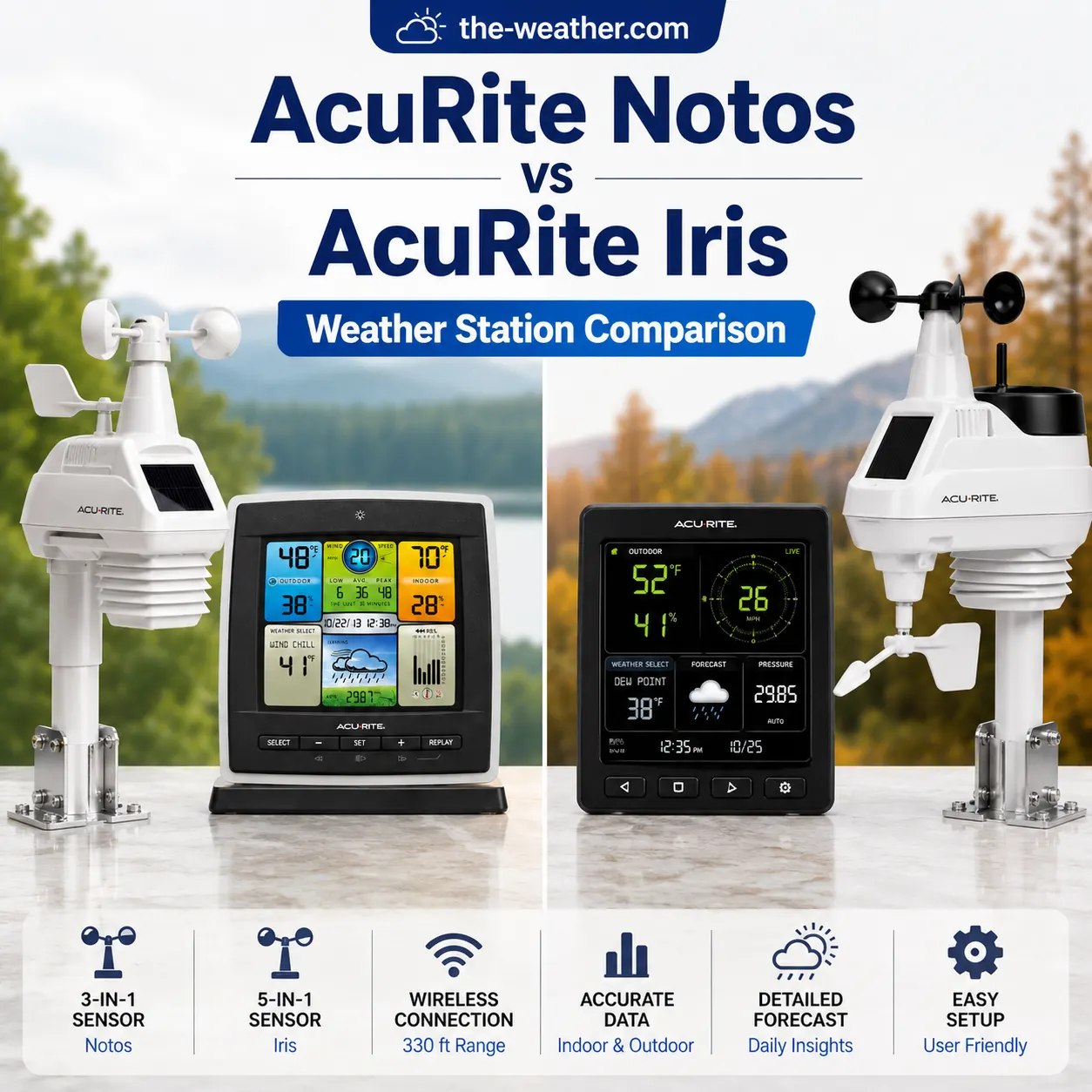
Notos 3-in-1 (left) vs Iris 5-in-1 (right). Both use 433MHz RF, both update wind speed every 18 seconds, both include self-calibrating forecast technology.
The AcuRite Notos and Iris are both personal weather stations from the same brand, using the same wireless protocol, the same update rate, and the same self-calibrating forecast system. The difference is in what they measure.
The Notos 3-in-1 measures wind speed, temperature, and humidity. That is it. No rain, no wind direction, no UV. For buyers who want wind data at a lower cost without committing to a full 5-in-1 setup, that is the right trade-off.
The Iris 5-in-1 adds wind direction and a tipping bucket rain gauge to the same three measurements. It also supports optional Wi-Fi connectivity. If you want the complete outdoor data picture, this is the station.
One thing worth clarifying upfront: neither station measures UV or solar radiation as a data output. The Iris sensor has a solar panel, but it powers an internal aspirating fan for temperature accuracy: it does not output UV index or solar radiation readings. This is a common misconception when buyers compare specifications.
| What you need | Winner | Why |
|---|---|---|
| Lowest cost | Notos | Fewer sensors, lower price |
| Rainfall measurement | Iris | Built-in tipping bucket gauge |
| Wind direction | Iris | Wind vane included, updates every 36 sec |
| Longest battery life | Notos | ~2 years vs ~12–18 months for Iris |
| Weather Underground / CWOP | Iris | Richer data set, better for public networks |
| Temperature accuracy | Iris | ±1°F (improved sensor) vs ±2°F Notos |
| Simplest setup | Notos | Fewer components, no rain gauge to position |
| Most complete data | Iris | 5 measurements vs 3 on Notos |
| First weather station | Notos | Lower cost, simpler to start |
| Gardeners and growers | Iris | Rainfall totals matter for watering decisions |
| Storm tracking | Iris | Wind direction shows storm approach and departure |
| Lowest maintenance | Notos | No rain cup to clean, ~2 yr batteries |
| Most future-proof | Iris | Full data set grows with your interest |
You want wind speed data without paying for a full 5-in-1. You don't need rainfall measurement or wind direction. You want the longest sensor battery life (~2 years). Budget is a consideration.
Check Notos Price Amazon Associate: no extra cost to you.You want the full outdoor data set: wind speed, wind direction, rainfall, temperature, and humidity. You want optional Wi-Fi connectivity. You want to contribute to Weather Underground or CWOP.
Check Iris Price Amazon Associate: no extra cost to you.Side-by-Side Specifications
All specifications sourced from official AcuRite Iris product pages and the AcuRite Notos product page. Updated for the current Iris sensor generation.
Feature Comparison at a Glance

Both stations share the same wireless protocol, update rate, and self-calibrating forecast. The Iris adds wind direction and rain.
The infographic highlights the core differences. Wind speed, self-calibrating forecast, 18-second updates, and sensor range are identical across both stations: these are shared AcuRite platform features, not differentiators.
What actually separates them:
- Wind direction: Notos: no. Iris: yes, every 36 seconds. If you need to know where the wind is coming from, you need the Iris.
- Rain gauge: Notos: no. Iris: yes, tipping bucket with self-emptying cups. The single most common reason buyers step up from the Notos.
- Temperature accuracy: Notos: ±2°F. Iris 2026: ±1°F, improved with the new dual-solar aspirating fan design. A meaningful difference for CWOP and Weather Underground contributors.
- Battery life: Notos: ~2 years. Iris: ~12–18 months. The Iris draws more power because of the rain gauge mechanism and aspirating fan.
- Wi-Fi, Neither has built-in Wi-Fi by default. The Iris supports it via the separate AcuRite Access hub or the Direct-to-Wi-Fi display variant. The Notos supports it via the AcuRite SmartHub. Check the specific model before purchasing.
One important correction to a common misconception: neither station outputs UV index or solar radiation data. The Iris's solar panel powers an internal fan: it is not a UV sensor.
Full Feature Comparison Table
| Feature | Notos 3-in-1 | Iris 5-in-1 |
|---|---|---|
| Wind speed | ✓ | ✓ |
| Wind direction | ✗ | ✓ every 36 sec |
| Rainfall measurement | ✗ | ✓ tipping bucket |
| Temperature accuracy | ±2°F | ±1°F (2026 sensor) |
| UV / solar data output | ✗ | ✗ (solar panel = fan only) |
| Self-calibrating forecast | ✓ patented | ✓ patented |
| Wind speed update rate | 18 seconds | 18 seconds |
| Wireless range | 330 ft · 433 MHz | 330 ft · 433 MHz |
| Wi-Fi built-in | Optional (SmartHub) | Optional (Access / Wi-Fi variant) |
| Weather Underground | With SmartHub add-on | With Access add-on or Wi-Fi variant |
| Sensor battery life | ~2 years | ~12–18 months |
| Sensor batteries | 4 AA alkaline/lithium | 4 AA alkaline/lithium |
| CWOP compatible | With SmartHub | With Access hub |
| Best for | Wind + forecast, lower cost | Full outdoor data set |
Where the Notos Has the Edge
Battery life
The Notos sensor runs for approximately 2 years on 4 AA batteries. The Iris runs for approximately 12–18 months because it powers a rain gauge mechanism, an aspirating fan, and additional sensors. For buyers who want minimal maintenance, the Notos wins clearly on this count.
Price
The Notos costs less than the Iris. If you only need wind speed alongside temperature and humidity, no rain, no direction, you are not paying for sensors you will never use. The Notos is the right tool for that specific need.
Simplicity
Fewer measurements means a less cluttered display. For buyers who find the Iris overwhelming or who just want a clean wind-and-temperature readout, the Notos display is easier to interpret at a glance.
Where the Iris Has the Edge
Temperature accuracy
The current Iris sensor achieves ±1°F temperature accuracy, down from the Notos's ±2°F. AcuRite attributes this to the improved dual-solar aspirating fan design, which draws ambient air across the temperature sensor to reduce radiant heat error. For NOAA CWOP contributors and Weather Underground data sharers, this difference is meaningful.
Wind direction
The Iris includes a wind vane that updates every 36 seconds. Knowing where the wind is coming from, not just how fast, is essential for storm tracking, CWOP contribution, and anyone who wants to understand the weather system behind the numbers. The Notos cannot provide this.
Rainfall
The Iris's tipping bucket rain gauge with self-emptying cups measures cumulative rainfall over the day, week, and month. This is the most common reason buyers step up from the Notos: realising after a few months that they want to know how much it rained last night.
Full ecosystem value
With a Wi-Fi-enabled display or the AcuRite Access hub, the Iris connects to the My AcuRite platform and Weather Underground. The Notos can do the same via the SmartHub, but the Iris's richer data set, including rainfall and wind direction, makes the connected experience more useful.
Upgrading From a Basic Indoor Weather Station?
If you already have an indoor thermometer or a basic indoor/outdoor display and are considering a step up, here is how the Notos and Iris fit into that decision:
- Buy the Notos if you want to add wind speed to your existing indoor readings without committing to a full outdoor station. It is the logical first step up from an indoor-only display.
- Buy the Iris if you want a complete outdoor station: wind, rain, temperature, humidity, and direction all in one sensor. This replaces the need for a basic station entirely rather than supplementing it.
- Skip both if you only want remote monitoring: neither station has built-in Wi-Fi by default. The Ambient WS-2902C is the right station if phone app access is your primary goal.
The honest decision summary
- Buy the Notos if: you want wind speed data at a lower cost, don't need rain or direction, and want the longest battery life between changes
- Buy the Iris if: you want the complete outdoor data set, you plan to contribute to Weather Underground or CWOP, or you want the more accurate 2026 temperature sensor
- Neither if: you want Wi-Fi built-in at no extra cost: both require either an add-on hub or a specific display variant for Wi-Fi. Consider the Ambient WS-2902C for built-in Wi-Fi with a full 5-in-1 sensor suite
- Step up further if: you want built-in Wi-Fi, faster updates, and a larger community: the Ambient WS-2902C or the WS-5000 for cold climates
Limitations to Know: Notos vs Iris
These follow from AcuRite's specifications and the way each sensor is built.
- No rainfall measurement
- No wind direction: speed only, no compass bearing
- No Wi-Fi without buying an additional SmartHub
- Sensor is physically larger and heavier: harder to mount in tight spaces
- Rain gauge cup needs occasional cleaning: debris causes inaccurate readings
- Wi-Fi requires a separate Access hub, not included in the base package
- A wind vane turns slowly in calm air, so direction can lag in light wind
Who Should Avoid Each Station
- You want to know how much rain fell last night
- You want to track storm direction by wind bearing
- You plan to contribute detailed data to Weather Underground or CWOP
- You want app connectivity without buying an extra hub
- You only need temperature, humidity, and wind speed
- You want the lowest cost option in the AcuRite range
- You want infrequent battery changes: the Notos lasts significantly longer
- You want built-in Wi-Fi without any extra hardware: neither station has it by default
Setup and Maintenance Difficulty
| Task | Notos | Iris |
|---|---|---|
| Initial installation | Easy | Moderate |
| Sensor mounting | Simple pole or wall | Pole, open exposure for rain |
| Battery changes | ~Every 2 years | ~Every 12–18 months |
| Ongoing maintenance | Very low | Low, occasional rain cup cleaning |
| Display setup | Under 10 minutes | Under 10 minutes |
Easy-to-Miss Trade-offs Before You Buy
Our analysis of what each choice means in daily use.
- No rainfall data. If you want to know how much rain fell overnight, the Notos cannot tell you.
- Outgrowing the sensor. If weather data hooks you, wind direction and rainfall mean stepping up to the Iris later.
- No wind direction for storm tracking. During a fast-moving storm you see speed but not bearing.
- Paying for features you may rarely check. If you mostly look at wind speed and temperature, the Notos covers that for less.
- More maintenance than expected. The rain gauge cup needs occasional cleaning to prevent debris from causing inaccurate readings: a small but regular job.
- Wi-Fi still requires an extra purchase. Wi-Fi connectivity needs a separate Access hub, which adds to the total cost.
What Each Station Does Well
Our summary from AcuRite's specifications.
Notos strengths
- Wind speed updates every 18 seconds
- Clean, uncluttered display that is easy to read from across a room
Iris strengths
- Rain totals alongside wind and temperature in one place
- Wind direction readings for tracking storm approach and departure
- The ability to connect to Weather Underground and see their data on the public map
Which way to lean
Think about rain first: the Iris measures it, the Notos does not. Wind direction is the second difference. If neither matters to you, the Notos covers the basics for less (our view).
Looking beyond AcuRite? Our guide to the 5 best home weather stations compares stations from Ambient, WeatherFlow and Davis.
Frequently Asked Questions
AcuRite Notos vs Iris: which should I buy?
Buy the Notos if you want wind speed data at a lower cost and don't need rainfall or wind direction. Buy the Iris if you want the complete outdoor data set including rain and direction. Both use the same 18-second wind speed update rate and the same self-calibrating forecast technology.
Does the AcuRite Notos measure rain?
No. The Notos 3-in-1 sensor measures wind speed, outdoor temperature, and outdoor humidity only. For rainfall, the Iris 5-in-1 includes a tipping bucket self-emptying rain gauge.
Does the AcuRite Iris have Wi-Fi?
Not by default on the standard model. The standard Iris uses 433MHz RF between sensor and display. Wi-Fi requires either the Direct-to-Wi-Fi Iris display variant or the separate AcuRite Access hub. The Notos supports Wi-Fi via the AcuRite SmartHub. Check the specific model before purchasing.
How does the wind speed update rate compare?
Both the Notos and Iris update wind speed every 18 seconds: confirmed on AcuRite's official product pages. The Iris additionally measures wind direction, which updates every 36 seconds. The Notos does not measure wind direction.
Does the AcuRite Iris measure UV or solar radiation?
No. The Iris 5-in-1 measures wind speed, wind direction, rainfall, temperature, and humidity: those are the five. The solar panel powers an internal aspirating fan to improve temperature accuracy. It does not output UV index or solar radiation data. Neither does the Notos.
What batteries do the Notos and Iris sensors use?
Both use 4 AA alkaline or lithium batteries. AcuRite recommends lithium below -4°F (-20°C). The Notos lasts approximately 2 years per set. The Iris lasts approximately 12–18 months because the aspirating fan and rain gauge mechanism draw more power.
Our full reviews cover every spec, who each station is not right for, and exactly how they compare against Ambient Weather and La Crosse alternatives.
Sources
All specifications sourced from the official AcuRite Notos product page, the AcuRite Iris product range, and the official 2026 Iris sensor specification page. Wind direction and temperature update rates sourced from official AcuRite product listings. UV/solar clarification sourced from AcuRite's product descriptions. No manufacturer compensation was received.

Lena Thornton
Weather Tech Specialist & CWOP Contributor. Lena has researched and reviewed weather stations from AcuRite, Ambient Weather, La Crosse Technology, Ecowitt, Davis Instruments, and Tempest. She covers sensor technology, accuracy testing, and home weather station comparisons at The-Weather.com. Published June 2026.
Ready to decide?
Find your pick on Amazon
Prices and stock change daily. Check the current price, delivery options and what owners say in their reviews.
Our top picksCompare our picks on AmazonToday's price, delivery & owner reviews on Amazon
Check on Amazon →