

Product covered in this analysis
AcuRite Atlas
See today’s price, delivery options and customer reviews on Amazon.
As an Amazon Associate, I earn from qualifying purchases.In this article 9 sections
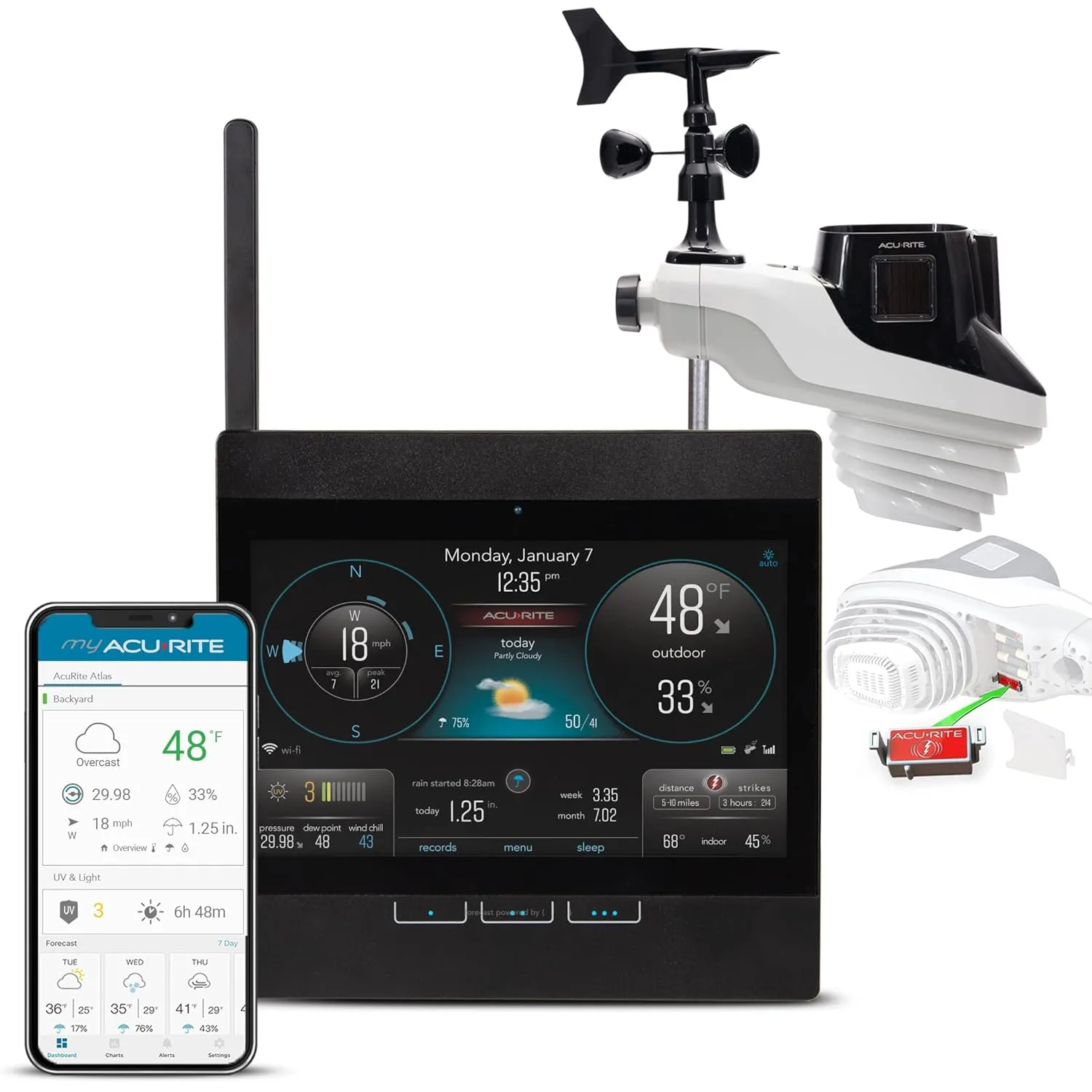
AcuRite Atlas outdoor sensor with three solar panels (for aspirating fan only) and the direct-to-Wi-Fi HD display console.
Lena Thornton here: lead analyst at The-Weather.com. There is a specific category of buyer the AcuRite Atlas is built for: someone who has outgrown a basic 5-in-1 station and wants professional-quality data without the cost and complexity of a Davis or Ecowitt setup. The Atlas earns its place in that gap, but with a few limitations worth knowing before you buy.
This review covers the sensor specs, the direct-to-Wi-Fi display, the lightning detection system, a comparison against the Ambient WS-2902C and Davis Vantage Vue, and who should, and shouldn't, buy this station.
AcuRite Atlas: Verified Specifications
Pros and Cons
- ±1°F temperature accuracy via three-solar-panel aspirating fan: more accurate than passive-shield stations at this price
- 10-second wind updates: captures fast-moving gusts that 16 and 30-second stations miss entirely
- Integrated lightning detection up to 25 miles: cloud-to-ground and in-cloud strikes
- UV index and light intensity measured and reported: rare below $400
- Direct-to-Wi-Fi HD display: no separate hub required on the 01001M model
- Self-emptying rain gauge with 0.01-inch resolution
- My AcuRite platform: remote monitoring, custom alerts, historical charts
- Weather Underground and CWOP data sharing built-in
- Optional Solar Power Pack (06051M) eliminates battery changes
- Battery-only sensor: solar panels run the aspirating fan, not the instruments. Regular AA battery changes required without the optional Solar Power Pack
- 2.4GHz Wi-Fi only: will not connect to 5GHz networks. Can be a problem in modern mesh Wi-Fi setups
- No Alexa or Google Home integration: smart home voice assistants not supported
- Higher price than mid-range 5-in-1 stations like the WS-2902C
- Early production lightning issue: aspirating fan wiring caused false lightning alerts on original units; corrected in a recall. Current units are fine
- No CWOP without Wi-Fi: data sharing requires active Wi-Fi connection
AcuRite Atlas vs the Competition
The Atlas sits between the popular mid-range 5-in-1 stations and the professional Davis Vantage tier. Here is where it wins, where it loses, and who each station is actually for.
| Feature | Ambient WS-2902C | AcuRite Atlas (01001M) | Davis Vantage Vue |
|---|---|---|---|
| Temperature accuracy | ±2°F passive | ±1°F aspirated | ±1°F passive |
| Wind speed updates | 16 seconds | 10 seconds | 2.5 seconds |
| UV index | ✗ | ✓ | ✓ |
| Lightning detection | ✗ | ✓ Up to 25 miles | ✗ Built-in |
| Wi-Fi | ✓ Built-in | ✓ Direct (no hub) | Requires WeatherLink Live |
| Sensor power | Batteries | Batteries (solar = fan only) | Solar + battery backup |
| Alexa / Google Home | ✓ | ✗ | ✗ |
| Weather Underground | ✓ | ✓ | ✓ |
| Best for | Best value overall | Serious data, lightning safety | Maximum reliability |
Inside the Sensor: What Makes the Atlas Different
The aspirating fan and ±1°F accuracy
Most home weather stations use a passive radiation shield: a louvred plastic housing that blocks direct sun from the temperature sensor. The problem is that on calm, sunny days, air stagnates inside the shield and temperature readings drift upward. The Atlas solves this with three solar panels that power a small internal fan, which continuously draws fresh ambient air across the sensor. This is the same principle used in professional-grade equipment and is why the Atlas achieves ±1°F where most passive-shield stations in this price range achieve ±2–3°F.
On calm, sunny afternoons, when passive stations tend to read 2–5°F high, the Atlas's aspirated sensor is at its most valuable. For NOAA CWOP contributors and Weather Underground data sharers, this accuracy difference is meaningful and measurable.
10-second wind updates
The Atlas updates wind speed every 10 seconds: compared to 16 seconds on the Ambient WS-2902C and 18 seconds on AcuRite's own Iris and Notos sensors. This matters during fast-moving convective events where gusts peak and fall within seconds. The Atlas is more likely to capture the true peak gust speed during thunderstorms, frontal passages, and afternoon convective cells than slower-updating stations.
Lightning detection
The Atlas sensor detects the unique electromagnetic pulses produced by both cloud-to-ground and in-cloud lightning strikes, up to 25 miles away. The display shows a running strike count and estimated distance to the nearest activity. Per NOAA's National Severe Storms Laboratory, lightning detection at this range provides sufficient warning time to reach shelter: the critical window for outdoor safety decisions.
One important note: early production Atlas units had a known wiring issue where the aspirating fan's electrical interference triggered false lightning alerts. AcuRite issued a recall and corrected this in a firmware update. Current production units do not have this problem, but if you are buying a used Atlas, verify the firmware version is current.
UV index and light intensity
The Atlas measures UV index from 1–15 and light intensity up to 120,000 lumens, both updated every 30 seconds. These measurements are useful for gardeners tracking sun exposure for plant health, for monitoring UV risk for outdoor activities, and for understanding how solar conditions affect local temperature patterns. Few stations under $400 include UV as a measured output rather than a calculated estimate.
The Direct-to-Wi-Fi HD Display
The most significant operational improvement in the 01001M Atlas configuration is the elimination of the separate AcuRite Access hub. The HD display connects directly to your home's 2.4GHz Wi-Fi network, receives the 433MHz outdoor sensor signal, and sends data to the My AcuRite cloud platform simultaneously.
The display itself is a genuine step up from standard LCD weather station consoles: bright, wide-angle, clearly legible from across a room, and includes a battery backup that preserves settings and historical data during power outages.
Via the My AcuRite platform you can: monitor conditions remotely from any device, set custom push notification alerts for temperature, wind, rain, UV, and lightning, view historical charts and trend data, and share your data to Weather Underground and CWOP automatically. The platform is more capable than the AcuRite Access dashboard it replaced.
AcuRite Atlas in Action
This walkthrough shows the Atlas sensor build quality, the HD display layout, and the Wi-Fi setup process: worth watching before you buy to see the display clarity and the sensor mounting mechanism (single tightening knob, no tools required).
On a 2.4GHz network, setup is straightforward: the integrated sensor suite mounts with one tightening knob, and the Wi-Fi connection typically takes under 5 minutes. The My AcuRite app configuration is straightforward once you have the display connected.
The AcuRite Atlas is not right for you if:
- You want the best value for core weather data: The Ambient WS-2902C gives you wind, rain, temperature, humidity, UV, and solar radiation with built-in Wi-Fi at roughly half the Atlas price. For casual to intermediate weather monitoring, the WS-2902C is the stronger value.
- You have a 5GHz-only Wi-Fi network: The Atlas requires 2.4GHz. Modern mesh systems and some dual-band routers that merge both bands can make this setup difficult. Check your router before ordering.
- You want Alexa or Google Home integration: The Atlas does not support smart home voice assistants. The Ambient WS-2902C integrates with both Alexa and Google Home.
- You want solar-powered sensor instruments: The Atlas solar panels power the aspirating fan only: the instruments run on AA batteries. Without the optional Solar Power Pack (06051M), you will need to change batteries periodically.
- You want professional research-grade reliability: The Davis Vantage Pro2 is the right tool at that level. The Atlas is prosumer-grade: very good for home use and citizen science, but not equivalent to research station equipment.
Who the AcuRite Atlas Actually Suits
- Storm-prone climate owners who want early warning: Lightning detection at 25 miles provides genuine safety value in thunderstorm-prone regions. Combined with 10-second wind updates that capture gust fronts before they arrive, the Atlas is the most storm-aware consumer station in this price range.
- Serious CWOP and Weather Underground contributors: The ±1°F aspirated temperature accuracy and 10-second wind updates make Atlas data more valuable to public weather networks than passive-shield station data. If your goal is contributing quality data to national networks, the Atlas is worth the premium over the WS-2902C.
- Gardeners and growers who need UV data: UV index and light intensity measurements updated every 30 seconds give gardeners actionable data for sun exposure management, UV-sensitive crop protection, and watering decisions aligned with actual solar conditions.
- Buyers who have outgrown a 5-in-1 station: If you already own a WS-2902C or AcuRite Iris and want measurably better temperature accuracy, faster wind updates, and lightning detection without going to Davis Pro2 pricing, the Atlas is the logical step up.
The AcuRite Atlas is available on Amazon: check current stock and pricing.
Check AvailabilityCommon Buyer Regrets: What to Know Before You Order
These are details from AcuRite's documentation that are easy to miss before ordering.
The three solar panels on the Atlas sensor are dedicated entirely to the aspirating fan: they do not power the weather instruments. The station runs on 4 AA batteries. Without the optional Solar Power Pack (model 06051M, sold separately), you will need to change batteries periodically. The solar panels can suggest otherwise, but the sensor itself is not solar-powered.
The Atlas requires a 2.4GHz Wi-Fi network. Many modern mesh systems and dual-band routers broadcast both bands under a single network name: your phone connects to 5GHz automatically while the Atlas tries to join 2.4GHz, causing setup to fail with no clear error message. Before ordering, check your router settings and confirm you can isolate the 2.4GHz band during initial setup. This is the most common cause of Wi-Fi connection failure on first setup.
Lightning detection is built into the outdoor sensor array on the 01001M and 01007M configurations. Some Atlas display units and older configurations are sold without the lightning-capable sensor: buyers occasionally order the display-only replacement unit assuming lightning comes with it. Always check that the listing includes the full outdoor sensor suite, not a display-only replacement unit.
The Atlas connects to My AcuRite and Weather Underground but does not integrate with Amazon Alexa or Google Home. If asking your smart speaker for the current outdoor temperature is important to you, the Ambient WS-2902C supports both. This is a real gap for smart home users and one worth knowing before committing to the Atlas.
Frequently Asked Questions
Does the AcuRite Atlas require a separate hub to connect to Wi-Fi?
Not on the 01001M configuration. The HD display connects directly to your home's 2.4GHz Wi-Fi network without any additional hardware. Older Atlas configurations using the AcuRite Access module do require a hub. Always check the model number: 01001M means direct-to-Wi-Fi display included.
How is the AcuRite Atlas outdoor sensor powered?
The outdoor sensor runs on 4 AA batteries. The three solar panels on the sensor power the internal aspirating fan: they do not power the weather instruments themselves. AcuRite recommends lithium batteries for temperatures below -4°F (-20°C). An optional Solar Power Pack (model 06051M, sold separately) is available to eliminate battery changes entirely.
Does the AcuRite Atlas work with Alexa or Google Home?
No. The Atlas connects to the My AcuRite platform and supports Weather Underground and CWOP data sharing, but does not integrate with Amazon Alexa or Google Home. If smart home voice assistant integration is important to you, the Ambient WS-2902C supports both.
How accurate is the AcuRite Atlas temperature sensor?
±1°F (0.56°C) temperature accuracy and ±2% RH humidity accuracy, per AcuRite's official specifications. This is achieved through three solar panels that continuously power an internal aspirating fan, drawing fresh ambient air across the sensor to eliminate radiant heat error: the primary cause of inflated temperature readings on passive-shield sensors on calm, sunny days.
How far can the AcuRite Atlas detect lightning?
Up to 25 miles for both cloud-to-ground and in-cloud strikes. The display shows a running count and estimated distance. Note: early production units had a known false-lightning issue caused by aspirating fan wiring interference: AcuRite issued a recall and corrected this. Current production units and units with updated firmware do not have this problem.
AcuRite Atlas vs Ambient Weather WS-2902C: which should I buy?
The WS-2902C is the better value for most buyers: full 5-in-1 sensor suite, built-in Wi-Fi, Alexa and Google Home support, large owner community, at roughly half the Atlas price. Choose the Atlas if you specifically need lightning detection, UV index measurement, 10-second wind updates, or the ±1°F aspirated temperature accuracy. See our best home weather stations comparison for the full breakdown.
Verdict
The AcuRite Atlas delivers on its prosumer positioning. The aspirating fan temperature accuracy, 10-second wind updates, UV measurement, and lightning detection are all genuine differentiators from standard 5-in-1 stations. The battery-only sensor power and 2.4GHz-only Wi-Fi are real limitations, but neither is a dealbreaker for the buyer this station is designed for. If you are ready to step up from a basic 5-in-1 and want measurably better data without Davis Pro2 pricing, the Atlas is one of the strongest options in this tier.
Get the AcuRite Atlas on Amazon As an Amazon Associate, we earn from qualifying purchases at no extra cost to you.We compared five home weather stations on accuracy, sensor quality, Wi-Fi reliability, and long-term value, from budget 5-in-1 models to full prosumer stations. Ambient WS-2902C, WS-5000, Davis Vantage Vue, Tempest, and AcuRite Iris all included.
Review Methodology
All specifications sourced from the official AcuRite Atlas product range and AcuRite Atlas support documentation. Lightning detection specifications from AcuRite's official product pages. Early production lightning wiring issue sourced from Weather Station Depot's Atlas review and Weather Station Advisor. Comparison data from manufacturer spec sheets. No manufacturer compensation was received.

Lena Thornton
Weather Station Analyst and Lead Reviewer at The-Weather.com. Lena has researched, reviewed and analysed weather stations from AcuRite, Ambient Weather, Davis Instruments, Ecowitt, La Crosse Technology, and Tempest. She covers sensor technology, accuracy testing, and home weather station comparisons. Updated June 2026.
Ready to decide?
Get the AcuRite Atlas
Prices and stock change daily. Check the current price, delivery options and what owners say in their reviews.