As an Amazon Associate, I earn from qualifying purchases.
In this article 11 sections
- What Is a Wind Vane?
- How Does a Wind Vane Work?
- Wind Vane vs Weather Vane: What Is the Difference?
- What Does a Wind Vane Measure?
- Reading Wind Direction: What Each Compass Point Means
- Types of Wind Vanes
- Placement and Accuracy
- Common Wind Vane Problems and Fixes
- Wind Vanes in Home Weather Stations
- History of the Weather Vane
- Frequently Asked Questions

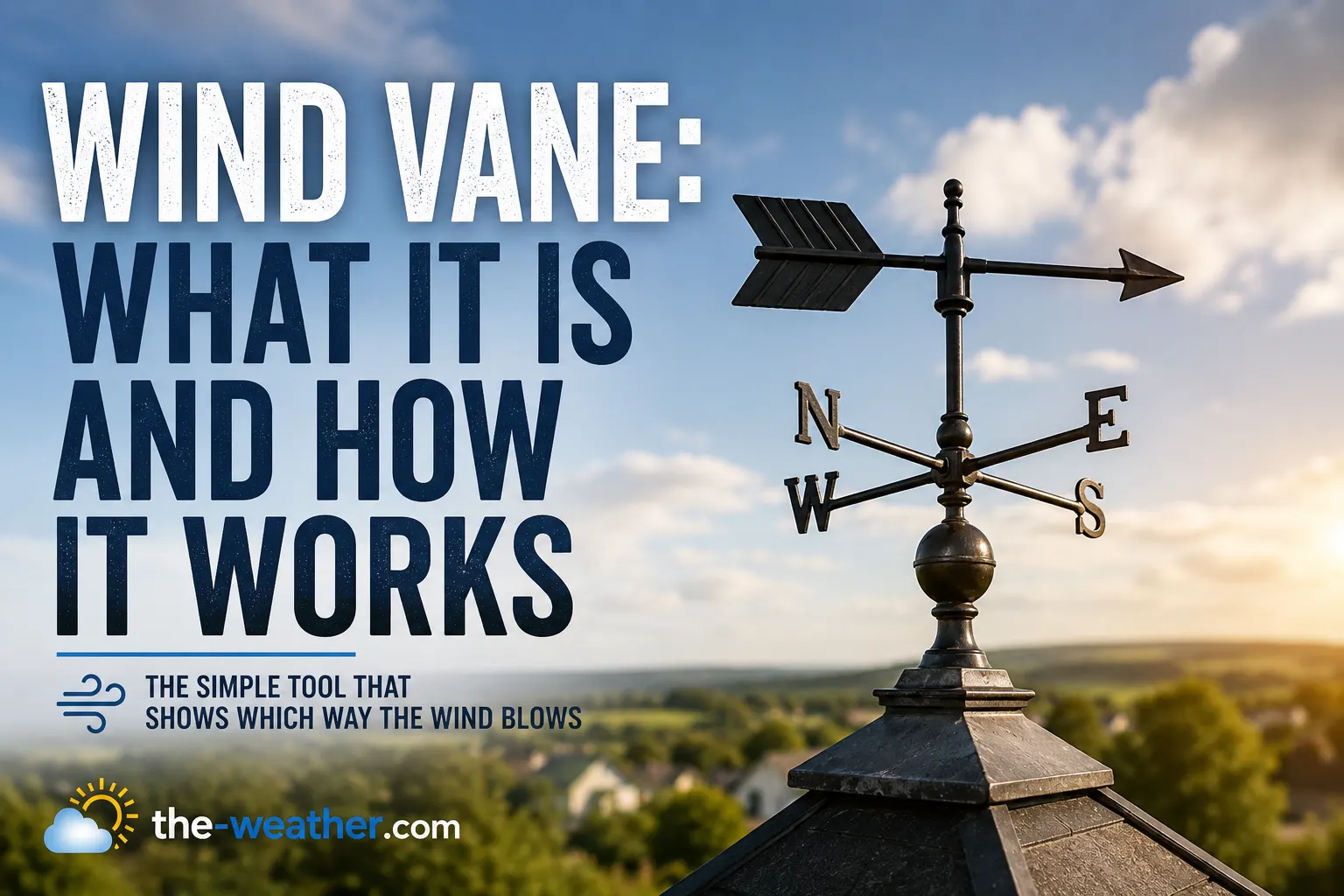
A wind vane is one of the oldest weather instruments in existence, and still one of the most useful. It tells you the single piece of information that most weather apps do not: which direction the wind at your exact location is blowing from right now.
Wind direction is one of the most reliable indicators of incoming weather. In the northern hemisphere, a southwest wind often signals a warm front approaching. A sharp shift to the northwest usually means a cold front has just passed and clearing conditions are on the way. No forecast app captures that shift at your property the way a properly mounted wind vane does.
A wind vane measures wind direction: the compass bearing the wind is blowing from. It points into the wind, so when the arrow points north, a north wind is blowing from the north toward the south. Wind vane and weather vane are the same instrument, the technical and common names for the same device. Most home weather stations include a digital wind vane combined with the anemometer in a single sensor unit.
What Is a Wind Vane?
A wind vane, also called a weather vane or weathercock, is a meteorological instrument that rotates freely on a vertical axis to indicate the direction from which the wind is blowing. It is classified as an anemoscope: an instrument that shows wind direction without measuring wind speed.
Wind vanes have been used for weather observation for over 2,000 years. The ancient Greek Tower of the Winds in Athens, built around 50 BC, featured one of the earliest known wind vanes as part of its meteorological design. Today, digital wind vane sensors built into home weather stations perform the same function electronically, reporting direction in compass degrees to a display console or phone app.
Wind direction is reported as the direction the wind is coming from, not the direction it is blowing toward. A north wind blows from the north toward the south. This convention is consistent across all meteorological instruments, weather apps, and forecasts.
Did you know: The NOAA standard for wind direction measurement requires a wind vane mounted at 33 feet (10 metres) above open, flat terrain with no obstructions. Most home installations fall short of this, which is why home wind readings often differ from official station data.
How Does a Wind Vane Work?
A wind vane works through a simple principle of aerodynamic imbalance. The design is intentionally asymmetric: one end (the tail) presents a large surface area to the wind, and the other end (the pointer) is narrow and pointed. Wind exerts more force on the larger tail surface, pushing it downwind until the pointer faces directly into the oncoming wind.
The large tail surface catches the wind. Because the tail has more surface area than the pointer, the wind exerts a stronger force on it.
The tail is pushed downwind, causing the entire vane to rotate on its vertical shaft until the force on both sides is balanced.
When balanced, the pointed end faces directly into the wind. The direction the pointer faces is the direction the wind is coming from.
In analog vanes, compass points (N, S, E, W) around the base show the reading visually. In digital weather station sensors, a potentiometer or Hall-effect magnetic sensor converts shaft rotation to a compass degree reading transmitted wirelessly to the console.
Wind Vane vs Weather Vane: What Is the Difference?
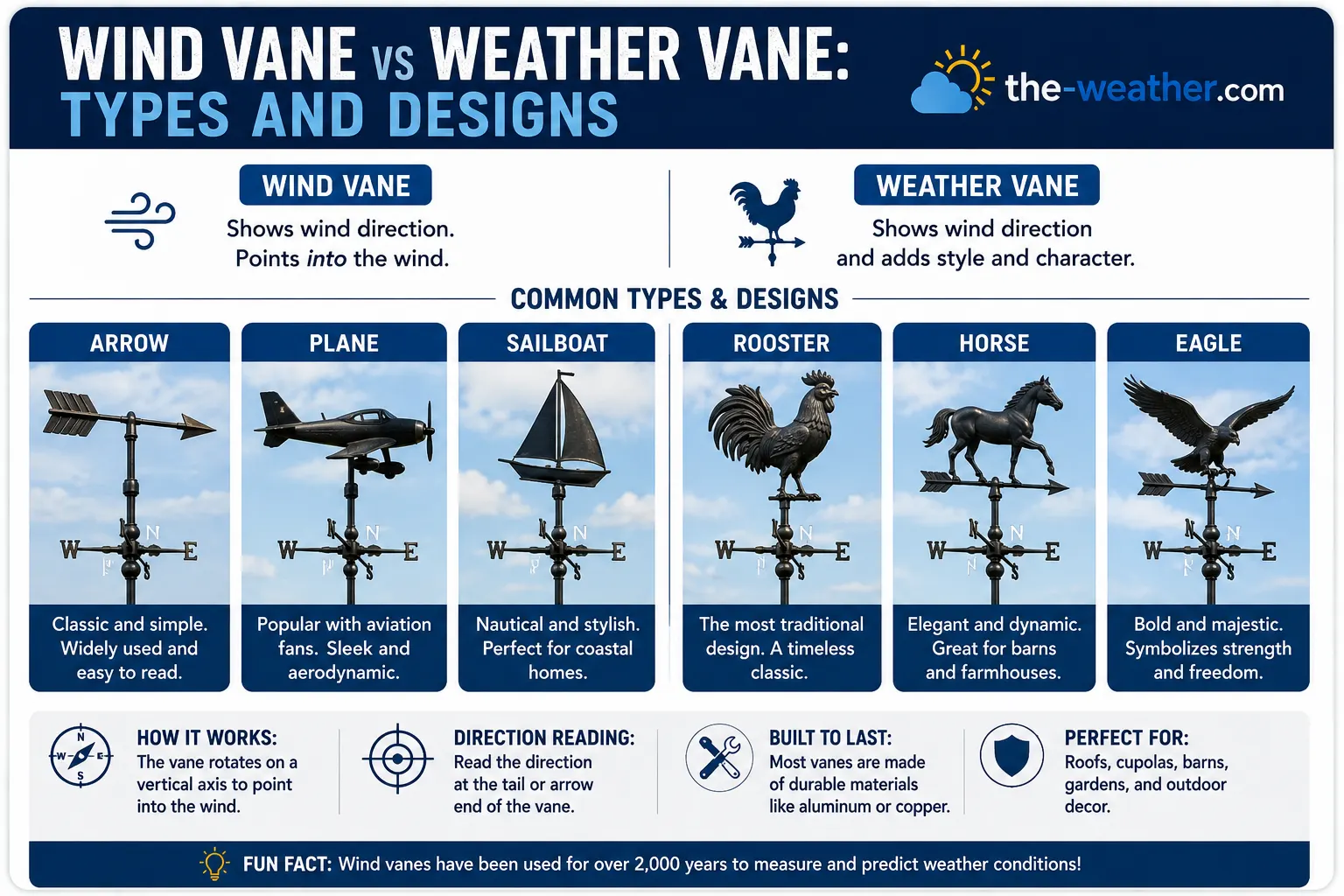
There is no functional difference between a wind vane and a weather vane. They are the same instrument referred to by two different names depending on context:
| Term | Context | Typical Form |
|---|---|---|
| Wind vane | Meteorological, scientific, weather station documentation | Digital sensor, simple arrow on post |
| Weather vane | Common use, architecture, decoration | Rooster, horse, ship, arrow on rooftop |
| Weathercock | Historical, European term, specifically rooster shape | Rooster silhouette on church steeples |
Both rotate freely on a vertical shaft to point into the wind. The only difference is whether the instrument is primarily decorative or functional, and whether it is read visually or electronically. A rooster weathervane on a barn and a digital wind vane sensor on a home weather station mast perform identical functions.
What Does a Wind Vane Measure?
A wind vane measures wind direction only. It does not measure wind speed. The two are separate measurements requiring separate instruments: a wind vane for direction, an anemometer for speed. In most home weather stations, both instruments are combined in a single outdoor sensor unit, but they measure different things using different mechanisms.
| What it measures | What it does NOT measure |
|---|---|
| Wind direction (compass degrees or cardinal) | Wind speed |
| Direction the wind is coming from | Wind gusts |
| Reported as 0 to 360° or N/NE/E/SE/S/SW/W/NW | Temperature, humidity, pressure, rainfall |
Reading Wind Direction: What Each Compass Point Means
Wind direction carries practical weather forecasting information, particularly for recognising approaching fronts. In the northern hemisphere, wind direction is one of the most reliable short-range forecasting tools available at home.
Watch for wind shifts rather than just the current direction. A rapid shift from south to northwest in a few hours is the classic cold front signature: expect temperature drops of 10°F to 20°F (6°C to 11°C) and improving skies within hours. A barometric pressure drop combined with a southerly wind shift is one of the most reliable storm warnings available from home instruments.
Types of Wind Vanes
The simplest and most common functional design. A pointed arrow counterbalanced by a flat tail. Used in most home weather station sensor units and basic meteorological installations.
The most iconic decorative design, dominant in Europe since the 9th century. The rooster's body acts as the tail surface. Functional as a wind direction indicator while serving as an architectural ornament.
Popular for marine and coastal applications. The hull silhouette points into the wind. Used decoratively on coastal properties and functionally on sailing vessels as a masthead indicator.
A material category rather than a shape. Copper weathers to a verdigris patina over time. Preferred for high-end decorative installations on historic homes and barns. More durable than aluminum in coastal salt-air environments.
The functional type used in home weather stations. Uses a Hall-effect magnetic sensor or potentiometer to convert shaft position to a digital compass reading. No visible arrow or ornamentation. Transmits wirelessly to a console or app.
Measures both wind speed and direction with no moving parts. Used in the WeatherFlow Tempest and Ecowitt Wittboy Pro. Determines wind direction by comparing ultrasonic pulse timing across multiple transducer pairs. More accurate in light wind and freezing conditions.
Wind Vane vs Ultrasonic Wind Sensor: Which Is More Accurate?
Both mechanical wind vanes and ultrasonic wind sensors measure wind direction, but they do so differently and each has distinct strengths and limitations.
| Feature | Mechanical Wind Vane | Ultrasonic Wind Sensor |
|---|---|---|
| Moving parts | Yes (rotating shaft) | No |
| Direction accuracy | ±3 to ±10 degrees | ±3 degrees |
| Light wind performance | Stalls below 2 to 3 mph | Reads accurately to 0 mph |
| Freezing conditions | Bearing can freeze and jam | Unaffected |
| Maintenance | Bearing lubrication, debris clearing | None required |
| Cost | Included in most stations ($150+) | Stations from $329 (Tempest) |
| Examples | Davis Vantage Pro2, Ambient WS-2902C | WeatherFlow Tempest, Ecowitt Wittboy Pro |
For most home users in temperate climates, a well-placed mechanical wind vane sensor is entirely adequate. The ultrasonic advantage matters most in cold climates where bearing freeze is a real risk, and for those who need accurate light-wind direction readings.
Placement and Accuracy
Wind vane placement has more impact on reading accuracy than the quality of the sensor itself. A premium digital vane in a sheltered location will produce worse data than a basic sensor mounted in an open, elevated position.
- Mount as high as practical above surrounding obstacles. The NWS standard is 33 feet (10 metres) above open terrain. For home use, rooftop mounting or a tall mast in an open yard is the best achievable approximation.
- Ensure free rotation in all directions. The vane must be able to spin a full 360 degrees without obstruction from mounting hardware, cables, or nearby structures.
- Align compass points carefully. For decorative weathervanes, ensure the N/S/E/W directional arms are oriented to true north using a compass. Magnetic declination varies by location and can offset readings by several degrees.
- Avoid mounting near buildings or trees. Structures create wind turbulence and shadow zones that cause the vane to oscillate or point in the wrong direction even when wind is steady at open sites nearby.
- Do not mount on a fence or low post. Ground-level wind is significantly different from the wind at standard measurement height. Fences and low structures also create local turbulence that distorts direction readings.
Common Wind Vane Problems and Fixes
Most wind vane issues fall into a small number of categories. Here are the most common problems and what to do about each one.
| Problem | Cause | Fix |
|---|---|---|
| Vane stuck in one direction | Frozen bearing, corrosion, or debris jamming the shaft | Inspect and clean the bearing. Apply a dry PTFE lubricant rated for outdoor use. Never use WD-40: it attracts dirt and worsens the problem over time. |
| Direction reading 90 or 180 degrees off | Incorrect north alignment during installation | Re-align the compass arms using a magnetic compass corrected for local magnetic declination. Most digital station software also allows a manual offset correction in degrees. |
| Vane spins freely but reports wrong direction | Magnetic sensor misalignment or loose potentiometer connection | Check all sensor connections and cable seating. Run the station's calibration or sensor test mode. Some stations allow a north offset adjustment in the console settings. |
| Erratic or jumping readings | Turbulence from nearby obstacles, or worn bearing with excessive play | Relocate the sensor away from structures. If the bearing has play, the vane unit will need replacement: most home station sensor heads are replaceable as a unit. |
| Vane reads correctly but stalls in light wind | Normal mechanical vane behavior below 2 to 3 mph threshold | This is not a fault. It is a characteristic of all mechanical vanes. If light wind direction is important, consider an ultrasonic wind sensor upgrade. |
| Bird damage or impact | Birds perching on or striking the vane | Add bird deterrent spikes to the mounting pole below the sensor head. Most sensor heads for home stations are available as replacement parts from the manufacturer. |
| Spider webs blocking rotation | Spiders nesting in the sensor housing or around the shaft | Clean with a soft brush and compressed air. Inspect monthly during warm months. A light application of petroleum jelly around the base of the shaft discourages web building. |
Wind Vanes in Home Weather Stations
In modern home weather stations, the wind vane and anemometer are almost always integrated into a single outdoor sensor unit. The combination sensor sits on a mounting pole or rooftop mast and transmits wind speed and direction wirelessly to an indoor console or connects via Wi-Fi to a phone app.
| Station | Wind vane type | Direction accuracy | Separate mount? |
|---|---|---|---|
| Ambient WS-2902C | Mechanical vane sensor | ±10 degrees | No |
| WeatherFlow Tempest | Ultrasonic (no moving parts) | ±3 degrees | No |
| Davis Vantage Pro2 (specs) | Mechanical vane sensor | ±3 degrees | Yes, up to 40ft cable |
| Ecowitt Wittboy Pro | Ultrasonic (no moving parts) | ±3 degrees | No |
The Davis Vantage Pro2 is the only consumer station that allows the wind sensor (vane and anemometer combined) to be mounted separately from the main sensor suite using a cable up to 40 feet long. This matters for wind accuracy: you can mount the wind sensor at the most exposed point on your property while the temperature and rain sensors stay in a more accessible location. See our full home weather stations guide for a complete comparison.
History of the Weather Vane
The weather vane is one of the oldest meteorological instruments in continuous use. The earliest known example is the bronze Triton figure atop the Tower of the Winds in Athens, built around 50 BC by the astronomer Andronikos of Kyrrhestos. The tower, still standing today, used the wind vane alongside sundials and a water clock to track time and weather simultaneously.
In medieval Europe, a 9th-century papal decree required churches to display a rooster on their steeples as a symbol of Christian vigilance, referencing the biblical account of the rooster crowing at Peter's denial. Because steeples were the tallest structures in any settlement and ideal vane mounts, the rooster became the dominant weathervane design across Europe for centuries. The English term "weathercock" directly references this history.
In colonial America, weather vanes became prominent on public buildings and farms. George Washington commissioned a dove of peace weathervane for his Mount Vernon estate in 1787. Paul Revere's grasshopper weathervane, mounted on Faneuil Hall in Boston in 1742, remains one of the most famous American weather vanes still in its original location.
Digital wind vane sensors first appeared in consumer home weather stations in the 1990s with the Davis Instruments Vantage series. Ultrasonic wind sensors with no moving parts entered the consumer market with the WeatherFlow Tempest in 2020.
Frequently Asked Questions
What is a wind vane used for?
A wind vane measures and displays the direction the wind is blowing from. It is used in home weather stations, sailing, aviation, agriculture, and rooftop decoration. Wind direction is one of the most reliable indicators of incoming weather in the northern hemisphere: south and southwest winds often precede warm fronts, while northwest winds typically follow cold fronts bringing clearing conditions.
What is the difference between a wind vane and a weather vane?
A wind vane and a weather vane are the same instrument. Wind vane is the technical meteorological term used in weather station documentation and scientific contexts. Weather vane is the common term used for decorative rooftop versions shaped like roosters, arrows, horses, or ships. Both rotate to point into the wind and indicate the direction the wind is coming from.
What does a wind vane measure?
A wind vane measures wind direction: the compass bearing from which the wind is blowing. It reports direction in degrees (0 to 360) or cardinal points (N, NE, E, SE, S, SW, W, NW). Wind direction is always the direction the wind comes from, not toward. A north wind blows from the north toward the south.
How does a wind vane work?
A wind vane works through aerodynamic imbalance. The large tail surface catches more wind force than the pointed front end, causing the vane to rotate until the pointer faces directly into the oncoming wind. In digital weather station sensors, a magnetic sensor converts shaft rotation to a compass degree reading transmitted wirelessly to the console.
What direction does a wind vane point?
A wind vane points into the wind, toward the direction the wind is coming from. If the arrow points north, the wind is blowing from the north (a north wind). This matches the meteorological convention of naming winds by their origin: a southwest wind blows from the southwest toward the northeast.
Why is a rooster on a weathervane?
The rooster became the dominant weathervane design due to a 9th-century papal decree requiring churches to display a rooster on their steeple as a symbol of Christian vigilance. Because steeples were the tallest structures and ideal wind vane mounts, the rooster shape became synonymous with weather vanes across Europe and later America. The English term "weathercock" comes directly from this tradition.
Are wind vanes expensive?
Wind vanes range widely in price. Decorative weathervanes cost $30 to $300 depending on material and design. Digital wind vane sensors for home weather stations are included in station packages ranging from $150 to $600. Professional-grade wind vanes cost $200 to $2,000 or more.
What is the best location for a wind vane?
The best location is in an open area with no obstructions within a 45-degree angle in any direction. The NWS standard is 33 feet (10 metres) above open, flat terrain. For home use, rooftop mounting or a tall pole in an open yard is ideal. Avoid mounting near buildings, trees, or fences that create turbulence.
What does the arrow pointing north mean on a wind vane?
When the arrow points north, a north wind is blowing from the north toward the south. In meteorology, winds are always named for the direction they originate from. A north wind typically brings cooler, drier air in the northern hemisphere and often follows the passage of a cold front.
Do weathervanes get struck by lightning?
Yes, metal weathervanes mounted at the highest point of a structure can attract lightning. Benjamin Franklin's lightning rod design incorporated a weathervane on top for this reason. Modern rooftop weathervanes should be bonded to a proper lightning protection system. Home weather station wind sensors on poles should use a grounding rod.
Does a wind vane work without wind?
No. A mechanical wind vane requires airflow to rotate and indicate direction. In calm conditions, it rests in its last position and reports that direction until wind resumes. Most digital weather stations display the last recorded wind direction when wind speed drops to zero. Ultrasonic sensors also need some airflow to determine direction between their transducers.
How accurate are wind vanes?
Consumer mechanical wind vanes are typically accurate to within ±3 to ±10 degrees depending on build quality and placement. The Davis Vantage Pro2 is rated ±3 degrees. Budget station vanes are typically rated ±10 degrees. Ultrasonic sensors like the WeatherFlow Tempest achieve ±3 degrees with no moving parts. Placement matters more than sensor quality: a basic sensor in an open, elevated location will outperform a premium sensor mounted near a building.
Sources
Wind measurement standards from the World Meteorological Organisation (WMO) Guide to Meteorological Instruments and Methods of Observation. NWS wind sensor siting guidelines from weather.gov. Manufacturer wind vane specifications from Davis Instruments, WeatherFlow, Ecowitt, and Ambient Weather official documentation. Historical weathervane information from Smithsonian archives. No manufacturer compensation was received.
Lena Thornton
Weather Station Analyst & CWOP Contributor. Lena has researched, reviewed and analysed weather stations and instruments for over a decade. She contributes observation data to the Citizen Weather Observer Program (CWOP) and writes exclusively for the-weather.com.