
Models compared on this page
Our shortlist, side by side
Check the current price, delivery options and full specs on Amazon.
As an Amazon Associate, I earn from qualifying purchases.In this article 13 sections
- Tempest vs AcuRite Iris at a Glance
- Rain: Counting Drops vs Catching Water
- Wind: Cups vs Sound
- A Screen on the Counter, or Everything in an App
- Power: Solar Battery vs AA Batteries
- Lightning
- What You Would Need to Add to Match the Other
- Known Problems Owners Run Into
- Which Weather Station Should You Buy?
- When Neither Is the Right Station
- Tempest vs AcuRite Iris FAQ
- Update Log
- Sources
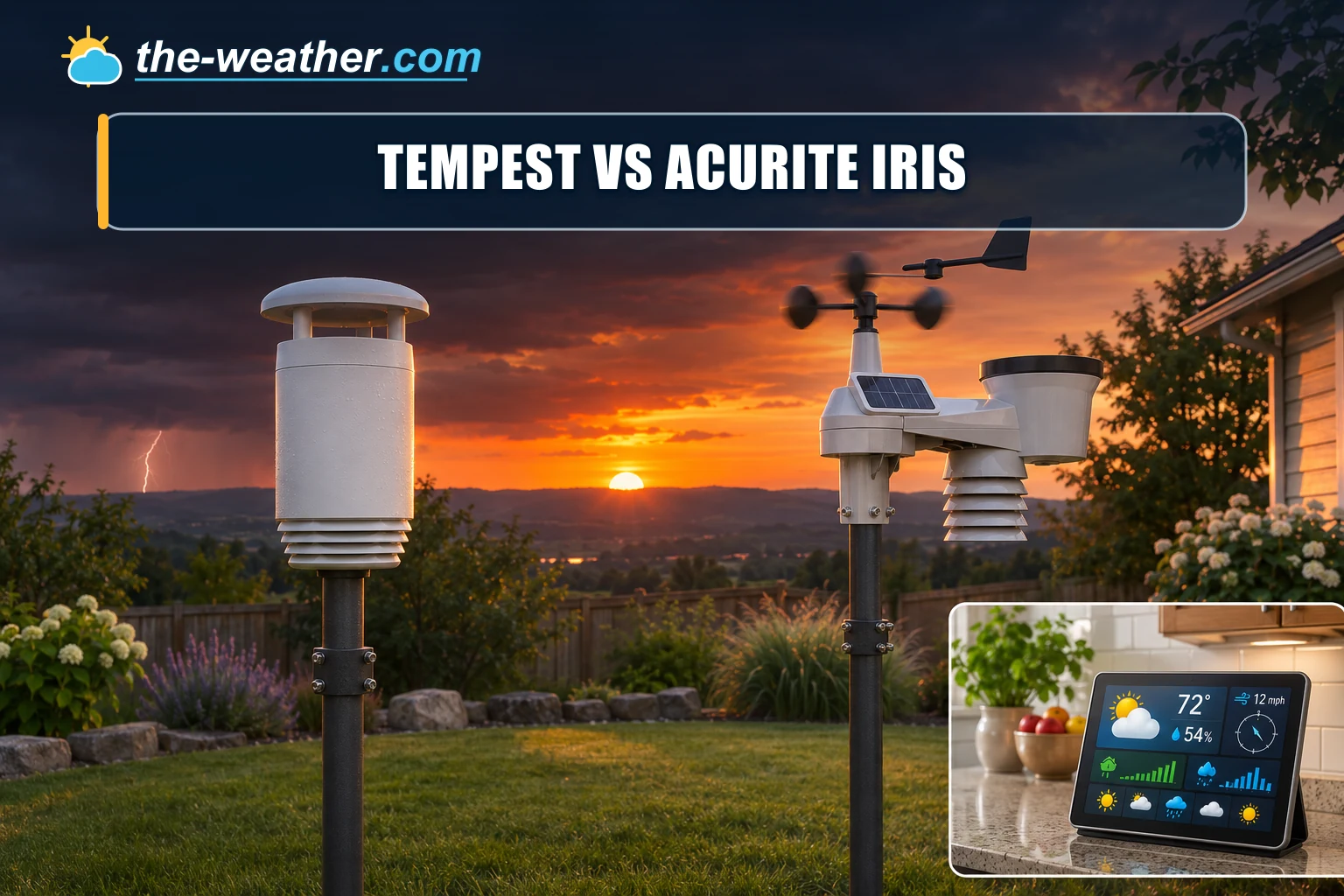
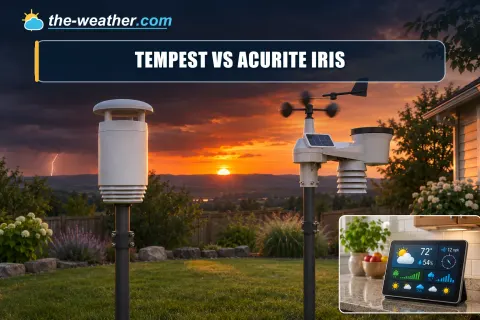
On paper they both "measure the weather in your backyard". In real life they are built on two different ideas. The Tempest is one sealed cylinder with no moving parts and no screen: everything happens in an app. The AcuRite Iris is a classic 5-in-1 sensor with spinning cups, a wind vane and a tipping bucket, sending its readings to a display on your kitchen counter. Which idea suits you says more about your habits than about the hardware.
Short answer: choose the Tempest if you want built-in lightning detection, no moving parts, a station that charges itself by solar, and you are happy reading everything on your phone. Choose the AcuRite Iris if you want a display in the house, a traditional tipping-bucket rain gauge, and readings that keep showing without internet, and you are fine with changing AA batteries and cleaning the rain funnel now and then. Rain is the big trade-off: the Tempest counts drops by vibration and can blend in radar data (NC Rain), the Iris catches the water. Lightning on the Iris needs a separate sensor and a compatible display.
Editorial Research & Review
- Written by
- Lena Thornton, Weather Station Analyst & CWOP Contributor
- Review basis
- WeatherFlow's Tempest FAQ, mounting tips and Tempest '26 announcement; AcuRite's instruction manual for the Iris (5-in-1) sensor, model 06014, and AcuRite's Iris product range. Every number on this page says which document it comes from.
- Hands-on testing
- Not performed by The-Weather.com for the stations on this page
- Research last verified
- November 25, 2026
Tempest vs AcuRite Iris at a Glance
One thing to know first: "AcuRite Iris" is a family. AcuRite sells the same Iris (5-in-1) outdoor sensor with many different indoor displays, from a basic color screen to Wi-Fi models. The sensor numbers below are the same for all of them; what you see indoors depends on the display.
Three examples from AcuRite's own Iris range, to show how much the display decides:
| Iris set (AcuRite's name) | Screen | Wi-Fi | Lightning |
|---|---|---|---|
| Iris (5-in-1) with Color Display and Weather Ticker (01512M) | Color | Not in the name | Not in the name |
| Iris (5-in-1) with Direct-to-Wi-Fi Display (01544M) | Wi-Fi display | Yes | Not in the name |
| Iris (5-in-1) with Color Display with Lightning Detection (01022M) | Color | Not in the name | Yes |
Product names from AcuRite's Iris range, checked November 25, 2026. Where the name does not say it, we do not assume it. Our Amazon button goes to the AcuRite Iris (5-in-1) with color display, model 01512MCB.
What is in the box? For the Iris sensor, AcuRite's manual lists the sensor, mounting hardware, a mounting bracket and the manual; the pole is not included. For the Tempest, WeatherFlow's FAQ lists a flat base and a pole mount among the parts; plan for a pole or post as well.
| Station | Strong fit for | How it measures rain | Display | Shop |
|---|---|---|---|---|
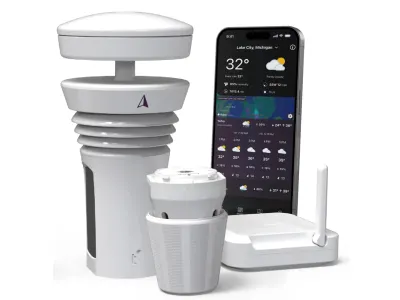 WeatherFlow Tempest Read our Tempest review | Smart home, lightning alerts, low maintenance | Haptic sensor (counts drops by vibration) | None: app and web | Check on Amazon |
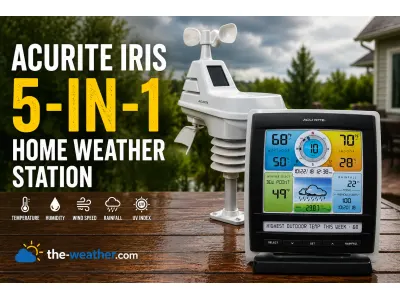 AcuRite Iris (5-in-1) Read our Iris review | A screen in the house, classic rain gauge | Tipping bucket, 0.01 inch steps | Indoor display (model-dependent) | Check on AmazonCheck the display model on the listing |
| Feature | WeatherFlow Tempest | AcuRite Iris (5-in-1) |
|---|---|---|
| Measures | Wind, rain, temperature, humidity, pressure, light and UV, lightning | Temperature, humidity, wind speed, wind direction, rain (pressure and more depend on the display) |
| Wind sensor | Ultrasonic, no moving parts | Spinning cups and a vane |
| Wind speed limit | Upper detection limit 100 mph (FAQ) | 0 to 99 mph (manual) |
| Rain sensor | Haptic; does not measure snow | Tipping bucket, 0.01 inch (0.25 mm) and up |
| Lightning | Built in, up to about 25 miles (40 km) | Not in the sensor; needs AcuRite's separate lightning sensor and a compatible display |
| Data updates | Wind in 3-second samples, full observation every minute (API documentation) | Wind speed every 18 s, direction every 30 s, temperature and humidity every 36 s (manual) |
| Outdoor range | -35°F to 140°F operating range | -40°F to 158°F temperature range |
| Wireless range | Up to 1,000 ft line of sight; at least 300 ft in a typical home | 330 ft (100 m), depending on home construction |
| Power | Solar with internal battery (removable on the Tempest '26) | 4 AA batteries; the solar panel runs a small fan, not the sensor |
| Indoors | Hub (no screen); app and web | Display; Wi-Fi only on Wi-Fi display models |
| Smart home and sharing | Alexa, Rachio, IFTTT, Weather Underground, open API; official Home Assistant integrations | Wi-Fi models: AcuRite app and Weather Underground |
| Without internet | Needs Wi-Fi for full use; during an outage the app can show the latest readings over Bluetooth near the hub | The display shows the sensor's readings without internet |
| Snow | Not measured (FAQ) | Not covered in the sensor manual |
| Forecast | Nearcast forecast; best accuracy after about 60 days, 8-month Better Forecast Guarantee (FAQ) | Depends on the display |
| Warranty | 2 years, 60-day returns (FAQ) | 1 year (manual) |
Tempest: Tempest FAQ, API documentation, Tempest '26 announcement, Tempest product page, Home Assistant. Iris: AcuRite Iris (5-in-1) sensor manual, model 06014 and AcuRite's Iris range.
Rain: Counting Drops vs Catching Water
This is the biggest real-world difference.
The Iris catches rain in a funnel that fills a small tipping bucket. Each tip adds about 0.01 inch. AcuRite's manual even describes a test: drip water in, and there should be roughly 25 drops between tips. Simple, physical, easy to check. The downside: funnels collect leaves and bugs, so you clean it now and then, and the sensor has to be level (it has a bubble level for that).
The Tempest has no funnel at all. Its haptic sensor counts raindrops by the vibration each one makes on top of the unit. Nothing clogs, but a mount that shakes or a bird that lands can look like rain, and snow is too light to register. The app also shows NC Rain by default, a neighborhood estimate that blends your Tempest with radar and nearby gauges. Our Tempest rain accuracy page explains when that helps and when it confuses.
Who wins? If an exact yard total matters to you, the tipping bucket is the more traditional choice and easier to verify. If you mainly want rain alerts and no cleaning, the Tempest is the calmer ride.
Wind: Cups vs Sound
The Iris uses spinning cups and a vane: proven and easy to understand, with wind speed updated every 18 seconds and direction every 30 seconds according to the manual. Moving parts wear over time; AcuRite sells replacement parts for its sensors.
The Tempest measures wind with sound pulses (ultrasonic), with nothing to spin. WeatherFlow's data uses 3-second wind samples, so gusts show up quickly. Its FAQ gives an upper detection limit of 100 mph; the Iris manual lists 0 to 99 mph. For a backyard, both cover what you will normally see.
Height matters more than the sensor type for both. AcuRite says to mount the Iris at least 5 ft high, and WeatherFlow recommends 6 to 8 ft for the Tempest. See installing a Tempest.
A Screen on the Counter, or Everything in an App
The Iris comes with an indoor display. Depending on the model you get a color screen, a high-definition screen, or a Wi-Fi display that also sends your data to the AcuRite app and Weather Underground. Not every Iris display has Wi-Fi: check the model before you buy if you want your data on your phone.
The Tempest has no screen. The hub sits indoors, and you read everything in the Tempest app or on the web. WeatherFlow suggests an old tablet if you want something on the wall. In return you get the smart home side: Alexa, Rachio sprinklers, IFTTT, Weather Underground and an open API (Tempest FAQ), plus two official Home Assistant integrations (Home Assistant). WeatherFlow's product page says data and forecasts come with no subscription required.
One practical difference: an Iris display keeps showing the outdoor readings when your internet is down. The Tempest needs Wi-Fi for full use; during an outage the hub keeps storing data and the app can show the latest readings over Bluetooth when you are near the hub (FAQ).
Power: Solar Battery vs AA Batteries
The Tempest charges itself by solar, so it needs direct sun. On the Tempest '26 the battery is removable and replaceable.
The Iris sensor runs on 4 AA batteries; AcuRite asks for lithium batteries where it gets very cold. Its solar panel powers a small fan that pulls air past the temperature sensor, to reduce heating by the sun. AcuRite's manual describes the panel as running that fan, not as charging the batteries.
Lightning
Built into every Tempest: it detects strikes up to about 25 miles away and estimates the distance. With the Iris, lightning needs AcuRite's separate lightning sensor (model 06045M) and a display that supports it, or a bundle that includes both. Our AcuRite lightning detection page lists which displays work with it.
Keep expectations realistic on both sides: WeatherFlow says the Tempest gives an estimated distance, can miss some strikes, and that nearby electrical noise can cause false alerts. A home lightning sensor is an early heads-up, not a safety system. If you hear thunder, go inside.
What You Would Need to Add to Match the Other
A fair way to compare two stations: start with one, and list what it takes to get the other one's strengths.
| You want | Starting from the Tempest | Starting from the Iris |
|---|---|---|
| Lightning alerts | Already built in | Add the 06045M lightning sensor plus a display that supports it, or buy a lightning bundle |
| Your data on your phone | Built in (app and web) | Choose a Wi-Fi display, such as the Direct-to-Wi-Fi model |
| A screen in the house | Use a tablet with the app (WeatherFlow's own suggestion) | Included |
| Smart sprinklers (Rachio) | Listed by WeatherFlow | Not listed in AcuRite's sensor manual or Iris range |
| A rain gauge you can test with water | Add a manual rain gauge next to it | Included (tipping bucket) |
So the Iris can grow toward the Tempest with the right display and add-ons, and the Tempest can get a "screen" with a spare tablet. What neither can do is change its rain sensor.
Known Problems Owners Run Into
- Tempest: false rain from a shaky mount or birds (WeatherFlow's FAQ and help pages), owner reports of under-reading in heavy rain (see our Tempest review), and running low on power in a shady spot. Fixes: Tempest rain accuracy and Tempest offline.
- Iris: AcuRite's own support pages cover lost connection between sensor and display, debris in the tipping cups, wind cups that stop spinning and a temperature board that fails. Our AcuRite Iris not working page walks through each one.
Notice the pattern: the Tempest's weak spots are about its sensor method and its spot, the Iris's are about moving parts and cleaning. Pick the kind of chore you mind least.
Which Weather Station Should You Buy?
Strong fit if you want it all in one box
WeatherFlow Tempest
Why we would pick it: everything the Iris needs add-ons for, lightning and phone access, comes in the one unit. No moving parts, solar powered, and the deepest smart home options of the two. It is the low-maintenance choice for people who live in their phone anyway.
Research basis: the Tempest FAQ, the Tempest '26 announcement and our Tempest review.
Good fit if
- You want lightning alerts without extra sensors
- You want no cups to freeze and no funnel to clean
- You use Alexa, Rachio, IFTTT or Home Assistant
Skip it if
- You want a screen in the house without an old tablet
- You want a classic rain gauge you can check with water
- Your only mounting spot is shady or shaky
WeatherFlow Tempest
See today's Tempest priceon Amazon · opens in a new tabWhen we checked on November 25, 2026, Amazon listed the Tempest '26 (model 2026). Read our Tempest review
Strong fit for a display in the house
AcuRite Iris (5-in-1)
Why we would pick it: a familiar 5-in-1 with a tipping-bucket rain gauge you can check with a few drops of water, and a display on the counter so the whole family sees the weather without opening an app, even when the internet is down.
Research basis: AcuRite's Iris (5-in-1) sensor manual, AcuRite's Iris range and our Iris review.
Good fit if
- You want a screen indoors, no phone needed
- You prefer a traditional tipping-bucket rain gauge
- You want the display to work without internet
Skip it if
- You want lightning without buying extra parts
- You do not want to change AA batteries or clean a funnel
- You want Rachio sprinkler integration
AcuRite Iris (5-in-1)
See today's Iris priceon Amazon · opens in a new tabThis button goes to the Iris 01512MCB (color display). Read our Iris review
When Neither Is the Right Station
Want a screen, ultrasonic wind and a separate tipping-bucket gauge in one system? Look at the Tempest vs Ambient WS-5000 comparison. Want Wi-Fi built into every model plus a display? See Tempest vs WS-2902C and Ambient WS-2902C vs AcuRite Iris. Want proven cups and a long track record? Read Vantage Vue vs Tempest.
Tempest vs AcuRite Iris FAQ
Which is more accurate for rain, the Tempest or the AcuRite Iris?
They measure differently. The Iris uses a tipping bucket in 0.01 inch steps, which is easy to check. The Tempest counts drops by vibration and can show a neighborhood estimate (NC Rain). Neither maker publishes a field comparison, so we would not call one more accurate in every storm.
Does the AcuRite Iris detect lightning?
Not by itself. Lightning needs AcuRite's separate lightning sensor (06045M) and a display that supports it, or a lightning bundle. The Tempest has lightning detection built in, up to about 25 miles.
Does the Tempest have a display?
No. You read the data in the Tempest app or on the web. WeatherFlow suggests an old tablet if you want a screen on the wall.
Which one needs less maintenance?
The Tempest: no moving parts, no funnel and solar charging. The Iris needs AA batteries and the occasional clean of its rain funnel and tipping bucket.
Does every AcuRite Iris have Wi-Fi?
No. Wi-Fi depends on the display. AcuRite sells Iris sets with and without Wi-Fi, so check the model on the listing.
Update Log
- November 25, 2026: Page published. Tempest facts from WeatherFlow's FAQ, API documentation and Tempest '26 announcement; Iris facts from AcuRite's 06014 sensor manual.
Sources
- Tempest: Frequently Asked Questions
- Tempest: Mounting Guidelines and Tips
- Tempest: The Next Generation of Tempest Has Arrived (November 2025)
- WeatherFlow Tempest UDP API documentation
- AcuRite: Iris (5-in-1) Weather Sensor instruction manual, model 06014
- AcuRite: Iris weather stations
More on the Tempest: Tempest review · Tempest rain accuracy · Tempest offline fixes · Installing a Tempest · Tempest vs WS-5000 · Tempest vs WS-2902C · Vantage Vue vs Tempest
Ready to decide?
Find your pick on Amazon
Prices and stock change daily. Check the current price, delivery options and what owners say in their reviews.
Our top picksCompare our picks on AmazonCurrent price, delivery & full specs on Amazon
Check on Amazon →