
Models compared on this page
Our shortlist, side by side
Check the current price, delivery options and full specs on Amazon.
As an Amazon Associate, I earn from qualifying purchases.In this article 9 sections
- How the Tempest Measures Rain Without a Bucket
- What NC Rain Is, and Why It Is On by Default
- Why Your Tempest Total Differs From a Rain Gauge
- False Rain: Wind, Birds and Wobbly Poles
- How to Compare Your Tempest With a Rain Gauge, Fairly
- Who Is the Tempest's Rain Sensor Right For?
- Tempest Rain Accuracy FAQ
- Update Log
- Sources
Your neighbor's rain gauge says 1.2 inches. Your Tempest says 0.9. Or the other way around. Before you decide one of them is broken: they are not measuring rain the same way, and the Tempest app may not even be showing you what its own sensor counted. Once you know which number you are looking at, most of the mystery goes away.
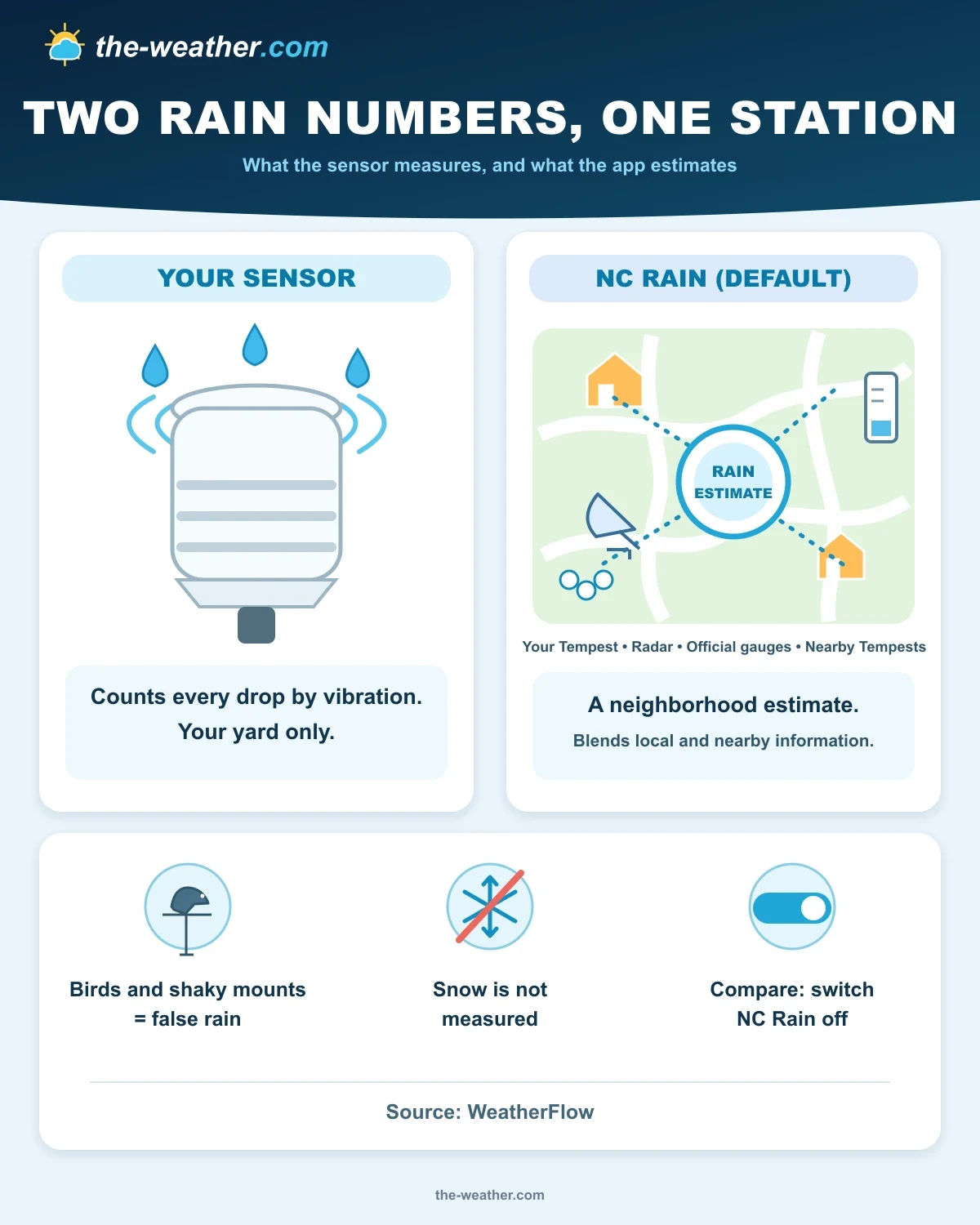
Short answer: the Tempest has no bucket. Its haptic sensor counts raindrops by the vibration each one makes on the top of the unit. On top of that, the app shows NC Rain by default: an estimate for your neighborhood that blends your Tempest with radar, nearby professional rain gauges and other Tempest stations. That estimate can differ from what fell in your yard, and WeatherFlow says it can be less accurate where short showers and thunderstorms are common or where terrain has a big influence. You can switch NC Rain off in the app to see your own sensor's count. Sources: Tempest help: NC Rain and the Tempest FAQ.
Editorial Research
- Written by
- Lena Thornton, Weather Station Analyst & CWOP Contributor
- Based on
- WeatherFlow's Tempest FAQ, its help articles on NC Rain and rain data, the Tempest '26 announcement (November 2025) and WeatherFlow's public data documentation. Owner reports are named as owner reports. We did not run our own rain comparison with a Tempest.
- Research last verified
- November 25, 2026
How the Tempest Measures Rain Without a Bucket
Most home weather stations catch rain in a funnel and let it fill a tiny seesaw, called a tipping bucket. Every time the bucket tips, the station adds a fixed amount, often 0.01 inch.
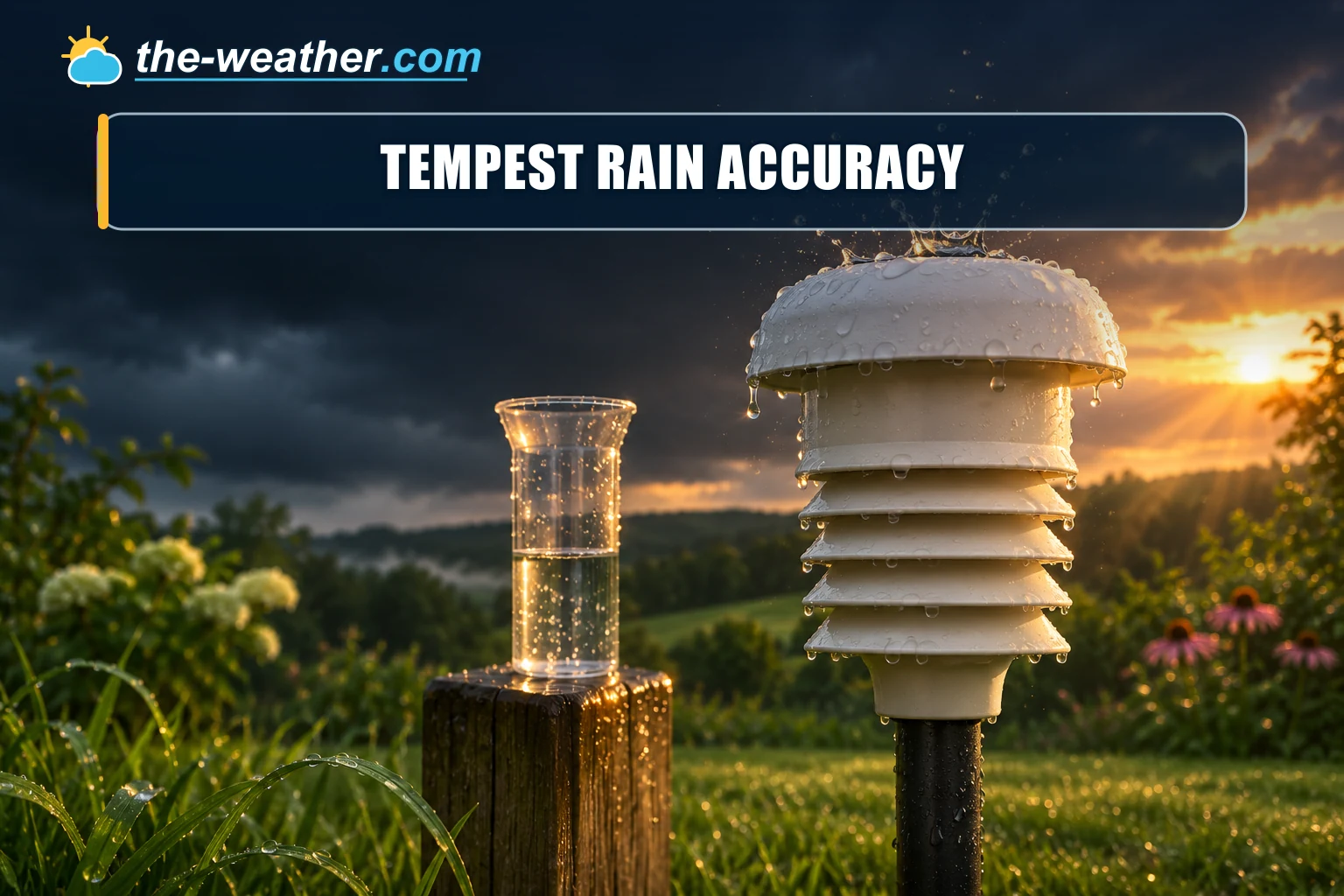
The Tempest does something completely different. WeatherFlow calls it a patented haptic rain sensor: it "measures and counts each falling raindrop" by "quantifying rain from the vibrations caused by the impacts of each raindrop" on the top of the unit (Tempest FAQ). From those impacts it works out the rain total, the rain rate, and when rain started and stopped.
What that means for you:
- Nothing to clog. No funnel, no leaves, no spider apartments. That is the big upside.
- It reacts to vibration. Because it listens for impacts, anything else that shakes the unit can look like rain. WeatherFlow warns that a moving Tempest "could create false rain readings".
- It does not measure snow. The FAQ is clear: "The impact of falling snow is too light for the sensor to pick up." Winter totals from melted snow need a different gauge.
- Hail is flagged separately. WeatherFlow's data format has a precipitation type field with rain and hail values (Tempest API documentation).
What NC Rain Is, and Why It Is On by Default
NC stands for Nearcast. According to WeatherFlow's help article, NC Rain is an estimate of the average rain total around your Tempest at neighborhood scale. It combines:
WeatherFlow turns NC Rain on by default. The idea is sensible: one sensor on one pole can be fooled, while a blend of several sources smooths out the odd mistake. The catch is in WeatherFlow's own fine print: NC Rain can be less accurate where brief showers and thunderstorms are frequent, and where terrain has a large influence (Tempest help: NC Rain).
In plain words: if a thunderstorm parks over your street and misses the radar's average, your yard and the neighborhood estimate can tell two different stories. Both can be "right" for what they measure.
How to see your own sensor's rain
WeatherFlow says you can switch NC Rain off in the advanced device settings of the Tempest app. The app then shows the haptic sensor's own measurements, including graphs and history. The NC Rain data is kept, so you can switch back at any time. App menus change now and then, so if you cannot find the switch, look for the device settings of your Tempest, not the station settings.
| Setting | What you see | Good for |
|---|---|---|
| NC Rain on (default) | Neighborhood estimate: your sensor blended with radar, official gauges and nearby Tempests | Smoothing out one-off sensor errors, general "how much rain did we get" |
| NC Rain off | The drops your own Tempest counted | Your own yard, comparing with a manual gauge next to it, spotting false rain |
Why Your Tempest Total Differs From a Rain Gauge
When owners compare a Tempest with a gauge, the difference usually comes from one of these:
| What you notice | Possible reason | What to check |
|---|---|---|
| Tempest lower or higher than your gauge after a storm | You are comparing NC Rain (a neighborhood estimate) with your own yard | Switch NC Rain off and compare again |
| Rain on a dry, windy day | The mount shakes or sways | A sturdier mount; WeatherFlow says it "should not shake, sway or vibrate in strong winds" |
| Short bursts of rain with blue sky | Birds landing on the unit | The bird deterrent accessory (see below) |
| Zero during snow | Snow is too light to register | Normal: the Tempest does not measure snow |
| Different from a gauge across the yard | Trees, roofs or walls shelter one of the two | Put both in the open, away from trees, roofs and walls |
Mount and snow lines: Tempest FAQ. NC Rain: Tempest help.
Owners in WeatherFlow's community and long-term reviewers have reported under-reading in heavy rain. I treat that as owner experience, not a measured fact: it depends a lot on the mount, the storm and which setting was on. Our Tempest review goes into those reports.
What changed with the Tempest '26
The Tempest '26, launched in November 2025, has "upgraded temperature, humidity, and rain sensors", and WeatherFlow says firmware updates improve "the reliability of rain measurements across all models" (Tempest '26 announcement). We found no rain accuracy figure for the '26 in WeatherFlow's FAQ or in the announcement, and no independent long-term data on the '26 rain sensor yet. So: promising, not proven.
False Rain: Wind, Birds and Wobbly Poles
Because the sensor listens for impacts, false rain almost always means something is tapping or shaking the unit.
- Vibration from the mount. WeatherFlow's mounting advice says to avoid deck railings and flagpoles, because both are "prone to vibrations" (Tempest mounting tips). A short, stiff pole beats a tall, whippy one.
- Birds. A Tempest on a pole is a very attractive bird perch. WeatherFlow sells a bird deterrent accessory that fits on top to stop birds from landing. Its help article describes it as optional: most owners do not need it, it is meant for spots where birds keep causing false rain or making a mess (Tempest help: Bird Deterrent Accessory).
- Anything touching it. Branches, a loose cable tie flapping in the wind, a curious squirrel. If it can tap, it can rain.
Mounting tips for a quiet, steady Tempest are in our Tempest installation page.
How to Compare Your Tempest With a Rain Gauge, Fairly
If you want to know how your own Tempest does, a simple side-by-side test tells you more than any forum thread. Here is how I would set it up:
- Switch NC Rain off for the test, so you compare your sensor with your gauge, not with the neighborhood.
- Use a good manual gauge with a wide opening, and read it at the same time every day. Our rain gauge picks and how rainfall is measured explain what to look for.
- Put both in the open, at a similar height, away from roofs and trees, and not in each other's rain shadow.
- Compare several rain days, not one storm. Light drizzle, steady rain and downpours can each behave differently.
- Write down the type of rain. If the gap only appears in heavy storms, or only in drizzle, that tells you more than an average.
And if your gauge is the one that is off? It happens. A tilted gauge or a cloudy tube can be wrong too: rain gauge not recording covers the usual suspects.
Still choosing a station?
Check the Tempest on Amazonon Amazon · opens in a new tabIf rain accuracy is your top priority, a station with a tipping-bucket gauge may suit you better: see Tempest vs AcuRite Iris and Tempest vs WS-5000.
Who Is the Tempest's Rain Sensor Right For?
My honest take: the haptic sensor is great if you want rain alerts, rain start times and a low-maintenance station, and you are happy to let NC Rain smooth the numbers. If you report rain totals to a network, compare them closely with official data, or live where snow is a big part of the year, pair the Tempest with a manual gauge, or choose a station with a tipping bucket. A clean funnel is boring, but boring is exactly what you want from a rain total.
Tempest Rain Accuracy FAQ
How does the Tempest measure rain?
With a haptic sensor that counts raindrops by the vibration each impact makes on top of the unit. There is no funnel or bucket. Source: the Tempest FAQ.
What is NC Rain on the Tempest?
NC (Nearcast) Rain is a neighborhood-scale rain estimate that blends your Tempest with radar, nearby professional rain gauges and other Tempest stations. WeatherFlow turns it on by default.
Can I turn NC Rain off?
Yes. WeatherFlow says you can switch it off in the advanced device settings of the Tempest app. The app then shows your sensor's own rain data, and the NC Rain data is kept if you switch back.
Why does my Tempest show rain when it is dry?
Something is shaking or tapping the unit: a mount that sways in the wind, birds landing on top, or a branch or cable touching it. WeatherFlow advises a mount that does not vibrate and sells an optional bird deterrent.
Does the Tempest measure snow?
No. WeatherFlow's FAQ says snow is too light for the haptic sensor to pick up, so the Tempest does not measure snowfall.
Is the Tempest '26 rain sensor more accurate?
WeatherFlow says the '26 has an upgraded rain sensor and that firmware updates improve rain reliability on all models. We found no accuracy figure for the '26 in WeatherFlow's FAQ or announcement, and no independent long-term data yet.
Update Log
- November 25, 2026: Page published. Facts checked against WeatherFlow's FAQ, help articles, API documentation and the Tempest '26 announcement.
Sources
- Tempest: Frequently Asked Questions
- Tempest help: NC Rain (Nearcast Rain)
- Tempest help: Tempest System Rain Data
- Tempest help: Bird Deterrent Accessory
- Tempest: Personal Weather Station Mounting Guidelines and Tips
- Tempest: The Next Generation of Tempest Has Arrived (November 2025)
- WeatherFlow Tempest UDP API documentation
More on the Tempest: Tempest review · Tempest offline fixes · Installing a Tempest · Tempest vs AcuRite Iris · Tempest vs WS-5000 · Tempest vs WS-2902C · Vantage Vue vs Tempest
Ready to decide?
Find your pick on Amazon
Prices and stock change daily. Check the current price, delivery options and what owners say in their reviews.
Our top picksCompare our picks on AmazonCurrent price, delivery & full specs on Amazon
Check on Amazon →