
Our picks in this guide
Compare the models in this guide
See today’s price, delivery options and customer reviews on Amazon.
As an Amazon Associate, I earn from qualifying purchases.In this article 9 sections

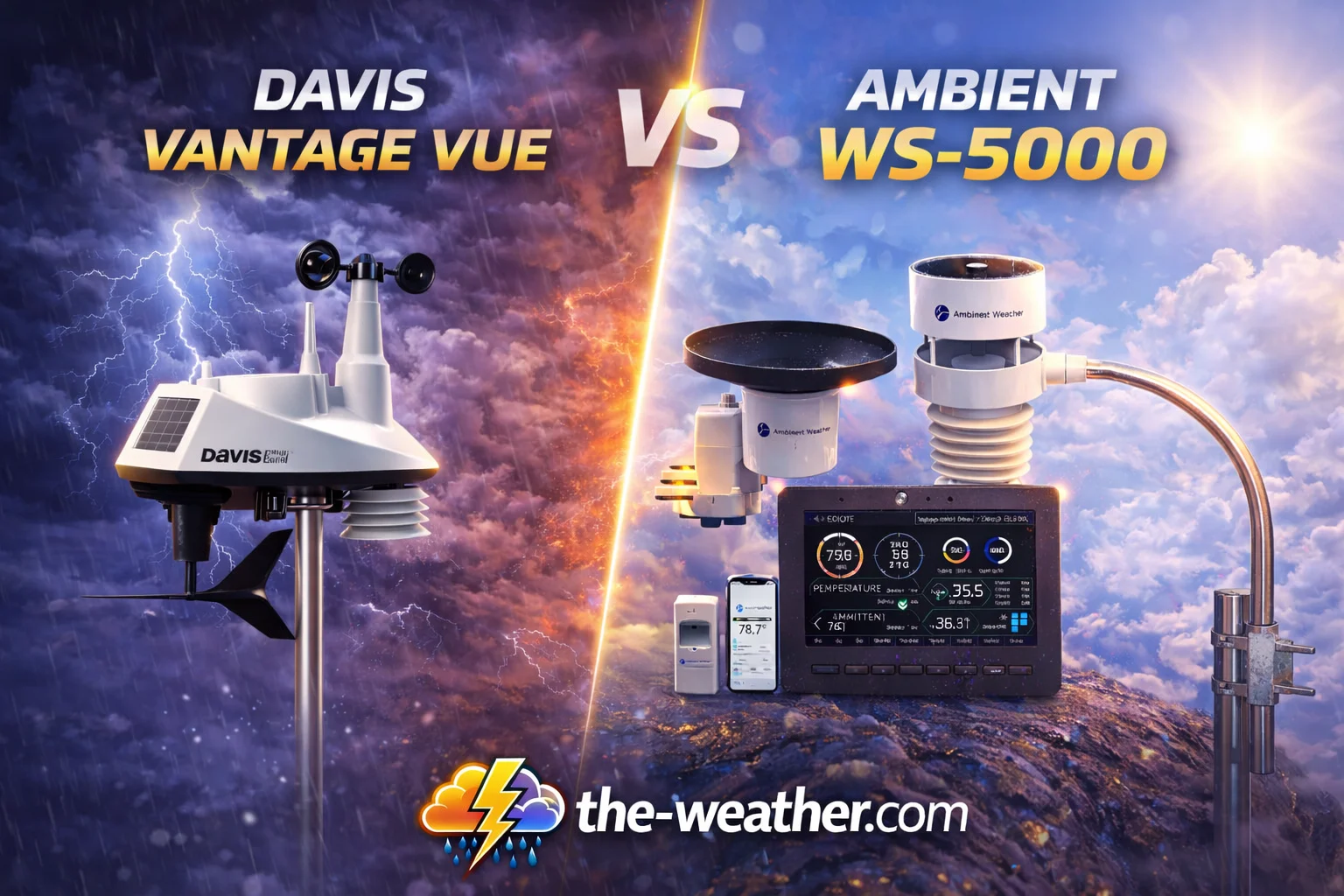
Vantage Vue vs WeatherFlow Tempest: a visual comparison of sensor design, update speed, and smart features to see which weather station performs best in 2026.
⚡ The 5-Second Verdict
- You want a proven station that runs unchanged for years
- A physical display console in your home matters
- You live in a high-wind region (measures up to 200 mph)
- You contribute data to CWOP or professional networks
- Lightning detection is a priority for you
- Zero maintenance and no moving parts appeal to you
- You want Nearcast AI hyperlocal forecasting
- Setup in under five minutes fits your lifestyle
✔ Prices checked regularly · Updated March 2026 · Amazon updates pricing daily
* As an Amazon Associate, The-Weather.com earns from qualifying purchases. Using our links costs you nothing extra.
Looking at Davis' top model? See the Davis Vantage Pro2 with sonic anemometer and WeatherLink Live.
Head-to-Head Spec Comparison
Every key spec side by side. This comparison has genuine split results: both stations win in different categories, and neither is a runaway winner overall.
| Feature | Davis Vantage Vue | WeatherFlow Tempest |
|---|---|---|
| Price (approx.) | ~$420–$499 with console | ~$329–$339 ✓ LOWER PRICE |
| Update Interval | Every 2.5 seconds ✓ WINNER | Every 3 seconds |
| Wind Sensor | Mechanical cup-and-vane, wind-tunnel calibrated ✓ PROVEN | Ultrasonic, no moving parts |
| Max Wind Speed | ~180 mph (290 km/h) ✓ WINNER | ~89 mph (practical upper limit for ultrasonic sensor) |
| Freeze Resistance | Cups may freeze in ice storms | Ultrasonic, highly resistant to freezing ✓ WINNER |
| Rain Sensor | Tipping bucket, consistent across intensities ✓ RAIN ACCURACY | Haptic, no moving parts, struggles in heavy rain |
| Lightning Detection | None | Yes, up to 25 miles (40 km) ✓ WINNER |
| AI Forecast | No (WeatherLink Cloud forecast) | Nearcast AI, improves over 60 days ✓ WINNER |
| Physical Display | HD touchscreen WeatherLink Console ✓ WINNER | None, app only |
| Setup Time | 30–60 minutes | Under 5 minutes ✓ WINNER |
| Wireless Range | 1,000 ft (300 m) ✓ TIE | 1,000 ft (305 m) ✓ TIE |
| Smart Home | Alexa via WeatherLink | Alexa, Siri, IFTTT, Rachio ✓ MORE OPTIONS |
| Maintenance | Annual tipping-bucket cleaning recommended | Near zero: no clogging, no bearings ✓ WINNER |
| Documented Longevity | Often 10+ years; 8 years before first overhaul (TWSE unit) ✓ WINNER | Newer product; TWSE notes shorter lifespan than peers |
| Subscription | Free basic tier; Pro tier optional ✓ TIE | No subscription, lifetime data included ✓ TIE |
| Best For | Precision, durability, CWOP, high-wind regions ✓ PRECISION PICK | Lightning alerts, smart home, low maintenance, app-first users |
Where One Still Beats the Other
The Vantage Vue still beats the Tempest on rain accuracy, maximum wind speed, and proven long-term durability. The Tempest still beats the Vantage Vue on lightning detection, AI forecasting, smart home depth, and zero-maintenance design. The right choice depends entirely on which of those categories matter most to you.
The Vantage Vue is built for long-term accuracy and durability, while the Tempest focuses on smart features and convenience. If you need precise data for years with a physical display, choose Davis. If you want lightning alerts and a maintenance-free system, choose Tempest.
These two stations are closer in price than most buyers expect, and they both take weather monitoring seriously. But they represent genuinely different philosophies: the Davis is a precision instrument built to last; the Tempest is a connected platform built to be smart. Understanding which category matters more to you is the entire decision.
1. Rain Accuracy: Tipping Bucket vs. Haptic Sensor
2. Lightning Detection: A Decisive Advantage for the Tempest
This is the Tempest’s most important feature, and the one most buyers underestimate. The Tempest includes a built-in electromagnetic lightning sensor that detects strikes up to approximately 25 miles (40 km) away and sends immediate push notifications through the app. Weather Station Experts’ testing found it among the fastest and most responsive lightning detectors in their lineup, regularly picking up distant strikes before other stations on their test bench. The Davis Vantage Vue has no lightning detection whatsoever. If you live in a storm-prone region or want early warning for family outdoors, this single feature is a compelling reason to choose the Tempest.
3. Wind Speed Range: 200 mph vs. Approximately 100 mph
The Davis Vantage Vue’s mechanical anemometer is wind-tunnel tested to approximately 180 mph (290 km/h), and records wind as low as 2 mph (3 km/h). The Tempest’s ultrasonic sensor has no moving parts to break but its practical measurement ceiling is approximately 89 mph. Gadgeteer long-term users also documented wind underreporting at very high wind speeds, and directional fluctuation after heavy rain events when water droplets entered the wind measurement gap. For storm spotters, CWOP reporters, or anyone in hurricane-prone areas, the Davis has the range advantage.
4. Durability: The Honest Picture
Weather Station Experts have been running their Vantage Vue unit since September 2016, and in their 2025 buyer’s guide, reported it needed its first significant overhaul after eight years: describing this as twice the lifespan of most comparable stations. Davis stations are often reported to last 10+ years. Regarding the Tempest, Weather Station Experts noted in the same guide that its long-term lifespan is still less documented compared to Davis. The Tempest’s zero-moving-parts design may prove advantageous long-term, but the decade-level track record is still accumulating.
Hidden Flaws You Need to Know
Both stations have documented weaknesses that most comparison posts understate or skip entirely.
Real-World Scenario: Two Weather Observers, Two Different Stations
Tom is a CWOP weather observer in central Oklahoma. He tracks severe storms, reports wind data to NWS networks, and lives in a region where spring winds routinely exceed 70 mph and occasional events push well past 100. His tipping-bucket data needs to be accurate across all rainfall intensities for his public reports. He chooses the Vantage Vue. Eight years later, after two tornado warnings, three ice storms, and one hailstorm that dented his drip funnel, it is still running accurately. The mechanical anemometer has never frozen up for more than a few hours.
Nina lives in suburban Atlanta with two young children and a dog. She does not report to weather networks. What she wants is immediate notification when lightning approaches so she can get her kids inside from the yard. She also wants her station to set up in an afternoon and never need attention. She chooses the Tempest. It is installed in under five minutes. The app notifies her of lightning within seconds of every nearby strike. After a heavy July thunderstorm, she notices the rainfall total looks low: she compares it to her neighbor’s manual gauge and it is about 25% under. She notes it, recalibrates, and moves on. For her actual use case, the Tempest does exactly what she needed.
The right station is the one that solves your specific problem.
Who Should Buy Which?
This is a clean buyer split. Your use case, climate, and relationship with your data determine the correct answer.
🟩 Choose the Vantage Vue if you are…
- A CWOP reporter or serious enthusiast who needs the fastest updates (2.5 sec) and professionally calibrated sensors
- In a high-wind or hurricane region where gusts regularly exceed 89 mph and measurement range up to approximately 180 mph matters
- A long-term buyer who values a station with a documented 10+ year reliability track record
- Focused on rainfall accuracy across all intensities, including heavy rain and tropical events
- A display-first user who wants a physical HD touchscreen to check conditions at a glance
📸 Choose the Tempest if you are…
- A storm safety buyer who needs instant lightning alerts up to 25 miles away for family or pets
- A smart home enthusiast using Alexa, Siri, IFTTT, or Rachio irrigation who wants deep integration
- App-first and convenience-driven, comfortable checking conditions on a phone rather than a console
- In a cold or icy climate where the ultrasonic sensor’s resistance to freezing is a practical advantage
- A zero-maintenance buyer who does not want to clean sensors, maintain bearings, or service moving parts
Frequently Asked Questions
Final Verdict
One still beats the other, but which one depends entirely on what you are asking it to do.
The Davis Vantage Vue still wins on proven accuracy, durability, and maximum wind range. Its tipping-bucket rain gauge outperforms the Tempest’s haptic sensor in heavy rainfall. Its mechanical anemometer is wind-tunnel calibrated to 200 mph. Its documented track record of 8–10+ years of operation is unmatched at this price tier. For CWOP reporters, storm spotters, and serious weather enthusiasts, it remains the professional’s choice.
But the Tempest wins on features, convenience, and intelligence. Its lightning detection has no peer in the home weather station market. Its Nearcast AI forecast improves specifically to your backyard over time. It sets up in under five minutes, never needs cleaning, and integrates deeper into smart home systems than Davis. At $329–$339 it costs over $100 less than the Vantage Vue bundle.
Buy the Vantage Vue for precision, durability, and professional-grade reporting. Buy the Tempest for lightning alerts, smart home integration, and zero-maintenance convenience.
✔ Prices checked regularly · Updated March 2026
* As an Amazon Associate, The-Weather.com earns from qualifying purchases. Using our links costs you nothing extra.
📦 After You Buy: Next Steps
Just ordered? Here is what to do first, and what most new owners wish they had configured from day one.
More From The-Weather.com
View full profile →
Lena has researched and reviewed more than 40 personal weather stations since 2019. She evaluates every station against reference-grade equipment and only recommends what she would install at her own home. This post was last reviewed and updated in March 2026.
Ready to decide?
Find your pick on Amazon
Prices and stock change daily. Check the current price, delivery options and what owners say in their reviews.
Our top picksCompare our picks on AmazonToday's price, delivery & owner reviews on Amazon
Check on Amazon →