
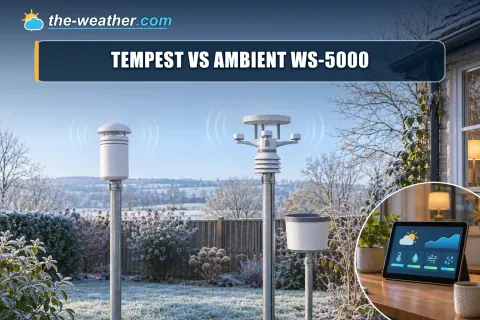
Models compared on this page
Our shortlist, side by side
Check the current price, delivery options and full specs on Amazon.
As an Amazon Associate, I earn from qualifying purchases.In this article 14 sections
- Tempest vs WS-5000 at a Glance
- Rain: The Biggest Difference
- Wind: Both Ultrasonic, With Different Limits
- Display or App
- Lightning and Add-on Sensors
- Power and Maintenance
- Cold Climates and Snow
- What You Would Need to Add to Match the Other
- Known Problems Owners Run Into
- Which Weather Station Should You Buy?
- When Neither Is the Right Station
- Tempest vs WS-5000 FAQ
- Update Log
- Sources
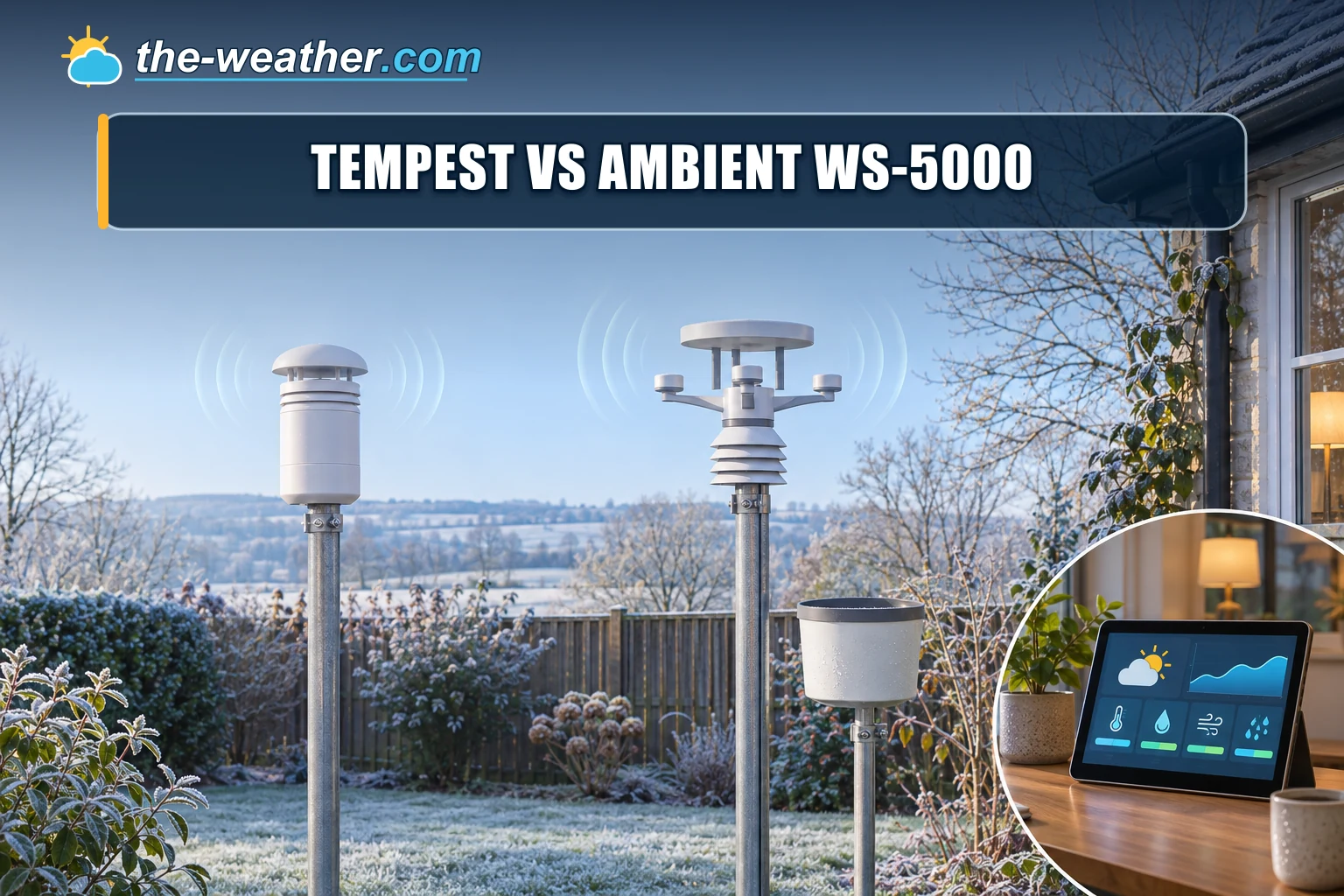
These two get compared a lot, and for good reason: both measure wind with sound pulses instead of spinning cups, so there is nothing to wear out or freeze up there. After that, they go separate ways. The Tempest packs everything into one sealed unit and leaves the screen to your phone. The Ambient WS-5000 spreads out: an ultrasonic sensor array, a separate rain gauge and a color display tablet indoors, with room to grow.
Short answer: choose the Tempest if you want one simple unit with built-in lightning detection, solar charging and strong smart home options, and you do not need a screen. Choose the Ambient WS-5000 if you want a color display in the house, a separate tipping-bucket rain gauge, a full outdoor update every 4.9 seconds (Ambient's manual) and the option to add up to 8 extra sensors, such as soil moisture or lightning. The WS-5000 asks a little more of you: two units to mount, a rain funnel to clean every few months and batteries to change every 1 to 3 years.
Editorial Research & Review
- Written by
- Lena Thornton, Weather Station Analyst & CWOP Contributor
- Review basis
- WeatherFlow's Tempest FAQ, mounting tips and Tempest '26 announcement; Ambient Weather's WS-5000 user manual (version 1.3) and its WS-5000 product page. Every number on this page says which document it comes from.
- Hands-on testing
- Not performed by The-Weather.com for the stations on this page
- Research last verified
- November 25, 2026
Tempest vs WS-5000 at a Glance
| Station | Strong fit for | Rain | Display | Shop |
|---|---|---|---|---|
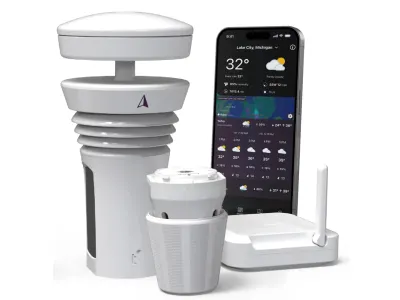 WeatherFlow Tempest Read our Tempest review | One-unit simplicity, lightning, smart home | Haptic sensor in the same unit | None: app and web | Check on Amazon |
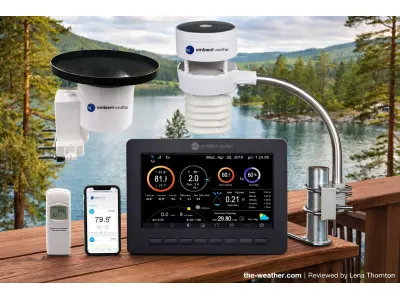 Ambient WS-5000 Read our WS-5000 review | A screen indoors, data fans, add-on sensors | Separate tipping-bucket gauge | Color display tablet | Check on Amazon |
| Feature | WeatherFlow Tempest | Ambient WS-5000 |
|---|---|---|
| Wind sensor | Ultrasonic, no moving parts | Ultrasonic, no moving parts |
| Wind speed limit | Upper detection limit 100 mph (FAQ) | 0 to 89 mph operational (manual) |
| Rain | Haptic sensor; does not measure snow | Separate tipping-bucket gauge, 0.004 inch resolution (manual) |
| Outdoor updates | Wind in 3-second samples, full observation every minute (API documentation) | Every 4.9 seconds (manual) |
| Lightning | Built in, up to about 25 miles (40 km) | Optional add-on sensor (WH31L) |
| Add-on sensors | Not a sensor platform | Up to 8 (Ambient product page) |
| Outdoor temperature range | -35°F to 140°F operating range | -40°F to 149°F with lithium batteries (manual) |
| Wireless range | Up to 1,000 ft line of sight; at least 300 ft in a typical home | 1,000 ft in open air; 300 ft under most conditions (manual) |
| Power outdoors | Solar with internal battery (removable on the Tempest '26) | Solar panel on the sensor array plus AA batteries (array and rain gauge); the manual says to replace batteries every 2 to 3 years in one place and every 1 to 2 years in another |
| Snow | Not measured (FAQ) | The rain gauge measures liquid rain, not snow (manual glossary) |
| Cold-climate extras | Battery charges down to about -67°F (FAQ) | Optional heater for the ultrasonic sensor (needs AC power); anti-icing spray advised in snowy areas (manual) |
| Without internet | Needs Wi-Fi for full use; app can show latest readings over Bluetooth near the hub | The display tablet receives the outdoor sensors directly |
| Indoors | Hub without a screen; app and web | Color display tablet with Wi-Fi |
| Smart home | Alexa, Rachio, IFTTT, Weather Underground, open API (FAQ); official Home Assistant integrations | Alexa, Google Home, IFTTT (product page); Rachio through IFTTT (manual) |
| Subscription | Data and forecasts with no subscription required (product page) | Ambient Weather Network free; AWN+ is an extra tier, with one month free included (product page) |
| Warranty | 2 years, 60-day returns (FAQ) | 1 year limited (manual) |
Tempest: Tempest FAQ, API documentation, Tempest '26 announcement, Tempest product page, Home Assistant. WS-5000: WS-5000 user manual, version 1.3 and the WS-5000 product page.
Rain: The Biggest Difference
The WS-5000 comes with a separate rain gauge: a funnel and a tipping bucket, with a resolution of 0.004 inch according to Ambient's manual. You mount it apart from the wind sensor, which lets you put each in its best spot. The manual is honest about the chores: clean the rain gauge every few months, and give it a level, easy-to-reach place.
The Tempest measures rain on top of the same unit, with a haptic sensor that counts drops by their vibration. No funnel to clean, but a shaky mount or a bird can trigger false rain, and snow does not register. By default the app shows NC Rain, which blends your sensor with radar and nearby gauges. More in Tempest rain accuracy.
For rain fans, the WS-5000's separate bucket is the more traditional, easier-to-check setup. For "tell me when it starts raining and leave me alone", the Tempest is simpler.
Wind: Both Ultrasonic, With Different Limits
Here they agree on the idea: sound pulses between transducers, no cups, no bearings. Ambient's manual puts it nicely: cup bearings are moving parts that "wear over time". Neither of these has that problem.
The details differ. Ambient's manual lists the WS-5000's wind range as 0 to 89 mph (operational), with an accuracy of plus or minus 1 mph below 22 mph and plus or minus 5% above. WeatherFlow's FAQ gives the Tempest an upper detection limit of 100 mph and says speeds above that may be outside its accuracy specifications. Both easily cover normal backyard weather.
For speed of updates, the WS-5000 sends outdoor data every 4.9 seconds (manual). WeatherFlow's data uses 3-second wind samples and a full observation every minute.
Siting matters more than the spec sheet. Ambient suggests at least 5 ft from buildings and four times the height of the tallest obstruction away from it; WeatherFlow recommends 6 to 8 ft above ground in an open, sunny spot. See installing a Tempest.
Display or App
The WS-5000 includes a color display tablet for indoors, which also connects the station to Wi-Fi. You can glance at it without unlocking a phone, and it shows a lot at once.
The Tempest has a hub without a screen. Everything is in the Tempest app and on the web; WeatherFlow suggests an old tablet if you want something on the wall. Its strength is on the smart home side: Rachio sprinklers, Alexa, IFTTT, Weather Underground and an open API (FAQ), plus two official Home Assistant integrations. The WS-5000 works with Alexa, Google Home and IFTTT according to Ambient's product page, and its manual shows IFTTT turning off Rachio sprinklers when it rains. So both can talk to a smart sprinkler; the Tempest does it directly, the WS-5000 through IFTTT.
Lightning and Add-on Sensors
Lightning is built into every Tempest, with strikes detected up to about 25 miles away. The WS-5000 can do lightning too, with Ambient's optional WH31L lightning sensor. Whichever you choose, treat it as an early heads-up: WeatherFlow says the Tempest gives an estimated distance, can miss some strikes and can be fooled by nearby electrical noise. If you hear thunder, go inside.
Where the WS-5000 clearly pulls ahead is growth. Ambient lists it as compatible with up to 8 add-on sensors: extra temperature and humidity sensors for rooms or a greenhouse, soil moisture, air quality, a leak detector and lightning. The Tempest is one unit; what you buy is what you get.
Power and Maintenance
The Tempest charges by solar and needs direct sun. The Tempest '26 has bigger solar panels and a removable, replaceable battery.
The WS-5000 sensor array has a solar panel and AA batteries, and the rain gauge runs on batteries too. Ambient's manual says to replace them every 2 to 3 years in its site survey section and every 1 to 2 years in its maintenance section, with lithium batteries for cold climates, and to clean the rain gauge every few months. Two units also means two things to mount.
Cold Climates and Snow
Ultrasonic wind is a big plus in winter: no cups to ice up. Beyond that, the two prepare for cold in different ways.
- Tempest: WeatherFlow says the battery keeps charging down to about -67°F and the operating range is -35°F to 140°F. The Tempest '26 adds an improved weather- and water-resistant coating. Snow is not measured, and short winter days make a sunny spot more important (see Tempest offline).
- WS-5000: Ambient offers an optional heater for the ultrasonic sensor, which needs AC power through a cable. In snowy areas the manual advises an anti-icing silicone spray on top to stop snow building up, and lithium batteries for temperatures down to -40°F. The rain gauge measures liquid rain, not snow.
If you live where snow sits on everything for weeks, the WS-5000's heater option is the more complete cold-weather toolkit, at the cost of running power out to the pole. The Tempest keeps it cordless, as long as the sun reaches it.
What You Would Need to Add to Match the Other
| You want | Starting from the Tempest | Starting from the WS-5000 |
|---|---|---|
| Lightning alerts | Built in | Add the WH31L lightning sensor |
| A screen in the house | Use a tablet with the app (WeatherFlow's suggestion) | Included |
| Room, greenhouse or soil sensors | Not possible: the Tempest is one unit | Add up to 8 sensors |
| A rain gauge you can check | Add a manual rain gauge next to it | Included (separate tipping bucket) |
| Rachio sprinklers | Direct | Through IFTTT |
The pattern: the Tempest covers more out of the box, the WS-5000 can grow further. The one thing you cannot add to a Tempest is more sensors.
Known Problems Owners Run Into
- Tempest: false rain from a shaky mount or birds (WeatherFlow's FAQ and help pages), owner reports of under-reading in heavy rain (see our Tempest review), and power drops in shady spots. Fixes: Tempest rain accuracy and Tempest offline.
- WS-5000: the chores Ambient's own manual warns about: a rain funnel that needs cleaning every few months, batteries that can leak if left in too long, and radio range that drops behind walls and metal. Our WS-5000 review goes deeper.
Which Weather Station Should You Buy?
Strong fit for one-unit simplicity
WeatherFlow Tempest
Why we would pick it: the same no-cups wind idea as the WS-5000, without the second unit to mount, the funnel to clean or the batteries to swap. Lightning is built in, the warranty is longer (2 years against 1), and Rachio works directly.
Research basis: the Tempest FAQ, the Tempest '26 announcement and our Tempest review.
Good fit if
- You want lightning alerts out of the box
- You want the least maintenance possible
- You use Rachio, Alexa, IFTTT or Home Assistant
Skip it if
- You want a display in the house
- You want add-on sensors for rooms, soil or air quality
- You want a separate, checkable rain gauge
WeatherFlow Tempest
See today's Tempest priceon Amazon · opens in a new tabWhen we checked on November 25, 2026, Amazon listed the Tempest '26 (model 2026). Read our Tempest review
Strong fit for data fans who want a screen
Ambient Weather WS-5000
Why we would pick it: ultrasonic wind plus a separate tipping-bucket rain gauge, a color display indoors, a full outdoor update every 4.9 seconds and room for up to 8 add-on sensors. The station to grow into.
Research basis: Ambient's WS-5000 user manual, the WS-5000 product page and our WS-5000 review.
Good fit if
- You want a color display on the counter
- You care about a traditional rain gauge
- You may add soil, room or air quality sensors later
Skip it if
- You want lightning without an extra sensor
- You want one unit and no rain funnel to clean
- You do not want to clean a rain funnel every few months
When Neither Is the Right Station
Want a display and a classic 5-in-1? See Tempest vs AcuRite Iris. Want Ambient's display with cup wind sensors instead? See Tempest vs WS-2902C. Want proven cups and a long track record? Read Vantage Vue vs Tempest.
Tempest vs WS-5000 FAQ
Do both the Tempest and the WS-5000 use ultrasonic wind sensors?
Yes. Both measure wind with sound pulses and have no spinning cups. Ambient lists 0 to 89 mph for the WS-5000; WeatherFlow gives the Tempest an upper detection limit of 100 mph.
Which has the better rain gauge?
The WS-5000 has a separate tipping-bucket gauge (0.004 inch resolution in Ambient's manual) that you clean every few months. The Tempest counts drops by vibration on the unit itself and does not measure snow. For checkable rain totals, the tipping bucket is the more traditional choice.
Does the WS-5000 detect lightning?
With Ambient's optional WH31L lightning sensor. The Tempest has lightning detection built in, up to about 25 miles.
Which one updates faster?
Ambient's manual gives the WS-5000 an outdoor update rate of 4.9 seconds. WeatherFlow's data uses 3-second wind samples and a full observation every minute.
Do I need a subscription?
Not for the basics. WeatherFlow says the Tempest needs no subscription. Ambient's network is free; AWN+ is an extra tier, and one month of it comes free with the station.
Update Log
- November 25, 2026: Page published. Tempest facts from WeatherFlow's FAQ, API documentation and Tempest '26 announcement; WS-5000 facts from Ambient's user manual (version 1.3) and product page.
Sources
- Tempest: Frequently Asked Questions
- Tempest: The Next Generation of Tempest Has Arrived (November 2025)
- WeatherFlow Tempest UDP API documentation
- Ambient Weather: WS-5000 user manual (version 1.3)
- Ambient Weather: WS-5000 Ultrasonic Smart Weather Station
More on the Tempest: Tempest review · Tempest rain accuracy · Tempest offline fixes · Installing a Tempest · Tempest vs AcuRite Iris · Tempest vs WS-2902C · Vantage Vue vs Tempest
Ready to decide?
Find your pick on Amazon
Prices and stock change daily. Check the current price, delivery options and what owners say in their reviews.
Our top picksCompare our picks on AmazonCurrent price, delivery & full specs on Amazon
Check on Amazon →