
As an Amazon Associate, I earn from qualifying purchases.
In this article 9 sections
Every power station box shouts two numbers at you, something like "1,024 Wh" and "2,000 W". They look alike, they are not, and mixing them up is an easy way to end up with a station that cannot run the one thing you bought it for. Here is the plain version, with the formulas the makers print in their own manuals.
Short answer: watt-hours (Wh) tell you how long a power station lasts: it is the size of the tank. Watts (W) tell you what it can run at once: it is the width of the tap. You never get every watt-hour out: Jackery's manual counts with 85% usable, Anker's with about 90 to 95%. Motors (fridges, pumps, furnace blowers) also need a short burst of extra power when they start, which is what the surge or peak rating is for. Runtime ≈ Wh × 0.85 ÷ the watts of what you plug in.
Editorial Research
- Written by
- Lena Thornton, Weather Station Analyst & CWOP Contributor
- Based on
- The Jackery Explorer 1500 user manual (capacity, runtime formula, surge and temperature limits) and the Anker SOLIX C1000 Gen 2 troubleshooting and user guide (discharge time formula, battery and storage advice). We did not test these products; every runtime below is our own calculation, shown step by step.
- Research last verified
- November 28, 2026
Watts vs watt-hours, in one picture
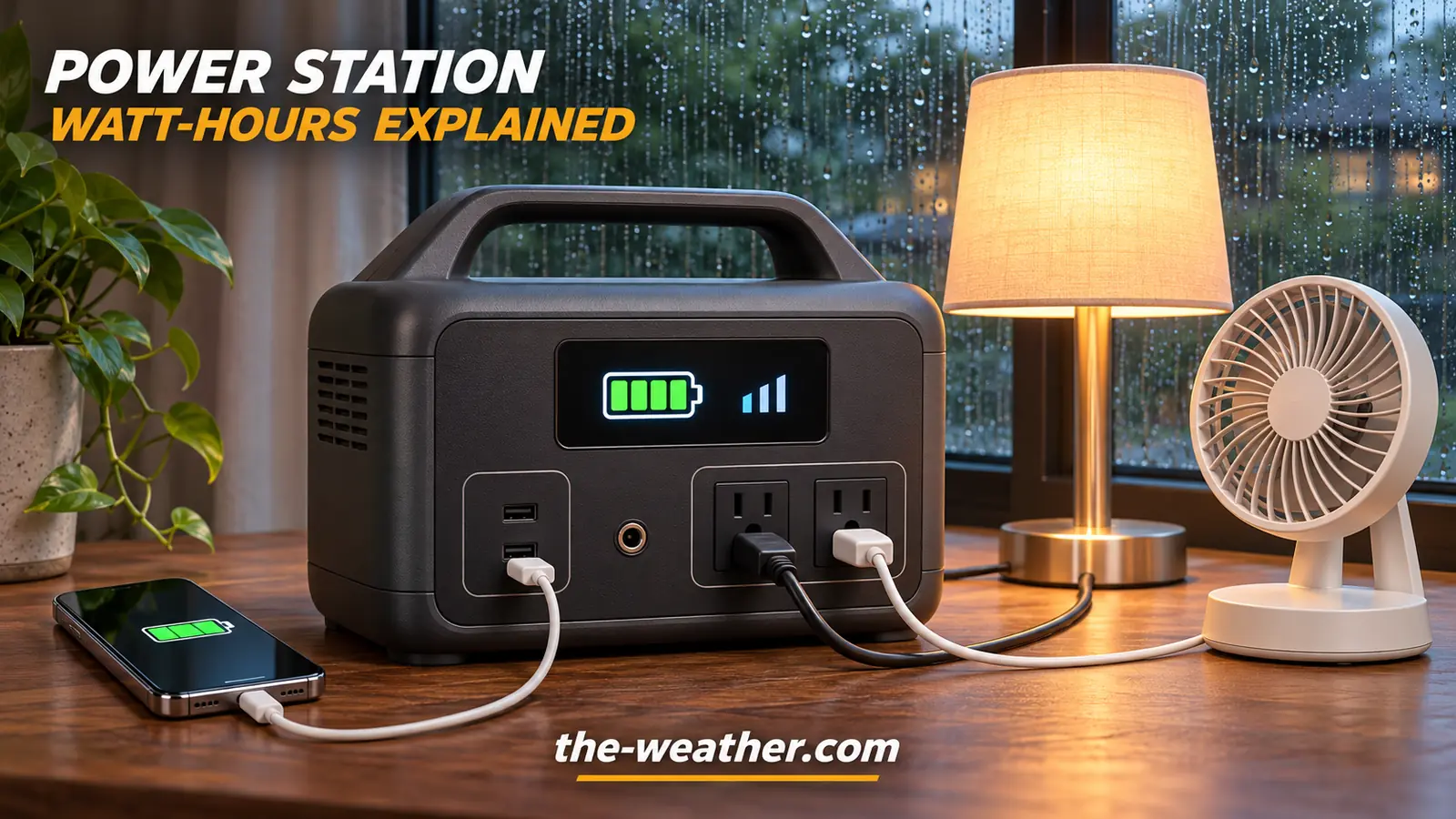
Think of a water tank on the roof with a tap at the bottom.
- Watt-hours (Wh) are the water in the tank. A 1,024 Wh station holds four times as much as a 256 Wh one.
- Watts (W) are how wide the tap can open. A station rated 2,000 W can feed devices that together pull up to 2,000 W at the same moment.
So a big tank with a narrow tap runs small things for a very long time but cannot start a pump. A small tank with a wide tap can start the pump, but not for long. For a storm outage you need both numbers to fit: the watts for the biggest thing you plug in, the watt-hours for how many hours you want to get through.
The link between them is simple: watts × hours = watt-hours. A 100 W device running for 10 hours uses 1,000 Wh.
Where the watt-hour number comes from
Battery makers start with amp-hours (Ah) and volts (V), and multiply. Jackery shows it right on the spec page of its Explorer 1500 user manual: "60.9Ah / 25.2V (1534.68Wh)". Check it: 60.9 × 25.2 = 1,534.68. That is the full size of the battery cells, before anything is lost on the way to your devices.
Handy when a listing only gives amp-hours: amp-hours × volts = watt-hours. Just make sure the volts belong to the same battery, not to the 120 V outlet.
How much of the battery you really get
Turning battery power into normal 120-volt wall-outlet power costs some energy, mostly as heat in the inverter (the part that makes wall-outlet power). The makers handle this differently in their own manuals:
- Jackery (Explorer 1500 manual): "The actual working time = 1534.68Wh* 0.85 / operating power of your device in watts." So 85% usable.
- Anker (SOLIX C1000 Gen 2 troubleshooting and user guide): discharge time = battery capacity × current charge ÷ discharge power × discharge efficiency, with an efficiency of "about 0.9–0.95". Its own example: 1,024 Wh at 80% charge and a 200 W load gives about 3.7 hours.
On all our pages we use the more careful 0.85 for every brand. If your station does better, you get a pleasant bonus instead of an unpleasant surprise at 3 a.m. Notice the second thing Anker's formula does: it counts the current charge. A station at 60% when the storm hits only gives you 60% of the table below.
Runtime per size: the quick table
Here is the whole idea in one table. Find your station size on the left and the watts of what you plug in on top. Not sure about your device's watts? The label on the back or the manual usually says, and a plug-in electricity usage monitor tells you what it really uses over a day.
Most things in a house do not pull the same watts all the time. A fridge compressor switches on and off, a furnace runs in cycles, a CPAP with a heated humidifier uses more in a cold room. That is why our device pages work with the average: see the fridge, CPAP and gas furnace pages for the numbers per device.
Continuous watts vs surge (peak) watts
Look at the output line in a manual and you usually see two watt numbers. The Explorer 1500 says: "1800W max continuous, 3600W surge peak".
- Continuous is what the station can deliver for as long as the battery lasts.
- Surge or peak is a short burst for the moment something with a motor starts.
Jackery explains why in the same manual: motors and compressors are "inductive loads", and "An inductive load will use up to 3X its normal power usage when it starts." That covers the fridge compressor, the sump pump and the furnace blower: three things many households want to keep running in a storm. So check two things: the running watts of your biggest motor against the continuous rating, and its starting watts against the surge rating. Jackery's tip: check whether your device lists an "instant start" power rating. Our sump pump page shows how much that start can matter.
Two things that shrink your watt-hours before the storm
- A station that is not full. Jackery: "If the LCD screen shows less than 20% capacity, plug it into a power source ... as soon as possible." Anker advises to "Recharge to 100% every three months" in storage. A station in the closet slowly loses charge, so top it up when a storm watch goes out.
- Cold. Batteries have temperature limits. The Explorer 1500 manual gives -10 to 40 °C (14 to 104 °F) for use and 0 to 40 °C (32 to 104 °F) for charging; Anker lists 0 to 40 °C for charging the C1000 Gen 2 too. A station in an unheated garage during an ice storm may refuse to charge until it warms up. Keep it inside the heated part of the house.
So which numbers should you look at?
- Watts first: add up what must run at the same time, and check the biggest motor's start against the surge rating.
- Watt-hours second: watts × hours you want to cover, divided by 0.85.
- Then the rest: battery type and cycles, UPS switchover, and whether you can add batteries later.
The power station and generator size calculator does steps 1 and 2 for you. Pick your devices and it shows the watts at once, the starting watts and the hours per station size.
My take
If you remember one line, make it this one: watts decide if it runs, watt-hours decide how long. Then take 85% of the box number and you are planning with what the makers themselves count on. I like to think of it like a rain gauge: the size of the gauge does not matter if the storm never fills it, and a full gauge says nothing about how hard it rained at the peak. You need both numbers.
Plan the whole house: backup power for storm outages in 4 steps · power station and generator size calculator
Quick Answers
What is the difference between watts and watt-hours on a power station?
Watt-hours (Wh) are how much energy the battery holds, so how long it lasts. Watts (W) are how much power it can deliver at once, so what it can run. Watts × hours = watt-hours.
How much of a power station's capacity can I actually use?
Not all of it. Jackery's Explorer 1500 manual counts with 85% (Wh × 0.85 ÷ watts); Anker's C1000 Gen 2 guide uses a discharge efficiency of about 0.9 to 0.95. We use 0.85 as the careful number.
How long will a 1,000 Wh power station last?
With our formula, a 1,024 Wh station runs a 100 W load for about 8.7 hours and a 500 W load for about 1.75 hours, from a full charge. Divide 870 by the watts of what you plug in.
What does surge watts mean on a power station?
The short burst of extra power a station can give when a motor starts. Jackery's manual says an inductive load such as a motor or compressor can use up to 3 times its normal power when it starts.
How do I convert amp-hours to watt-hours?
Multiply amp-hours by the battery's volts. Jackery's Explorer 1500: 60.9 Ah × 25.2 V = 1,534.68 Wh.
Sources: Jackery Explorer 1500 user manual · Anker SOLIX C1000 Gen 2 troubleshooting and user guide