
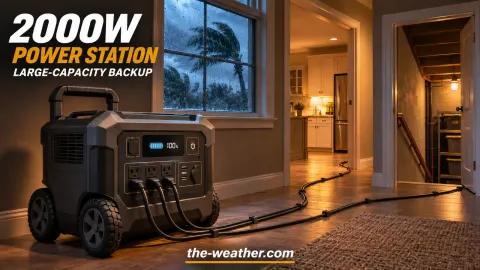
Product covered in this analysis
2000W to 3600W Power Stations for Home Backup
Check the current price, delivery options and full specs on Amazon.
As an Amazon Associate, I earn from qualifying purchases.In this article 9 sections
Somewhere around 2,000 watt-hours, a power station stops being a gadget and starts feeling like home backup. These are the big units: 2 to 3.6 kWh of battery and 1,500 to 3,600 watts of output. They can carry the fridge through a day, keep the sump pump ready and give the furnace a few hours. Here is what they really do in a storm outage, and the limits that only show up in the manuals.
Short answer: in our calculation a 2,000 Wh station keeps an average fridge going for about a day, or the fridge, Wi-Fi and a sump pump together for about 8 hours, if the station can start the pump. A 3,600 Wh station roughly doubles that. Before you buy, check three things the manuals reveal: the normal output (not the boost number) against your biggest motor's start, which outlet gives the full watts, and the auto-off setting that can switch your fridge off in the night.
Editorial Research
- Written by
- Lena Thornton, Weather Station Analyst & CWOP Contributor
- Based on
- The user manuals of the EcoFlow DELTA 3 Max, BLUETTI Elite 300 and Jackery HomePower 3600 Plus, the makers' specifications for the Anker SOLIX S2000 and BLUETTI FridgePower, the runtime formula in the Jackery Explorer 1500 user manual, and the device figures on our own outage pages. We did not test these products; every runtime below is our own calculation, shown step by step.
- Research last verified
- November 28, 2026
What 2 and 3.6 kWh run in a storm outage
Same method as on all our pages: battery Wh × 0.85 ÷ watts, the formula Jackery prints in its Explorer 1500 user manual. Why 0.85 and not the full box number? See watts vs watt-hours, explained.
The pattern: this class covers the essentials of a whole household for a day or more, and the big helpers (sump pump, furnace) for hours. Add a solar panel or a generator outside to recharge, and a multi-day outage becomes manageable.
The motor check: normal output, not boost
Big stations love big boost numbers. The manuals are clear that those are for heating appliances:
- EcoFlow DELTA 3 Max (user manual): US version 2,400 W rated, 3,400 W with X-Boost, which "is more suitable for heating devices".
- BLUETTI Elite 300 (user manual): 2,400 W, Power Lifting up to 4,800 W "only for pure resistive loads".
The same BLUETTI manual gives the reason in one line: "Some devices with motors or compressors may consume 2–4 times their rated power during startup". A sump pump that runs at about 1,115 W can ask for 2,200 to 4,500 W for that first moment. A 2,400 W station may or may not catch that; a station with a real surge rating, like BLUETTI's FridgePower (3,600 W peak according to BLUETTI), has more room. If the sump pump is the reason you buy, check its starting amps first, or read our sump pump page for backups made for the job.
Read the outlet list, not only the headline
A headline watt number is the total for the whole station. Per outlet it can be lower. The Jackery HomePower 3600 Plus (user manual) shows it well: "3600W Rated, 7200W Surge peak" in total, but its four normal 120 V outlets are listed at "20A Max, 2400W, 3600W in Total". So one appliance on one normal outlet gets 2,400 W at most; the 3,600 W is for several devices together, or for its 30 A (NEMA TT-30) outlet. The same manual adds that in UPS (bypass) mode the output reaches 1,440 W before an outage, and the full rating only during the outage. Check the outlet list in the manual of any big station before you count on the headline number.
The setting to change before the storm: auto-off
Power stations save battery by switching outlets off when they think nothing is using them. Normally that is clever. With a fridge it can backfire, because a fridge compressor rests between cycles. EcoFlow says it plainly in the DELTA 3 Max manual: "When the power station is connected to intermittent loads like refrigerators or air conditioners, this feature may be triggered", and advises setting the AC timeout to "never" in the EcoFlow app for things like food and medicine. Jackery's HomePower 3600 Plus has an Energy Saving Mode that shuts the unit down after 12 hours without charging or discharging. Whatever brand you buy: find the auto-off or energy-saving setting in the app and set it for your fridge before the storm, then check on the battery level now and then.
UPS mode and medical devices
Most of the big stations here list a UPS mode (the station passes wall power through and takes over when the grid drops); the EcoFlow manual we used does not mention one. Read the fine print, though. Jackery: switches "within 10 ms", but "This product does not support 0 ms switching", and asks you to "test compatibility with your device multiple times". EcoFlow's DELTA 3 Max manual says the product "is not intended for powering life-sustaining medical equipment" and to consult the equipment maker for other medical devices. If someone at home uses a CPAP, start with our CPAP battery backup page and the supplier.
Five big stations side by side
Big stations that fit a home outage plan
Picked from the makers' own documents: about 2 kWh or more and LiFePO4 batteries. We have not tested them.
2 kWh that still fits in a closet
Anker SOLIX S2000
Why it is on the list: 2,010 Wh LiFePO4, 1,500 W, a UPS switchover of 10 ms or less and 6,000 cycles to 80% capacity, according to Anker. About a day of fridge in our table. Its 1,500 W is the lowest output here, so it suits the quiet loads more than big motors.
Research basis: Anker SOLIX S2000 specifications. New model: check the listing for the US version.
2 kWh with 2,400 W
EcoFlow DELTA 3 Max
Why it is on the list: 2,048 Wh LFP and 2,400 W in the US version according to its manual, plus a 12 V car outlet (126 W). The Amazon listing we link is sold as a set with an alternator charger; check the listing for what is included. Set the AC timeout to "never" for a fridge, as EcoFlow itself advises.
Research basis: EcoFlow DELTA 3 Max user manual (v1.0, 2025).
The most surge room at 2 kWh
BLUETTI FridgePower
Why it is on the list: 2,016 Wh LiFePO4, 1,800 W continuous and 3,600 W peak, 10 ms UPS, according to BLUETTI, which names fridges and sump pumps as uses. The peak rating is what a motor start needs.
Research basis: BLUETTI FridgePower product page.
3 kWh, with solar panels
BLUETTI Elite 300
Why it is on the list: 3,014 Wh LiFePO4, 2,400 W (US) and a 10 ms UPS according to its manual. The Amazon listing we link is sold as a set with solar panels; check the listing for what is included. About a day and a half of fridge in our math.
Research basis: BLUETTI Elite 300 user manual (US).
For a long outage, expandable
Jackery HomePower 3600 Plus
Why it is on the list: 3,584 Wh LiFePO4, 3,600 W in total with a 7,200 W surge peak (2,400 W per normal outlet), 6,000 cycles to 70%+, a 10 ms UPS and room for up to 5 extra battery packs, according to its manual. Its charging range down to -20 °C is the widest in this list.
Research basis: Jackery HomePower 3600 Plus user manual · product page.
Affiliate links: we may earn a commission if you buy through them, at no extra cost to you. We have not tested these power stations ourselves.
My take
If your storms knock the power out for a day or more, this is the class that makes sense, and in our view 2 kWh is a sensible middle for many homes. Go bigger only if the sump pump or the furnace really has to run on it, and then look at the normal output, the peak and the outlet before the battery size. And do yourself a favor: the evening the storm watch goes out, charge it full and check that auto-off setting. A big battery that switched itself off at midnight is just a very heavy doorstop.
Plan the whole house: backup power for storm outages in 4 steps · power station and generator size calculator · the 1 kWh class · expandable stations
Quick Answers
What will a 2000W power station run?
In our calculation a 2,000 Wh station runs an average fridge for about a day, the fridge and Wi-Fi for about 16 hours, or fridge, Wi-Fi and a sump pump together for about 8 hours.
Can a 2000W power station run a sump pump?
Often, if its normal output and surge cover the pump's start. BLUETTI's manual warns that motors may use 2 to 4 times their rated power at startup. Check your pump's starting amps, and don't count on boost modes like X-Boost or Power Lifting: their manuals reserve them for heating loads.
Why does my power station turn off with a fridge plugged in?
Probably the auto-off or energy-saving feature. EcoFlow's manual says intermittent loads like refrigerators may trigger it, and advises setting the AC timeout to "never" for food and medicine.
How long will a 3600Wh power station last?
Divide about 3,050 (3,584 Wh × 0.85) by the watts you plug in. An average fridge runs about 42 hours, a single-speed furnace blower about 5.5 hours of fan time.
Can a big power station power my whole house?
Not like the grid. It runs chosen appliances for hours to days. For connecting any backup source to house wiring, the Department of Energy's Building America Solution Center advises a licensed electrical contractor and a transfer switch that prevents backfeeding.
Sources: EcoFlow DELTA 3 Max user manual · BLUETTI Elite 300 user manual · Jackery HomePower 3600 Plus user manual · Jackery HomePower 3600 Plus · Anker SOLIX S2000 · BLUETTI FridgePower · Jackery Explorer 1500 user manual · DOE Building America Solution Center: generators for backup power
Ready to decide?
Get the 2000W to 3600W Power Stations for Home Backup
Prices and stock change daily. Check the current price, delivery options and what owners say in their reviews.
In this review2000W to 3600W Power Stations for Home BackupCurrent price, delivery & full specs on Amazon
Check on Amazon →