
As an Amazon Associate, I earn from qualifying purchases.
In this article 11 sections
- Three Ways to Measure Wind Speed
- How to Use a Handheld Anemometer
- Average Wind vs Gusts: How Weather Stations Report It
- How an Anemometer Turns Rotation Into Wind Speed
- Why Height and Place Matter
- No Meter? Estimate Wind With the Beaufort Scale
- Wind Speed Units and Conversions
- Anemometer Calibration and Accuracy Checks
- How to Measure Wind Speed FAQ
- Update Log
- Sources
You can measure wind speed three ways: with a handheld anemometer, with a weather station on a mast, or roughly by eye with the Beaufort scale. The tool matters less than how you use it. A meter held at an angle, too low or behind a house can be far off, and a single number means little unless you know whether it is an average or a gust. Here is how to measure wind speed properly, using the rules the National Weather Service uses at airports.
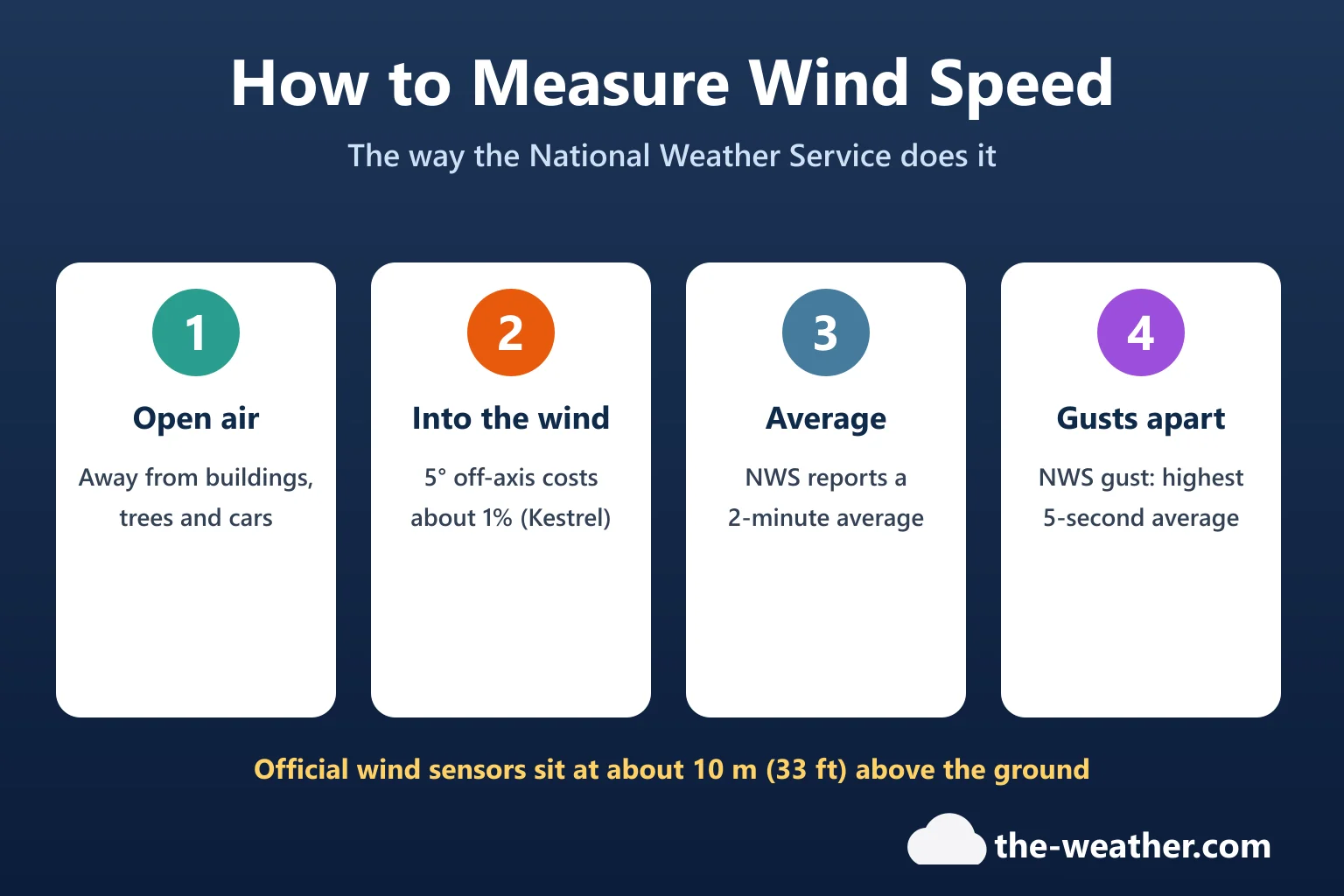
Short answer: hold an anemometer in open air, away from buildings and trees, facing the wind the way its manual shows. Read an average over a set time instead of one moment (US airport stations report a 2-minute average) and note the gust separately (the NWS bases gusts on the highest 5-second average). Official wind is measured at about 10 meters (33 feet) above the ground, and wind usually gets stronger with height, so readings at head height tend to be lower. No meter? The Beaufort scale lets you estimate wind from smoke, leaves and branches.
Editorial Research
- Written by
- Lena Thornton, Weather Station Analyst & CWOP Contributor
- Based on
- The National Weather Service ASOS User's Guide (1998), the NOAA Storm Prediction Center's Beaufort wind scale, Kestrel's 5700 manual and support FAQ, the BTMETER BT-100 manual, and wind-measurement notes from the University of Reading observatory, Oklahoma Mesonet and the UMass Renewable Energy Research Laboratory
- Hands-on testing
- Not performed by The-Weather.com
- Research last verified
- October 22, 2026
Three Ways to Measure Wind Speed
| Method | Good for | Limits |
|---|---|---|
| Handheld anemometer | Spot checks: a drone or kite session, sailing, shooting, an HVAC vent | Measures where you stand, usually at head height; only as good as how you hold it |
| Weather station anemometer on a mast | Continuous readings, averages, gusts and history at home | Needs a high, open mounting spot to give representative readings |
| Beaufort scale (by eye) | A quick estimate with no equipment | Gives a range, not a number |
New to the instrument itself? Our anemometer guide explains what it is, how the types work and how to place one.
How to Use a Handheld Anemometer
- Find open air. Step away from buildings, walls, trees and vehicles. Wind bends and slows around obstacles, so a reading next to your house says little about the wind in the open.
- Hold it high and away from your body. Your body blocks the wind, so hold the meter at arm's length, or mount it on a tripod if it has a thread.
- Face the wind the way your meter is built. Check the manual or the arrow on the housing: on a Kestrel, for example, the manual says to point the back of the unit directly into the wind. Angle matters: Kestrel says holding its meter 5° off-axis reduces accuracy by 1%, 10° by 2% and 15° by 3%. Our tip: turn slowly until the reading is highest, then hold that position.
- Read an average, not one number. Meters average over different times: the BTMETER BT-100 shows a 15-second average, and Kestrel's support FAQ says the Kestrel's wind display is a 3-second rolling average. To compare with a forecast, take several average readings over a minute or two and average those yourself (our tip).
- Note the peak separately. Use the MAX function for the highest reading. Note that a handheld MAX is the single highest reading, which is usually higher than an official gust (see below).
- Write down the unit and the height you measured at, so you can compare readings later.
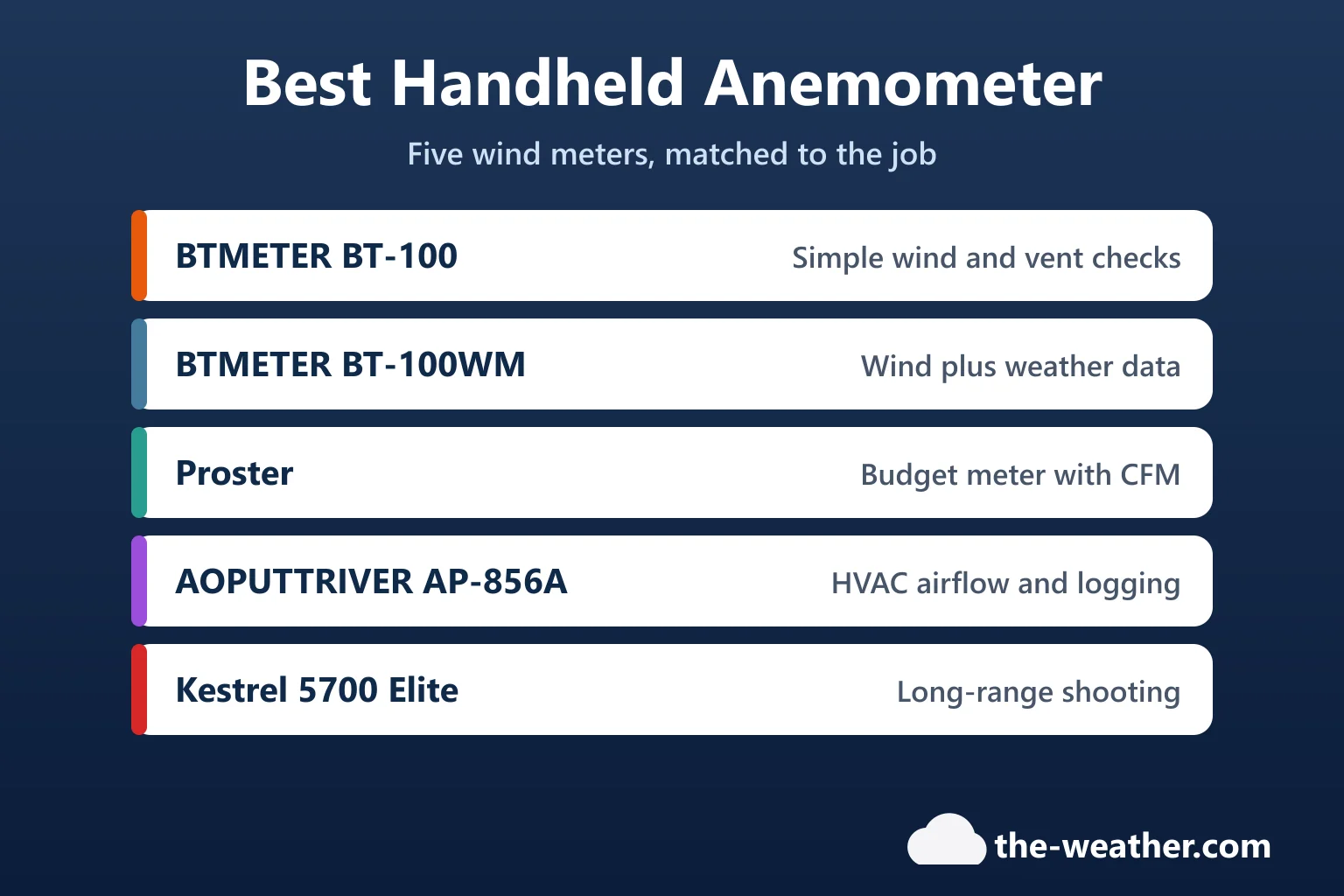
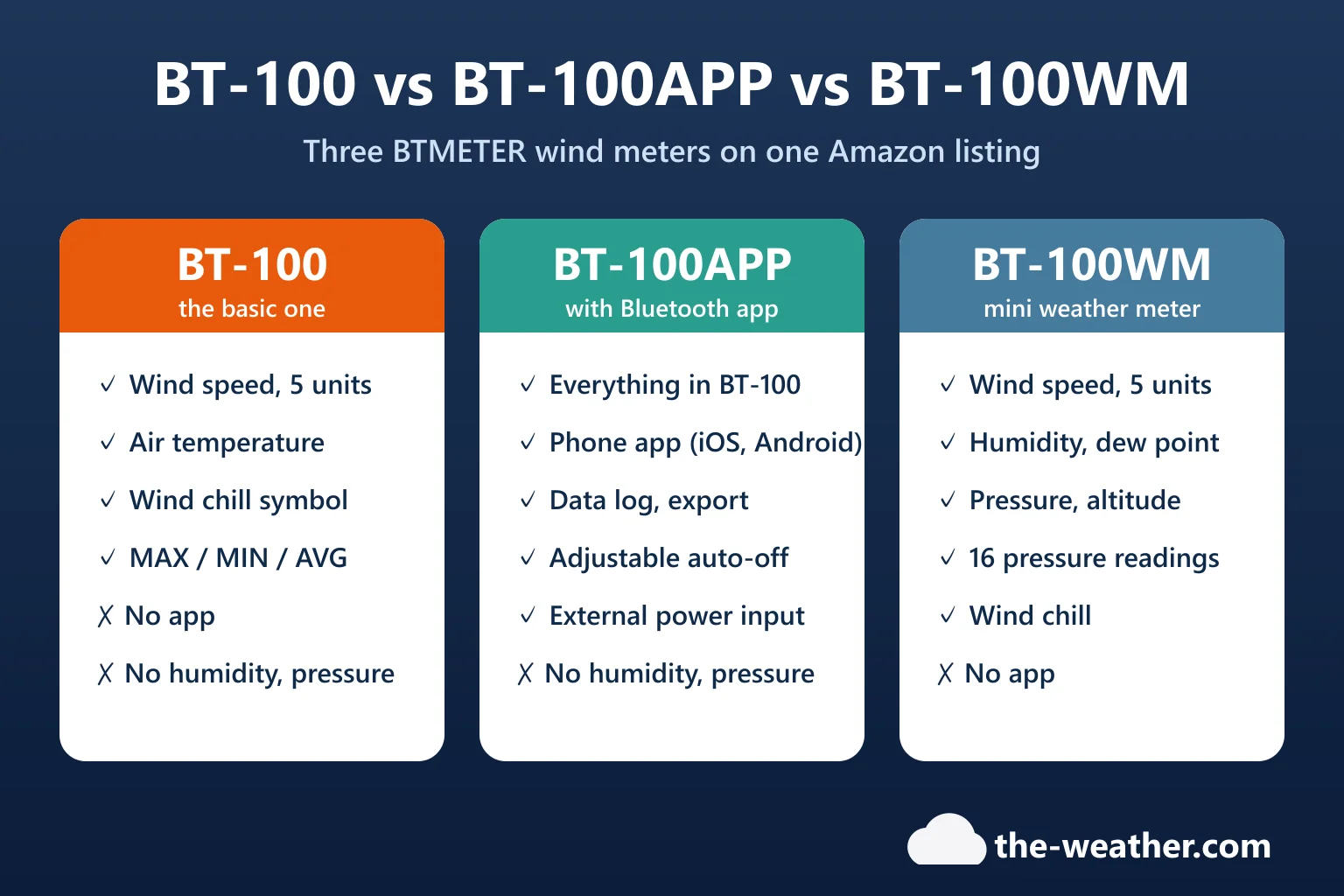
Using the BTMETER BT-100? Its buttons are explained in our BT-100 manual in plain English. Choosing a meter? See our best handheld anemometer guide.
Average Wind vs Gusts: How Weather Stations Report It
The wind number in an airport report is not a single moment. The NWS ASOS User's Guide (1998) describes it like this:
- Every second the sensor measures wind speed and direction. These are turned into 5-second averages.
- The reported wind is a 2-minute average, updated every 5 seconds.
- Calm: a 2-minute average of 2 knots or less is reported as calm.
- Gusts are based on the highest 5-second average. Roughly, a gust is stored when the 2-minute average is at least 9 knots and the highest 5-second average in the last minute is 5 knots or more above it; it is reported when further conditions over the last 10 minutes are met.
Other networks use other averaging periods. The University of Reading's observatory, for example, uses 10-minute mean wind speeds following WMO and ICAO specifications, and Oklahoma Mesonet reports a 5-minute average. So always check which average a number is before you compare it with your own reading.
How an Anemometer Turns Rotation Into Wind Speed
A cup or vane anemometer spins faster as the wind gets stronger. The instrument converts that rotation into a speed using its factory calibration: the classic airport cup sensor described in the ASOS guide, for example, drives a small generator whose output is calibrated in knots. You do not calculate anything yourself: the meter shows the speed in the unit you pick. If you need a different unit, convert it with the table below.
Why Height and Place Matter
The ASOS User's Guide says federal standards for siting weather equipment specify a wind sensor height of 10 meters (32.8 feet), with some variance permitted; typical ASOS wind sensors sit at 33 or 27 feet. Wind speed changes with height above the ground (wind shear, as the UMass Renewable Energy Research Laboratory's resource assessment fact sheet puts it), and obstacles slow it near the surface, so a reading at head height will usually be lower than the official wind. For a home station, mount the wind sensor as high and as clear of the roof and trees as you safely can: our anemometer guide and installation guide cover placement.
No Meter? Estimate Wind With the Beaufort Scale
The Beaufort scale links wind speed to what you can see. These descriptions are from NOAA's Storm Prediction Center (wind in knots; mph is our conversion, rounded). Our anemometer guide has the full scale up to force 12.
| Force | Wind | Name | What you see on land |
|---|---|---|---|
| 0 | Under 1 knot (under 1 mph) | Calm | Calm, smoke rises vertically |
| 1 | 1-3 knots (1-3 mph) | Light air | Smoke drift shows wind direction, wind vanes still |
| 2 | 4-6 knots (5-7 mph) | Light breeze | Wind felt on face, leaves rustle, vanes begin to move |
| 3 | 7-10 knots (8-12 mph) | Gentle breeze | Leaves and small twigs constantly moving, light flags extended |
| 4 | 11-16 knots (13-18 mph) | Moderate breeze | Dust, leaves and loose paper lifted, small branches move |
| 5 | 17-21 knots (20-24 mph) | Fresh breeze | Small trees in leaf begin to sway |
| 6 | 22-27 knots (25-31 mph) | Strong breeze | Larger branches moving, whistling in wires |
Stronger than force 6, follow official forecasts and warnings rather than going out to measure.
Wind Speed Units and Conversions
| Unit | Used for | In mph (our conversion) |
|---|---|---|
| mph | US forecasts and most home stations | 1 |
| knots | Aviation, marine and airport reports | 1 knot = 1.151 mph |
| m/s | Science, drone and kite specs | 1 m/s = 2.237 mph |
| km/h | Metric forecasts | 1 km/h = 0.621 mph |
| ft/min | HVAC airflow | 88 ft/min = 1 mph |
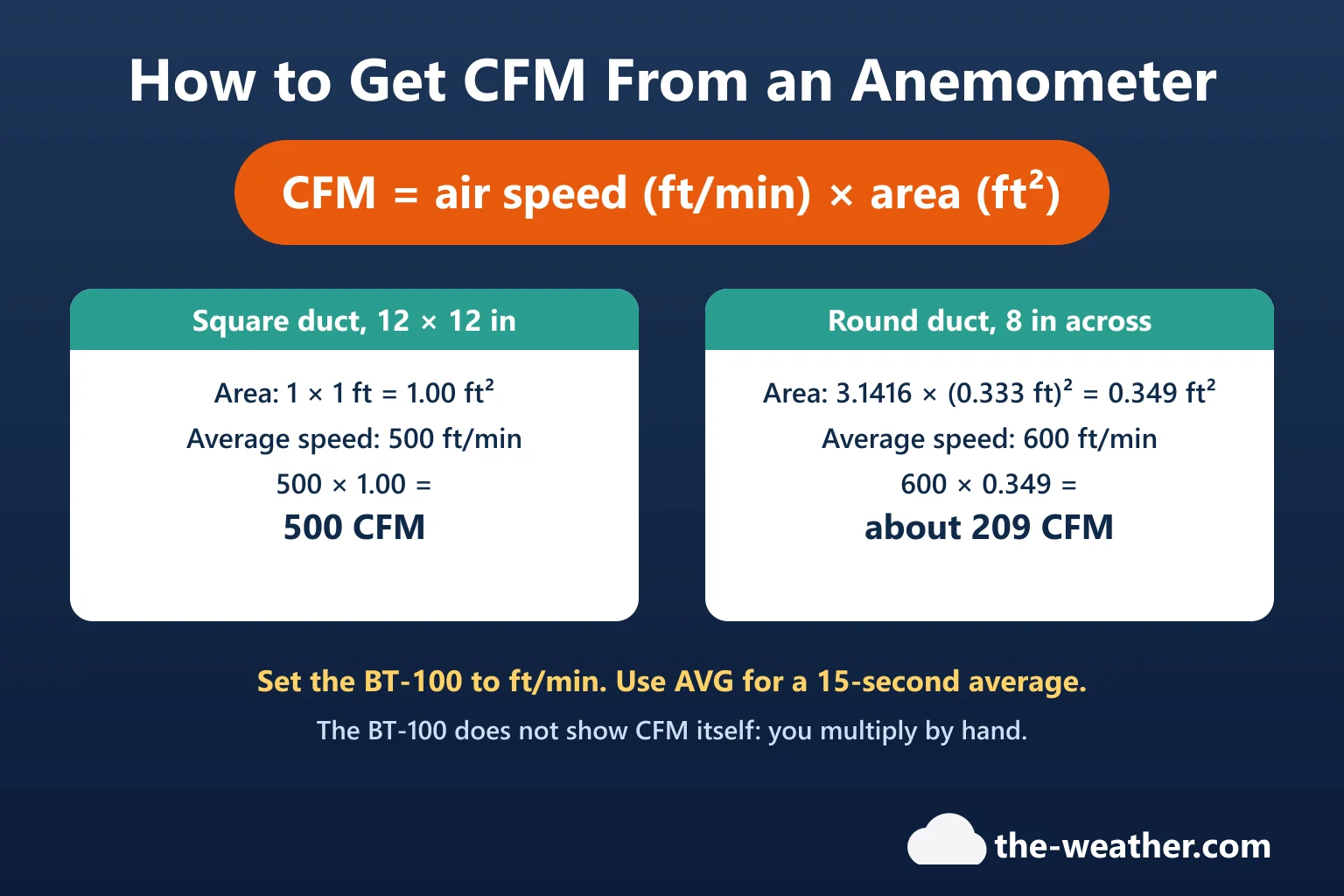
Measuring airflow at a vent rather than wind? You also need the area of the opening: see how to measure CFM with an anemometer.
Anemometer Calibration and Accuracy Checks
Real calibration is done against a reference: Kestrel, for example, says its wind and airflow standard is calibrated in the NIST laser Doppler wind tunnel. You cannot do that at home, but you can check your readings (our tips):
- Compare with an official station on a day with steady wind. Look up the latest observation for the nearest airport (for example on the NWS Aviation Weather Center site, aviationweather.gov, where wind is given in knots), convert it, and compare it with your own average. Expect your reading to be lower if you measure lower or near obstacles.
- Know your meter's margin. A meter rated at ±5% can read 19 to 21 mph in a true 20 mph wind (the BT-100's manual states ±5%).
- Know the low end. Small vane meters need some air to turn: the BT-100 manual starts at 0.5 m/s (about 1 mph).
- Keep moving parts in shape. Kestrel recommends replacing its impeller every 2 to 3 years depending on use. For mast sensors, the ASOS guide notes that the traditional cup and vane design occasionally freezes up in icing conditions.
How to Measure Wind Speed FAQ
What is the best way to measure wind speed?
With an anemometer in open air, facing the wind the way its manual shows, reading an average over a minute or two and noting gusts separately. For continuous measurements, a weather station anemometer mounted high and clear of obstacles works best.
How do I measure wind speed without an anemometer?
Use the Beaufort scale: watch smoke, leaves, branches and flags and match them to the scale. For example, leaves and small twigs constantly moving means about 7 to 10 knots (8 to 12 mph), according to NOAA's Storm Prediction Center.
How high should an anemometer be?
Official weather stations measure wind at about 10 meters (33 feet) above the ground, according to the NWS ASOS User's Guide. At home, mount it as high and as clear of roofs and trees as you safely can.
What is the difference between wind speed and a wind gust?
Wind speed in reports is an average (US airport stations use 2 minutes). A gust is a short peak above that average; the NWS bases gusts on the highest 5-second average wind. A handheld meter's MAX is a single peak reading, so it is usually higher than an official gust.
How do you use a handheld anemometer?
Switch it on, choose your unit, hold it at arm's length in open air facing the wind as its manual shows, and read the average and maximum functions rather than a single moment.
Update Log
- October 22, 2026: First version.
Sources
- National Weather Service: Automated Surface Observing System (ASOS) User's Guide, 1998 (PDF), sections 3.2 and 7.2.1
- NOAA Storm Prediction Center: Beaufort Wind Scale
- Kestrel support: 5700 FAQ (rolling average, off-axis accuracy, impeller, NIST wind tunnel) and Kestrel 5700 instruction manual (PDF)
- BTMETER: BT-100 instruction manual (PDF)
- University of Reading Atmospheric Observatory: wind speed and direction
- Oklahoma Mesonet: wind measurements
- UMass Renewable Energy Research Laboratory: Wind Resource Assessment fact sheet (PDF)