
As an Amazon Associate, I earn from qualifying purchases.
In this article 9 sections
Handheld vane anemometers like the BTMETER BT-100 are often sold as "CFM meters", but many of them, including the BT-100, never show a CFM number. They measure air speed. To get airflow in cubic feet per minute (CFM), you multiply that speed by the size of the opening. Here is how, with worked examples for square and round ducts, a quick conversion table and the honest limits of a handheld reading.
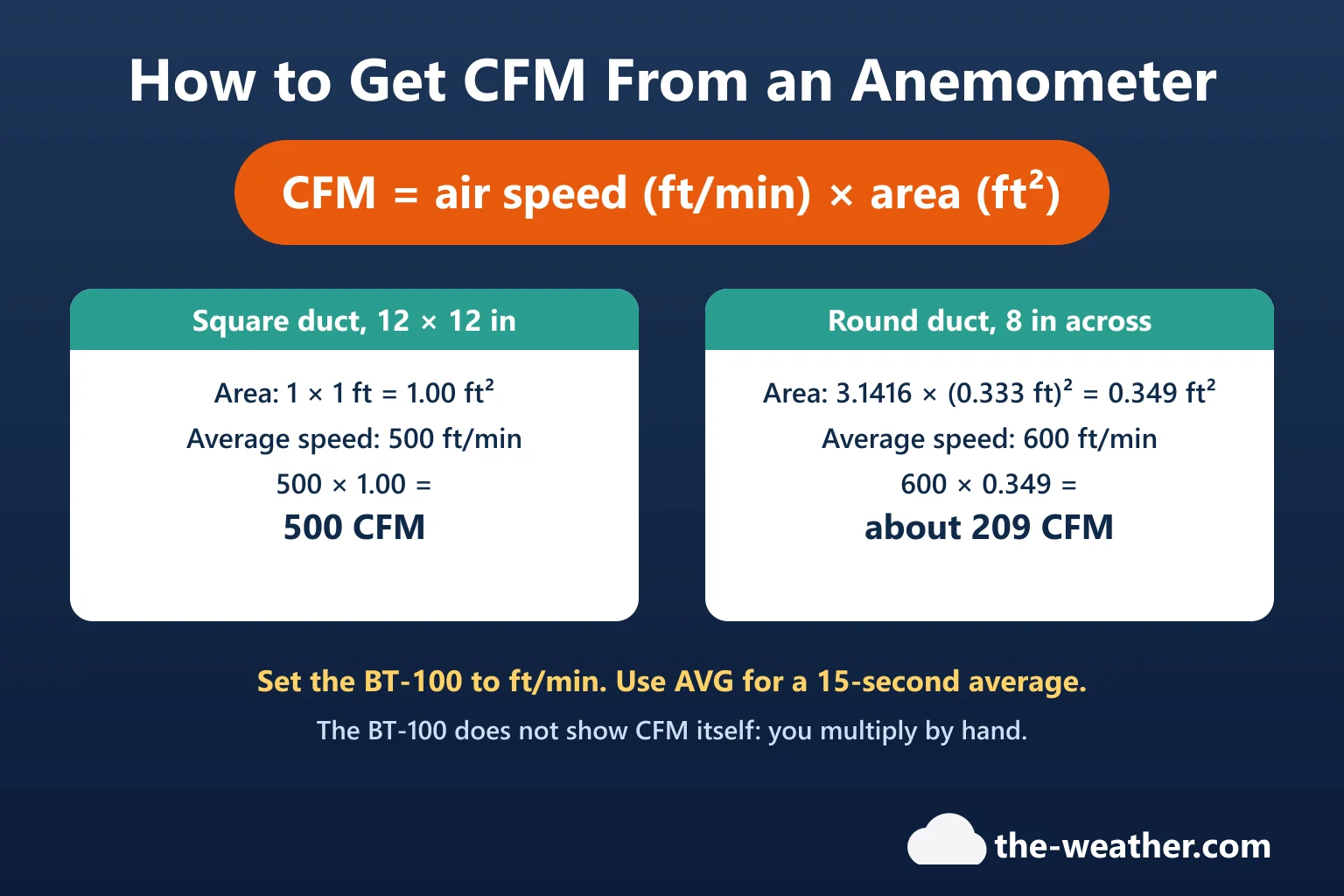
Short answer: CFM = average air speed in feet per minute × the opening's area in square feet. Set the anemometer to ft/min, measure the air speed (use the average function), work out the area (width × height ÷ 144 for a rectangle in inches, or 3.1416 × radius² ÷ 144 for a round duct in inches), and multiply. Example: 500 ft/min through a 12 × 12 inch duct (1 ft²) is 500 CFM.
Editorial Research
- Written by
- Lena Thornton, Weather Station Analyst & CWOP Contributor
- Based on
- The airflow formula and CFM answers BTMETER gives on its BT-100 and BT-100APP Amazon listings, BTMETER's BT-100 manual (units, accuracy, AVG), and NOAA's definition of the international foot; the worked examples are our own arithmetic
- Hands-on testing
- Not performed by The-Weather.com
- Research last verified
- October 22, 2026
The Formula
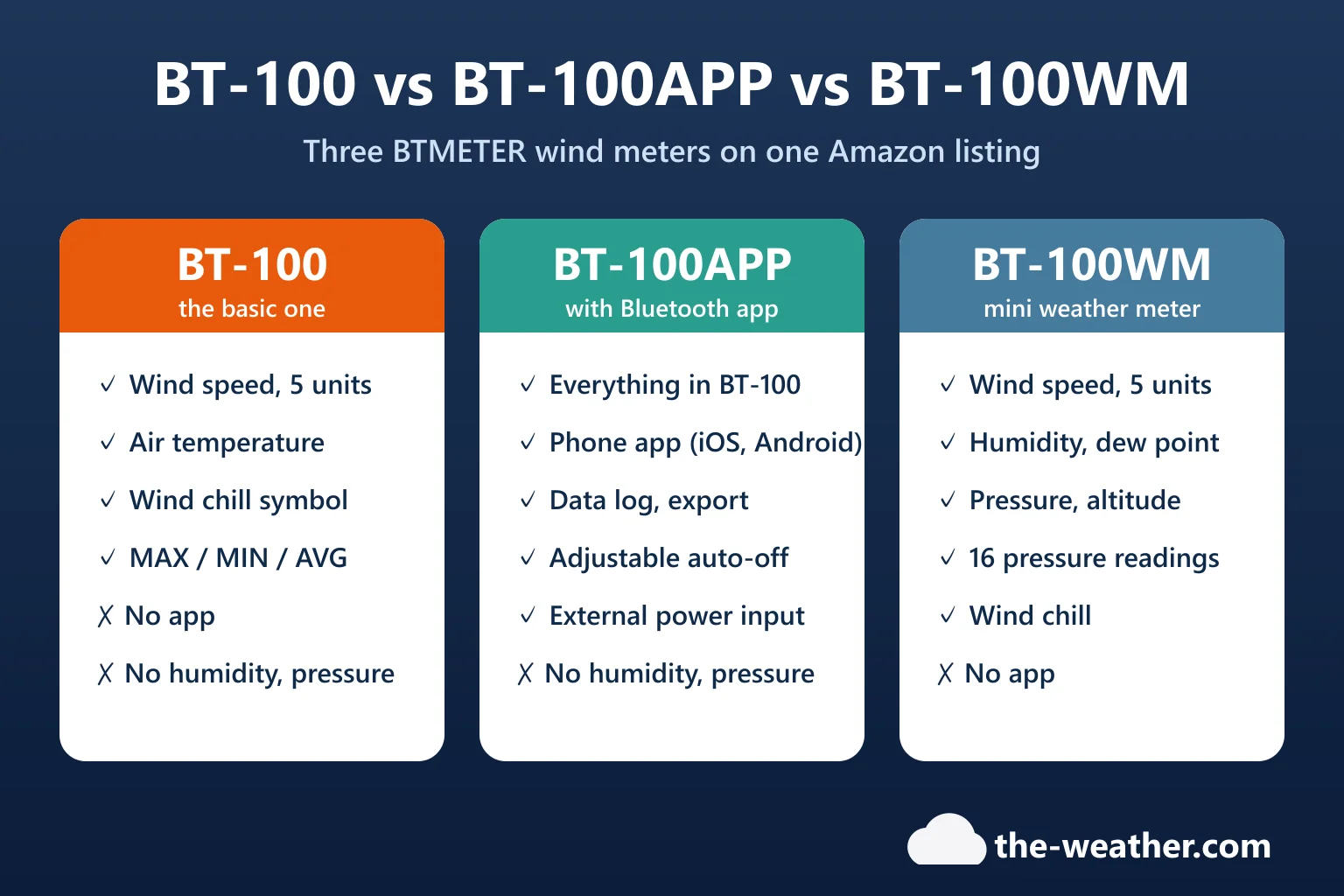
BTMETER puts it on its own listings. The BT-100 listing says "Air Flow in CFM (Q)=Wind speed(V) x Duct Cross Sectional Area(A)"; the BT-100APP listing spells it out as "Airflow (CFM) = Average Air Velocity (FPM) × Duct Cross-Sectional Area (ft²)". And in its FAQ on the BT-100 listing, BTMETER confirms the meter "can't directly display CFM airflow volume reading - manual calculation will be required". Asked whether it can be used at an air handler's inlet filter, BTMETER answers yes, with the same note: you calculate the CFM yourself. So the meter gives you one half of the sum; a tape measure gives you the other.
Step by Step
- Set the unit to ft/min. On the BT-100, press UNIT until ft/min shows (its range is 99 to 5,860 ft/min, per the manual).
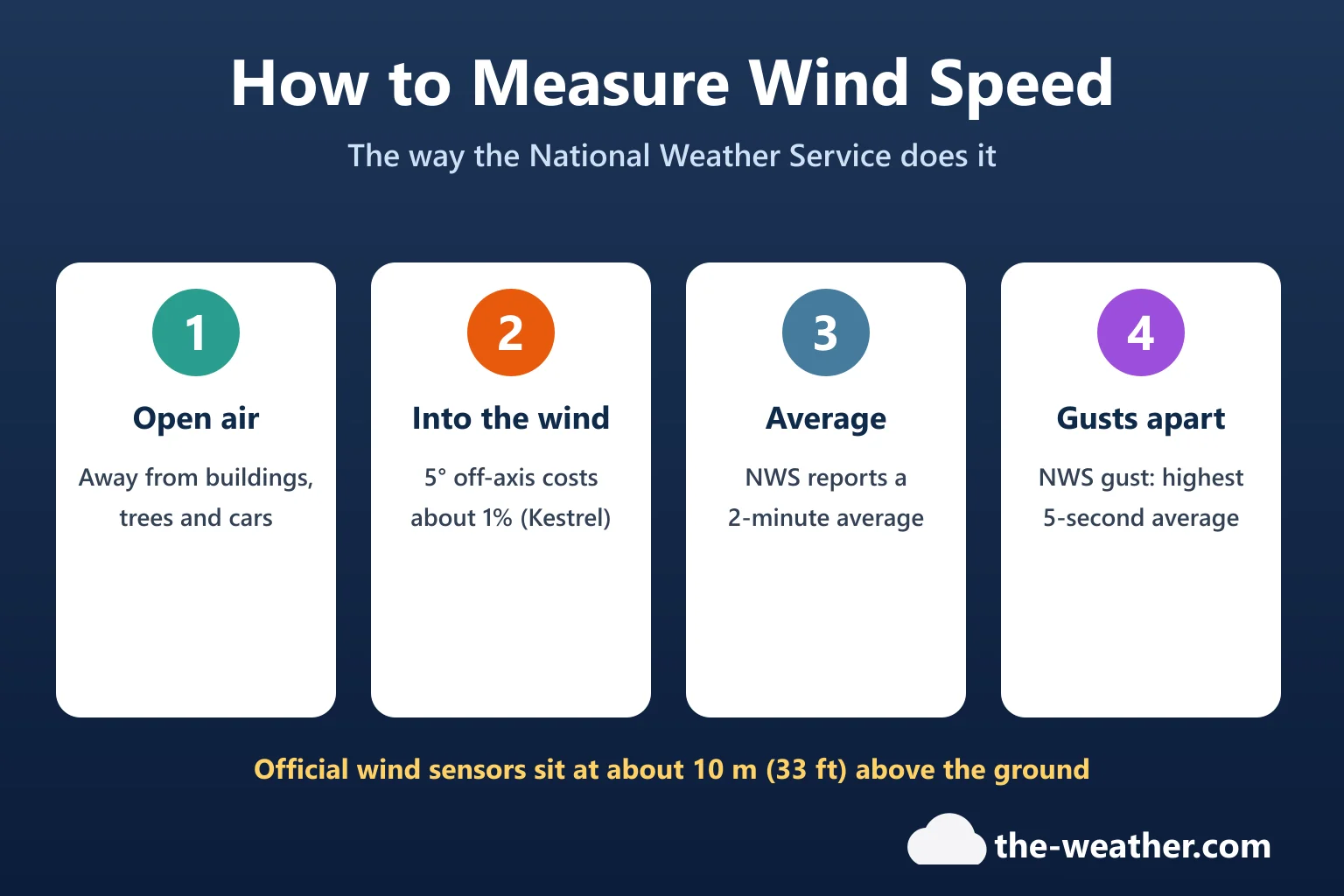
- Measure the opening. The size of the opening you hold the meter at, in inches: an open duct end, a vent or register face, or a filter opening. The BT-100 is about 6.5 x 3.3 inches with a large fan head (BTMETER's FAQ), so it will not fit inside a small duct; you measure where the air comes out.
- Work out the area in square feet.
- Rectangle: width × height in inches ÷ 144.
- Round: 3.1416 × (diameter ÷ 2)² in inches ÷ 144.
- Measure the air speed at several spots. Air moves faster in the middle of an opening than near the edges, so one reading in the center times the full area can overstate the airflow. Hold the fan square to the airflow and take an AVG reading (on the BT-100 it averages over 15 seconds) in the center and near each edge, then average those numbers. The BT-100's manual range starts at 99 ft/min (the listing says 59), so very weak airflow may not register.
- Multiply: average ft/min × ft² = CFM.
The anemometer only measures speed; the CFM is your own calculation. At a grille or louver, the open area is smaller than the outside size, so the full grille size will overstate CFM; an open duct end with a known inside size gives a cleaner number.
Worked Examples (Our Arithmetic)
| Opening | Area | Air speed | Airflow |
|---|---|---|---|
| Square duct 12 × 12 in | 144 ÷ 144 = 1.00 ft² | 500 ft/min | 500 CFM |
| Rectangular vent 10 × 6 in | 60 ÷ 144 = 0.417 ft² | 400 ft/min | about 167 CFM |
| Round duct 8 in | 3.1416 × 16 ÷ 144 = 0.349 ft² | 600 ft/min | about 209 CFM |
| Round duct 6 in | 3.1416 × 9 ÷ 144 = 0.196 ft² | 700 ft/min | about 137 CFM |
The air speeds are example numbers, not recommended values for your system.
Reading in m/s or mph? Convert First
If your meter shows another unit, convert to ft/min before you multiply. One foot is exactly 0.3048 meters (the international foot, NOAA), which gives these factors:
| From | To ft/min, multiply by | Example |
|---|---|---|
| m/s | 196.85 | 2.5 m/s = about 492 ft/min |
| mph | 88 | 5 mph = 440 ft/min |
| km/h | 54.68 | 9 km/h = about 492 ft/min |
How Exact Is a Handheld CFM Number?
- The meter's own margin: BTMETER's manual gives ±5% of the reading for the BT-100. That margin carries straight into your CFM: 500 CFM could be 475 to 525 CFM (our arithmetic).
- One reading is not enough (our tip): see step 4. The BT-100 manual does not say whether AVG keeps averaging while you move the meter, so average separate readings yourself.
- Grilles and louvers (our tip): see the note under the steps. A grille's open area is smaller than its outside size.
- Best use (our view): comparing rooms, checking before and after a filter change, or finding a weak vent. For balancing a whole system, call an HVAC technician.
Which Meter Did We Base This On?
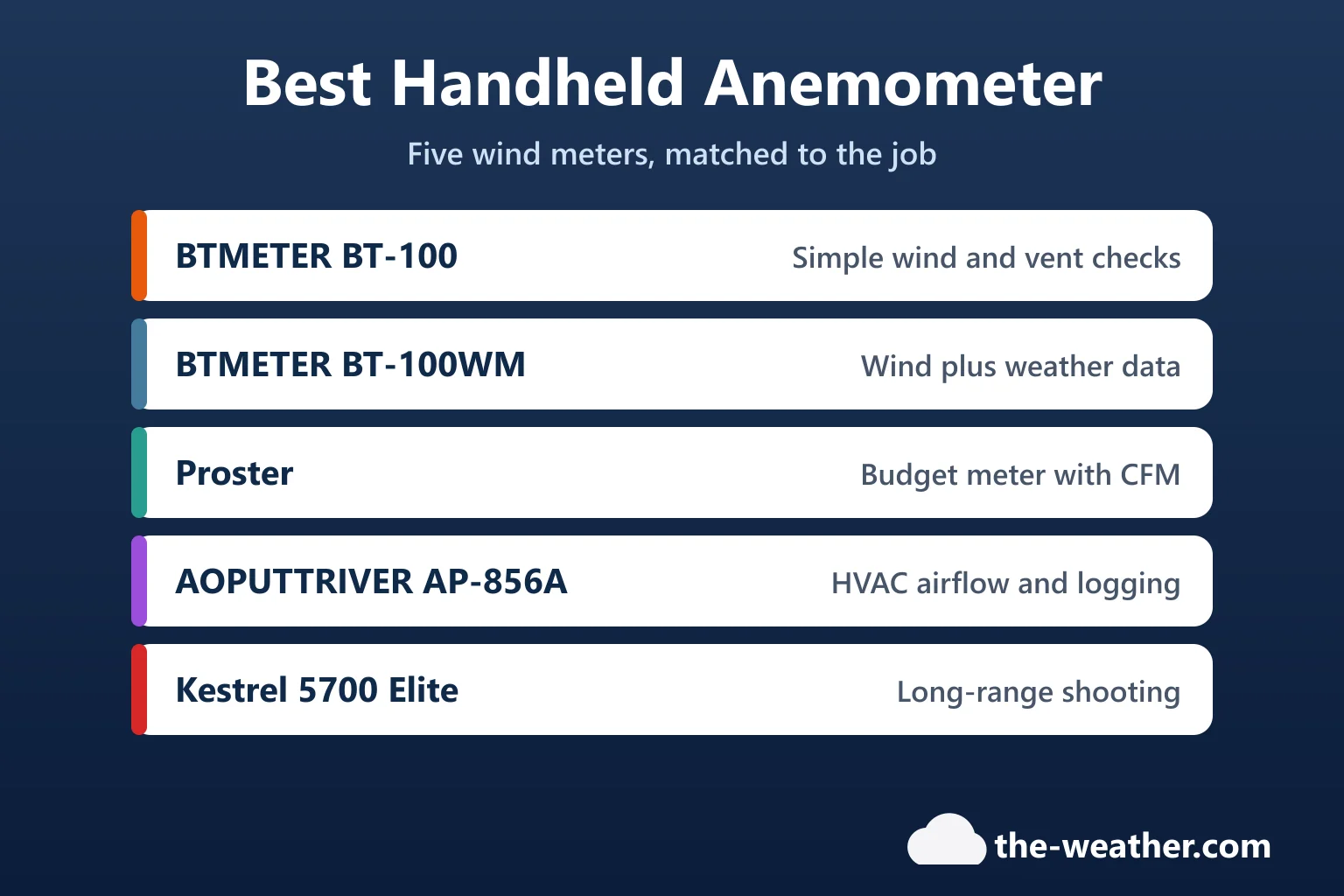
The steps above follow the BTMETER BT-100, a vane anemometer with an ft/min setting and a 15-second average. It measures the air speed; the CFM calculation is yours. See our BT-100 review, the BT-100 manual in plain English, our best handheld anemometer picks, or our anemometer guide for other types.
BTMETER BT-100 on Amazon. Affiliate link: we may earn a commission if you buy through it, at no extra cost to you.
CFM and Anemometer FAQ
How do you calculate CFM with an anemometer?
Measure the average air speed in feet per minute, measure the opening's area in square feet, and multiply them: CFM = ft/min × ft².
Does the BTMETER BT-100 show CFM?
No. BTMETER says it cannot display CFM directly; you calculate it from the ft/min reading and the duct's cross-section.
How do I find the area of a round duct in square feet?
Take half the diameter in inches, square it, multiply by 3.1416 and divide by 144. An 8-inch duct is about 0.349 square feet.
How do I convert m/s to ft/min?
Multiply by 196.85. For mph, multiply by 88; for km/h, by 54.68.
How accurate is a CFM number from a handheld anemometer?
No better than the meter: the BT-100's manual says ±5% of the reading. Uneven airflow across the opening adds more uncertainty, so measure several spots and average.
Update Log
- October 22, 2026: First version.
Sources
- BTMETER BT-100 Amazon listing and FAQ (ASIN B07J64TCBQ) and BT-100APP listing (ASIN B07JVNYNB3), read October 22, 2026
- BTMETER: Anemometer instruction manual, BT-100 (PDF)
- NOAA National Geodetic Survey: the international foot (1 foot = 0.3048 meter)