
As an Amazon Associate, I earn from qualifying purchases.
In this article 11 sections
The forecast says 15°F, but the app shows "feels like -2°F". So which one freezes your pipes, your car battery and your tomatoes? Here is what the wind chill really measures, and the one thing it never does.
Short answer: wind chill is how cold it feels on skin, for people and animals. It does not make water, pipes, plants or cars colder than the real air temperature. The National Weather Service says objects only cool down faster in the wind, and "will NOT cool below the actual air temperature". So water only freezes when the air itself is at or below 32°F.
Editorial Research
- Written by
- Lena Thornton, Weather Station Analyst & CWOP Contributor
- Based on
- National Weather Service wind chill chart and cold weather FAQ, and winter injury information from University of New Hampshire Extension
- Research last verified
- October 24, 2026
What Wind Chill Actually Measures
Your body keeps a thin layer of warm air right next to your skin. On a calm day, that layer stays put and works like a tiny blanket. Wind blows it away, again and again, so your skin keeps losing heat.
The National Weather Service describes the wind chill as how cold people and animals feel outside, based on how fast exposed skin loses heat to wind and cold. As the wind gets stronger, heat leaves your body faster and it feels colder.
The NWS formula only works for temperatures at or below 50°F and wind speeds above 3 mph. On a calm day, or a mild one, there is no wind chill at all.
Want the number for your own forecast? Use our wind chill calculator. It uses the same NWS formula.
Can Wind Chill Freeze Water?
No. Water freezes when its temperature drops to 32°F, and wind can only bring it down to the temperature of the air around it.
So on a 36°F day with a 30 mph wind, the wind chill is about 23°F, but a puddle, a dog bowl or a bucket of water does not freeze from the wind. On a 25°F day it will freeze, with or without wind. The wind just makes it happen sooner.
Can Wind Chill Freeze Pipes?
Not below the air temperature, but it does speed things up. The National Weather Service says the only effect of wind chill on objects such as water pipes and car radiators is that they cool down faster. They will not cool below the actual air temperature.
That still matters. A pipe in a drafty crawl space or on an outside wall reaches the outdoor temperature sooner when cold wind blows through the gaps. If the air is below freezing, that pipe can freeze faster than you expect.
- Seal drafts around pipes in crawl spaces, garages and outside walls.
- Insulate pipes in unheated spaces.
- Watch the real temperature forecast, not the "feels like" number, to decide when pipes are at risk.
More winter home tips: does cold weather affect your water heater?
Can Wind Chill Affect Your Car?
The NWS uses a car as its own example: if the air is -5°F and the wind chill is -31°F, your car's radiator will not drop lower than -5°F.
So the wind chill number does not decide whether your antifreeze, battery or windshield washer fluid can handle the night. The real low temperature does. The wind only means your car gets cold faster after you park it.
Does Wind Chill Affect Plants?
Not in the way it affects you. Plants do not make their own body heat, so wind chill does not apply to them. Frost and freeze damage depend on the actual temperature of the plant and the air.
Wind does cause a different winter problem: drying. University of New Hampshire Extension explains that evergreens can lose more water through their needles and leaves than their roots can take up when the ground is frozen. Wind speeds up that water loss. The result is brown, "burned" foliage, often worst on the outer, most exposed leaves. UNH Extension calls this winter burn.
For frost on garden plants, our page on frost advisories and freeze warnings explains what each alert means.
What About Pets?
Pets feel the wind chill just like we do. The National Weather Service says wind chill applies to people and animals. Short walks, a sheltered spot out of the wind and fresh water that has not frozen go a long way. If you are shivering after five minutes, your dog probably is too.
When Does Wind Chill Become Dangerous?
The NWS gives one clear marker: at a wind chill of about -19°F, exposed skin can freeze in 30 minutes. The colder the wind chill, the faster frostbite can happen.
- Cover your face, ears and hands.
- Dress in layers and keep clothing dry.
- Limit time outside when the wind chill is very low.
Since October 1, 2024 the National Weather Service uses the names Cold Weather Advisory and Extreme Cold Warning for dangerous cold, with criteria set by each local office. Our page on watch vs warning vs advisory explains how much time each alert gives you.
Seeing Wind Chill on Your Weather Station
Many home weather stations with a wind sensor show wind chill on the display. They use the outdoor temperature and the wind speed from your own backyard, so the number can be quite different from the airport a few miles away. A sensor sheltered by a fence or a house will read less wind, and a lower wind chill effect, than an open field.
If you want accurate wind readings, mounting height matters. Our page on how to measure wind speed explains averages, gusts and placement.
Wind Chill FAQ
Can wind chill freeze water?
No. Water freezes at 32°F, and wind can only cool it down to the actual air temperature. Wind makes water reach that temperature faster, but it cannot push it lower.
Can pipes freeze because of wind chill?
Not below the air temperature. The National Weather Service says objects such as pipes only cool faster in the wind. If the air is below freezing, wind blowing through gaps can make an exposed pipe freeze sooner.
Does wind chill affect cars?
Only how fast they cool. NWS example: with an air temperature of -5°F and a wind chill of -31°F, a car radiator will not drop below -5°F.
Does wind chill affect plants?
No, plants do not feel wind chill. Wind can dry out evergreens in winter when the ground is frozen, which causes brown, burned-looking foliage.
Is wind chill a real temperature?
No. It is an index of how cold it feels on exposed skin. A thermometer in the wind still shows the air temperature.
Update Log
- October 24, 2026: First version, based on National Weather Service wind chill information.
Sources
- National Weather Service: Wind Chill Chart
- National Weather Service: Cold Weather FAQs
- University of New Hampshire Extension: Winter Burn on Evergreens
- National Weather Service: Cold hazard simplification (October 2024)
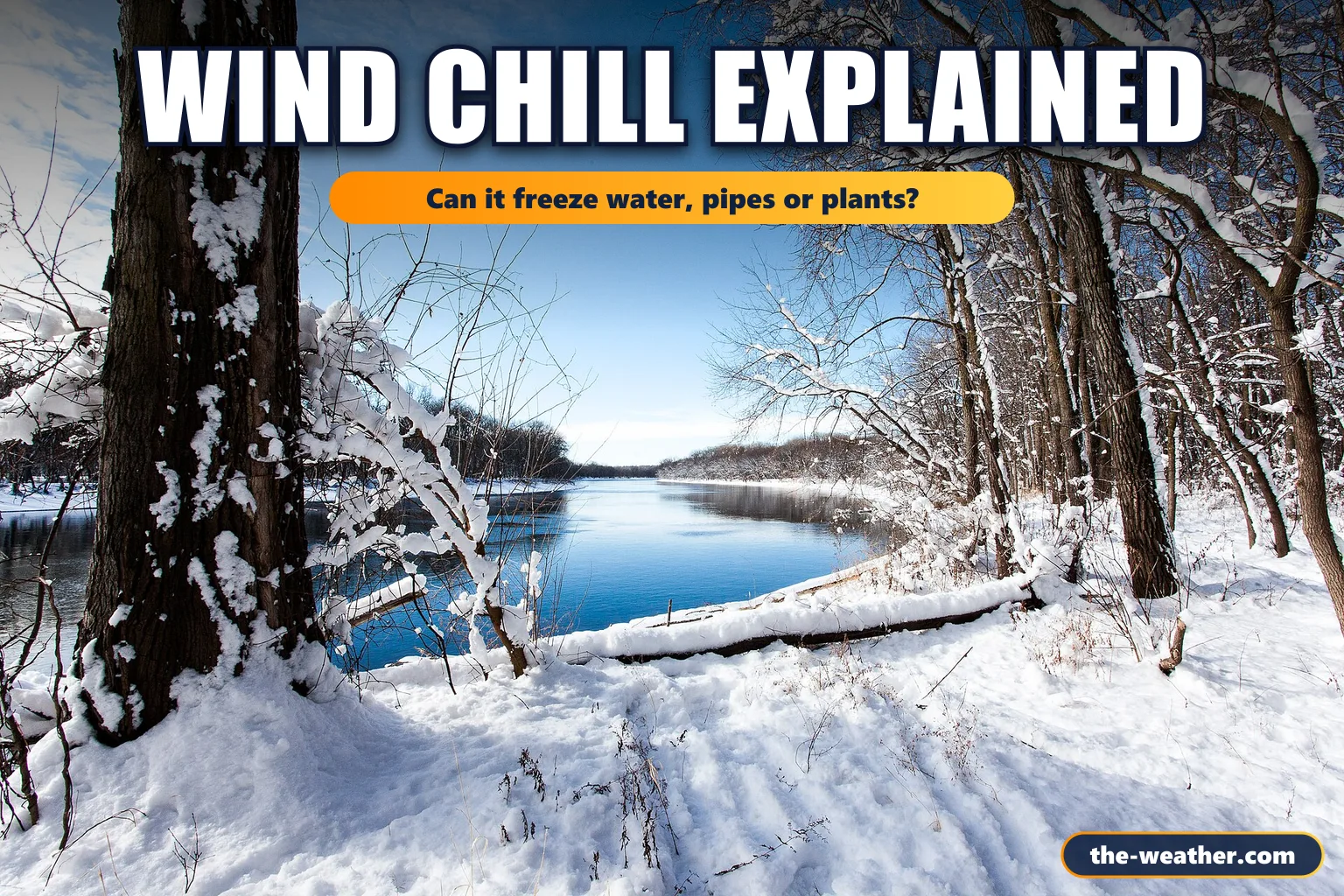
- Photo: National Park Service: Mississippi River at Crosby Farm Regional Park, Saint Paul, Minnesota (February 2016), public domain, via Wikimedia Commons
More cold weather basics: Wind chill calculator · Frost advisory vs freeze warning · Sleet vs freezing rain vs snow