
As an Amazon Associate, I earn from qualifying purchases.
In this article 9 sections
Same storm, same temperature on your porch thermometer, and yet one town gets fluffy snow, the next gets bouncing ice pellets and the one after that wakes up to trees glazed in ice. The difference happens thousands of feet above your head. Here is how snow, sleet and freezing rain form, which one is the most dangerous, and how to tell them apart from your window.
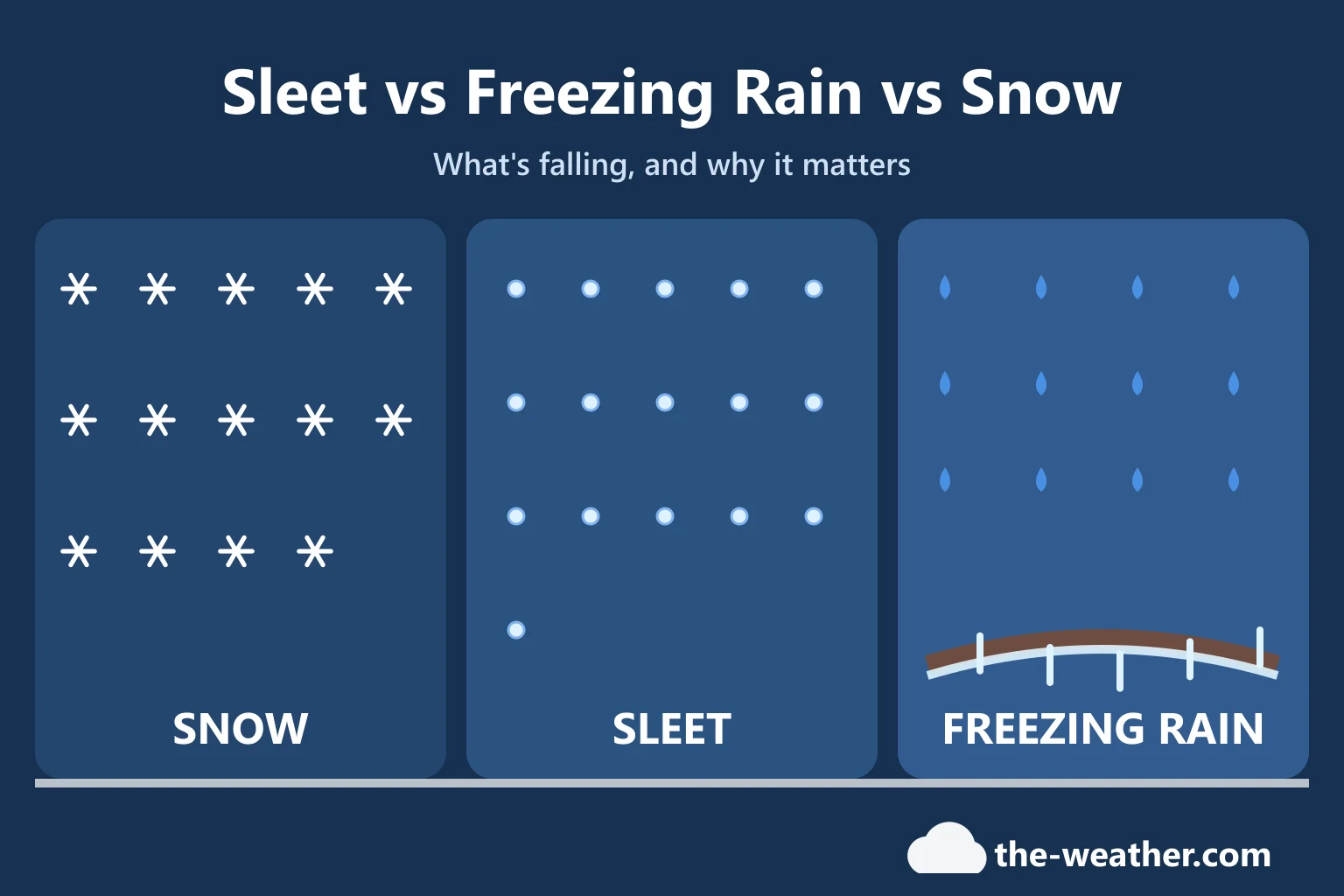
Short answer: snow stays frozen all the way down. Sleet is a snowflake that "partially melts and then refreezes" before it reaches the ground: small ice pellets that bounce. Freezing rain melts completely in a warm layer and only freezes when it hits the ground, a car or a power line, coating everything in ice (National Weather Service). Freezing rain is usually the most dangerous: ice can bring down trees and power lines.
Editorial Research
- Written by
- Lena Thornton, Weather Station Analyst & CWOP Contributor
- Based on
- National Weather Service pages on winter precipitation types (Amarillo), measuring freezing rain and sleet (Blacksburg), the NWS glossary, the NWS winter ice safety page and an NWS Des Moines information sheet on ice jams and flooding
- Research last verified
- October 21, 2026
It All Depends on the Warm Layer Above You
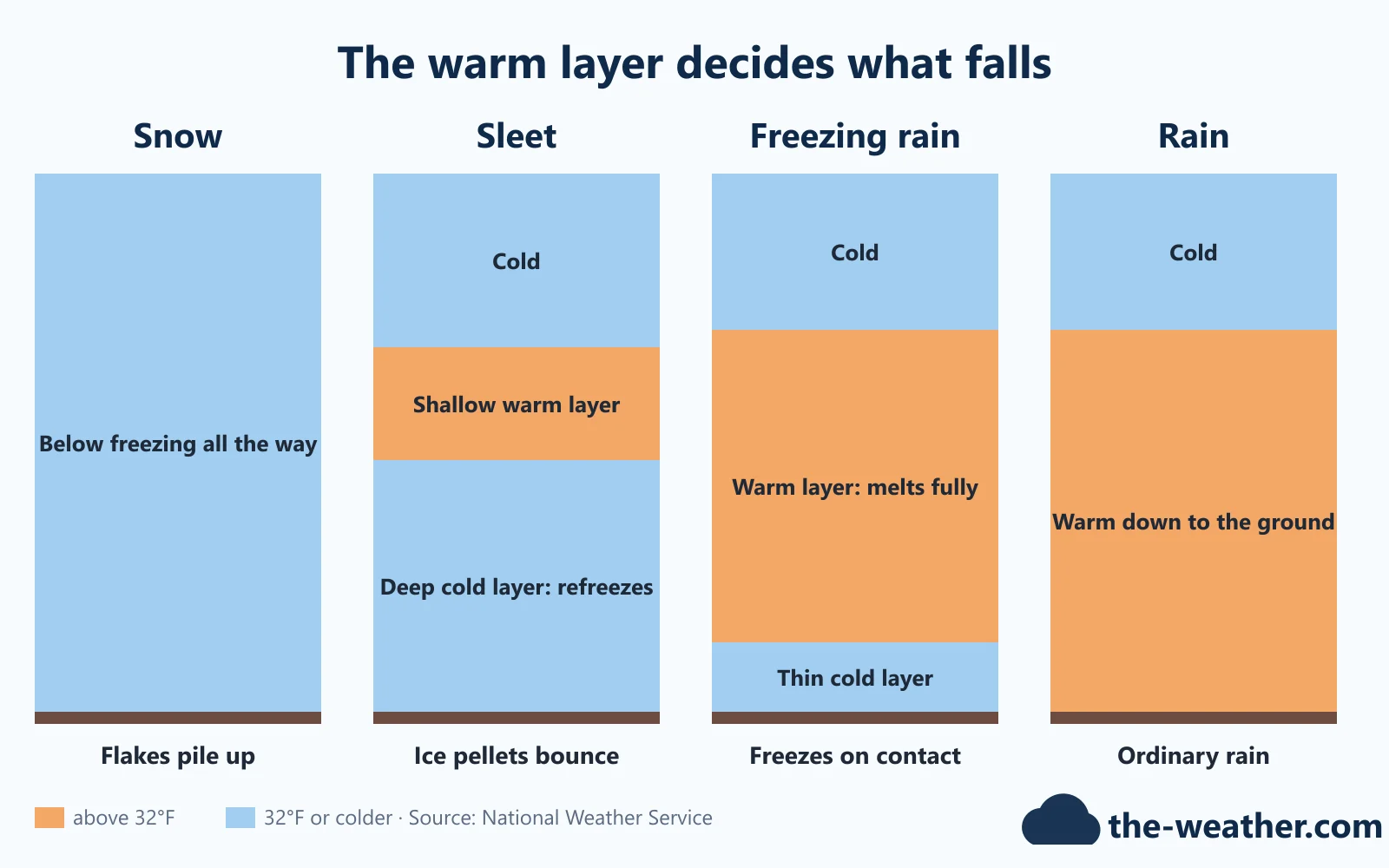
In winter, the NWS office in Amarillo notes, "more often than not, the main precipitation type that is observed is snow". What reaches you depends on whether the flakes fall through a layer of air above freezing on the way down, and how thick that layer is.
| Type | What happens on the way down | What you see |
|---|---|---|
| Snow | No melting, or only a very shallow layer that peaks below 33.8°F (1°C) | Flakes that pile up |
| Sleet | A shallow warm layer, typically peaking between 33.8 and 37.4°F (1 and 3°C) in the Amarillo example, partly melts the flake; a deep cold layer below refreezes it | Small ice pellets that bounce |
| Freezing rain | A warm layer melts the flake completely; only a thin freezing layer sits just above the ground | Rain that turns to a glaze of ice on everything it touches |
| Rain | The warm layer peaks above 37.4°F (3°C) and the air near the ground is above freezing | Ordinary rain |
The temperatures are examples from the National Weather Service office in Amarillo, not a simple test: what falls also depends on how deep the warm and cold layers are. Snow needs the air from cloud to ground at or below 32°F (0°C) "to ensure that no melting occurs", except for a very shallow melting layer that stays below 33.8°F (1°C).
Sleet vs Freezing Rain: The Key Difference
Both start as melted snow. The difference is where the water freezes. The NWS office in Blacksburg, Virginia puts it simply: with freezing rain, "the layer of freezing air is so thin that the raindrops do not have enough time to freeze" before they land. Sleet "is simply frozen raindrops and occurs when the layer of freezing air along the surface is thicker."
- Sleet is already ice when it lands. The NWS glossary calls it "pellets of ice composed of frozen or mostly frozen raindrops or refrozen partially melted snowflakes", and notes that the pellets usually bounce.
- Freezing rain is liquid when it lands and freezes on contact, building a coat of ice on roads, branches and wires.
Is Sleet Dangerous? And Why Freezing Rain Is Worse
Sleet can cover the ground too: the NWS glossary calls ice pellets covering the ground to a depth of half an inch or more "heavy sleet". But freezing rain is usually more dangerous, because the ice builds up on everything it touches. How bad it gets depends on how much ice accumulates and for how long. The NWS Blacksburg office explains that its ice "can rapidly add weight to tree branches and power lines, causing them to snap or break", and that it "can create slick spots on roadways" where drivers lose control with little or no warning. The NWS winter safety page adds that "heavy accumulations of ice can bring down trees and topple utility poles and communication towers."
That is why a big freezing rain event can mean days without power. Keep a way to hear alerts without electricity: a battery or crank NOAA weather alert radio keeps working when the power and internet are down.
Black ice: the hazard you cannot see
Black ice is not a type of precipitation but the result of one. The NWS describes it as "patchy ice on roadways or other transportation surfaces" that "is often clear (not white) with the black road surface visible underneath". It is "most prevalent during the early morning hours", for example after melted snow refreezes overnight. The same NWS page warns: "Bridges and overpasses are particularly dangerous because they freeze before other surfaces."
What Temperature Does Rain Freeze At?
Freezing rain arrives as liquid drops and freezes when it hits a surface that is cold enough, at or below freezing (32°F, 0°C). That is what makes it tricky: the air near the ground can be just below freezing while the air a few thousand feet up is well above it. Your thermometer may say 31°F while the "rain" falling on your windshield is liquid until it hits the glass.
Does Rain Melt Snow?
Less than most people think. According to an information sheet from the NWS office in Des Moines, Iowa, "rain will usually not add much heat to the process": "at 40 degrees, one inch of rain will only produce a tenth of an inch of added water from snow melt." Air temperature matters more. The bigger risk of rain on snow is flooding: frozen ground lets more water run straight off into streams.
How to Measure Sleet and Freezing Rain at Home
- Sleet: the NWS Blacksburg office says to slide a ruler "directly downward into the sleet until it reaches the ground" and read it to the nearest tenth of an inch, away from trees and buildings.
- Freezing rain (ice): measure the thickest and the thinnest ice on an object such as a branch or railing, then "add the two values together and then divide by two". That is your ice accumulation.
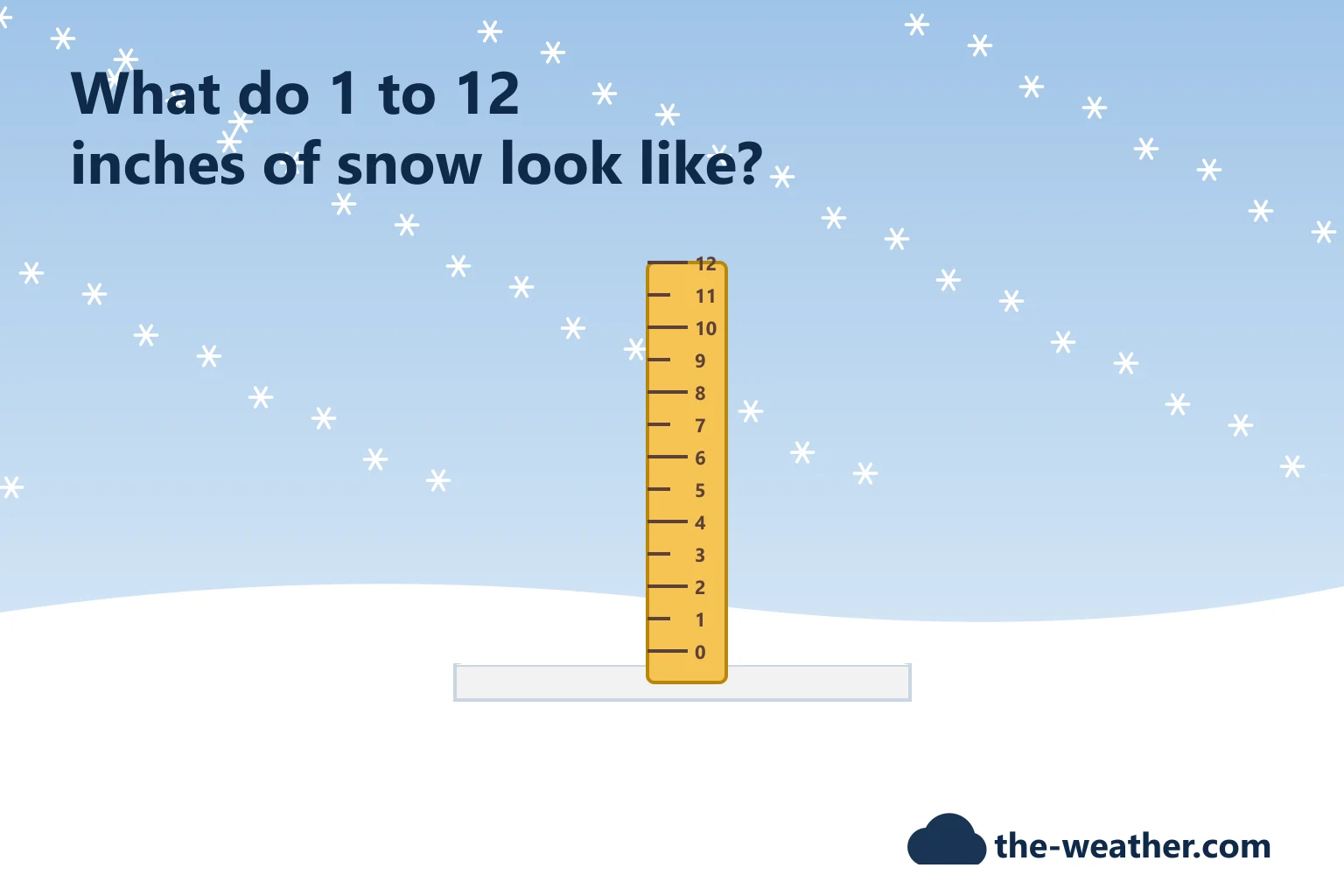
- Snow: see our guide on what 1 to 12 inches of snow look like and how to measure snow.
Sleet, Freezing Rain and Snow FAQ
What is the difference between sleet and freezing rain?
Sleet freezes into ice pellets before it reaches the ground; freezing rain falls as liquid and freezes when it touches the ground or other objects.
Is sleet dangerous?
It can cover the ground with ice pellets. Freezing rain is usually more dangerous, because a coat of ice can bring down trees and power lines.
Does rain melt snow?
A little. The NWS Des Moines office says that at 40°F one inch of rain only adds about a tenth of an inch of water from melting snow. Air temperature matters more.
Update Log
- October 21, 2026: First version, based on National Weather Service sources.
Sources
- National Weather Service Amarillo: Winter Precipitation Types
- National Weather Service Blacksburg: Freezing Rain and Sleet
- National Weather Service Glossary: Sleet
- National Weather Service: Ice Storms
- National Weather Service Des Moines: Ice Jams and Flooding (PDF)
More winter weather: Watch vs warning vs advisory · Frost advisory vs freeze warning · Why cold weather is dangerous