
As an Amazon Associate, I earn from qualifying purchases.
In this article 6 sections
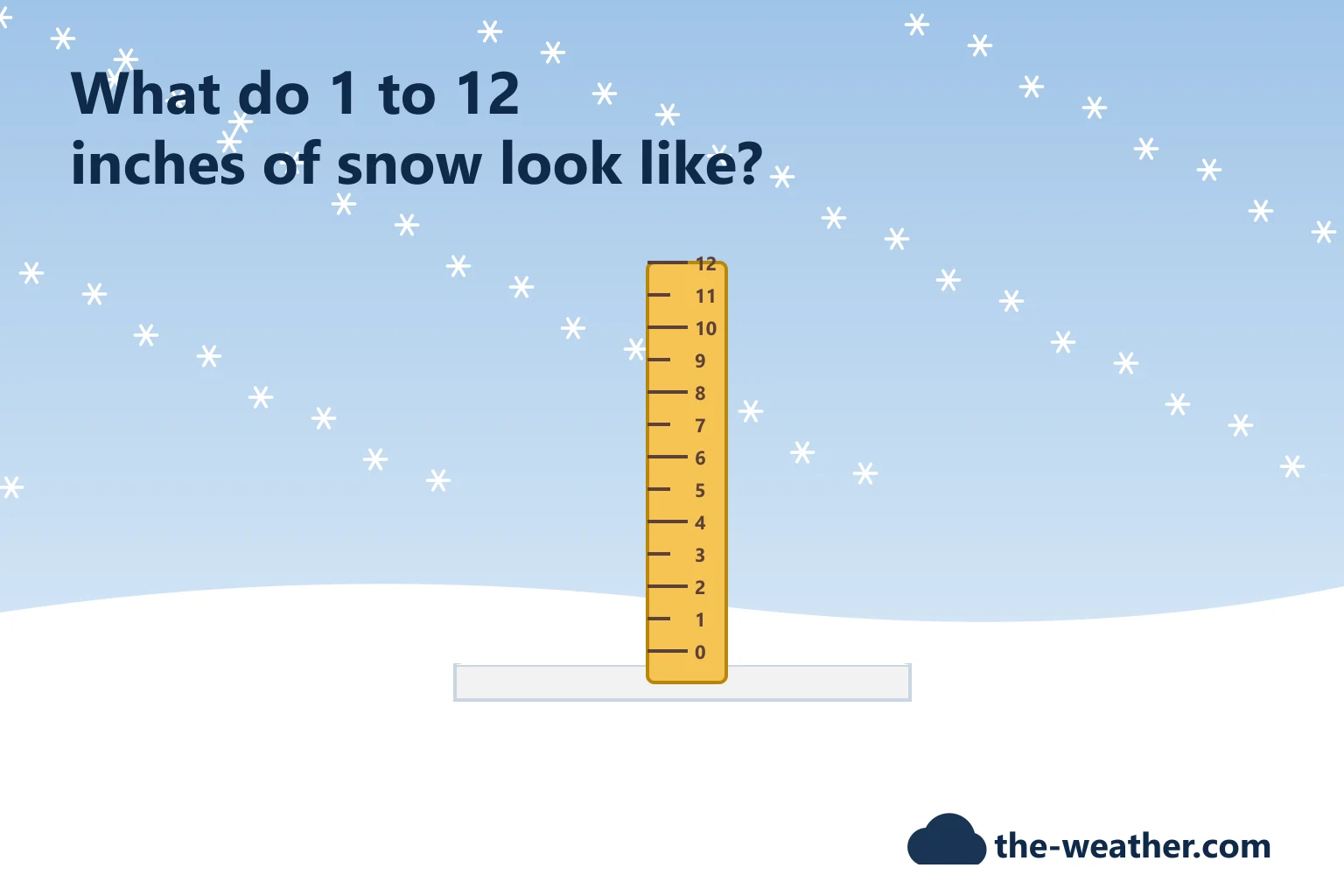
The forecast says "3 to 6 inches of snow" and your brain goes: is that a dusting or a day off? Inches of snow are hard to picture, and they are even harder to measure in a windy yard. Here is what 1 to 12 inches really look like, how much water is hiding in them, and how weather observers measure snow the official way.
Short answer: 1 inch of snow is about the width of a US quarter, 6 inches about the length of a dollar bill, and 12 inches a full ruler. How much water that snow holds varies: the old, rough rule of thumb is 10 inches of snow for 1 inch of water, which is not what to expect from every storm, and the National Weather Service says the ratio drops in wet snow near freezing and rises in deep cold (NWS La Crosse, Wisconsin). To measure new snow, use a flat white board and measure once a day to the nearest tenth of an inch (CoCoRaHS).
Editorial Research
- Written by
- Lena Thornton, Weather Station Analyst & CWOP Contributor
- Based on
- The CoCoRaHS guide to measuring snow, National Weather Service pages on snow ratios (La Crosse, Wisconsin) and snowmelt (Des Moines), NWS State College winter alert criteria, and the official sizes of the US quarter and dollar bill
- Research last verified
- October 21, 2026
What 1 to 12 Inches of Snow Look Like
These are visual comparisons to help you picture a forecast, not a way to measure snow. For measuring, see the official method further down.
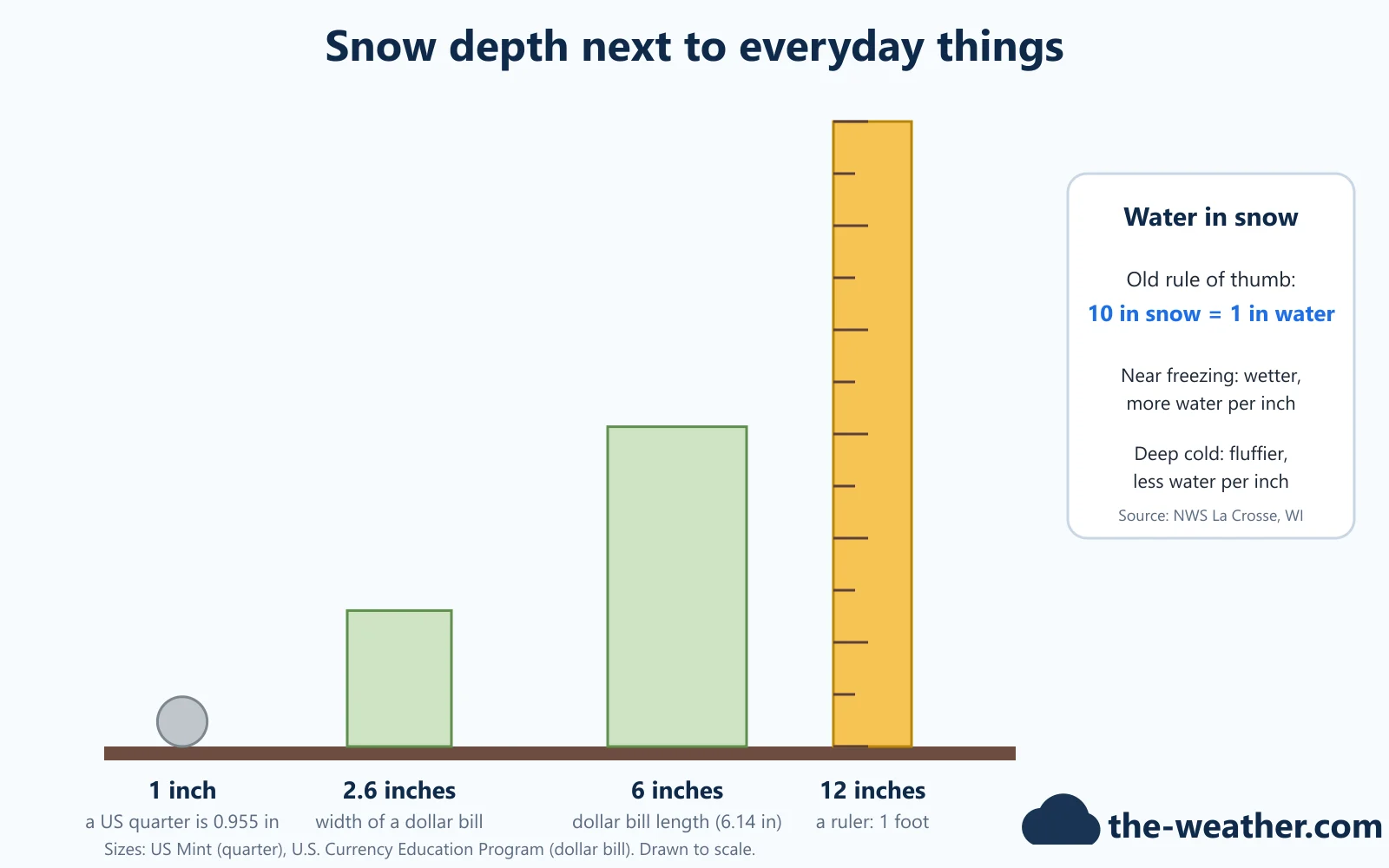
| Snow depth | Compare it with | Good to know |
|---|---|---|
| 1 inch | A US quarter is 0.955 inch across | CoCoRaHS observers write it down in tenths: 1.0 |
| 2 to 3 inches | A dollar bill is 2.61 inches wide | The NWS office in State College, Pennsylvania issues a Winter Weather Advisory at "2 or 3 inches depending on location" |
| 4 inches | A bit more than one and a half dollar bills wide | Near freezing, snow is wetter and holds more water per inch (NWS La Crosse) |
| 6 inches | A dollar bill is 6.14 inches long | In State College a Winter Storm Warning starts at "5 or 6 inches depending on location" |
| 8 to 9 inches | About three quarters of a ruler | A yardstick is easier than a short ruler at this depth |
| 12 inches (1 foot) | A standard ruler | With the old 10:1 rule of thumb, about 1 inch of water; wet snow holds more |
Coin and bill sizes: US Mint and the U.S. Currency Education Program. Alert criteria differ per NWS office; State College is one example. See watch vs warning vs advisory.
How Much Water Is in an Inch of Snow?
It depends on the snow. The NWS office in La Crosse, Wisconsin writes that "an old rule of thumb was that for every 10 inches of snow, there would be 1 inch of water (10:1)", but that "a 12:1 ratio might be more representative (on average) for the Upper Midwest". Two things change it:
- Temperature: "The warmer it is (closer to freezing), the lower the ratio will be." Wet, heavy snow holds more water per inch. "Deep cold, in general, promotes higher snow ratios": light, fluffy snow.
- Wind: strong wind breaks flakes apart, "leading to lower accumulations (lower snow ratios)".
Snow also gets denser as it sits. The NWS office in Des Moines notes that "on average in Iowa, one inch of fresh snowfall contains slightly less than a tenth of an inch of water", but "10 inches of snow remaining on the ground into early spring may contain as much as five inches of water". That is why a late-winter thaw can cause flooding.
How to Measure Snowfall at Home, the Official Way
First, two words that are easy to mix up. The National Weather Service measures them separately: snowfall is the "maximum amount of new snow that has fallen since the previous observation", and snow depth is "the total depth of snow (including any ice) on the ground", old and new snow together. Snow melts, settles and blows away, so the depth on the ground the next morning can be less than what fell during the storm. The NWS guidelines give an example: 4.2 inches fell, but only 2.6 inches were left on the board the next morning, and the correct snowfall to report is 4.2 inches.
CoCoRaHS (the Community Collaborative Rain, Hail and Snow Network) has a simple method:
- Make a snow board. "A snowboard is typically a flat piece of plywood painted white measuring at least 16" x 16"." Place it at ground level, away from the house: CoCoRaHS suggests "a distance of 2x the height of your house".
- Measure once every 24 hours. Push a ruler straight down to the board and read the depth. "Official snowfall measurement is in tenths of an inch", but CoCoRaHS adds that most rulers are marked in eighths or sixteenths of an inch: "Just enter what you can."
- Clear the board after your daily reading, so tomorrow you measure only new snow.
- Trace? "Less than a tenth of an inch is considered a 'trace'", and so is snow that melts as it lands.
- Huge storm? For very big snowfalls (20 inches or more), CoCoRaHS suggests "averaging several readings around your yard" and rounding to the nearest inch.
Measuring the water in the snow
If you have a standard 4-inch rain gauge, take a core: push the outer cylinder upside down into the snow on the board until the rim touches the board, then turn the board upside down while you slide the gauge off to the side, so the snow core stays in the gauge, and bring it inside. Melt it by setting the container in hot tap water (CoCoRaHS says not to use "direct heat from your stove") and pour the water into the inner measuring tube. Take the core after you measure the depth, because it disturbs the board. Our rain gauge guide shows which gauges have the inner tube you need.
Snow Depth FAQ
What does 3 inches of snow look like?
A little more than the width of a dollar bill (2.61 inches). In some places, such as State College, Pennsylvania, 2 to 3 inches is the level for a Winter Weather Advisory.
How much is a foot of snow?
12 inches, the length of a standard ruler. The old, rough 10:1 rule of thumb would make that about an inch of water, but real storms vary: wet snow holds more and dry snow less.
How much rain is in an inch of snow?
Usually around a tenth of an inch of water, but it varies: snow near freezing holds more water, snow in deep cold less. NWS Des Moines says fresh Iowa snow averages slightly less than a tenth of an inch of water per inch.
How do you measure snowfall?
On a flat white board at ground level, away from buildings. Measure the new snow once a day with a ruler, to the nearest tenth of an inch if you can, then clear the board.
What counts as a trace of snow?
Less than a tenth of an inch, or snow that melts as it lands.
Update Log
- October 21, 2026: First version, based on CoCoRaHS and National Weather Service sources.
Sources
- National Weather Service: Snow Measurement Guidelines (PDF)
- CoCoRaHS: How to Measure Snow
- National Weather Service La Crosse, WI: What Are Snow Ratios?
- National Weather Service Des Moines: Ice Jams and Flooding (PDF)
- National Weather Service State College: Watch, Warning and Advisory Criteria
- US Mint: Coin Specifications and US Currency Education Program: $1 note
More winter weather: Sleet vs freezing rain vs snow · Frost advisory vs freeze warning · Watch vs warning vs advisory