
As an Amazon Associate, I earn from qualifying purchases.
In this article 9 sections
Hot air rises. Everyone knows it, from the upstairs bedroom that is always too warm to the hot air balloon at the county fair. But why does it actually go up? The real answer has a small twist: the hot air does not lift itself. Gravity does the pushing.
Short answer: warm air is less dense than the cooler air around it: the same amount of space holds fewer air molecules. NOAA explains that density alone does not start the motion. Gravity pulls the cooler, denser air down; it "spreads out and undercuts the less dense air, which in turn forces the less dense air up". As the warm air rises it expands and cools, by 9.8°C per 1,000 meters for dry air, and that cooling is how clouds and thunderstorms form.
Editorial Research
- Written by
- Lena Thornton, Weather Station Analyst & CWOP Contributor
- Based on
- NOAA JetStream on parcel theory and lapse rates
- Research last verified
- October 24, 2026
Step 1: Warm Air Is Less Dense
Air is made of molecules that are always moving. Heat them up and they move faster and spread out. The same amount of air now takes up more space, so a cubic foot of warm air weighs a little less than a cubic foot of cool air. That is what "less dense" means.
Step 2: Gravity Does the Pushing
Here is the part most explanations skip. Warm air does not float up on its own. NOAA's JetStream explains it this way: gravity pulls cooler, denser air toward the Earth's surface. As that heavier air sinks, it spreads out and undercuts the lighter, warmer air, which "forces the less dense air up and into motion".
Think of a beach ball held under water. The ball does not climb by itself: the heavier water pushes in underneath and shoves it up. Warm air is the beach ball, the cooler air around it is the water.
The Hot Air Balloon Example
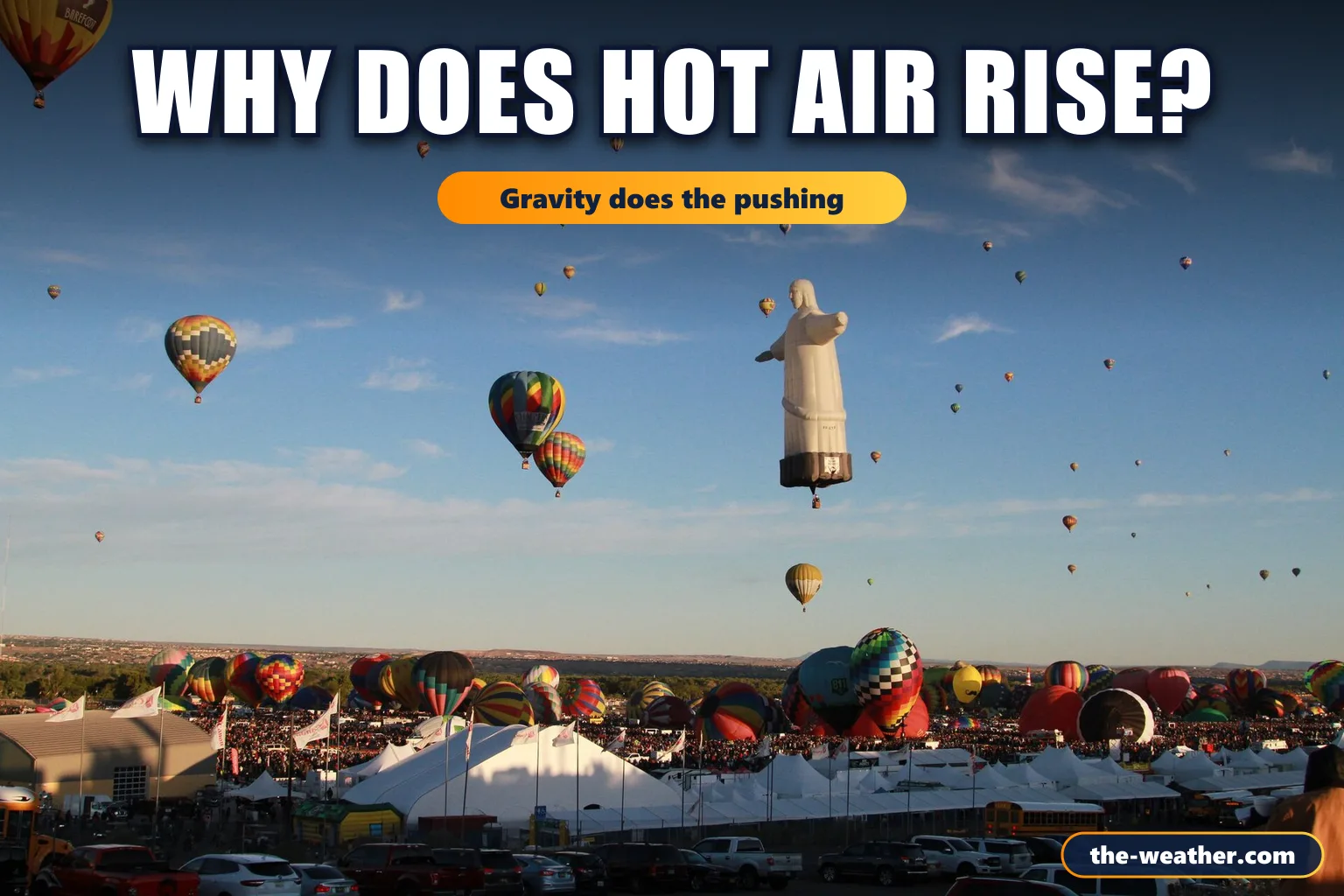
NOAA uses the classic example. A flame heats the air inside the balloon, making it less dense. The cooler air outside then sinks and undercuts the warmer air trapped in the balloon, and the whole thing lifts. Turn off the burner, the air inside cools, and the balloon comes back down.
Step 3: Rising Air Cools
As air rises, the pressure around it drops, so it expands. Expanding air cools. NOAA gives the numbers: unsaturated (dry) air cools at a fixed rate of 9.8°C per 1,000 meters (5.5°F per 1,000 feet). Saturated air cools more slowly, because water vapor condensing into droplets releases heat.
That is why the higher you go in the troposphere, the colder it usually gets, and why mountain tops are cold even on sunny days.
Why This Matters for Weather
Rising warm air is the engine behind a lot of everyday weather:
- Clouds: when rising air cools down to its dew point, the water vapor condenses into tiny droplets, and a cloud appears.
- Thunderstorms: on hot, humid afternoons, warm air can keep rising for miles. The heat released by condensation keeps it warmer than its surroundings, so it keeps going. That builds towering cumulonimbus clouds.
- Sea breezes: land heats up faster than water during the day. Warm air rises over the land and cooler air from the sea moves in underneath.
- Calm, cold nights: without sun, the ground cools, the air near it cools and becomes denser, and cold air settles in valleys and low spots. That is why the bottom of your yard can be the frostiest spot.
Hot Air Rising at Home
The same physics plays out in your house. Warm air collects upstairs and near the ceiling, while the floor stays cooler. A few practical effects:
- An indoor temperature sensor reads differently on a high shelf than at desk height. For a fair reading, place it around chest height, away from heaters and sunny windows.
- Attics get very hot in summer because warm air rises into them and gets trapped.
Why Does Hot Air Rise? FAQ
Why does hot air rise?
Because it is less dense than the cooler air around it. Gravity pulls the denser, cooler air down, and as it spreads out underneath it forces the warmer air up.
Does heat rise or does hot air rise?
Hot air rises. Heat itself moves in every direction; it is the warm, less dense air that gets pushed up by the cooler, denser air around it.
Why does rising air cool down?
Pressure drops with height, so rising air expands, and expanding air cools. NOAA gives 9.8°C per 1,000 meters for dry air; saturated air cools more slowly.
How does a hot air balloon work?
The burner heats the air inside, making it less dense. Cooler, denser air outside sinks and undercuts it, which lifts the balloon.
Why does warm air rising make clouds?
Rising air cools. When it cools to its dew point, water vapor condenses into droplets, and those droplets form a cloud.
Update Log
- October 24, 2026: First version, based on NOAA JetStream.
Sources
- NOAA JetStream: Parcel Theory
- Photo: U.S. Air Force / National Guard (Staff Sgt. Jamie Carrillo-Madrid): International Balloon Fiesta, Albuquerque (2019), public domain, via Wikimedia Commons
More weather basics: Layers of the atmosphere · What is an air mass? · Types of clouds