
As an Amazon Associate, I earn from qualifying purchases.
In this article 10 sections
Every rain shower, snowstorm and thunderstorm you have ever seen happened in the lowest few miles of air above your head. Above that, the atmosphere keeps going for thousands of miles, in layers that each behave in their own strange way. Here are the five layers of the atmosphere, from the ground up.
Short answer: from the ground up, the layers of the atmosphere are the troposphere (surface to about 7.5 miles, where almost all weather happens), the stratosphere (about 7.5 to 31 miles, home of the ozone layer), the mesosphere (about 31 to 50 miles, where most meteors burn up), the thermosphere (about 50 to 440 miles, where auroras and the International Space Station are) and the exosphere (about 440 to 6,200 miles). Heights from NASA; the boundaries move with latitude and season.
Editorial Research
- Written by
- Lena Thornton, Weather Station Analyst & CWOP Contributor
- Based on
- NASA's overview of Earth's atmospheric layers and NOAA JetStream on air parcels and lapse rates
- Research last verified
- October 24, 2026
The Five Layers at a Glance
| Layer | Height above the surface | Temperature as you go up | Known for |
|---|---|---|---|
| Troposphere | 0 to about 7.5 miles (12 km), on average | Gets colder | Almost all weather and clouds |
| Stratosphere | About 7.5 to 31 miles (12 to 50 km) | Gets warmer | The ozone layer |
| Mesosphere | About 31 to 50 miles (50 to 80 km) | Gets colder | Most meteors burn up here |
| Thermosphere | About 50 to 440 miles (80 to 700 km) | Gets warmer | Auroras, the International Space Station |
| Exosphere | About 440 to 6,200 miles (700 to 10,000 km) | Fades into space | The very thin outer edge |
Heights and temperature trends from NASA. They are averages: the layers are not sharp lines.
Troposphere: Where the Weather Lives
The troposphere starts at the ground and reaches, on average, about 12 kilometers (7.5 miles) up, according to NASA. NASA puts it simply: "Most of Earth's weather happens here." Almost all clouds, rain, snow and storms stay inside this layer.
In the troposphere, temperatures typically go down the higher you go. That is why mountain tops are colder than valleys. NOAA's JetStream gives the number for rising dry air: it cools at a fixed rate of 9.8°C per 1,000 meters (5.5°F per 1,000 feet). Saturated air cools more slowly, because condensation releases heat. That cooling is what turns rising, humid air into clouds. Read more in why does hot air rise?
The top of the troposphere is called the tropopause. It is not at the same height everywhere: it is higher over the warm tropics and lower over the poles, and it shifts with the seasons. The tallest thunderstorm clouds often flatten out against it, which gives a cumulonimbus its anvil shape. See cumulonimbus clouds.
Stratosphere: The Ozone Layer
NASA places the stratosphere between about 12 and 50 kilometers (7.5 and 31 miles). Here something surprising happens: the higher you go, the warmer it gets. The reason is the ozone layer, which sits in the stratosphere and absorbs ultraviolet light from the sun.
Because warm air sits on top of colder air, the stratosphere is very stable, with few clouds and little mixing. NASA calls it the highest part of the atmosphere that jet planes can reach.
Mesosphere: The Meteor Shield
From about 50 to 80 kilometers (31 to 50 miles) is the mesosphere. NASA notes that it "gets progressively colder with altitude", and that most meteors burn up in this layer. Those shooting stars on a clear August night? Most of them end their trip here.
Thermosphere: Auroras and the Space Station
NASA places the thermosphere between about 80 and 700 kilometers (50 and 440 miles). Temperatures increase with altitude here, because the very thin air absorbs strong radiation from the sun. You would still not feel warm: there are so few air molecules that they cannot carry much heat to you.
The International Space Station orbits in the thermosphere, and the northern and southern lights are sometimes seen in this layer too.
Exosphere: Where the Atmosphere Fades Out
The exosphere is the outermost layer, from about 700 to 10,000 kilometers (440 to 6,200 miles), according to NASA. The air is so thin that molecules can travel far without bumping into each other, and some escape into space. There is no hard line where the atmosphere ends.
What This Means for Your Weather Station
A backyard weather station measures the very bottom of the troposphere: the first few feet. Everything it reports, from temperature to barometric pressure, is shaped by the air above it. Pressure drops as you go up because there is less air above you, which is why stations show a "sea-level" pressure that corrects for your elevation.
The weather that reaches your station is steered by the upper troposphere: the jet stream and big air masses decide whether tomorrow is mild or bitter cold.
Layers of the Atmosphere FAQ
What are the five layers of the atmosphere in order?
From the ground up: troposphere, stratosphere, mesosphere, thermosphere and exosphere.
In which layer does weather happen?
In the troposphere, the lowest layer, which reaches about 7.5 miles (12 km) up on average. NASA says most of Earth's weather happens there.
Where is the ozone layer?
In the stratosphere, about 7.5 to 31 miles above the surface. The ozone absorbs ultraviolet light, which is why the stratosphere gets warmer with height.
Which layer is the coldest?
The mesosphere gets colder with altitude, and its upper part is the coldest region of the atmosphere.
Why does it get colder as you climb a mountain?
Because you are going up in the troposphere, where temperatures typically drop with height. NOAA says rising dry air cools by 9.8°C per 1,000 meters.
Update Log
- October 24, 2026: First version, based on NASA and NOAA information.
Sources
- NASA: Earth's Atmosphere, A Multi-layered Cake
- NOAA JetStream: Parcel Theory
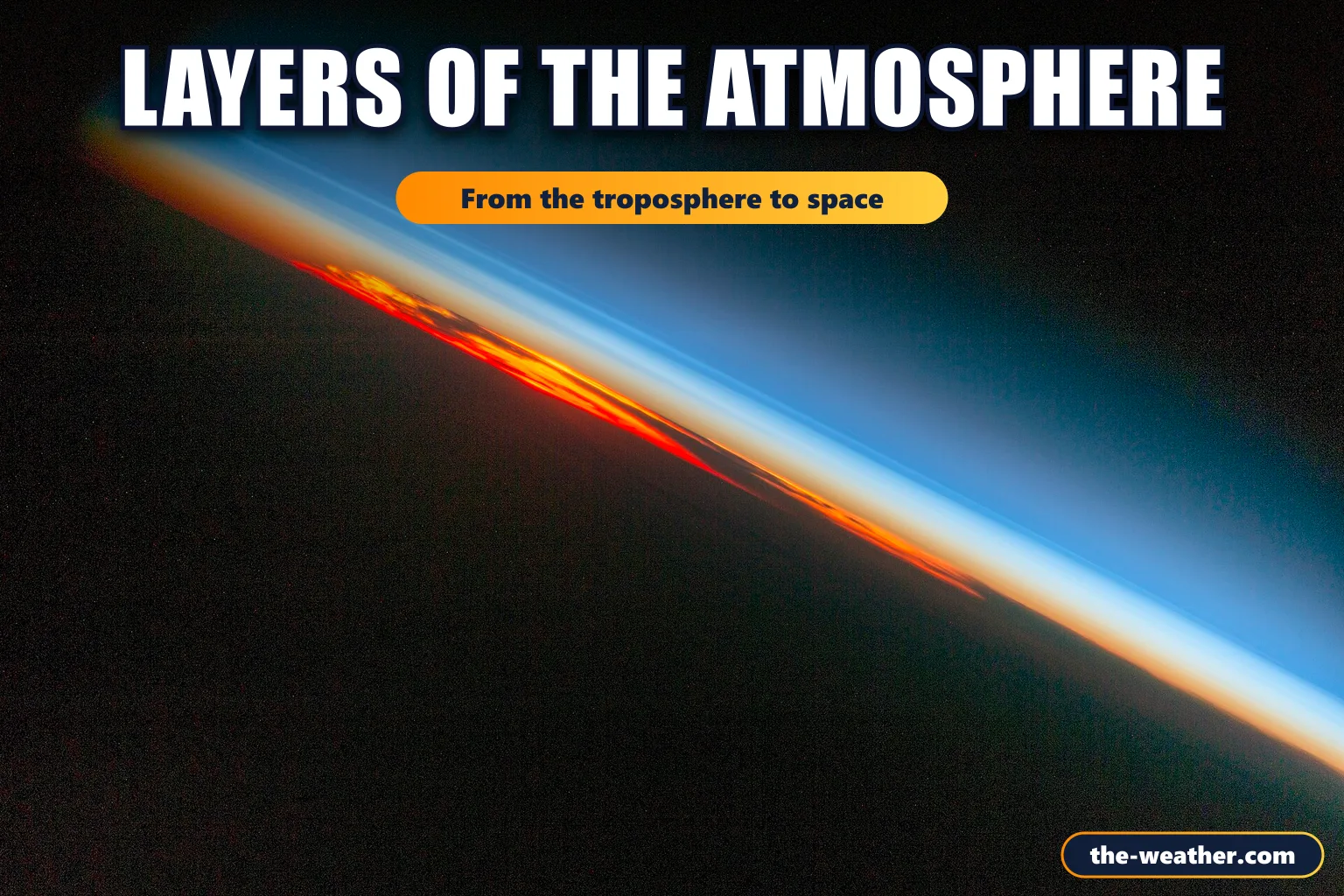
- Photo: NASA: sunset over the South Atlantic seen from the International Space Station, public domain, via Wikimedia Commons
More weather basics: Why does hot air rise? · What is an air mass? · Types of clouds