
As an Amazon Associate, I earn from qualifying purchases.
In this article 9 sections
"It snowed in April, so much for a warming climate." "It was 95°F all week, that must be climate change." Both sentences mix up the same two words. Weather and climate are related, but they answer different questions. Here is the difference in plain English, with real NOAA numbers.
Short answer: weather is what the atmosphere is doing right now and over the next days: temperature, rain, wind, clouds. NOAA says it "can change from minute-to-minute, hour-to-hour, day-to-day, and season-to-season". Climate is the long-term average of that weather in one place. NOAA describes it as "the average daily weather for an extended period of time at a certain location", and official U.S. climate averages cover 30 years. Weather is your mood today; climate is your personality.
Editorial Research
- Written by
- Lena Thornton, Weather Station Analyst & CWOP Contributor
- Based on
- NOAA National Ocean Service on weather and climate, and the NOAA NCEI 1991-2020 U.S. Climate Normals (monthly values for Miami, Phoenix, Minneapolis, Seattle and Anchorage airports)
- Research last verified
- October 24, 2026
Weather vs Climate: The Difference at a Glance
| Weather | Climate | |
|---|---|---|
| What it is | The state of the atmosphere at a time and place | The average weather of a place over a long period |
| Time scale | Minutes to weeks | Decades (U.S. normals use 30 years) |
| Typical question | "Do I need an umbrella tomorrow?" | "Is July usually rainy here?" |
| How it is described | Today's high, tonight's rain, this afternoon's wind | Normal highs and lows, average rainfall, extremes and how often they happen |
| Who tracks it | Forecasts, radar, your weather station | Long records from many stations, analyzed by NOAA's NCEI |
Definitions from NOAA's National Ocean Service and NCEI.
Five Differences Between Weather and Climate
- Time. Weather is about hours and days. Climate is about decades.
- Predictability. A forecast tells you about specific days ahead. Climate tells you what is normal for a season, not what happens on one date.
- What one day means. One cold day says something about the weather. Only many years of days say something about the climate.
- How you measure it. Weather is one reading or one forecast. Climate is built from thousands of readings averaged over a long period.
- What you do with it. Weather decides your jacket for today. Climate decides what kind of house, furnace, garden and clothes make sense where you live.
What a "Normal" Is
When the TV forecast says "5 degrees above normal", that normal is a climate number. NOAA's National Centers for Environmental Information (NCEI) calculates official U.S. Climate Normals as 30-year averages of measurements such as temperature and precipitation. The current set covers 1991 to 2020, and NCEI updates them every 10 years.
Here is what that looks like for five U.S. cities, straight from the 1991-2020 normals:
| City (airport station) | Normal January | Normal July | Normal yearly precipitation |
|---|---|---|---|
| Miami, FL | 68.6°F | 84.1°F | 67.4 in |
| Phoenix, AZ | 56.8°F | 95.5°F | 7.2 in |
| Seattle, WA | 42.8°F | 67.1°F | 39.3 in |
| Minneapolis, MN | 16.2°F | 74.3°F | 31.6 in |
| Anchorage, AK | 16.9°F | 59.6°F | 16.4 in |
Monthly average temperature (day and night together) and yearly precipitation, NOAA NCEI 1991-2020 U.S. Climate Normals.
That table is climate. A Minneapolis January day of 35°F is weather: unusually mild, but one day does not change the normal.
Weather vs Climate Examples
- Weather: "Thunderstorms in Minneapolis this evening." Climate: "June is the wettest month in Minneapolis, with a normal of about 4.6 inches."
- Weather: "Phoenix hit 110°F today." Climate: "Phoenix averages 95.5°F in July and only about 7 inches of rain a year."
- Weather: "Seattle is dry and sunny this weekend." Climate: "Seattle's wet season is late fall and winter; its normal November precipitation is more than six inches."
- Weather: "Snow is falling in Anchorage." Climate: "Anchorage has long, cold winters with a normal January around 17°F."
How Weather and Climate Are Related
Climate is made of weather. Add up 30 years of daily weather in one place, and you get its climate. That is why the two are easy to mix up: they use the same ingredients, just measured over very different time spans.
It also works the other way. The climate of a place sets the range of weather you can expect. Miami can have a chilly week, but it will not get Minneapolis-style January cold, because its climate does not "allow" it often. And when the climate slowly shifts, the weather you get on an ordinary day shifts with it.
A good comparison: weather is the single roll of the dice, climate is how the dice are loaded. One roll tells you little. Thousands of rolls tell you a lot.
Your Weather Station Measures Weather, Then Climate
A home weather station records weather: every few minutes it logs temperature, humidity, wind and rain. Keep it running for years, in the same good spot, and those records start to show your own backyard climate, including the small differences from the official station in town. Our page on local weather differences and microclimates explains why your yard can be a few degrees different.
Curious why the five cities above are so different? It mostly comes down to latitude, oceans and mountains. That is the topic of how latitude affects climate.
Weather vs Climate FAQ
What is the main difference between weather and climate?
Time. Weather is the condition of the atmosphere over minutes to weeks. Climate is the average weather of a place over a long period; official U.S. climate normals use 30 years.
Is climate just long-term weather?
More or less. NOAA describes climate as the average daily weather for an extended period at a certain location. It also includes how often extremes happen, not only the average.
Does a cold winter mean the climate is not warming?
No. One winter is weather. Climate trends show up only in long records over many years and many places.
How long is a climate period?
NOAA's official U.S. Climate Normals are 30-year averages. The current set covers 1991 to 2020 and is updated every 10 years.
Is humidity weather or climate?
Both. Today's humidity is weather. The average humidity of a place over decades is part of its climate.
Update Log
- October 24, 2026: First version, with NOAA definitions and 1991-2020 climate normals for five U.S. cities.
Sources
- NOAA National Ocean Service: What is the difference between weather and climate?
- NOAA NCEI: U.S. Climate Normals
- NOAA NCEI 1991-2020 monthly normals, stations USW00012839 (Miami), USW00023183 (Phoenix), USW00024233 (Seattle), USW00014922 (Minneapolis) and USW00026451 (Anchorage), retrieved October 24, 2026
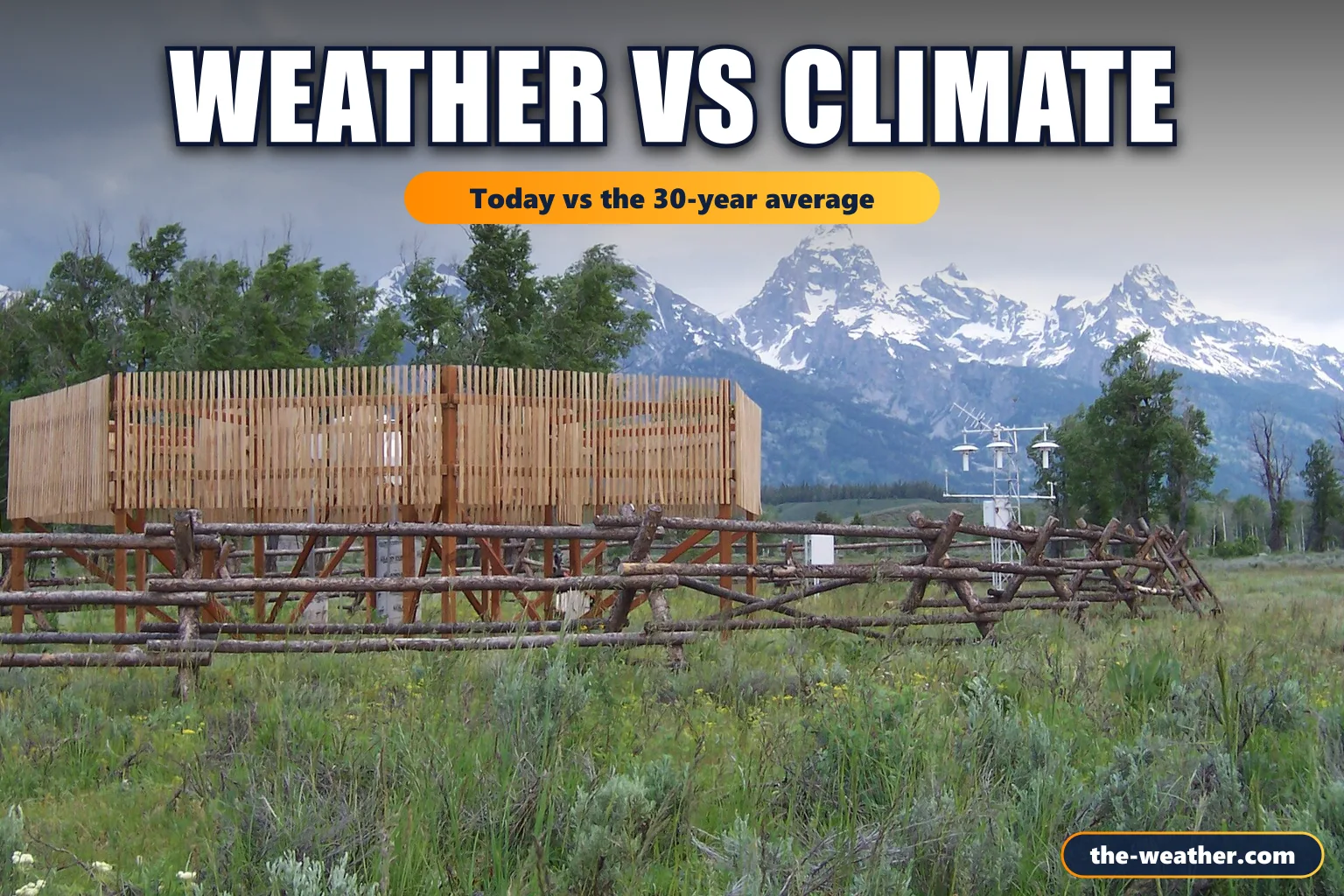
- Photo: NOAA Photo Library (Michael Boice, OAR/ARL/ATDD): U.S. Climate Reference Network station, public domain, via Wikimedia Commons
More weather basics: How latitude affects climate · What is an air mass? · What does chance of rain mean?