

We may earn a commission when you buy through links on this page, at no extra cost to you. Learn more
In this article 7 sections
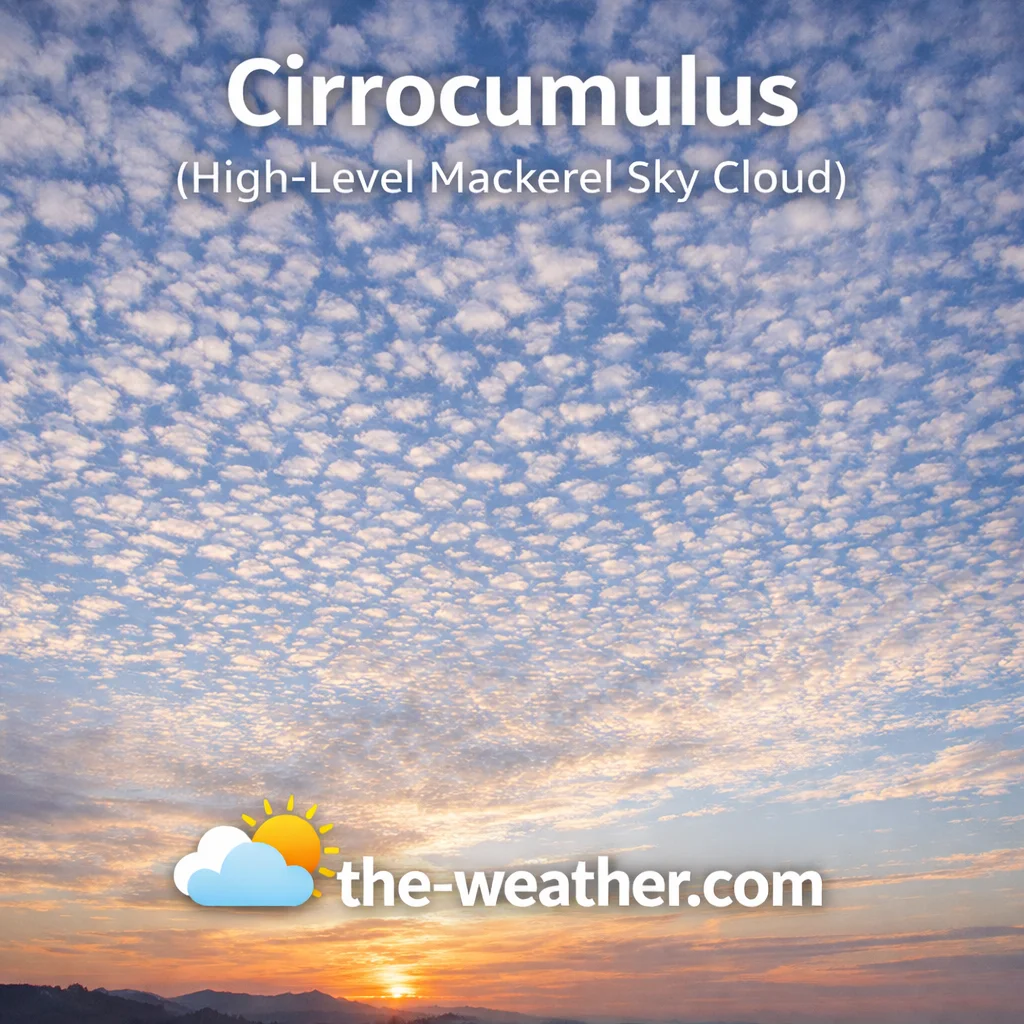
Short answer: Cirrocumulus (Cc) is a high, thin, white cloud made of tiny grains or ripples, without any gray shading. It forms at roughly 16,500 to 45,000 ft in mid-latitudes and consists almost entirely of ice crystals. It is the smallest-grained of all cloud types and usually lasts only a short time before it turns into a smoother veil or disappears.
How to Recognize Cirrocumulus
The World Meteorological Organization defines cirrocumulus as a thin, white patch, sheet or layer of cloud without shading, composed of very small elements in the form of grains, ripples, etc., merged or separate, and more or less regularly arranged; most of the elements have an apparent width of less than 1°.
Two words in that definition do the work: small and without shading. Everything else in the sky that looks like a field of cloudlets is usually altocumulus, which sits lower and shows gray shadows on the underside of each element.
Try it outside
The Finger Test: Cirrocumulus or Altocumulus?
Stretch your arm out and look at the cloud elements at least 30° above the horizon (about a third of the way up the sky). Your little finger at arm's length covers roughly 1° of sky.
| Check | Cirrocumulus | Altocumulus |
|---|---|---|
| Size of each element | Smaller than your little finger (less than 1°) | About one to three fingers wide (1 to 5°) |
| Shading | None: pure white, often slightly transparent | Gray, shaded undersides on at least some elements |
| Made of | Almost entirely ice crystals | Mainly water droplets |
| Height (mid-latitudes) | About 16,500 to 45,000 ft (5 to 13 km) | About 6,500 to 23,000 ft (2 to 7 km) |
| How long it lasts | Usually short-lived | Often lasts longer |
If the cloudlets are not near the overhead part of the sky, perspective makes them look smaller than they are. Only judge size above 30° elevation.
Sources: WMO International Cloud Atlas: cirrocumulus · WMO: physical constitution of cirrocumulus · WMO: physical constitution of altocumulus
The Four Kinds of Cirrocumulus
The Cloud Atlas splits cirrocumulus into four species and two varieties. You do not need the Latin to enjoy the sky, but the names tell you what you are looking at:
- Stratiformis: a wide sheet of small grains or ripples. The most common form.
- Lenticularis: smooth, lens- or almond-shaped patches, often formed by air flowing over mountains.
- Castellanus: tiny turrets rising from a common base. A sign of instability high in the atmosphere.
- Floccus: small ragged tufts, often trailing wisps of falling ice (virga).
- Undulatus (variety): the grains are arranged in parallel waves, the classic "mackerel sky".
- Lacunosus (variety): a thin layer full of round holes, like a net or honeycomb.
Fallstreak Holes: The Strangest Sight in Thin Cloud
Sometimes a sharp, round hole appears in a thin cloud layer with a wisp of falling ice in the middle. The Cloud Atlas calls this cavum. It forms in thin layers of supercooled water droplets, mostly altocumulus and sometimes cirrocumulus: once part of the layer freezes, the ice crystals grow at the expense of the droplets around them and fall out, leaving a hole that keeps growing. Aircraft passing through such a layer can trigger it.
What Cirrocumulus Says About the Weather
On its own, cirrocumulus is a fair-weather cloud: it means moisture and some instability high up, with dry air below. What matters is what it turns into:
- It fades away: fair weather continues.
- It spreads and merges into a milky veil of cirrostratus, perhaps with a halo, then lowers into altostratus: a warm front or larger storm system is likely approaching. The old sailors' rhyme "mackerel sky and mares' tails make lofty ships carry low sails" describes exactly this sequence, though it is a rule of thumb, not a forecast.
- Castellanus or floccus turrets appear in the morning: the upper atmosphere is unstable, which can precede afternoon showers or thunderstorms when the lower air is moist.
A home barometer helps confirm it: a steady fall in pressure while the high cloud thickens backs up the warm-front reading. See our guide to weather fronts.
Cirrocumulus Compared With Other High Clouds
| Cloud | Looks like | Typical meaning |
|---|---|---|
| Cirrus | Fibrous white streaks and hooks ("mares' tails") | Fair weather, or the first sign of an approaching system |
| Cirrocumulus | Tiny white grains or ripples, no shading | Short-lived; watch whether it thickens |
| Cirrostratus | Thin milky veil, often with a halo | Moisture increasing ahead of a front |
Frequently Asked Questions
Is a mackerel sky always cirrocumulus?
No. Many "mackerel skies" in photos are altocumulus, which has larger, shaded elements and sits lower. Use the finger test: cirrocumulus elements are smaller than your little finger at arm's length.
Does cirrocumulus bring rain?
Not by itself. Any ice falling from it evaporates long before reaching the ground. It can be an early sign of rain if it thickens into cirrostratus and altostratus over the following hours.
Why is cirrocumulus so rare?
It usually forms from patches of supercooled droplets high up that quickly freeze, and the small elements then smooth out into cirrus or cirrostratus. It rarely lasts long enough to be noticed.
For all ten cloud types in one place, see our types of clouds guide. For the thunderstorm cloud, see cumulonimbus.
Sources: WMO International Cloud Atlas: cirrocumulus · WMO: cavum (fallstreak hole) · WMO: cloud classification summary