
Our picks in this guide
Compare the models in this guide
See today’s price, delivery options and customer reviews on Amazon.
As an Amazon Associate, I earn from qualifying purchases.In this article 6 sections
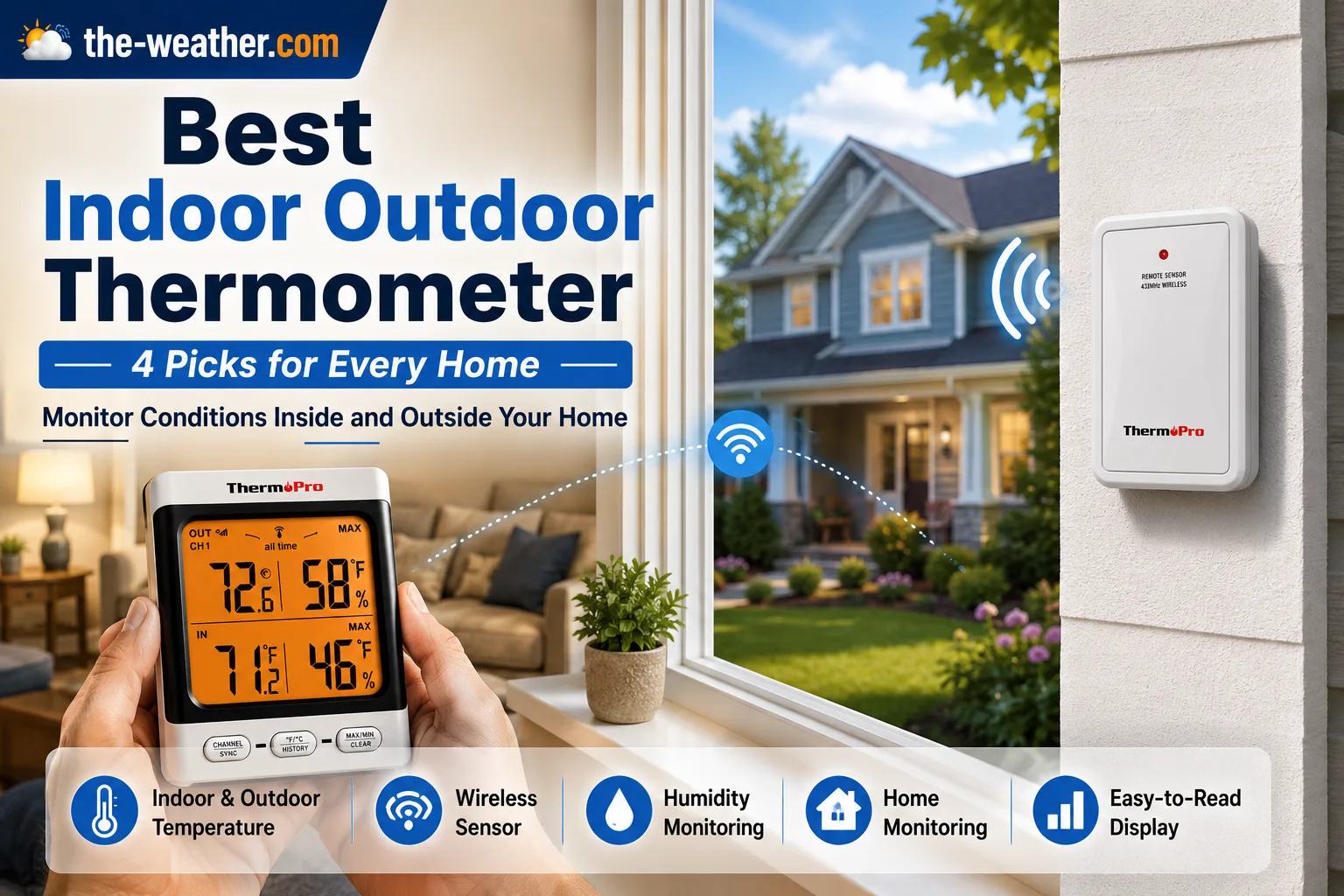
Our recommendation: The ThermoPro TP62 is the best indoor outdoor thermometer for most homes: wireless outdoor sensor, ±1°F accuracy, 200 ft range, no Wi-Fi or app required. For a colour display with temperature alerts choose the La Crosse 308-1414B. For simple and affordable indoor/outdoor monitoring choose the AcuRite 00611. For monitoring multiple outdoor zones simultaneously choose the Ambient WS-10.
A good indoor outdoor thermometer tells you the real temperature at your specific location, not a forecast, not a nearby airport, but your actual garden right now.
All four stations on this page are true indoor outdoor thermometers: each includes a weatherproof wireless outdoor sensor and an indoor display console. For a comparison with Wi-Fi-connected weather stations that add wind, rain, and app monitoring see our best Wi-Fi weather stations roundup.
Best Choice Summary
| If you want... | Buy this | Why |
|---|---|---|
| Best overall accuracy and range | ThermoPro TP62 | ±1°F, 200 ft RF, up to 3 sensors, backlit console |
| Simple, affordable, proven brand | AcuRite 00611 | ±2°F, 165 ft, trend arrows, humidity, AcuRite reliability |
| Colour display with temperature alerts | La Crosse 308-1414B | Colour LCD, animated forecast, programmable alerts |
| Multiple outdoor zones on one display | Ambient WS-10 | ±1°F, 3 sensors included, expandable to 8, calibration |
Quick Comparison
| Model | Temp accuracy | Range | Humidity | Colour display | Sensors | Link |
|---|---|---|---|---|---|---|
| ThermoPro TP62 ⭐ | ±1°F | 200 ft RF | ✓ | ✗ Backlit LCD | Up to 3 | Amazon |
| AcuRite 00611 | ±2°F | 165 ft RF | ✓ | ✗ LCD | 1 included | Amazon |
| La Crosse 308-1414B | Not published | Not published | ✓ | ✓ Colour | 1 included | Amazon |
| Ambient WS-10 | ±1°F | 300 ft RF | ✓ | ✗ LCD | 3 included · 8 max | Amazon |
Specifications sourced from official manufacturer documentation. Always verify current features on manufacturer websites. La Crosse 308-1414B accuracy and range not published in official documentation: check listing before purchasing.
How We Selected These Thermometers

Use this chart to match the right thermometer to your use case in under a minute.
Every station on this page qualifies as a genuine indoor outdoor thermometer: each includes a weatherproof wireless outdoor sensor and an indoor display console that shows both locations simultaneously. The selection criteria:
- True indoor/outdoor design: weatherproof outdoor sensor with dedicated indoor console. No indoor-only monitors included.
- Established products: all four have active sales history and owner review data to draw from.
- Distinct buyer profiles: each station serves a different primary need so buyers can identify the right fit quickly.
- No Wi-Fi required: all four work standalone via RF transmission, no router or app needed.
- Official specs cited: accuracy and range figures sourced from manufacturer documentation only.
1. ThermoPro TP62: Best Indoor Outdoor Thermometer Overall
±1°F accuracy · 200 ft RF · up to 3 remote sensors · backlit display · no Wi-Fi
The ThermoPro TP62 earns the top spot because it solves the core indoor outdoor thermometer problem better than any alternative at this price: it shows real outdoor conditions from an indoor display, accurately, without any Wi-Fi, app, or account. Install batteries, pair the sensor, and the console shows indoor and outdoor temperature and humidity within minutes.
The ±1°F temperature accuracy and ±2% RH humidity accuracy within the 30–80% range are the tightest specifications on this page per official ThermoPro documentation. Supporting up to 3 remote sensors means outdoor, garage, and basement can all show simultaneously on one console. For our full assessment see the ThermoPro TP62 review. For a comparison with the TP50 see the TP62 vs TP50 comparison.
- ±1°F, tightest accuracy on this page
- 200 ft range: covers most home and garden setups
- Up to 3 remote sensors from one console
- Backlit display: readable in low light
- Trend arrows for rising/falling conditions
- No Wi-Fi, no app: works straight out of the box
- No colour display
- No temperature alerts
- No calibration support
- Max/min records only: no data logging history
2. AcuRite 00611: Best Simple Indoor Outdoor Thermometer
Proven AcuRite reliability · humidity included · trend arrows · updates every 30 seconds
The AcuRite 00611 is the straightforward choice: a compact wireless indoor outdoor thermometer with humidity from a brand with a long track record in home weather monitoring. It updates every 30 seconds, shows temperature and humidity trends for both indoor and outdoor simultaneously, and records daily high and low values. The outdoor sensor is weather-resistant with an integrated hanger for easy mounting.
Temperature accuracy is ±2°F per official AcuRite specifications: slightly wider than the TP62's ±1°F but sufficient for most home monitoring purposes. The 165 ft range covers the majority of residential garden-to-house distances without difficulty. For buyers who want a dependable, no-fuss indoor outdoor thermometer from an established brand without multi-zone complexity, the 00611 delivers exactly that.
- AcuRite brand: established, reliable, US support
- Indoor and outdoor humidity included
- Updates every 30 seconds
- Temperature and humidity trend arrows
- Compact and easy to mount
- No Wi-Fi or app required
- ±2°F, less precise than TP62 and WS-10
- 165 ft range: shorter than TP62 and WS-10
- 1 sensor only: no multi-zone support
- No colour display, no alerts
3. La Crosse Technology 308-1414B: Best Colour Display with Alerts
Colour LCD · animated forecast · programmable temperature alerts · indoor and outdoor humidity
The La Crosse 308-1414B is the pick for buyers who want a colour display and programmable temperature alerts: two features absent from the TP62 and AcuRite 00611. The colour LCD shows indoor and outdoor temperature and humidity with animated forecast icons driven by the station's internal barometer. Programmable high and low temperature alerts trigger an audible notification when conditions cross your set thresholds: useful for frost warnings, heat alerts, and plant protection.
- Colour display, only one in this comparison
- Programmable temperature alerts: audible notification
- Animated forecast icons driven by barometer
- Indoor and outdoor humidity
- Adjustable brightness display
- Retired product: availability may be limited
- Accuracy not published in official documentation
- 1 sensor: no multi-zone support
- Range not published in official documentation
4. Ambient Weather WS-10: Best for Multiple Outdoor Zones
3 sensors included · expandable to 8 · ±1°F · calibration · audible alerts · 300 ft range
The Ambient Weather WS-10 is the right choice when monitoring a single outdoor location is not enough. The standard package includes three remote sensors: outdoor, garage, and basement or greenhouse can all display simultaneously on one console. The display supports up to 8 total channels, so additional sensors can be added as needs grow. Per Ambient Weather's official product page, temperature accuracy is ±1°F: matching the TP62 and beating the AcuRite 00611.
Calibration support for both temperature and humidity is a genuine advantage over the TP62 and AcuRite 00611: allowing you to fine-tune sensor readings to a known reference. Audible and visual alerts are available for channels 1–3. The 300 ft range is the longest on this page, useful for monitoring outbuildings or gardens at the edge of typical wireless range.
- 3 sensors included: monitor multiple zones from day one
- Expandable to 8 channels for full multi-zone coverage
- ±1°F temperature accuracy: matches TP62
- 300 ft range: longest on this page
- Calibration for temperature and humidity
- Audible and visual alerts for channels 1–3
- No colour display
- ±5% humidity accuracy: wider than TP62's ±2%
- Alerts only for channels 1–3, not all 8
- Calibration settings reset on battery removal
Where to Place Your Outdoor Sensor
Sensor placement affects accuracy more than the sensor specification in most real-world setups. These placement principles apply to all four stations on this page.
- North-facing wall, shaded all day
- Under an eave or overhang
- At least 5 feet off the ground
- Away from concrete, brick, and tarmac
- With good airflow around the sensor
- Direct sunlight at any time of day
- Near a dryer vent or AC unit
- On a south-facing wall in afternoon sun
- Against a dark-coloured fence or wall
- Close to the ground where cold air pools
A ±1°F sensor in direct sun reads less accurately than a ±2°F sensor properly shaded. Correct placement matters more than the accuracy specification on the box.
How These Thermometers Compare to Each Other
- TP62 wins on accuracy: ±1°F vs ±2°F
- TP62 wins on range: 200 ft vs 165 ft
- TP62 wins on multi-zone: up to 3 sensors vs 1
- TP62 wins on published accuracy: La Crosse not stated
- La Crosse wins on display: colour vs backlit LCD
- La Crosse wins on alerts: programmable thresholds
- WS-10 wins on sensors: 3 included vs 1 included
- WS-10 wins on range: 300 ft vs 200 ft
- TP62 wins on humidity accuracy: ±2% vs ±5%
- WS-10 wins on accuracy: ±1°F vs ±2°F
- WS-10 wins on sensors: 3 included vs 1
- AcuRite wins on simplicity: single sensor, no channel setup
On a tight budget? See our guide to inexpensive thermometers.
Frequently Asked Questions
What is the best indoor outdoor thermometer?
The ThermoPro TP62 suits most homes: ±1°F accuracy, 200 ft range, up to 3 sensors, backlit display, no Wi-Fi needed. For a colour display with alerts the La Crosse 308-1414B is the pick. For monitoring multiple zones the Ambient WS-10 includes 3 sensors and supports up to 8.
Do indoor outdoor thermometers need Wi-Fi?
No. All four stations on this page transmit via RF signal from outdoor sensor to indoor console: no Wi-Fi, no app, no router required. They work as completely standalone units straight out of the box.
How accurate are indoor outdoor thermometers?
Per official specifications: ThermoPro TP62 ±1°F, Ambient WS-10 ±1°F, AcuRite 00611 ±2°F. La Crosse 308-1414B accuracy is not published in official documentation. Placement in direct sun causes inflated readings regardless of the stated accuracy.
Where should I place an outdoor thermometer sensor?
Mount in a shaded, north-facing location at least 5 feet off the ground with good airflow. Avoid direct sun, dryer vents, AC units, and heat-absorbing surfaces. A well-placed sensor with wider accuracy tolerance reads more reliably than a precision sensor in poor placement.
Wi-Fi weather stations add wind speed, rainfall, UV, and remote phone alerts to indoor/outdoor temperature monitoring. Our roundup covers four stations for every budget.
Sources
Specifications from official manufacturer pages: ThermoPro TP62; AcuRite 00611; La Crosse 308-1414B; Ambient Weather WS-10. Not independently tested. Product specifications may change: verify on manufacturer websites before purchasing. No manufacturer compensation received.

Lena Thornton
Weather Station Analyst & CWOP Contributor. Lena has researched, reviewed and analysed weather stations and environmental sensors from AcuRite, Ambient Weather, ThermoPro, La Crosse Technology, Govee, and SensorPush. Updated June 2026.
Ready to decide?
Find your pick on Amazon
Prices and stock change daily. Check the current price, delivery options and what owners say in their reviews.
Our top picksCompare our picks on AmazonToday's price, delivery & owner reviews on Amazon
Check on Amazon →