
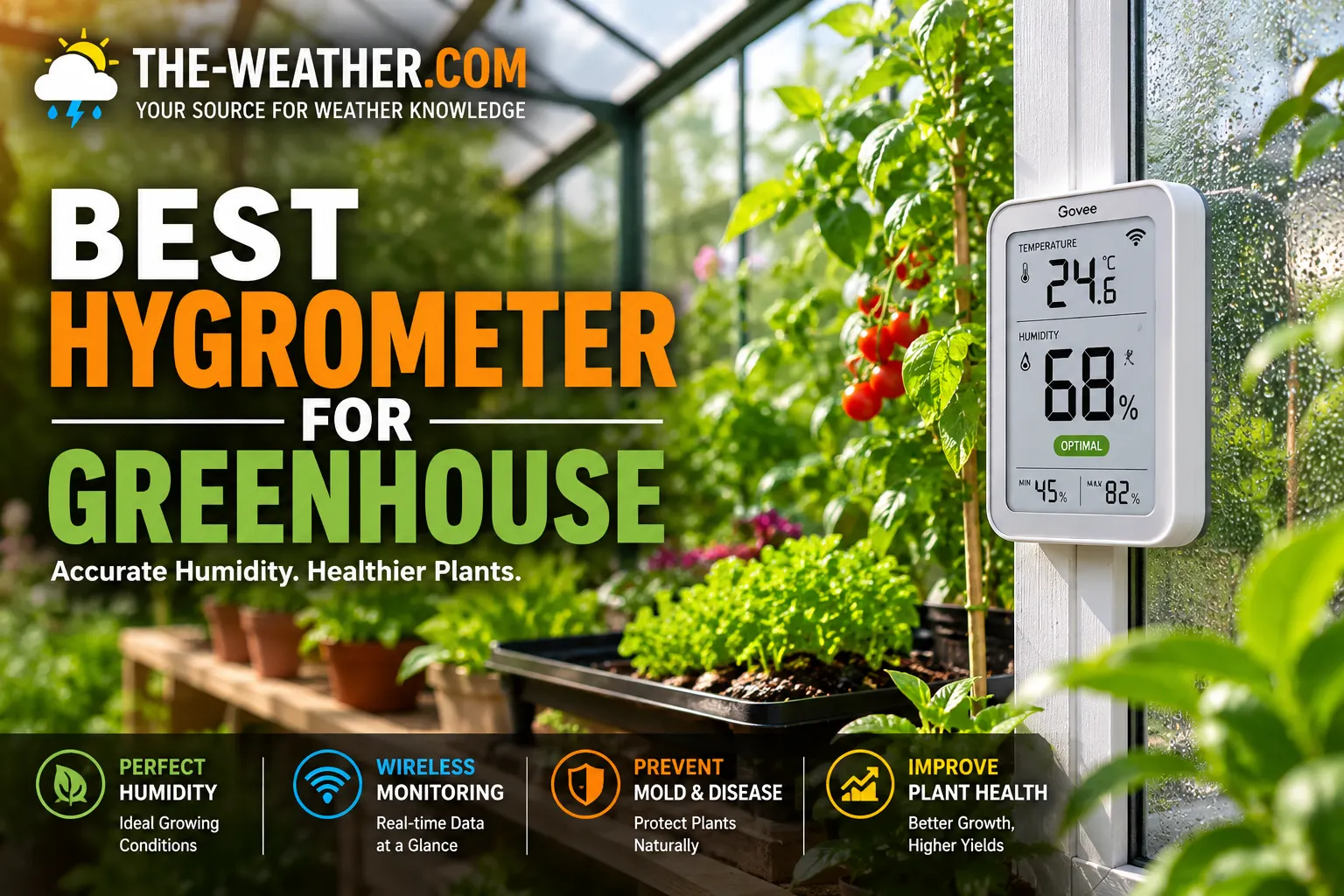
Getting greenhouse humidity wrong costs you plants. Too dry and seedlings fail to establish. Too wet and botrytis moves in overnight. The hygrometers below have been researched, reviewed and analysed for accuracy, durability in damp environments, and the practical features greenhouse growers actually use: remote alerts, data logging and multi-zone monitoring.
The Govee H5179 is the best all-round hygrometer for most greenhouse setups: Wi-Fi connected, app alerts, two-year data history, and accurate to ±3% RH at an affordable price. For precision growing or commercial use, the SensorPush HT1 with its ±2% RH Swiss-made sensor is the more reliable long-term choice.
At a Glance
| Your Need | Best Choice |
|---|---|
| Best overall | Govee H5179 |
| Best accuracy | SensorPush HT1 |
| Best budget | ThermoPro TP62 |
| Remote monitoring | Govee H5179 |
| Commercial greenhouse | SensorPush HT1 |
| No smartphone needed | ThermoPro TP62 |
Comparing hygrometers? Our overview of the best hygrometers for every room puts the picks for bedrooms, basements, grow tents and humidors side by side.
Quick Comparison
| Model | Accuracy | Connectivity | Range | Best For |
|---|---|---|---|---|
| Govee H5179 | ±3% RH / ±0.54°F | Wi-Fi + Bluetooth | 260 ft Bluetooth | Most growers |
| SensorPush HT1 | ±2% RH / ±0.5°F | Bluetooth (Wi-Fi via gateway) | 325 ft Bluetooth | Precision / commercial |
| ThermoPro TP62 | ±3% RH / ±1°F | Wireless (no app) | 200 ft wireless | Budget / no smartphone |
Best Overall: Govee H5179 WiFi Hygrometer Thermometer
Govee H5179
Wi-Fi + Bluetooth | Two-year data history | App alerts
The Govee H5179 connects directly to your home Wi-Fi without needing a separate hub, which makes installation straightforward for a detached greenhouse. Once paired with the Govee Home app, you can set custom high and low humidity thresholds and receive push notifications the moment conditions shift. The LCD screen gives you an at-a-glance max/min record, useful for spotting overnight humidity spikes before you open the greenhouse in the morning.
Many owners running multiple sensors across different greenhouse zones report consistent readings between units. The two-year cloud data history means you can compare this season's humidity patterns against last year without any manual logging.
- Direct Wi-Fi: no hub or gateway needed
- Two-year app data history
- Push alerts for humidity and temperature thresholds
- Compact size fits easily on a shelf or stake mount
- Strong value for the feature set
- Requires 2.4GHz Wi-Fi signal to reach greenhouse
- ±3% RH accuracy, not suited for precision propagation
- App required for full functionality
Best for Precision: SensorPush HT1 Humidity Sensor
SensorPush HT1
±2% RH accuracy | Swiss-made sensor | Bluetooth + optional Wi-Fi gateway
The SensorPush HT1 uses a calibrated Sensirion sensor: Swiss-made and widely used in pharmaceutical and laboratory environments. For greenhouse growers managing orchids, propagation chambers or humidity-sensitive seedlings where a few percentage points matter, this level of accuracy is worth the higher price. The sensor logs one reading per minute and stores up to 20 days of data on-device, accessible even without a Wi-Fi connection.
Bluetooth-only operation works well if your greenhouse is within range of your phone. For remote monitoring, the SensorPush G1 Wi-Fi Gateway (sold separately) pushes readings to the cloud continuously. The water-resistant build reduces the risk of sensor drift from condensation.
- ±2% RH: highest accuracy in this comparison
- Water-resistant build for humid environments
- 20-day on-device data storage without Wi-Fi
- VPD calculation support in the app
- Long Bluetooth range: 325 ft line of sight
- Wi-Fi requires separate G1 gateway purchase
- Higher upfront cost than most alternatives
- Coin cell battery (less common than AAA)
Best Budget Pick: ThermoPro TP62 Digital Hygrometer
ThermoPro TP62
Wireless outdoor sensor | No app needed | Indoor/outdoor display
The ThermoPro TP62 takes a different approach: no app, no account, no Wi-Fi required. The outdoor sensor transmits readings wirelessly to an indoor display unit, making it a practical option for growers who want a simple dedicated readout without connecting anything to a smartphone. Place the sensor inside the greenhouse and keep the display indoors or in a potting shed.
The comfort level indicator, a small icon showing Dry, Comfort or Wet, gives a quick visual cue when greenhouse humidity moves outside an acceptable range. The display also shows indoor readings, so you can compare inside versus outside conditions at a glance. It does not log historical data or send alerts, so it suits growers who check in manually rather than needing remote monitoring.
- No smartphone or app needed
- Shows indoor + outdoor readings simultaneously
- Simple setup: batteries in, pair done
- 200 ft wireless range covers most home greenhouses
- No data logging or alert notifications
- No remote monitoring away from home
- Display must stay within wireless range
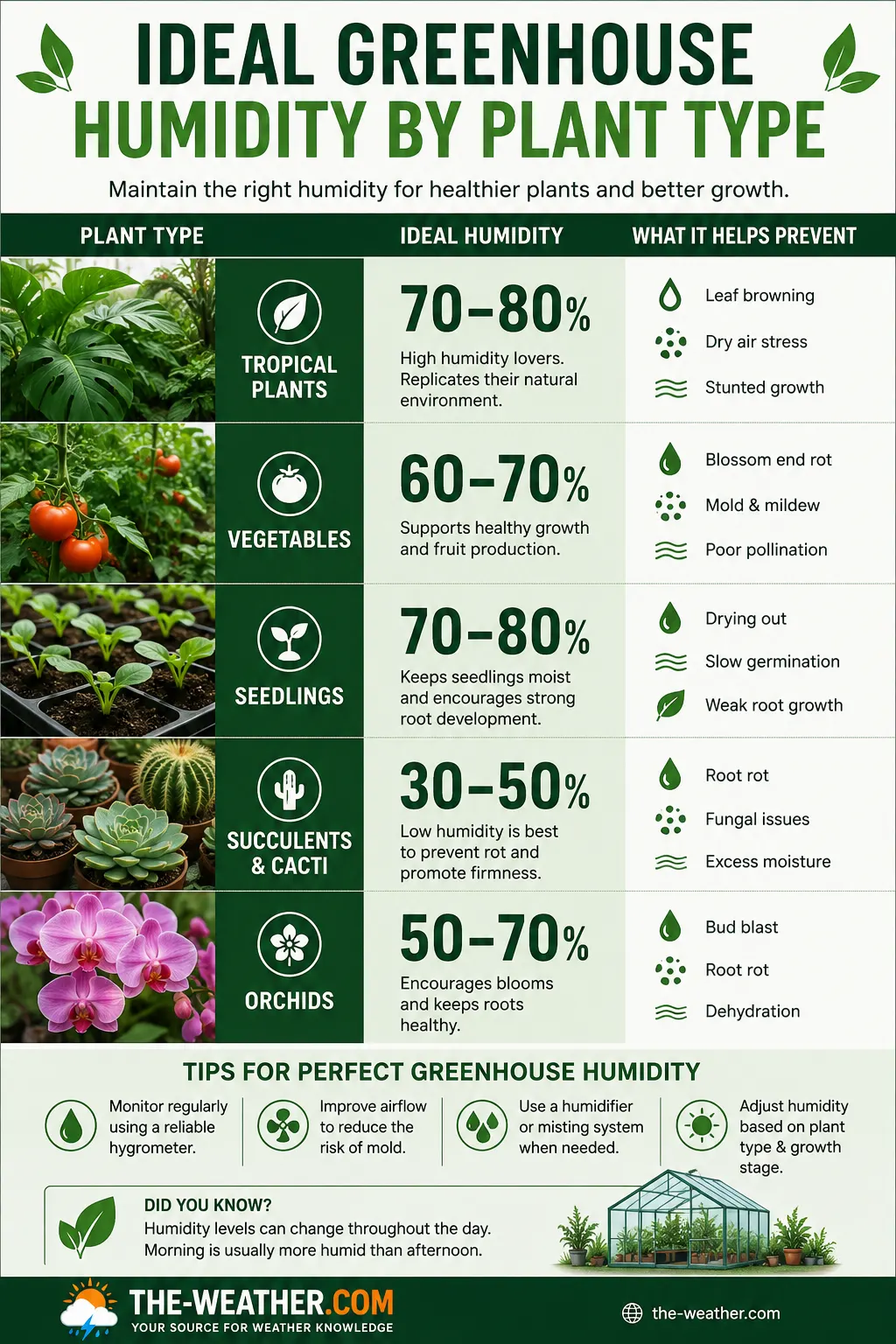
How to Choose a Greenhouse Hygrometer
Accuracy and sensor type
Capacitive digital sensors are the current standard for greenhouse use. Most consumer models read within ±3% RH under stable conditions. If you grow orchids, propagate from cuttings or manage a commercial nursery where humidity variance directly affects yield, a ±2% RH sensor like the one in the SensorPush HT1 justifies the extra cost.
Connectivity
Wi-Fi models (Govee H5179) are the easiest to set up if your greenhouse has a usable signal. Bluetooth-only sensors (SensorPush HT1) offer better range and battery life but require a gateway for remote access. Wireless RF models (ThermoPro TP62) work without any network at all: reliable but limited to on-site monitoring.
Alert thresholds
High-humidity alerts are the most important feature for disease prevention. When humidity climbs above 85% overnight, grey mould and powdery mildew spread rapidly. Any app-connected model lets you set a ceiling alert so you can open vents or run a fan before damage occurs. Standalone models without apps require manual checking.
Placement
Mount the sensor at plant canopy height, away from vents, doors and direct sun. Heat rising from propagation mats or grow lights creates localised humidity gradients that a single sensor at head height will miss. For greenhouses longer than 15 feet, two sensors at opposite ends give a more accurate picture of actual growing conditions.
Durability in wet environments
Standard consumer hygrometers are not designed for sustained high-humidity environments. Condensation on circuit boards causes calibration drift over time. The SensorPush HT1's water-resistant build addresses this directly. For other models, a ventilated enclosure or radiation shield extends sensor life significantly.